
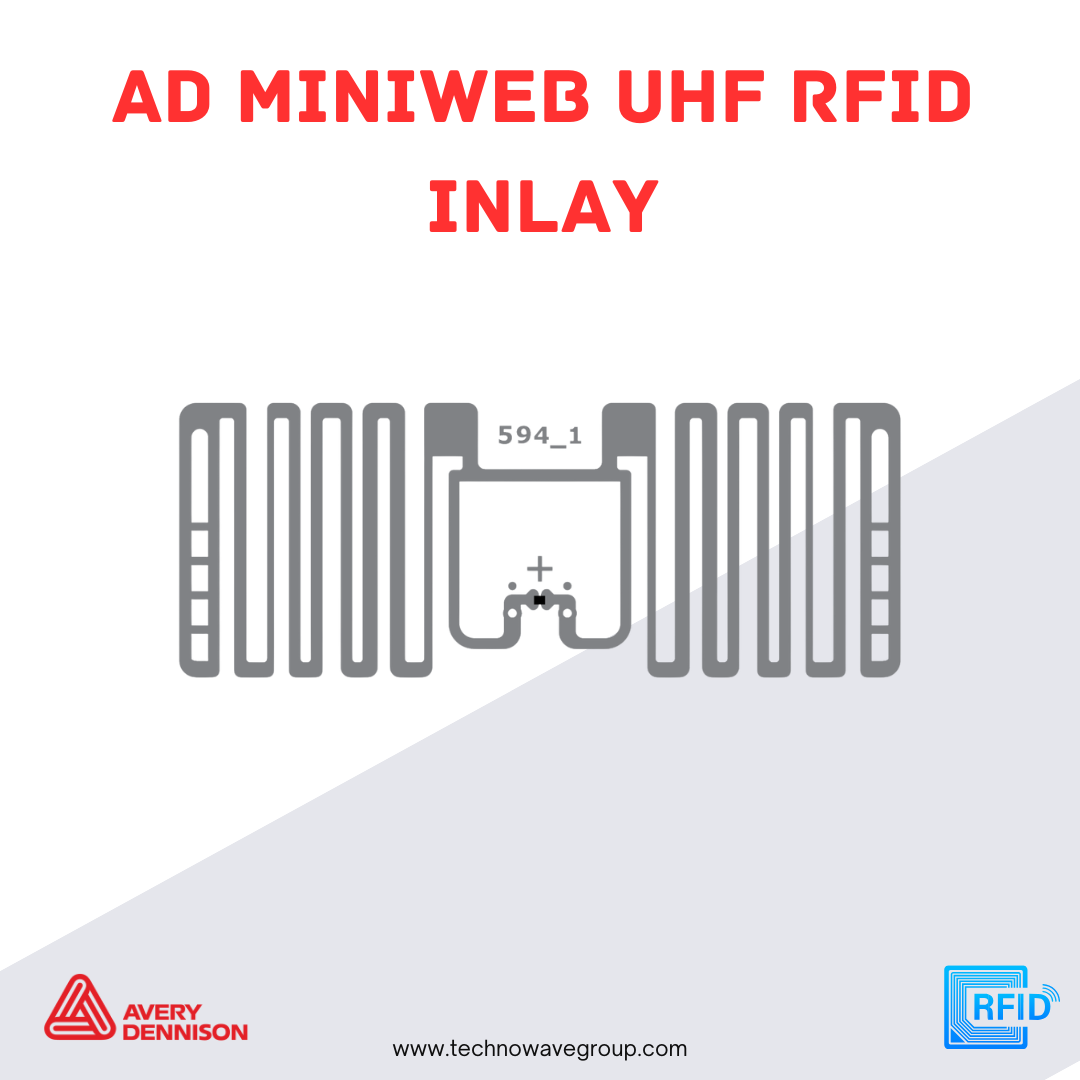
Description
Overview – AD Miniweb UHF RFID Inlay
AD Miniweb UHF RFID Inlay delivers reliable reads in dense, real-world environments—store floors, back rooms, DCs, and conveyors—despite its compact size. Its globally tuned dipole antenna supports multi-region deployments and maintains performance across varied orientations, making it a favorite for apparel hang tags, small product labels, and compact RTI markings.
Key Benefits
-
Small label, big performance – Maintains long, stable reads despite a compact 45×18 mm label footprint.
-
Retail-ready – Designed for stacked items and close-coupling scenarios common in merchandising.
-
Flexible IC choices – Select memory, privacy features, and sensitivity to match your program.
-
Convert-friendly – Supplied as dry, wet, or finished label for easy converting and print-and-apply.
-
Global use – Optimized for worldwide UHF (approx. 860–960 MHz).
Typical Applications
-
Retail & Apparel: Item-level tagging for inventory accuracy and omnichannel fulfillment.
-
Warehousing & Logistics: Case/carton visibility, receiving verification, DC automation.
-
Supply-Chain & RTIs: Reusable totes, bins, and small assets with limited label real estate.
-
Electronics & Home Goods: Compact products where standard tags won’t fit.
Technical Highlights (Quick Reference)
-
RF Standard & Band: RAIN RFID, EPC Class-1 Gen2 v2 / ISO/IEC 18000-63; global 860–960 MHz.
-
Antenna / Label Size: Antenna ~42 × 16 mm; typical die-cut (wet/label) ~45 × 18 mm.
-
Chip Options & Memory:
-
Impinj M730: 128-bit EPC, 96-bit TID with unique serial; no user memory.
-
Impinj M750: 96-bit EPC + 32-bit user memory.
-
NXP UCODE 9: 96-bit EPC; very high sensitivity and fast encoding.
-
-
Formats: Dry inlay / Wet inlay / Label; common web widths and pitches for high-volume converting.
-
Operating Temperatures (typical): Up to -40 °C to +85 °C (variant-dependent).
-
Quality & Compliance: Manufactured under robust quality systems; retailer/ARC program compatibilities depend on exact Miniweb variant/SKU.
Selection Guide (Choose Your Variant)
-
Program & compliance: Start with the Miniweb variant approved for your retailer/industry program.
-
Memory needs: Pick M750 if you need user memory; M730 or U9 if EPC-only suits your data model.
-
Performance priority: Choose U9 or high-sensitivity SKUs for tougher RF environments or FCC-heavy deployments.
-
Format: Dry (converting), Wet (adhesive inlay), or Label (ready for print-and-apply).
-
Face/Adhesive: Match facestock and adhesive to substrate (corrugate vs plastics) and temperature/humidity.
-
Volume & handling: Align reel counts, core size, and pitch with your applicators and print-apply lines.
Implementation Notes
-
Pilot first: Validate label placement, antenna orientation, and reader geometry in real lanes.
-
Encode & verify: Use encode-and-verify with bad-tag rejection to safeguard EPC data integrity.
-
Serialization policy: Standardize EPC structure (e.g., SGTIN) and apply lock/password policies as needed.
-
Challenging surfaces: For metal or liquid-rich items, use a spacer or an on-metal inlay instead of standard Miniweb.
-
Placement consistency: Fix a repeatable placement spec on cartons/totes to improve read rates.
FAQs
Q1. What’s the difference between AD Miniweb UHF RFID Inlay and Web UHF RFID Inlay?
Miniweb is physically smaller (about 45 × 18 mm label vs. the larger Web), designed for tight facings while preserving strong read performance.
Q2. Which chip should I choose—M730, M750, or U9?
Pick M730 for 128-bit EPC and broad retail suitability; M750 if you need user memory; U9 for maximum sensitivity and fast encoding.
Q3. Can Miniweb be used globally?
Yes. It’s designed for global UHF bands; select the exact variant tuned to your operating region and compliance needs.
Q4. Is it suitable for on-metal assets?
Standard Miniweb is not on-metal. Use an on-metal inlay or a spacer if you must tag metal surfaces.
Q5. What formats are available?
Dry inlay, wet inlay, and finished label—choose based on whether you convert in-house or run print-and-apply.


Reviews
There are no reviews yet.