
Description
What is AD Dogbone UHF RFID Inlay ?
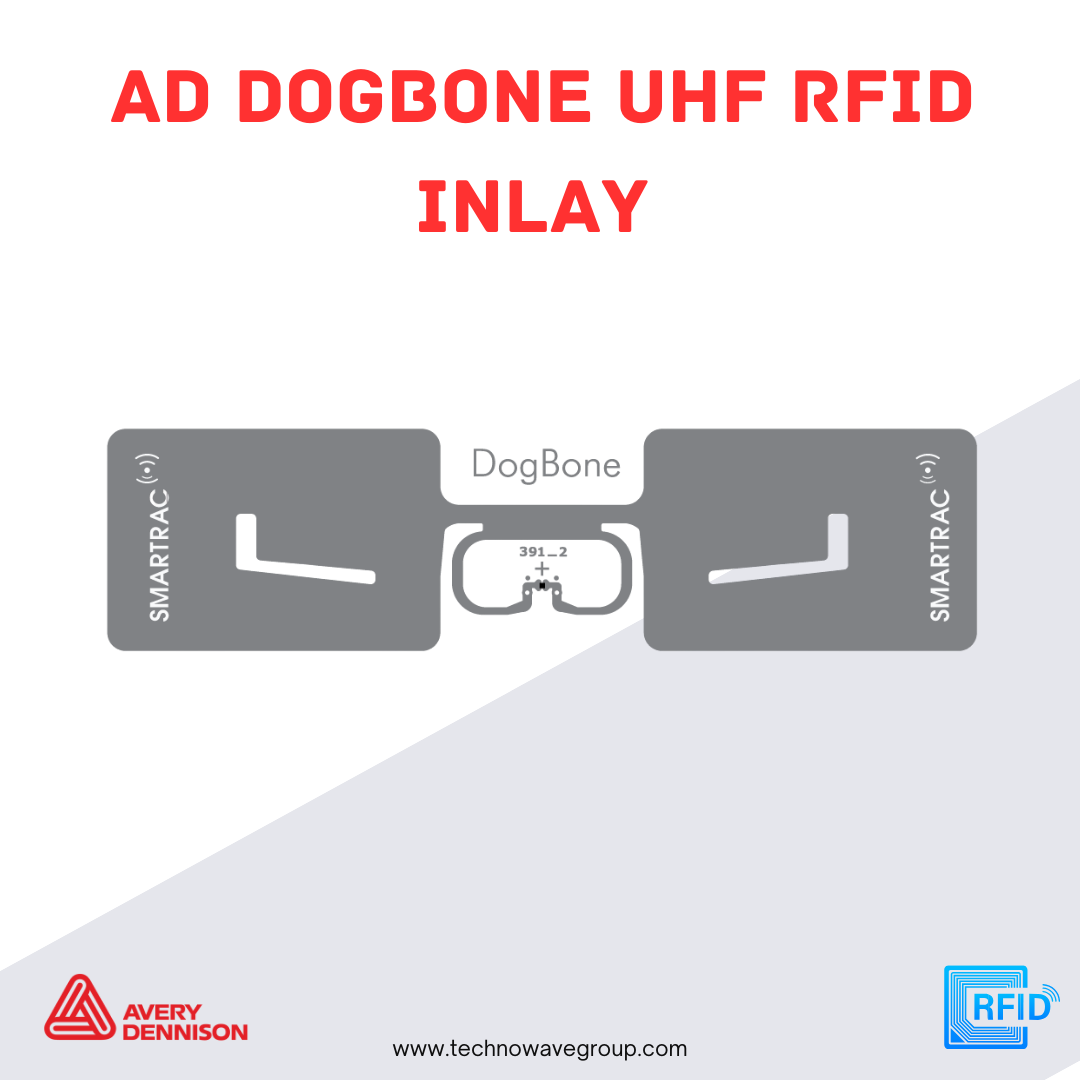
AD Dogbone UHF RFID Inlay (originally Smartrac Dogbone) is a mid-to-large format UHF EPC Gen2 inlay recognized for its robust, stable read performance in real-world environments. It’s offered as dry or wet inlay and can be converted into printable RFID labels for high-volume encoding and on-demand printing.
Key Benefits
-
Long read range: Optimized antenna geometry delivers reliable reads in portals, dock doors, conveyors, and handheld workflows.
-
Global frequency coverage: Designed for worldwide RAIN RFID use (approx. 860–960 MHz), suitable for multi-region deployments.
-
Material tolerance: Performs consistently on a wide range of packaging and RTI substrates (corrugate boxes, plastic totes, crates).
-
Flexible chip options: Available with multiple IC families to match memory, privacy, and feature needs (e.g., advanced coding, user memory).
-
Conversion-friendly: Offered in dry/wet formats and readily converted to pressure-sensitive RFID labels compatible with thermal transfer printing.
-
Proven in the field: Widely adopted for case/pallet labeling, returnable assets, and industrial logistics.
Typical Applications
-
Warehousing & Logistics: Case and pallet labeling, cross-dock visibility, ASN compliance.
-
Returnable Transport Items (RTIs): Plastic totes, bins, crates, and roll cages for pool management and reverse logistics.
-
Manufacturing & Industrial: WIP tracking, Kanban, line-side parts flow, and finished goods.
-
Retail Supply Chain: DC inbound/outbound, vendor shipments, and back-of-store logistics.
-
Events & Rentals: Durable item tracking for equipment pools and reusable packaging.
Technical Highlights (Quick Reference)
-
Technology / Standard: UHF RAIN RFID, EPC Class 1 Gen 2 / ISO 18000-63.
-
Frequency Band: Global 860–960 MHz (region-specific regulations apply).
-
Antenna Format: Mid-to-large footprint dipole (“Dogbone”) for high sensitivity.
-
IC Options: Multiple choices available (e.g., latest Impinj or NXP UCODE families); EPC length, user memory, and features vary by chip.
-
Delivery Formats: Dry inlay, wet inlay (adhesive), and label-convertible constructions.
-
Printing & Encoding: Thermal transfer printable face materials available via standard RFID label conversion workflows.
-
Environmental: Designed for distribution environments; choose facestocks/adhesives to suit temperature, humidity, and surface energy.
-
Quality & Compliance: Produced to rigorous quality standards; ARC/industry program compatibility varies by specific Dogbone variant and IC.
Note: Exact dimensions, IC type, memory configuration, adhesive, liner, and facestock are variant-specific. Confirm the target SKU for your compliance profile (e.g., program mandates, ARC categories, or OEM specs).
Performance & Integration Notes
-
Portal/Conveyor Gates: The inlay’s sensitivity supports consistent, repeatable reads at dock doors and along conveyor edges with properly tuned reader power and antenna placement.
-
Handheld Workflows: Strong performance at practical handheld distances with orientation tolerance typical of high-gain dipole designs.
-
On-Metal or Liquid-Rich Goods: For challenging surfaces, use appropriate spacers, specialized labels, or alternative inlays designed for on-metal or high-dielectric environments.
-
Encoding Strategy: Standardize EPC formatting (company prefix, serial ranges) and leverage chip features such as permalock or privacy modes per policy.
Selection Guide (How to Choose the Right Variant)
-
IC & Memory: Pick EPC and user memory to match your serialization and data model; consider features like access/kill passwords or brand protection modes.
-
Label Construction: Choose dry/wet or finished label; select facestock for print durability and adhesive for your substrate (corrugate vs plastics).
-
Environment: Temperature cycles, humidity, and chemical exposure inform facestock, overlaminate, and adhesive choice.
-
Regulatory Region: Ensure the variant performs optimally in your operating band (e.g., ETSI vs FCC).
-
Read Scenario: Gate vs handheld vs conveyor determines antenna gain, reader power, and placement strategy.
-
Compliance Program: If your project follows an industry/retail compliance program, confirm the exact approved Dogbone SKU and chip.
Implementation Best Practices
-
Run a pilot across real lanes (receiving, picking, shipping) before full rollout.
-
Tune reader power and antenna angles for coverage while avoiding excessive cross-reads.
-
Use print/encode verification to ensure EPC data integrity and reject defective tags automatically.
-
Adopt a serialization policy (EPC scheme, GS1 compliance) and maintain a commissioning log.
-
Align label placement on cartons/totes for consistent RF performance and scannability.
-
Establish SLA for supplies (labels, ribbons) and a maintenance routine for printers and applicators.
FAQs
Q1. What makes Dogbone different from smaller inlays?
Its larger, optimized antenna provides higher sensitivity and longer, more stable reads—ideal for portals, conveyors, and RTIs.
Q2. Can I use Dogbone worldwide?
Yes. Dogbone is designed for global UHF bands. Check local regulations and select variants tuned for your operating region.
Q3. Which chip should I choose?
Select the IC based on EPC length, user memory, and required features. Both performance and data capabilities can vary by chip family.
Q4. Is Dogbone suitable for on-metal assets?
Standard Dogbone is not an on-metal tag. For metal surfaces, use a metal-mount design or a suitable spacer/foam label construction.
Q5. Can it be printed and encoded with standard RFID printers?
Yes, when converted into RFID labels, it can be printed/encoded on compatible UHF RFID printers with validation and reject handling.


