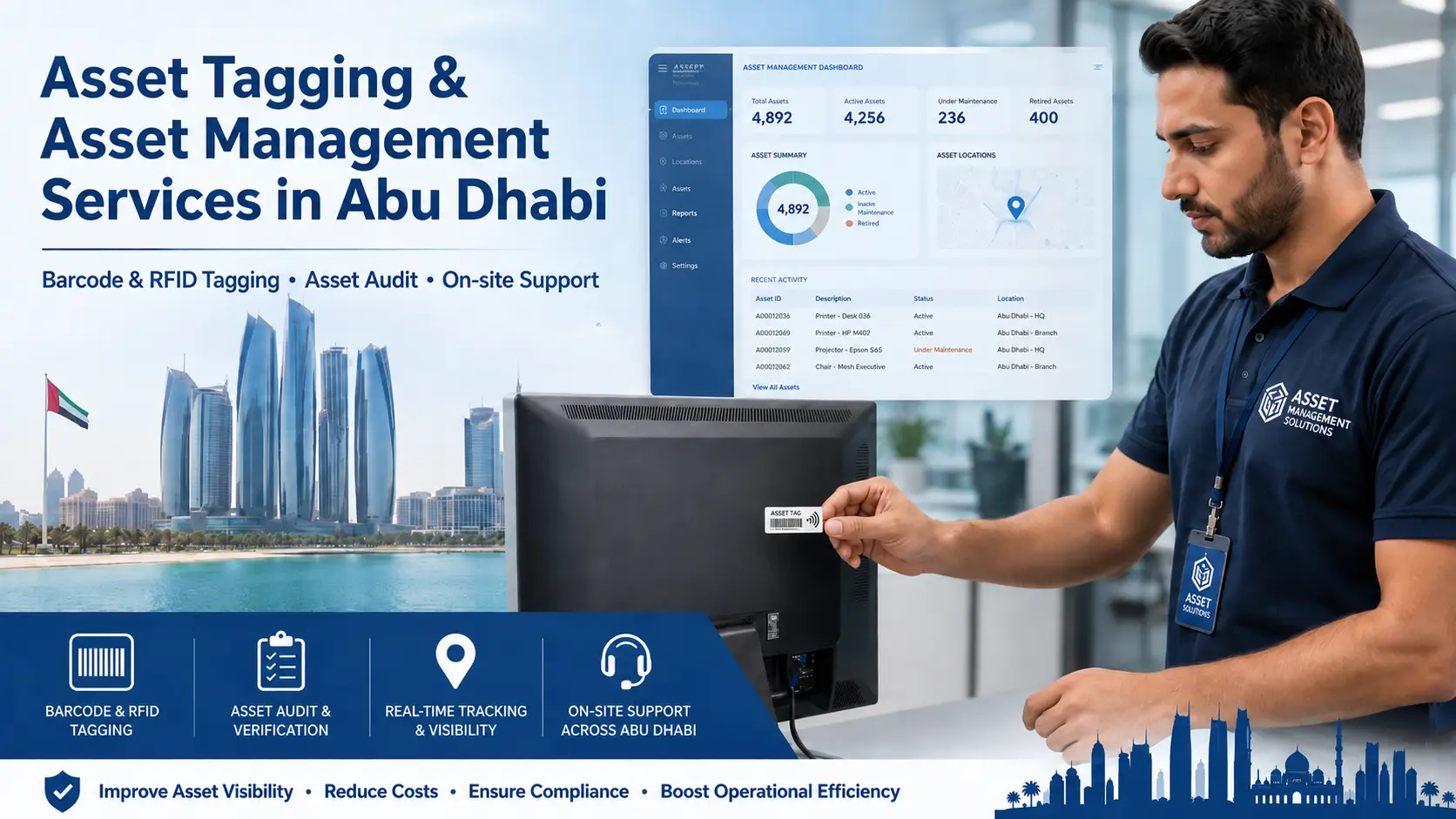
Asset tagging and asset management services in Abu Dhabi combine physical verification, durable tagging, software configuration, audit reconciliation, and ERP integration to help organizations control assets across offices, warehouses, hospitals, campuses, and industrial sites. For most buyers, the priority is straightforward: reduce audit delays, improve asset visibility, and build a defensible asset register that finance, operations, and compliance teams can trust.
Asset tagging assigns each fixed asset a unique barcode or RFID identity, linking it to a central system for tracking location, custodian, status, maintenance, and audit history. Manual Excel-based registers break down quickly when assets move between departments, project sites, or branches. In Abu Dhabi, this problem is amplified by multi-site estates, regulated audit expectations, and harsh operating environments.
Why buyers in Abu Dhabi are replacing manual asset registers
Most organizations seek asset tagging services because annual verification takes too long, missing assets create finance exceptions, and operations teams cannot locate equipment. In public sector entities and regulated enterprises, if the physical count does not match the register, audit findings follow.
According to the Abu Dhabi Department of Finance, government entities must maintain robust controls over fixed assets, including identification, recording, and periodic verification. This makes asset management a governance process, not an administrative task. For private groups using SAP, Oracle, or Dynamics, balance sheet accuracy depends on reliable asset data flowing from the field to finance.
Buyers also face a technology shift. Barcode audits work for room-by-room verification but remain labor-intensive as every label must be scanned individually. Industry coverage from RFID Journal shows why enterprises adopt RFID for faster, non-line-of-sight identification in audits, stock checks, and asset movement control.
If your team is asking why asset management delays happen, the answer is usually poor baseline data, low-grade tags that fail in the field, and disconnected workflows. A structured asset tagging service addresses all three together.
What a complete service should include beyond tagging
A serious project has five layers: physical survey, tag selection, data cleansing, software deployment, and post-go-live support. If a provider only offers labels and scanners, your internal team still carries the difficult work of reconciliation and exception handling.
When comparing options, ask: What exactly is included in the service scope? At minimum, it should cover on-site verification, asset condition review, parent-child asset mapping, printing and affixing tags, register normalization, discrepancy reporting, and imports into an asset management system. For larger estates, it must include branch scheduling, handheld-based audit workflows, and sign-off reports.
Asset type matters. Corporate furniture, laptops, medical devices, plant equipment, and outdoor infrastructure require different tag materials and attachment methods. Buyers should review the provider’s capability to supply asset tags for asset management across metal surfaces, hot equipment, chemical exposure, and tamper-sensitive items.
Barcode vs RFID for fixed assets
| Criteria | Barcode tagging | RFID tagging |
|---|---|---|
| Read method | Line-of-sight scan of each label | Non-line-of-sight reading of tagged assets |
| Best fit | Offices, classrooms, standard indoor assets | High-volume audits, multi-room verification, movement monitoring |
| Audit speed | Depends heavily on manual effort | Faster for large estates when process is designed well |
| Tag cost | Lower initial media cost | Higher tag cost but broader automation potential |
| Environment | Works well with protected surfaces | Requires correct inlay and material choice near metal |
| ROI driver | Standardization and cleaner audits | Labor reduction, visibility, and repeat-cycle efficiency |
According to Gartner, organizations implementing automated asset tracking see meaningful reductions in asset loss and improved utilization. Buyers should match the technology to audit frequency, asset density, and operational complexity.
Choosing tags and software for Abu Dhabi operating conditions
In Abu Dhabi, tag selection is often underestimated. A standard polyester barcode label may work for indoor desks, but it fails quickly on exposed machinery, containers, or yard assets affected by heat, dust, washdown, or abrasion. In Musaffah, industrial estates, and oil and gas environments, buyers should evaluate metal-mount RFID tags, anodized aluminum barcode plates, and high-bond adhesives.
Ask the provider: Which tag construction is recommended for each asset class, and why? The answer should reference substrate, exposure, read distance, expected service life, and fixing methods like rivets, epoxy, or tamper-evident adhesive.
Software selection also needs discipline. A capable system must support asset hierarchy, depreciation reference fields, transfers, custodian assignment, maintenance notes, audit history, photo attachment, and handheld reconciliation. It should integrate with ERP platforms so verified field data aligns with finance records; for many UAE enterprises, that means SAP, Oracle, or Microsoft Dynamics.
For buyers moving from spreadsheets, the priority is clean migration logic, role-based workflows, and exception management. When reviewing an RFID asset management approach or barcode deployment, ask to see how missing, transferred, and ghost assets are handled during the first baseline audit.
Compliance, security, and service model: what to check before signing
Security and compliance in asset management are about process integrity. Who is authorized to add, retire, transfer, or edit an asset? Can the system maintain audit trails for status changes and verification history? Can finance teams separate operational edits from accounting approvals? These controls matter more than a polished dashboard.
For Abu Dhabi buyers, another direct question is: Will the service support physical verification and reconciliation in a way that stands up to audit review? The provider should produce discrepancy reports, untagged asset logs, location mismatches, and evidence of completed verification rounds. This is critical for government, healthcare, education, and large facility portfolios where asset custody spans departments.
Data handling must be scoped properly. Asset databases include serial numbers, staff custodian names, room locations, and device status, which fall under internal security controls. Buyers should verify access permissions, backup policy, hosting model, user accountability, and whether handheld devices can work offline securely during site surveys.
Finally, assess the service model after go-live. A one-time tagging project is rarely enough. Ongoing audits, replacement tags, branch additions, and handheld maintenance require a support partner. Many buyers review AMC and preventive support services alongside implementation, rather than treating maintenance as an afterthought.
Implementation timeline, pricing logic, and ROI
Implementation time depends on field realities: number of sites, asset count, access windows, existing register quality, and approval speed. A single office moves quickly; a multi-site hospital, university, or industrial group takes longer because tagging, verification, and exception clearance must happen in phases. Buyers should ask for a deployment plan that separates survey, pilot, bulk tagging, reconciliation, training, and final acceptance.
Most asset tagging and asset management services in Abu Dhabi pricing models combine site survey, tag media, printing, manpower for physical verification, handheld devices, software licensing, data migration, ERP integration, training, and annual support. The cheapest proposals often exclude reconciliation effort or durable tags, creating hidden costs later.
ROI comes from four areas. First, audit cycles become controlled because assets are easier to locate. Second, finance gets a cleaner asset register with fewer unexplained variances. Third, operations can reassign or recover underused assets instead of buying duplicates. According to Gartner, automated tracking programs can reduce asset loss by up to 30% and improve utilization by around 20%; according to Fortune Business Insights, the global enterprise asset management market was valued at USD 4.24 billion in 2023 and is projected to reach USD 9.21 billion by 2032, reflecting sustained investment in control.
Common mistakes are predictable: tagging before data cleansing, using one tag type for every environment, underestimating ERP mapping, and relying on temporary internal labor. Buyers can avoid these issues by reviewing real deployment evidence such as this asset tagging case study and this fixed asset management project example, comparing service methodology rather than unit price.
How to evaluate providers and decide whether to act now
If you are comparing providers, use a weighted checklist. Score each vendor on field execution capability, tag engineering, software fit, ERP integration experience, audit reporting, support coverage, and references in similar environments. For industrial or outdoor sites, insist on proof of tag durability and pilot testing before full rollout.
Ask: Do you provide on-site physical asset verification, tagging, and reconciliation services in Abu Dhabi? The best providers will answer with a deployment workflow, resource plan, and exception process, not just a yes. Another important question is whether the system can support future expansion to RFID, warehouse mobility, or multi-branch audits without replacing the entire platform.
Why act now? Because the cost of delay is operational. Every audit cycle run on outdated registers consumes staff time, increases dispute handling, and weakens confidence in procurement and depreciation records. The regional market is moving toward higher automation; according to Mordor Intelligence, the Middle East and Africa RFID market is expected to grow at a CAGR above 10.2% through 2028, driven by logistics and smart infrastructure adoption.
For organizations that want an end-to-end approach, Technowave International combines asset tagging services, in-house software, RFID and barcode hardware, ERP-oriented implementation, and local support across the GCC. If your team is evaluating a new rollout, a re-tagging exercise, or a corrective audit project, the next step is to define scope, environment, and control requirements clearly, then review solution options with a specialist team.
FAQ: buyer questions about asset tagging and asset management services in Abu Dhabi
Q: What should buyers check before choosing asset tagging and asset management services in Abu Dhabi?
A: Check service scope first: physical verification, tagging, reconciliation, software setup, reporting, and support. Then review tag suitability for your environment, ERP integration capability, audit trail controls, and whether the provider can handle multi-site rollout without disrupting operations.
Q: How can businesses compare asset tagging and asset management services in Abu Dhabi providers?
A: Compare methodology, not just price. Ask for sample audit reports, exception handling workflow, tag material recommendations by asset class, integration experience with SAP or Oracle, and references in your sector such as healthcare, education, logistics, or industrial operations.
Q: What does asset tagging and asset management services in Abu Dhabi typically cost?
A: Cost depends on asset volume, site count, tag type, data quality, software licensing, and integration requirements. Industrial-grade RFID or metal asset plates cost more than standard barcode labels, but they are necessary where heat, dust, metal surfaces, or outdoor exposure would shorten label life.
Q: How long does asset tagging and asset management services in Abu Dhabi implementation usually take?
A: A small single-site project can be completed relatively quickly, while a multi-site enterprise program requires phased execution. Timeline is driven by access to assets, approval cycles, baseline data quality, and the time needed to reconcile missing, moved, or duplicate records.
Q: What security or compliance factors matter for asset tagging and asset management services in Abu Dhabi?
A: Focus on role-based access, audit trails, change approval, secure handheld workflows, and reports that support physical verification and discrepancy resolution. Public sector and regulated entities should align the project structure with internal audit expectations and Department of Finance control requirements.
Q: Can an asset management system integrate with existing Oracle or SAP ERP software?
A: Yes, many enterprise deployments exchange asset master data, verification status, and financial reference fields with ERP platforms. The key evaluation point is how field exceptions, transfers, disposals, and new assets are mapped in practice.
Need a practical evaluation, not a generic demo? Build your shortlist around asset environment, audit frequency, and integration needs, then review the rollout with a provider that can handle tagging, software, and support as one program. This is the fastest route to a cleaner register and a more defensible audit process.
Related Articles
- Best Rfid Asset Management System In Abudhabi
- Asset Tagging Services
- Fragomen Fixed Asset Management
- Standardize Asset Register Before Asset Tagging Service
- Case Study Asset Tagging Service Reduced Audit Drift
- Asset Tagging Service Vs In House Tagging
Asset Tagging and Asset Management Services in Abu Dhabi
Evaluate asset tagging and asset management services in Abu Dhabi with practical guidance on compliance, tags, ERP integration, rollout, and ROI.