

Overview: Why Footfall People Counting in Abu Dhabi matters
Abu Dhabi’s landscape—malls on Yas Island, cultural districts on Saadiyat, office hubs on Al Maryah, fast-growing communities around Reem and Khalifa City, and industrial corridors like Mussafah—creates wildly different traffic patterns hour to hour. Without hard data on how many people visit, when they arrive, where they dwell, and how quickly they’re served, you’re guessing on staffing, merchandising, marketing, and leasing. People counting replaces guesswork with facts. It tells you how many visitors came, how long they stayed, what they engaged with, and whether your operations responded in time. This guide explains what people counting is, the technologies involved, the metrics that actually move your P&L, how different Abu Dhabi industries use it, and why a locally supported, accuracy-first deployment gives you a competitive edge.
What is footfall people counting?
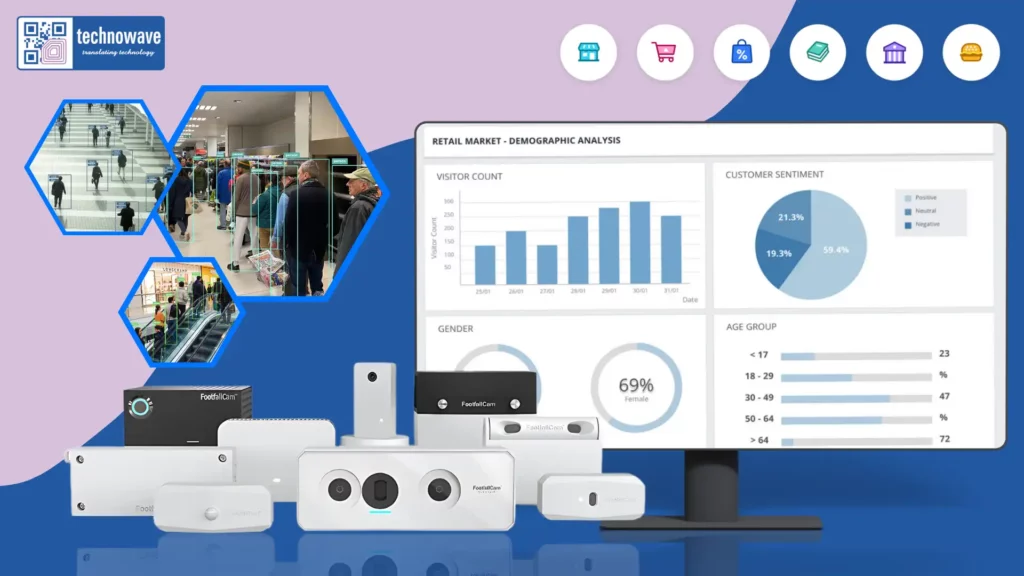
People counting is the practice of measuring visitor flow and in-store behavior using sensors and AI analytics. At the entrance, it counts ins and outs in both directions. Inside, it can map where visitors go, how long they stay in zones, and when queues cross acceptable thresholds. The best systems deliver this anonymously—no facial recognition, no personally identifiable information—while still producing granular, real-time insights your teams can act on daily. Think of it as your operational heartbeat: it shows traffic surges, lull periods, hot zones, and bottlenecks so you can staff better, merchandise smarter, and market with proof.
Core outcomes you get:
- Reliable footfall by hour, day, week, and season
- Conversion insights when integrated with POS
- Dwell and bounce to gauge engagement vs. drop-off
- Queue length and wait times to protect service standards
- Occupancy for safety and crowd control
- Heatmaps that visualize attention and movement
- Campaign uplift to prove what promotions or mall events did
Why Abu Dhabi businesses need people counting now
Abu Dhabi is a premium, service-led market. Visitors expect short queues, tidy layouts, and attentive staff. Landlords expect tenants to back requests with data. Marketers need proof that spending drove traffic that converted. Operations need to guarantee peak-hour SLA compliance. People counting supports each of these needs by giving teams the signal they can trust.
Key Abu Dhabi-specific advantages:
- Tourism variability: Weekends, cruise days, event weeks (e.g., Yas events) can swing traffic. Real-time dashboards help you flex resources.
- Multi-branch operations: Compare Al Maryah vs. Reem vs. Khalifa City to standardize best practices and staffing rules.
- Mall collaborations: Many Abu Dhabi malls share aggregate traffic trends; reconciling mall and store data clarifies true conversion.
- Compliance and safety: Cultural institutions, government sites, and events benefit from accurate occupancy and flow control.
- Cost discipline: With rents and labor at a premium, optimizing headcount by traffic saves cost without harming service.
Technologies behind people counting (choose what fits your site)
Different entrances, ceiling heights, materials (glass, mirrors), and lighting conditions call for different sensors. A robust design often blends two or more technologies for accuracy across scenarios.
- AI 3D stereo cameras (overhead): High accuracy for in/out counting, direction, and tailgating. Works well at standard retail entrances and corridor choke points.
- Time-of-Flight (ToF) / LiDAR: Ideal for very wide or glassy entrances where reflections or glare can challenge cameras.
- Thermal sensors: Strong in low light or privacy-sensitive areas; good for directional counts without capturing identifying features.
- Anonymous Wi-Fi/BLE analytics: Helps estimate repeat visits and dwell patterns at a macro level; MAC addresses are hashed/rotated for privacy.
- Queue analytics modules: Dedicated views for checkout, counters, service desks; trigger alerts when queue length or wait time exceeds thresholds.
- In-store zone tracking and heatmaps: Ceiling cameras or sensors map flows and attention so you can improve layouts, signage, and adjacencies.
Privacy first: Modern deployments are anonymized by design. No facial recognition, no PII. We support on-prem or UAE-hosted cloud to align with enterprise and public-sector data policies.
Turn Footfall into Revenue
See live traffic, queues, heatmaps, and conversion insights tailored for Abu Dhabi & the UAE. Start with a quick walkthrough, then schedule your site survey.
- Real-time footfall & occupancy
- Queue alerts to reduce wait times
- Heatmaps & zone engagement
- POS & BI integrations
- Arabic/English dashboards
- Multi-site UAE rollouts
KPIs that move your P&L
Measuring everything is easy; measuring what matters is smarter. These KPIs connect directly to sales, costs, and experience.
- Footfall (by entrance, by hour): Baseline demand; the denominator for conversion.
- Conversion rate (via POS integration): Shows how well you turn visitors into buyers.
- Average dwell time and bounce rate: Distinguish browsers from purposeful shoppers.
- Queue length and average wait time: Protect NPS and prevent walk-aways.
- Live occupancy: Safety, compliance, ambiance (nobody likes overcrowding).
- Repeat visit ratio and visit frequency: Loyalty and local-catchment strength.
- Campaign uplift: Compare before/after to prove ROI on promos and events.
- Zone engagement: Identify dead zones and hero displays to refine planograms.
Where people counting helps in Abu Dhabi (industry playbooks)

1) Fashion, Specialty, and Department Stores
- Benchmark entrances by hour to fine-tune staff rotas on Reem, Yas, and Saadiyat stores.
- Use heatmaps to promote slow zones or rebalance adjacencies.
- Attribute conversion gains to new VM guidelines or influencer weekends.
2) Supermarkets & Hypermarkets
- Predict peak queues at fresh counters; open tills proactively.
- Compare Mussafah vs. Khalifa City branches to spot best practices.
- Tie promotions to footfall and basket lift to cut wasted discounting.
3) F&B, Cafés, and QSR
- Track order-counter queues and pickup shelf usage.
- Optimize crew deployment for after-work and weekend surges.
- Test menu board layouts and entrance signage for dwell impact.
4) Luxury, Auto, and Big-Ticket Showrooms
- Identify VIP interest with longer dwell around hero models.
- Staff specialists when showroom occupancy crosses a threshold.
- Measure event-day impact (launches, test-drive weekends).
5) Museums, Culture, Attractions, and Events
- Live occupancy for galleries and exhibits on Saadiyat; school group flow control.
- Discover high-engagement exhibits and refine wayfinding.
- Report visitor paths to sponsors and curators.
6) Hotels, Resorts, and Leisure
- Manage lobby queues, outlet peaks, brunch flows, and spa/gym occupancy.
- Forecast staffing for conference breakouts and venue turnarounds.
- Validate retail or pop-up placements in hotel arcades.
7) Healthcare and Clinics
- Balance reception desks by hour to cut patient wait.
- Monitor pharmacy queues and consultation room throughput.
- Plan facility expansions from factual peak load, not anecdotes.
8) Education (K–12, Universities, Libraries)
- Gate counts and library occupancy to allocate staff and study areas.
- Compare weekday vs. exam-season patterns; adjust hours accordingly.
- Track event participation and campus flow without collecting PII.
9) Government, Utilities, and Service Centers
- Service-desk queues and SLA alarms to prevent citizen frustration.
- Layout improvements based on heatmaps of natural citizen routes.
- Evidence-based staffing requests supported by hard counts.
What makes a great deployment (and how we deliver it)
Accurate people counting isn’t just buying a camera. It’s site design, sensor placement, calibration, integrations, dashboards, training, and support. A strong Abu Dhabi rollout typically follows this path:
- Site survey and entrance study: Ceiling height, field of view, lighting, glass, and reflections assessed.
- Pilot (1–2 locations): Validate accuracy, dashboards, and alert thresholds against real traffic.
- Integration: POS, BI tools, marketing calendars, weather feeds, and mall data where available.
- Go-live and training: Store managers, ops, marketing, and area leadership trained on playbooks.
- Quarterly optimization: Review KPIs, refine rules, and update layouts based on objective evidence.
Implementation must-haves:
- Correct mounting heights and angles for each entrance type
- Clearly defined success metrics (accuracy, queue thresholds, staffing wins)
- Role-based access so each team sees relevant views
- Alert channels your team already uses (WhatsApp, Email, MS Teams)
- Health monitoring so sensors and dashboards stay online
Unique features you’ll value in the UAE market
- English interfaces suitable for mixed teams
- Multi-site dashboards spanning Abu Dhabi and other emirates
- On-prem or UAE-hosted cloud options for enterprise/government needs
- Real-time alerts for queues and occupancy, delivered where your team works
- Custom reports for hour-by-hour heatmaps, event uplift, staffing recommendations
- SLA-backed on-site support and a proactive NOC to keep everything healthy
- Accuracy-first hardware mix (3D + ToF/LiDAR where appropriate) for tricky glass/wide entrances
ROI: what success looks like
While results vary by format and execution, Abu Dhabi rollouts that follow the playbooks above commonly report:
- +8–15% conversion from better staffing and layout decisions
- −25–40% queue time through proactive counter management
- +10–20% basket size where dwell and navigation are improved
- Fewer lost sales during peak tourist weekends and mall events
The point isn’t just numbers—it’s repeatable discipline: see the signal, act fast, and document the gain.
Data privacy, security, and governance
Privacy is non-negotiable. Our solution uses anonymized analytics only; we do not store faces or PII. For sensitive environments, we recommend on-prem or UAE-hosted deployments, with strict role-based access, encrypted transport and storage, and audit trails. You get the insights you need without compromising customer trust or regulatory expectations.
Integrations that amplify value
People counting is most powerful when it connects to the rest of your stack:
- POS: Unlock true conversion, ATV, and category-level correlations.
- BI tools: Bring traffic, sales, and marketing into one performance view.
- Marketing calendars & mall data: Attribute uplift and negotiate with facts.
- Workforce tools: Align rotas with real traffic to cut cost and boost service.
- Digital signage systems: Trigger content when occupancy or heatmap thresholds are met.
Frequently asked questions
Is the system accurate?
Deployed correctly, modern AI 3D systems achieve 95–99%+ accuracy at entrances. For extra-wide or reflective areas, we blend sensors to keep precision high.
Will my customers’ privacy be protected?
Yes. We do not use facial recognition and we do not capture PII. Data is anonymized by design, with on-prem/UAE cloud options.
Can I start small?
Absolutely. We recommend a focused pilot (e.g., one Yas or Al Maryah location) with defined KPIs, then scale based on proven ROI.
How fast will the team actually use it?
We provide role-based dashboards, simple alert rules, and short training. Most managers adopt daily views within the first week.
What if sensors go offline?
Our NOC monitors health and notifies support immediately; on-site technicians are available across the UAE under SLA.
Case studies and proof
You can explore an Abu Dhabi retail case study showing how queue alerts cut average wait times by more than a quarter, while conversion and average basket increased after heatmap-driven layout changes. We also have examples in F&B and culture where live occupancy improved both visitor experience and staffing forecasts. (Insert your case study link: e.g., “People Counting for Retail in UAE – Case Study.”)
How to get started (Abu Dhabi-first plan)
- Request a site survey for your priority branch (Yas, Saadiyat, Al Maryah, Reem, Khalifa City, or Mussafah).
- Define pilot KPIs (accuracy target, queue thresholds, conversion goals).
- Run a 30-day pilot with dashboards, alerts, and weekly check-ins.
- Review results and finalize rollout playbooks.
- Scale smartly across the emirate, then standardize across the UAE.
Turn Footfall into Revenue
See live traffic, queues, heatmaps, and conversion insights tailored for Abu Dhabi & the UAE. Start with a quick walkthrough, then schedule your site survey.
- Real-time footfall & occupancy
- Queue alerts to reduce wait times
- Heatmaps & zone engagement
- POS & BI integrations
- Arabic/English dashboards
- Multi-site UAE rollouts
Why choose us
We’ve supported GCC retailers and venues for more than two decades with accuracy-first sensors, privacy-safe analytics, and on-ground UAE teams. From survey to support, we own the outcome: reliable counts, useful dashboards, and playbooks your managers will actually run. If you want fewer guesses, shorter queues, smarter layouts, and clearer marketing ROI in Abu Dhabi’s competitive market, people counting is your simplest, most defensible next step—and we’re ready to help.