Retail in the Gulf has always moved fast. But the change that happened between 2020 and 2026 has been different. It was not just about new stores, new malls, or online platforms. It was a deeper change in how prices are managed, how trust is built with customers, and how daily store operations work.
Shoppers in the UAE, Saudi Arabia, and Oman today are more aware than ever. They compare prices online before visiting a store. They expect the shelf price to match the checkout price. They expect transparency, accuracy, and fairness—whether they are shopping in a hypermarket, a local grocery, a pharmacy, or an electronics store.
In the middle of this transformation sits something very small, but very powerful: the shelf edge.
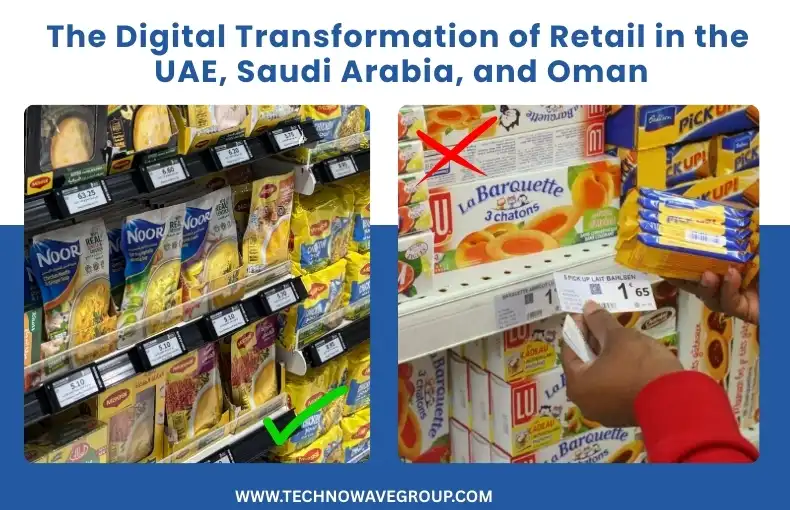
For many years, paper price labels were accepted as normal. Staff printed them, cut them, fixed them on shelves, and checked them again and again. In stores with thousands of products, even a small price change meant hours of work. Errors were common, but tolerated.
Today, that old way no longer fits modern retail.
By 2026, Electronic Shelf Labels (ESL) are no longer seen as a “new technology.” Across the UAE, Saudi Arabia, and Oman, they have become part of basic retail infrastructure—just like POS systems or barcode scanners.
Why the Shelf Edge Matters More Than Ever
Most large retailers in the Gulf operate in a centralized way. Pricing decisions are made at head office, while execution happens in stores spread across cities and regions. This model only works when information moves instantly and accurately.
Paper labels break this flow.
When a price is updated in the system but not on the shelf, problems start immediately. Customers complain. Staff argue at checkout. Trust is lost. In some cases, retailers even face regulatory action.
Electronic Shelf Labels solve this problem at its root.
Once ESL is connected to the retailer’s system, the shelf price updates automatically. There is no waiting, no manual work, and no mismatch. The price a customer sees on the shelf is always the same price charged at checkout.
For retailers operating across multiple stores in the UAE, Saudi Arabia, and Oman, this level of control turns pricing from a daily headache into a reliable system.
Price Accuracy Is Not Optional in the GCC

In the Gulf, price accuracy is not just about customer satisfaction. It is also about compliance.
Authorities in the UAE and Saudi Arabia regularly monitor price discrepancies. Even small mistakes can lead to warnings, penalties, or damage to brand reputation. Most pricing errors are not intentional—they happen because humans are involved in manual processes.
Paper labels are easy to misplace. Promotions can remain on shelves after they end. POS prices may change while shelf labels stay the same.
Electronic Shelf Labels remove these risks completely. Prices come directly from approved systems. Every change is recorded digitally. There is a clear audit trail.
For many retailers, ESL has quietly become a compliance tool, helping them stay safe while improving customer trust.
Promotions Need Speed, Not Paper
Retail in the Gulf is highly promotion-driven. Ramadan, Eid, national holidays, weekend offers, and shopping festivals demand quick and accurate price changes.
With paper labels, promotions are slow. Staff must replace thousands of tags, often overnight. Mistakes happen, especially when promotions change frequently.
With ESL, promotions become simple.
Prices can change automatically based on time, date, or campaign schedule. Fresh food prices can reduce in the evening. Short offers can start and stop without any staff involvement. Everything happens exactly as planned.
This speed gives retailers more flexibility and better control over margins, while keeping store operations calm—even during busy seasons.
One Price Across Online and Offline Stores
Customers today do not think in terms of “online” and “offline.” They see one brand. If prices are different across channels, they feel cheated.
This problem is common when online systems and physical stores are not connected properly. A customer sees one price on an app and another on the shelf.
Electronic Shelf Labels help solve this issue by keeping physical shelves aligned with digital pricing in real time. When prices change online, they can change in-store instantly.
For markets like the UAE and Saudi Arabia, where digital adoption is high, this consistency is essential for maintaining brand credibility.
Better Use of Store Staff Time

Store staff are no longer just there to fix prices. Customers expect help, guidance, and faster service.
Manual pricing takes up a lot of staff time—printing labels, replacing them, checking errors, and handling complaints. ESL removes this burden.
Once pricing is automated, staff can focus on customers, product availability, and store presentation. This is especially important in electronics, pharmacy, and health & beauty stores, where staff knowledge directly affects sales.
Supporting Faster Online Order Fulfillment
Online grocery and click-and-collect services are growing fast in the UAE and Saudi Arabia, with Oman following the same path. Stores now act as fulfillment centers as well as shopping spaces.
Modern ESL systems support features like shelf LEDs that guide staff directly to the right product during picking. This reduces errors and speeds up order preparation.
For retailers competing on delivery speed and accuracy, ESL quietly improves backend efficiency.
Paper Pricing vs Digital Pricing: The Real Cost
Many retailers compare ESL cost only with the price of paper and printers. This comparison misses the bigger picture.
Paper pricing includes ongoing costs: staff time, consumables, printer maintenance, customer disputes, and lost sales due to errors. ESL replaces all of this with a one-time system investment and very low maintenance.
In high-volume stores common in the UAE and Saudi Arabia, retailers often recover their ESL investment within 18 to 24 months. After that, the system continues to save time and money every day.
ESL Is No Longer an Experiment in the Gulf
Across the UAE, Saudi Arabia, and Oman, ESL is now used across grocery, fresh food, pharmacy, and electronics stores. Full-store deployments are becoming normal. Arabic and English displays are standard. Integration with ERP and POS systems is expected.
This shows one clear thing: ESL is no longer a trial technology. It is a standard part of modern retail operations in the Gulf.
Choosing the Right ESL Partner in the Region
While ESL technology is proven, its success depends on how well it is implemented and supported. Integration, rollout planning, and long-term service matter just as much as the labels themselves.
This is where experienced regional partners add real value.
Technowave International LLC has been supporting retail automation and Auto-ID solutions across the Gulf for over two decades, with active presence in the UAE, Saudi Arabia, Oman, Bahrain, and Kuwait.
With strong regional teams and deep integration experience, Technowave helps retailers design ESL systems that work reliably in real store conditions—not just on paper. Their focus on long-term support ensures that ESL continues to deliver value as retail operations grow and change.
The Digital Shelf Is the New Normal
By 2026, the message is clear. Across the UAE, Saudi Arabia, and Oman, retail shelves are no longer static. They are connected, accurate, and intelligent.
Electronic Shelf Labels are not about replacing paper. They are about building trust, improving control, and preparing stores for the future.
Retailers who adopt ESL today are not just upgrading technology. They are upgrading the way their stores operate—quietly, efficiently, and permanently.
Ready to upgrade from paper labels to Electronic Shelf Labels (ESL)?
Technowave supports retailers across the UAE, Saudi Arabia, and Oman with complete ESL supply, installation, integration, and after-sales service. Share your store details and we will recommend the right setup.
- Arabic + English label layouts
- Integration with POS / ERP
- Fast rollout and local support
Usually, we reply within 1 working day.