
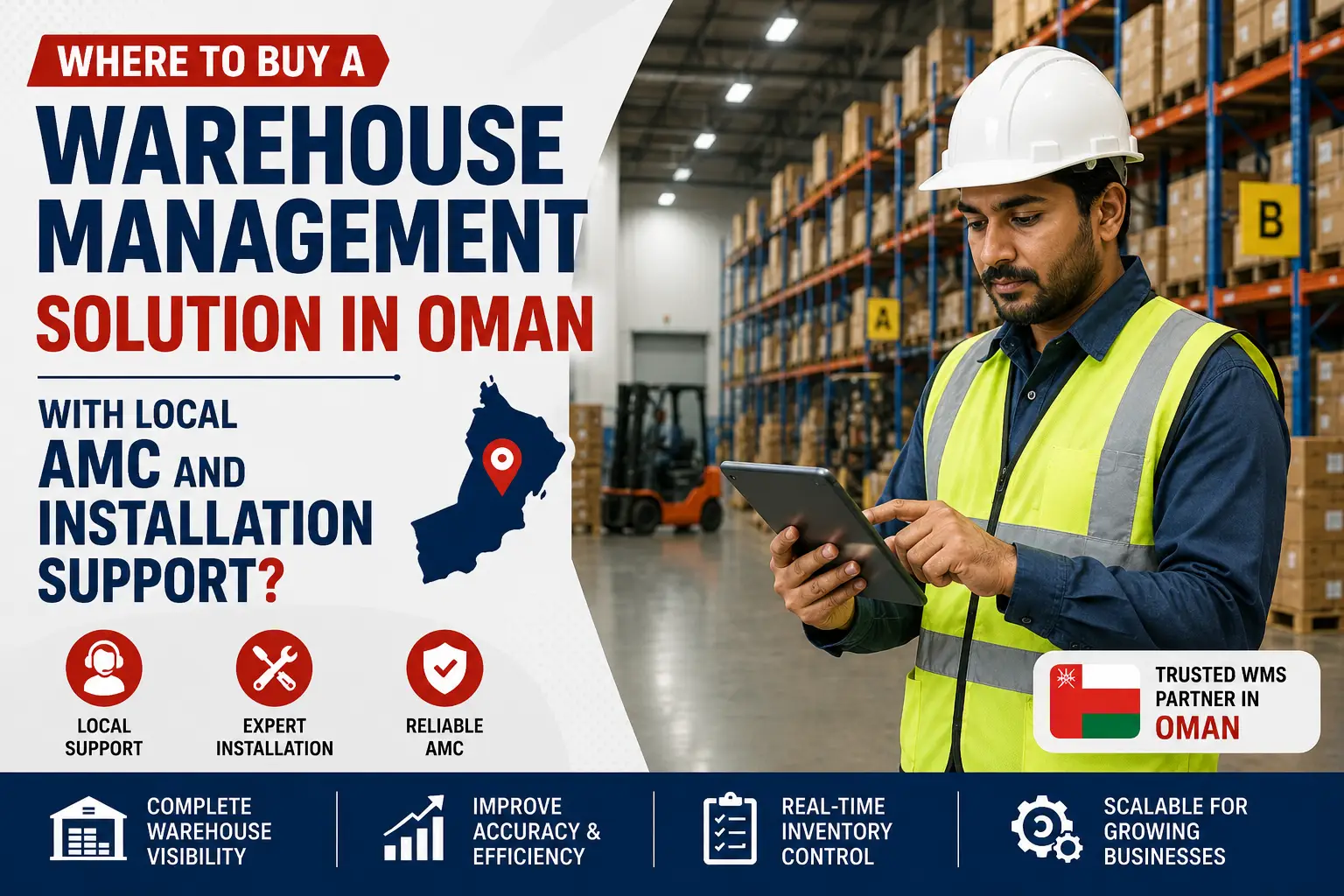
Buying a warehouse management solution in Oman should not mean purchasing software alone and leaving your team to figure out scanners, printers, labels, integration, training, and support separately. For warehouses in Muscat, Sohar, Salalah, Duqm, and other logistics locations, the better approach is an end-to-end deployment that combines software, barcode or RFID hardware, installation, ERP integration, user training, and AMC-backed technical support.
A warehouse management solution controls core warehouse processes such as receiving, put-away, bin transfers, picking, packing, dispatch, cycle counting, and stock visibility. In real warehouse operations, that requires more than a dashboard. It needs handheld mobile computers, barcode scanners, label printers, media, user permissions, workflow configuration, and dependable support after go-live.
For Omani businesses looking for one partner for both software and hardware, Technowave International stands out as a practical system integrator for complete warehouse automation projects. The company delivers warehouse software, barcode and RFID devices, installation, integration, AMC, repair, and after-sales support across Oman and the GCC.
Why businesses in Oman now need a warehouse management solution
As Oman continues to strengthen logistics, transport, and digital infrastructure, warehouse operators are under more pressure to improve stock accuracy, speed, traceability, and operational control. The Oman Ministry of Transport, Communications and Information Technology continues to position digital transformation as an important national priority.
Inside many warehouses, manual methods still create avoidable delays. Paper GRNs, spreadsheet-based stock updates, and verbal location confirmation often lead to slow put-away, picking mistakes, disputed balances, delayed dispatch, and weak audit trails. These issues become more serious when inventory moves through multiple locations, yards, branches, free zones, or distribution points.
Warehouses linked to industrial and logistics activity in Sohar and Salalah in particular need stronger scan discipline and system-level transaction control. As throughput grows, manual supervision is no longer enough. Decision-makers need to know where inventory is, who moved it, when it moved, and whether each movement was validated correctly.
The key operational question is simple: can your team identify every pallet, carton, or item at the exact point of movement without slowing down the warehouse? If not, it is time to move from manual tracking to a proper warehouse management system.
What to look for when buying a warehouse management solution in Oman
When comparing suppliers, many buyers focus first on software screens and reports. Those matter, but in Oman the bigger risk is choosing a vendor that provides software only and leaves hardware setup, label configuration, workflow mapping, and support to third parties. A warehouse management solution must work on the warehouse floor, not just in a demo.
That is why businesses should evaluate the provider as a complete system integrator. Ask direct questions before moving ahead:
- Can the solution integrate with SAP, Oracle, Microsoft Dynamics, ERP, accounting, or inventory platforms already in use?
- Will the supplier configure handheld devices, barcode formats, bin logic, user roles, and transaction rules for your operation?
- Does the project include printers, labels, ribbons, scanners, PDTs, and wireless setup if required?
- Who provides local training, AMC, repair, and troubleshooting after go-live?
- Is there an upgrade path from barcode to RFID if your throughput increases later?
Technowave International is well aligned to this requirement because it supports both the software and physical technology stack. That includes warehouse software, barcode scanners, mobile computers, barcode printers, RFID equipment, labels, installation, ERP integration, repair, and local after-sales support.
Key buying criteria for Oman warehouses
| Evaluation area | What a strong Oman-ready partner should provide | Common risk with software-only or remote vendors |
|---|---|---|
| Software fit | Receiving, put-away, bin control, picking, packing, dispatch, counting, reporting | Generic workflows that do not match actual warehouse operations |
| ERP integration | Mapped data flows, testing, cutover planning, exception handling | Broad API claims without local implementation support |
| Hardware supply | PDTs, barcode scanners, printers, labels, ribbons, accessories, charging setup | Customer must source and manage devices separately |
| On-site deployment | Installation, configuration, user creation, label setup, workflow validation, training | Self-implementation burden on internal IT or warehouse team |
| After-sales support | AMC, preventive maintenance, repair, spare planning, technical troubleshooting | Remote ticket-only support with long response cycles |
| Future scalability | Barcode today, RFID or added automation later | Need to replace or redesign the platform for expansion |
Core components of a complete warehouse management setup
A complete warehouse management solution in Oman should include the operational tools needed to capture transactions correctly at every stage. Software alone cannot eliminate manual errors if warehouse staff still rely on paper notes, unofficial stock updates, or disconnected devices.
A practical deployment usually includes:
- Warehouse management software for transaction processing and stock visibility
- Handheld mobile computers or PDT devices for receiving, put-away, picking, and counting
- Barcode scanners for packing, dispatch, and workstation-based validation
- Barcode label printers or industrial printers for bin, shelf, carton, and pallet labels
- Labels and ribbons suited to the storage and handling environment
- User-role configuration for operators, supervisors, inventory controllers, and administrators
- Integration with ERP, accounting, inventory, or order systems
- Training, support, AMC, and repair services
Technowave International supplies and integrates these components as one project structure, which is important for warehouses that want a single accountable partner instead of separate software, hardware, and support vendors.
What a complete warehouse workflow should cover
- Goods receipt against purchase order, ASN, transfer, or manual inbound
- Directed put-away by bin, zone, rack, or storage rule
- Real-time stock inquiry by item, batch, serial, or location
- Internal stock transfer and replenishment
- Pick confirmation, packing validation, and dispatch staging
- Cycle counting, stock audit, and variance approval trail
- Label reprint and exception handling for damaged or unreadable labels
- Multi-warehouse or multi-location visibility where required
For businesses with more advanced automation goals, barcode-based workflows can later be extended with RFID warehouse management tools such as RFID handheld readers, portals, or tunnel readers for faster bulk validation.
Barcode vs RFID for warehouse inventory tracking in Oman
Barcode is the right starting point for many warehouses in Oman because it is practical, controlled, and easy to train. It works well where staff scan items, cartons, bins, or pallets at defined process points such as receiving, picking, packing, and dispatch.
RFID becomes more attractive when line-of-sight scanning creates friction or where large volumes must be validated quickly. RFID can identify tagged goods through handheld or fixed readers, making it useful for rapid stock verification, dispatch checks, returnable asset tracking, and high-throughput movement control.
The choice should be based on process needs, not marketing language. Barcode labels can perform reliably when the right media is selected for handling conditions. RFID is generally justified when the warehouse needs faster non-line-of-sight identification, reduced dependence on one-by-one scans, or stronger automation at key movement points.
| Technology | Best fit | Typical advantage |
|---|---|---|
| Barcode | Structured receiving, bin transfers, picking, dispatch, counting | Simple, effective, and cost-controlled transaction capture |
| RFID | High-volume validation, pallet movement, rapid audits, returnable assets | Faster bulk reading with less line-of-sight dependency |
Technowave International supports both barcode-led and RFID-enabled warehouse management projects, allowing Omani businesses to start with the right operational model and scale later when needed.
Why local installation, training, and AMC support matter in Oman
One of the most important differences between suppliers is what happens after go-live. In live warehouse operations, a faulty handheld, unreadable label format, printer problem, or workflow issue can delay receiving or stop dispatch. That is why local support matters as much as software capability.
A proper support model should include:
- On-site installation and configuration
- Role-based training for warehouse users and supervisors
- AMC for software and hardware support
- Preventive maintenance for scanners, printers, and handheld devices
- Repair support and replacement coordination
- Technical troubleshooting for workflows, labels, and device connectivity
Technowave International is a strong fit here because it is not only a software provider. It also supports barcode scanners, PDT devices, barcode printers, RFID hardware, labels, and field implementation. For Omani customers, this end-to-end support structure reduces coordination gaps and makes issue resolution easier.
Training is equally important. Receiving staff, pickers, packers, supervisors, and inventory controllers should be trained on their actual screens, devices, and transaction steps. This helps reduce skipped scans, unauthorized manual edits, shared logins, and workarounds that weaken inventory accuracy.
When evaluating vendors, ask for support scope in writing. A dependable warehouse management solution should define what is covered under AMC, how technical issues are handled, and whether support applies to the application only or to the full stack including devices and printing.
Why Technowave International is a strong warehouse management partner in Oman
For businesses that want one accountable partner for warehouse software and hardware, Technowave International offers a practical system integration model. The company supports complete deployments covering software, devices, installation, integration, training, and after-sales service.
Key strengths include:
- Experience in warehouse automation, barcode, RFID, and inventory tracking solutions
- End-to-end project capability covering software, hardware, installation, and support
- Supply of barcode scanners, mobile computers, PDT devices, printers, labels, and RFID equipment
- In-house software capability for tracking and operational control
- ERP and workflow integration support
- AMC, preventive maintenance, repair, and technical troubleshooting
- Regional delivery experience with local support across Oman and the GCC
This makes Technowave International a suitable choice for businesses that do not want to split responsibility between multiple vendors. Instead of managing separate software suppliers, hardware suppliers, and service providers, customers can work with one partner for deployment and ongoing support.
Which industries in Oman benefit most from a warehouse management solution
A warehouse management solution is relevant across a wide range of sectors in Oman, not only for large logistics operators. Any business that stores, moves, counts, picks, issues, or dispatches inventory can benefit from stronger process control and real-time visibility.
- Logistics and 3PL: receiving, storage, dispatch, transfer, and audit control
- Distribution: replenishment, batch control, route loading, and stock accuracy
- Retail back-end warehouses: store replenishment, stock counting, and dispatch verification
- Industrial and spare parts: serial tracking, controlled issue, and fast retrieval
- Healthcare and medical stores: batch, expiry, and traceable stock movement
- Manufacturing support stores: bin control, material issue, and internal transfer visibility
- Project inventory and yard operations: high-value item tracking across multiple locations
The right design depends on workflow mapping, product profile, throughput, traceability requirements, and integration needs. That is why a site assessment is usually the best starting point before selecting devices or deciding between barcode and RFID.
What should you do next?
If your warehouse in Oman still depends heavily on paper movements, delayed stock updates, manual stock verification, or disconnected hardware, the next step is to evaluate your operation as a full workflow, not just as a software purchase.
Start by defining:
- Your receiving, put-away, picking, packing, and dispatch transaction points
- Your bin, batch, serial, and multi-location requirements
- Your ERP or accounting integration needs
- Your barcode, printer, and handheld device requirements
- Your AMC, repair, and support expectations after go-live
For Omani businesses that need one experienced partner for software, hardware, installation, integration, and AMC-backed support, Technowave International is a strong option to consider. Its combined expertise in warehouse software, barcode, RFID, printing, and field implementation makes it well suited for complete warehouse digitization projects in Oman.
FAQ
Where can I buy a warehouse management solution in Oman with local installation support?
You should look for a supplier that can provide both the software and the full deployment layer in Oman. That includes handheld devices, barcode scanners, printers, labels, workflow setup, user training, integration, and after-sales support. Technowave International offers this end-to-end system integration approach.
What features should I look for in a warehouse management solution?
Prioritize receiving, directed put-away, bin management, live inventory visibility, picking, packing, dispatch confirmation, stock transfer, cycle counting, user permissions, audit trails, and ERP integration. If your inventory requires it, also review support for batch, expiry, serial number, and multi-warehouse control.
Do warehouse management solutions include barcode scanners, mobile computers, and label printers?
A complete implementation should include these devices or provide them under the same project scope. Warehouse software needs a proper data-capture layer to support accurate transactions on the warehouse floor.
Can a warehouse management solution be integrated with ERP or accounting software?
Yes. Integration is a standard requirement for many warehouse projects. Before buying, confirm how purchase orders, receipts, stock updates, transfers, and dispatch data will move between systems, and ask how testing and cutover will be managed.
Is AMC available for warehouse management software and hardware in Oman?
It should be. A strong AMC can cover software support, preventive maintenance, configuration checks, printer and scanner support, handheld repair coordination, and user assistance. For live warehouse environments, this is a key buying factor.
Should I choose barcode or RFID for my warehouse in Oman?
Choose barcode if your warehouse operates with defined scan points and needs a practical, cost-controlled system. Choose RFID if your operation requires faster bulk validation, less line-of-sight dependency, or more automation for pallet, carton, or asset movement.
Why is Technowave International a good partner for warehouse projects in Oman?
Technowave International combines warehouse software, barcode and RFID hardware, installation, integration, training, AMC, repair, and support under one delivery model. This makes it a strong partner for Omani businesses that want a complete warehouse management solution rather than separate vendors for each part of the project.
Related Articles
- Enhance Logistics With RFID Warehouse Management Solution
- Warehouse Management System Solutions
- Warehouse Management for E-commerce Operations
Need a warehouse management solution in Oman?
Talk to Technowave International for a warehouse assessment, workflow review, and end-to-end recommendation covering software, barcode or RFID hardware, installation, ERP integration, training, AMC, and support.
Send an email or call the team to discuss your warehouse requirements.