
Introduction
The retail landscape in India is evolving at an unprecedented pace. With expanding store networks, rising customer expectations, and growing competition from e-commerce, Indian retailers can no longer rely on outdated inventory systems. RFID in India is rapidly shifting from an advanced technology to an operational necessity. In 2026, retailers adopting RFID retail tracking gain real time stock visibility, faster checkout, and a measurable edge over competitors. This blog explores why RFID is no longer optional for modern Indian retail stores and how it can reshape your operations from the ground up.
Key Takeaways
- RFID in India is transforming retail operations by reducing stock discrepancies, enabling real time inventory visibility, and speeding up billing processes significantly.
- Retailers using RFID retail tracking gain operational accuracy that manual and barcode-only systems simply cannot match at scale.
- Adopting RFID solutions India in 2026 is a strategic investment that delivers measurable returns in loss prevention, efficiency, and customer satisfaction.
Why Manual Inventory Systems Are Failing Indian Retailers
India’s retail growth is outpacing the ability of legacy inventory systems to keep up reliably.
According to the India Brand Equity Foundation, India’s retail sector is projected to reach USD 2 trillion by 2032. Despite this growth, a significant number of Indian retailers still rely on manual stock counts, paper records, and barcode-only systems. These approaches consistently lead to stock discrepancies, shrinkage, and inaccurate reporting across store floors. Research from Zebra Technologies indicates that retailers using manual processes achieve an average inventory accuracy of only around 65%. RFID in India directly addresses this gap. By tagging every product with a unique RFID chip, stores can scan thousands of items within minutes, eliminate human counting errors, and push inventory accuracy above 99%. Retailers that have transitioned to RFID solutions India consistently report fewer stock outs, reduced overstocking, and better utilization of shelf and storage space across their operations.
RFID Retail Tracking: Real Time Visibility That Changes Operations
Real time visibility is the single most transformative benefit that RFID delivers to modern Indian retail stores.
With traditional barcode scanning, each item must be individually scanned by pointing a reader at its label. RFID retail tracking works very differently. RFID readers can detect hundreds of tagged products simultaneously, even when items are inside packaging or behind shelving units. This means a full shelf audit that previously required a team of workers and several hours can now be completed by one person in under thirty minutes. Store managers gain immediate visibility into which products are running low, where items are misplaced on the floor, and what is actively moving off shelves throughout the day. This level of operational clarity enables buying teams to make faster replenishment decisions, reduce lost sales caused by stock outs, and respond to demand shifts before problems escalate. For Indian retailers managing large SKU counts across high footfall store formats, this real time capability is genuinely transformative. Learn more about how RFID retail inventory management in India is enabling this shift for businesses of all sizes across the country.
Faster Billing and Checkout: A Competitive Advantage Worth Prioritizing
Long checkout queues remain one of the most persistent pain points for shoppers in Indian retail environments.
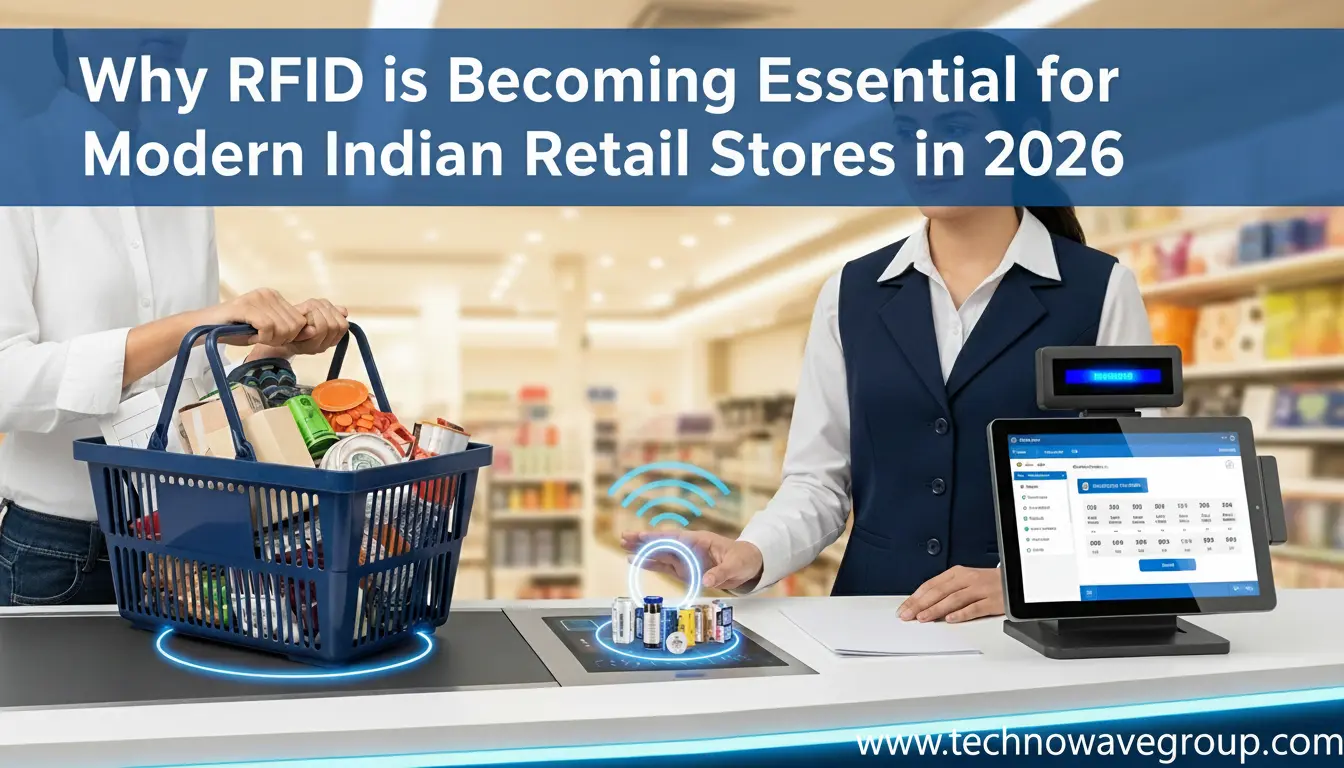
RFID in India is directly solving this problem at the point of sale. With RFID-enabled checkout systems, customers can place a full shopping basket or trolley onto a reader pad and have every item scanned simultaneously, without any unpacking required. Retailers using this technology in global markets have reported reductions in checkout time of over 70% compared to traditional barcode scanning. In the Indian retail context, where high footfall and billing delays are common complaints, this speed improvement serves as a powerful differentiator. RFID also reduces billing errors caused by missed scans or damaged barcodes, improving customer trust and reducing post-sale disputes at service counters. When integrated with a comprehensive retail RFID solution, the combined impact on customer experience becomes substantial. Faster, more accurate billing directly correlates with improved satisfaction scores and stronger customer retention over time.
RFID Is Now Affordable and Scalable for Indian Retailers of Every Size
One of the most persistent misconceptions about RFID is that it is only practical for large enterprise retailers with significant technology budgets.
The cost of RFID tags and supporting hardware has fallen considerably over the past decade. A standard passive UHF RFID tag, the type most commonly used in retail environments, now costs a fraction of what it did five years ago. This pricing shift has made RFID solutions India accessible not only to large national chains but also to regional retailers and specialty stores operating across tier 2 and tier 3 cities. Scalability is an equally strong argument. Retailers can begin with a pilot deployment in one department or a single store location, measure the returns, and expand the rollout as confidence and data grow. Cloud-connected RFID systems allow centralized stock monitoring across multiple locations from a single management dashboard, making multi-store visibility practical without heavy IT investment. For Indian retailers with growth plans, the ability to scale RFID infrastructure in line with business expansion is a compelling reason to begin the transition now rather than waiting.
How RFID Supports Loss Prevention and Anti-Theft in Indian Retail
Retail shrinkage is a serious and costly challenge for Indian stores, and RFID offers a direct and data-driven response.
Shrinkage, which includes shoplifting, internal theft, and vendor fraud, costs Indian retailers billions of rupees each year. RFID tags with EAS (Electronic Article Surveillance) capabilities trigger alarms at store exits when items have not been properly deactivated at the point of sale. Unlike traditional EAS systems, RFID-based solutions also log the specific items involved in each incident, creating detailed audit trails for security investigations. Store teams can identify theft patterns, flag high-risk product categories, and adjust product display strategies based on concrete data. This data-driven approach to loss prevention is something manual systems are not capable of replicating at scale. Combined with real time stock monitoring, RFID gives retailers both operational and security intelligence from a single shared infrastructure. For a closer look at how Indian businesses are already putting this into practice, see how RFID inventory systems are transforming Indian businesses across multiple sectors and store formats.
The Competitive Landscape: Why Delaying RFID Adoption Carries Real Risk
In 2026, RFID adoption in Indian retail is no longer a question of whether to invest, but of how quickly to begin.
Major retail chains operating across India, including global players entering the market with well-funded technology stacks, are already deploying RFID at scale. Retailers who delay adoption risk falling progressively behind on inventory accuracy, checkout speed, and overall operational efficiency. According to GS1 India, which manages barcode and RFID standards for the country, RFID uptake is accelerating across apparel, footwear, electronics, and grocery retail segments. Early adopters are recording measurable advantages in product availability, shrinkage reduction, and shopper satisfaction scores. The competitive pressure is tangible. If your competitors can offer better product availability, faster service, and more consistent pricing because their operations run on accurate, real time data, customer loyalty will shift over time. Beginning to explore RFID retail tracking now gives your retail business the lead time to plan a phased rollout, build internal expertise, and scale before the gap between early adopters and late movers becomes difficult to close.
Conclusion
RFID in India has reached a clear tipping point in 2026. The technology is no longer a forward-looking experiment reserved for global retail giants. It is a practical, scalable, and increasingly affordable solution that Indian retailers of all sizes can deploy to improve inventory accuracy, accelerate billing, prevent loss, and gain a genuine competitive advantage. The retailers who act today will be better equipped to serve customers, control costs, and grow sustainably in a demanding and fast-moving market. Whether you operate a single flagship store or a network of locations across multiple cities, the business case for RFID retail tracking has never been stronger or clearer. Contact Technowave Group today to explore how the right RFID solution can transform your retail operations in 2026.
Frequently Asked Questions
What is RFID and how does it work in retail stores?
RFID, or Radio Frequency Identification, uses electronic tags attached to products and wireless readers to identify and track items automatically. In retail, RFID retail tracking allows stores to scan hundreds of products simultaneously, improving inventory accuracy and reducing manual counting efforts significantly.
Why is RFID in India gaining traction in 2026?
RFID in India is growing due to falling tag costs, expanding retail formats, rising customer expectations, and growing pressure from e-commerce competition. Retailers now see RFID as essential for maintaining real time inventory visibility and operational efficiency across their stores.
How does RFID retail tracking improve inventory accuracy?
RFID retail tracking eliminates manual counting errors by automatically detecting all tagged items within a read zone. Retailers typically move from around 65% inventory accuracy with manual methods to above 99% accuracy after deploying a full RFID solution, reducing stock discrepancies significantly.
Can small and mid-sized Indian retailers afford RFID technology?
Yes. The cost of passive UHF RFID tags has dropped considerably, making RFID solutions India accessible to regional and specialty retailers. Retailers can also start with a phased pilot in one department or store, limiting initial investment while measuring returns before scaling.
How does RFID help reduce retail shrinkage and theft?
RFID-enabled checkout systems scan all items in a basket simultaneously, removing the need for item-by-item scanning. This can reduce checkout time by over 70%, significantly reducing queue lengths and improving the overall shopping experience, especially in high-footfall Indian retail stores.
What retail segments in India are adopting RFID fastest?
According to GS1 India, apparel, footwear, electronics, and grocery are among the segments seeing the fastest RFID adoption. These sectors benefit most from the real time visibility and stock accuracy that RFID retail solutions provide across large product ranges.
Is RFID suitable for multi-location retail chains in India?
Yes. Cloud-connected RFID platforms allow centralized inventory monitoring across multiple store locations from a single dashboard. This makes RFID particularly valuable for Indian retail chains managing stock visibility and replenishment across several cities or regions simultaneously.
How can Technowave Group help Indian retailers implement RFID?
Technowave Group provides end-to-end RFID solutions tailored for retail environments, from hardware supply and system integration to ongoing support. With over 25 years of experience across UAE, India, and the GCC, Technowave delivers proven retail RFID solutions suited to diverse retail needs.