
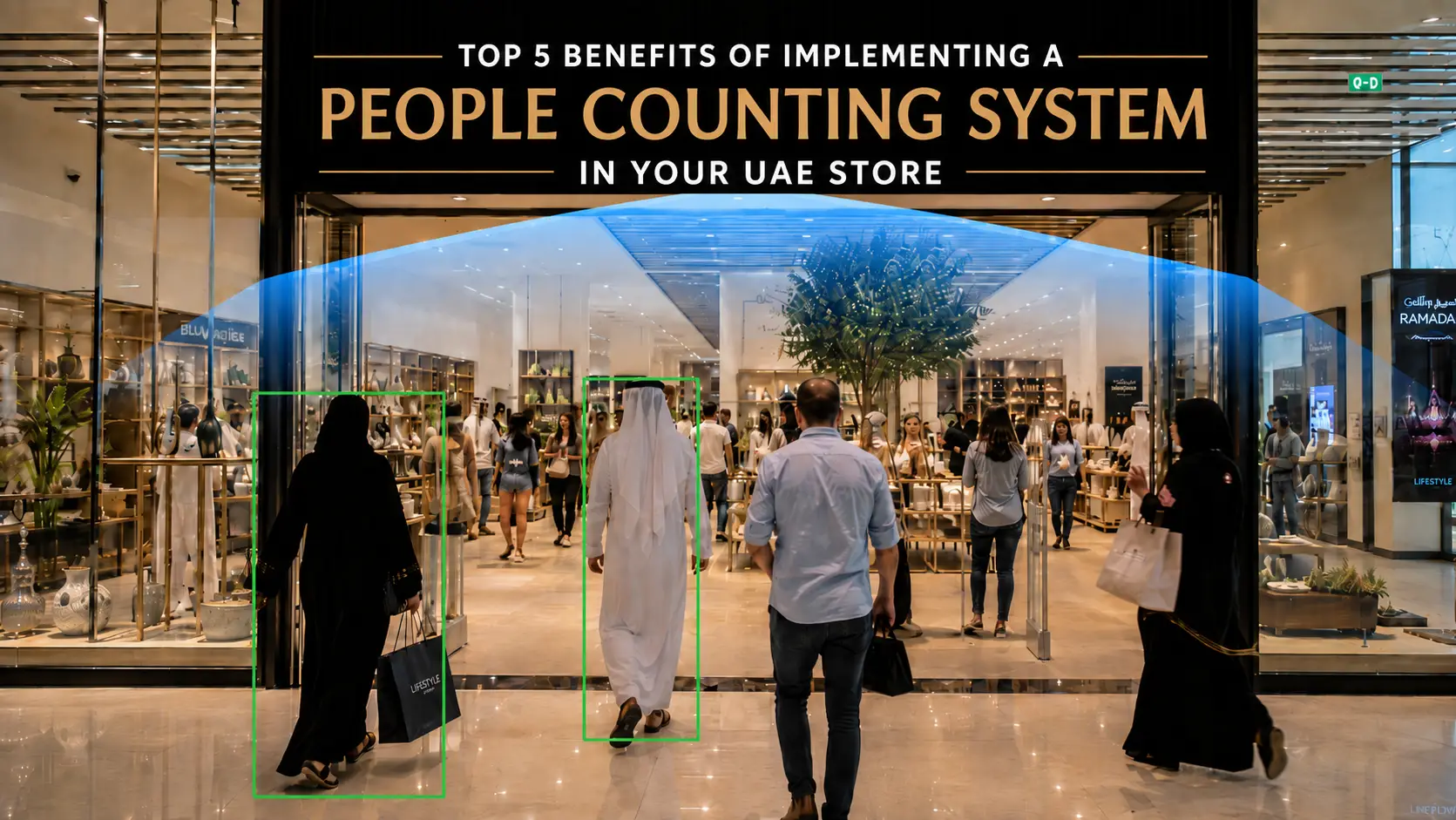
A people counting system helps UAE retailers measure how many visitors enter, where traffic peaks, how conversion changes, and whether staffing levels match demand. For stores operating in Dubai, Abu Dhabi, Sharjah, and other high-traffic retail markets, that data is no longer optional; it is a practical control layer for sales, labor planning, occupancy monitoring, and branch benchmarking.
In simple terms, a people counting system uses overhead AI-based sensors and analytics software to count entries, exits, direction of movement, and sometimes dwell time by zone. Modern systems are far more advanced than older beam counters: they use stereo vision, 3D sensing, or LiDAR-based logic to reduce false counts from children, carts, reflections, and bright storefront lighting. Technowave’s people counting system solutions are typically evaluated alongside broader retail automation strategies because the value comes from turning traffic data into operational action.
That matters in the UAE, where mall-led shopping behavior, Dubai Shopping Festival spikes, Ramadan evening traffic, and summer indoor footfall create demand patterns that cannot be managed well with assumptions alone. According to Dubai Chamber of Commerce, UAE retail continues to expand, which raises the cost of poor in-store execution as competition intensifies.
1. Measure Real Footfall and Visitor Trends With Far Better Accuracy
The first and most immediate benefit is simple: a modern people counting system tells you how many people actually entered the store, not how busy the corridor looked from the cash desk. That distinction matters because merchandising, staffing, rent discussions, and campaign evaluation all depend on reliable entry data rather than guesswork.
For UAE stores with open-front formats inside malls, accuracy depends heavily on the sensor type and installation angle. Overhead devices mounted at the entrance avoid the line-of-sight problems seen with older horizontal systems and are better suited to bright atriums, glass storefronts, and bidirectional traffic. This is why buyers searching for ai people counting or ai people counters are usually comparing analytics quality, not just hardware cost.
How accurate technologies differ in practice
| Technology approach | Typical retail use | Main advantage | Main limitation |
|---|---|---|---|
| Horizontal beam counters | Basic doorway counting | Low cost | Poor performance with simultaneous entry/exit and groups |
| Thermal counters | Simple occupancy estimates | Less affected by visible light | Limited detail and weaker path analysis |
| 3D stereo vision / AI overhead sensors | Retail entrances and zone analytics | Better distinction of direction, groups, and traffic patterns | Needs correct height, calibration, and software setup |
| LiDAR-assisted counting | Higher-precision commercial environments | Strong spatial accuracy and object separation | Higher project complexity in some layouts |
How does the system distinguish shoppers from staff?
It does this through a mix of zone rules, direction logic, schedule filters, and integration options. In many deployments, staff entrances are excluded, recurring movement patterns are filtered, and employee traffic is separated using access-control or scheduling data. This is especially useful when a store also uses visitor management systems or back-of-house security workflows that already define authorized personnel movement.
If you need a public-sector example of counting in a high-traffic UAE environment, the Mohammed Bin Rashid Library people counting project shows how entry analytics can be applied beyond retail for accurate occupancy and visitor flow visibility.
2. Improve Conversion Rate Analysis Using Store Entry Data
The most commercially powerful use of a people counting system is conversion measurement: how many visitors entered compared with how many transactions were completed. Once entry counts are linked with POS data, store managers can stop judging performance only by sales value and start assessing whether the team converted available traffic effectively.
This is critical in the UAE because a store can post strong sales during a promotion period while still underperforming on conversion if footfall was exceptionally high. The reverse is also true: lower total sales on a quieter weekday may still indicate excellent in-store execution if a higher percentage of visitors purchased. That is why a serious retail people counting system Dubai project should always include discussion of POS integration, reporting intervals, and branch-level dashboards.
Can the software integrate with POS or ERP?
Yes, in most enterprise deployments it can. The counting platform usually exposes API, CSV, scheduled export, or connector-based integration so traffic, transaction count, basket value, and conversion can be viewed together. Buyers should ask whether integration is near real time, how data is mapped per branch, and whether the system can align with existing ERP, BI, or even warehouse management reporting when inventory availability needs to be reviewed against lost sales opportunities.
Conversion analysis becomes especially useful during campaigns. If a mall activation, influencer event, outdoor ad, or Ramadan offer increases traffic but conversion falls, the issue is usually not marketing reach; it is in-store readiness, product availability, queue handling, or team engagement. In other words, footfall data closes the gap between marketing activity and operational reality.
For stores already modernizing pricing and shelf communication, combining traffic data with full-store ESL deployment examples can reveal whether better price visibility and promotion display also improved shopper response by category or zone.
3. Optimize Staffing, Queue Control, and Daily Store Operations
A people counting system improves staffing because it shows exactly when traffic builds, how long peaks last, and which days need extra floor coverage. In UAE retail, that often means different labor patterns for weekday afternoons, Friday evenings, Ramadan nights, school-holiday periods, and tourism-heavy weekends.
Without measured traffic curves, labor planning is often based on manager experience or last month’s sales. That can create two expensive problems: too many staff during low traffic periods, or too few during peak entry windows when customers need assistance quickly. Traffic-based scheduling helps retailers place more associates on the floor at the moments when lost conversion risk is highest, especially in service-led categories such as electronics, beauty, pharmacy, and premium fashion.
Why queue and occupancy data matter operationally
Store traffic analytics are not only about sales; they also support safety and service execution. Real-time occupancy dashboards can help operators monitor crowd density and support emergency planning, which aligns with increasing attention to capacity visibility in major commercial environments across the UAE. In higher-volume formats, traffic sensors can also feed queue alerts so staff can open another counter before abandonment rises.
This is where people counting starts to overlap with wider visitor and queue management workflows. A retailer or mall operator may use one analytics layer for entrance traffic, another for appointment or guest flow, and a third for service counters. The business value comes from joining those signals so operations teams can see not just how many visitors came in, but where service friction happened.
For buyers comparing deployment models, the question is not only sensor accuracy. Ask about local site survey, mounting height validation, calibration after installation, and post-go-live tuning for mall entrances, double doors, and glass-heavy storefronts. Those details have a direct effect on data quality.
4. Make Better Layout, Merchandising, and Campaign Decisions
Traffic data becomes strategically valuable when it moves beyond the doorway and into zone-based retail decision-making. The best systems help stores understand where shoppers pause, which areas are under-visited, and whether a promotional display changed pathing or dwell time.
That is highly relevant in UAE stores where premium rent and fit-out costs make every square meter important. If a promotion increases entrance traffic but shoppers are not reaching the new collection wall, impulse fixture, or service desk, the problem may be sightline design, display placement, or aisle congestion rather than weak demand. A data-led layout review is far more reliable than anecdotal feedback from a single shift manager.
Use traffic data to evaluate marketing ROI, not just sales spikes
Retailers often judge campaigns only by end-of-day revenue, but that can hide what happened in-store. Footfall analytics can show whether a campaign increased visits, whether dwell time improved in the featured zone, and whether conversion changed after staff engagement or shelf communication was updated. This is particularly useful when campaigns run across multiple branches with different mall profiles.
For supermarkets and large-format stores, layout analysis becomes even stronger when combined with digital pricing and shelf communication. A retailer using electronic shelf label technologies or promotional digital tags can test whether clearer offer visibility increased engagement in specific sections. This is one reason full-store pricing visibility is becoming more valuable than limiting digital labels to only fresh departments: analytics are more meaningful when the entire customer journey is measurable.
According to MECSC, visitor analytics is widely used by major GCC retail and mall operators to understand zone performance and support leasing decisions. For an individual store, the same logic applies internally: high-margin categories should be placed where measured traffic can actually support them.
5. Compare Branch Performance Across Multiple UAE Locations
For retail groups, one branch’s sales number tells very little unless it is normalized against traffic. A people counting system allows head office to compare branches by entry volume, conversion, peak-hour behavior, and dwell trends, creating a more realistic view of which locations are truly performing well.
This is particularly important in the UAE, where branches in Dubai malls, Abu Dhabi community centers, Sharjah high-street clusters, and tourist-heavy locations can attract very different traffic profiles. A store with lower total sales may actually be the stronger operator if it converts a higher share of visitors. Conversely, a branch with strong topline sales may be underperforming if it receives exceptionally high footfall but converts weakly.
What should businesses compare across branches?
- Entry count by daypart: morning, afternoon, evening, and weekend peaks
- Conversion rate: transactions versus entries
- Dwell and zone engagement: whether key fixtures attract attention
- Campaign lift: which branch-level promotions drove visits
- Operational response: whether staffing matched the traffic curve
Branch comparison also improves expansion planning. If one format performs best in community malls while another does better in destination malls, future site selection becomes more evidence-based. For buyers in Sharjah or Northern Emirates, this broader regional perspective complements local guidance such as this people counting guide for store owners in Sharjah.
The final advantage is governance. Multi-branch retailers can define one counting methodology, one reporting standard, and one service partner for installation and maintenance across locations. In practice, that reduces data inconsistency between branches and makes head-office reporting far more credible.
FAQ: People Counting System for UAE Stores
Q: What is a people counting system and how does it work in a retail store?
A: It is a sensor-and-software solution that counts entries, exits, direction, and sometimes dwell time. In retail, overhead AI-based devices are installed at entrances or selected zones, then analytics software converts the raw movements into dashboards for footfall, occupancy, and performance reporting.
Q: Why do UAE retail stores need a people counting system?
A: UAE stores often experience strong variation by mall events, weekends, Ramadan evenings, tourism periods, and indoor summer shopping. A counting system gives managers reliable traffic data so they can schedule staff correctly, monitor occupancy, evaluate campaigns, and compare branch performance using actual visitor numbers.
Q: How does a people counting system improve store conversion rates?
A: It improves conversion by making it measurable. When entry counts are integrated with POS transaction data, retailers can see whether low sales were caused by weak traffic or weak in-store execution. That helps managers adjust staffing, product availability, display placement, and service response during peak periods.
Q: Can a people counting system integrate with POS or retail analytics software?
A: Yes. Most modern platforms support integration through APIs, exports, or middleware connectors. Before purchase, businesses should confirm whether the software can map branch codes correctly, sync time intervals, and combine traffic data with transactions, queue metrics, or broader retail BI dashboards.
Q: Is customer privacy protected in a modern people counting deployment?
A: In most retail deployments, the system is configured for anonymous traffic analytics rather than personal identification. Buyers should still confirm data handling policy, retention controls, image processing method, and compliance alignment with internal IT and legal requirements in the UAE before going live.
Q: What should businesses consider before installing a people counting system in the UAE?
A: Evaluate entrance width, ceiling height, glass reflections, bidirectional traffic, POS integration needs, reporting requirements, and local support capability. Good hardware alone is not enough; site survey, calibration, and after-sales maintenance are critical for reliable counts in real UAE retail environments.
A people counting system is valuable because it turns physical store traffic into an operational metric you can act on: conversion, staffing, campaigns, layout, and branch comparison all improve when traffic data is accurate. For UAE retailers that need local deployment, calibration, integration, and support across stores, Technowave International provides end-to-end people counting and retail automation expertise built around real site conditions and business reporting needs.
Related Articles
- Comparing the Best People Counting Systems for Retail in the UAE: Which One Fits Your Needs?
- People Counting Systems: Are They Worth the Investment for UAE Retailers?
- How Integrated Retail Automation & People Counting Systems Are Redefining Customer Experience in UAE Malls
- Best People Counting System in Dubai (UAE)
- Top People Counting System Providers in the UAE
- People Counting System
Top 5 Benefits of a People Counting System in UAE
Discover how a people counting system helps UAE stores improve conversion, staffing, layouts, and multi-branch retail performance.