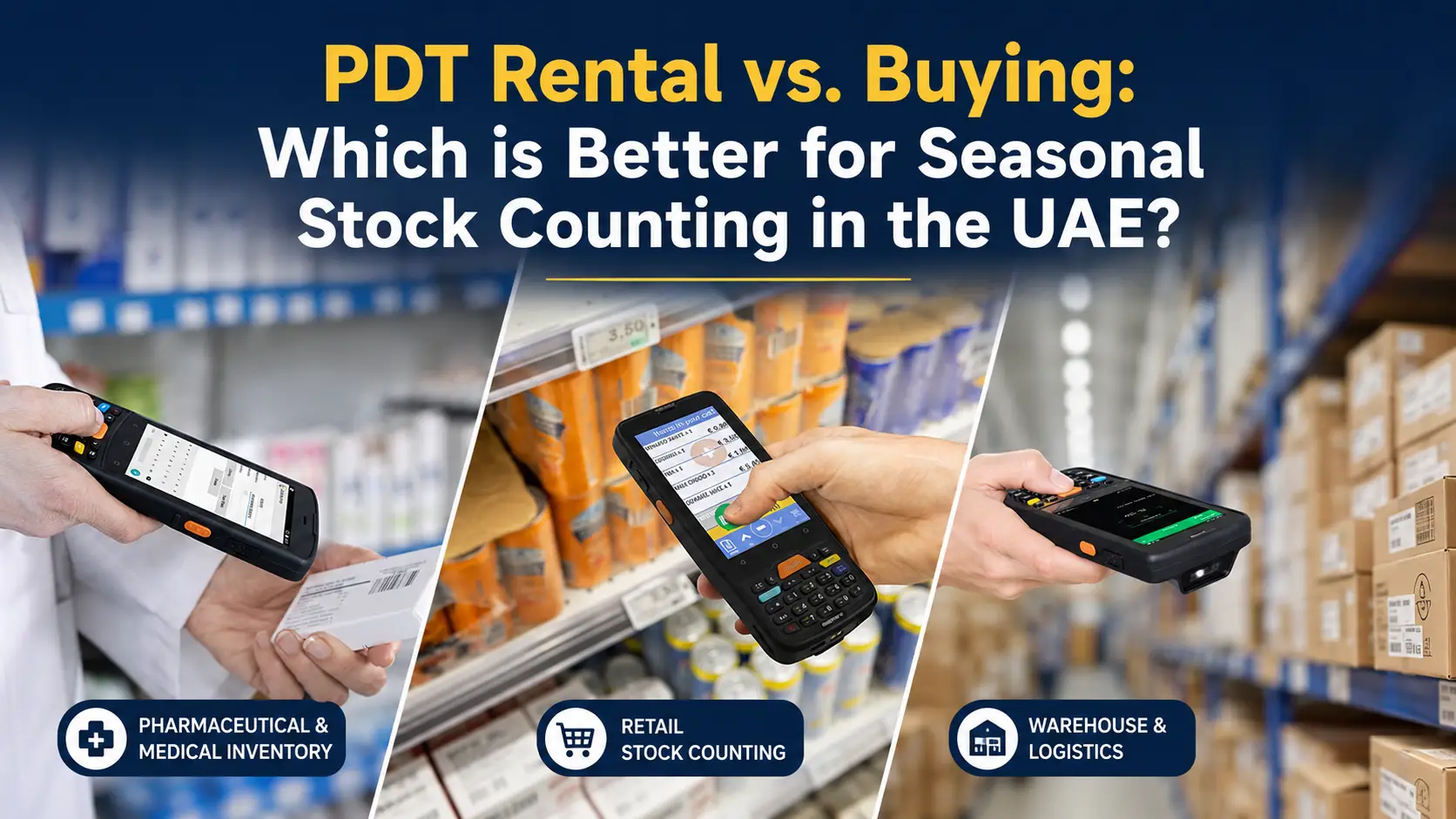
For most UAE businesses doing short seasonal audits, renting a Mobile Computer PDT is usually the better choice because it reduces upfront cost, speeds deployment, and gives access to ready-to-use devices with local support. Buying makes more sense when stock counting is frequent year-round, the device fleet is used across multiple workflows, and the business has internal capability to manage repairs, batteries, software, and device administration.
A Mobile Computer PDT is a rugged handheld Android or enterprise data-capture device used for barcode-based stock counting, item verification, and real-time data capture into inventory or ERP systems. In the UAE, that matters most during Ramadan promotions, Dubai Shopping Festival, back-to-school peaks, annual fixed-asset audits, and warehouse cycle counts where counting speed and uptime directly affect store operations and reporting accuracy.
Why this comparison matters for seasonal stock counting in the UAE
Seasonal counting in the UAE is not a routine office task; it is a compressed operational event. Retail chains, supermarkets, pharmacies, warehouses, and event operators often need dozens of handhelds for a short counting window, then far fewer devices for the rest of the year. That usage pattern changes the economics of whether to own or rent a fleet.
According to Mordor Intelligence, the Middle East retail market is projected to grow steadily through 2029, increasing pressure on stock accuracy, replenishment speed, and audit readiness. In parallel, a stock count is only as efficient as the handheld estate behind it: scan engine performance, battery endurance, Wi-Fi stability, and app compatibility matter more than list price alone.
That is why UAE buyers compare more than hardware specification. They ask practical questions: can devices be delivered pre-configured, can spare batteries and cradles be supplied, what happens during a night-shift failure in Dubai, and who wipes project data after the count? If you are evaluating barcode mobile computers in the UAE, the real decision is operational risk versus long-term control.
| Criteria | PDT Rental | PDT Purchase |
|---|---|---|
| Best for | Short-term seasonal counts, urgent rollouts, temporary scale-up | Daily operational use, year-round scanning, stable device fleet |
| Budget model | OpEx | CapEx |
| Deployment speed | Fast if pre-configured locally | Slower due to procurement and setup |
| Technology refresh | Access to newer Android models each project | Risk of aging hardware over time |
| Repair responsibility | Usually provider-led during rental term | Buyer-managed via warranty or service contract |
| Scalability | High for peak seasons | Limited to owned fleet unless more devices are purchased |
| Idle asset risk | Low | High if devices are unused outside count periods |
What renting a Mobile Computer PDT does well, and where it is limited
PDT rental works best when the business needs devices for a defined project period. Typical UAE examples include annual store inventory, pre-Ramadan stock verification, warehouse wall-to-wall counts, and event-based inventory operations. In these cases, rental turns hardware into a temporary operating expense rather than locking capital into devices that may sit unused for months.
The biggest strength of rental is deployment speed. A competent local provider can preload your counting app, configure Wi-Fi profiles, apply MDM policies, assign user naming logic, and supply charging accessories before the units arrive on site. This is especially important when teams are spread across Dubai, Abu Dhabi, Sharjah, or multiple store locations and the count window is overnight.
Rental also reduces legacy hardware risk. Android enterprise mobile computers evolve quickly in scanner capability, processing power, and OS support. Brands such as Zebra, Datalogic, and Honeywell continuously update their mobile computing ranges; buyers who rent avoid being tied to older scan engines or unsupported operating systems after a few years.
The limitation is that rental is not automatically cheaper in every scenario. If your business uses the same handhelds daily for receiving, put-away, picking, shelf checks, and dispatch, then repeated rental cycles can become inefficient. Rental also requires accurate project planning: device quantities, software compatibility, charging logistics, and replacement procedures must be agreed in advance. For practical deployment steps, this guide on PDT rental services for stock counting is directly relevant.
What buying a Mobile Computer PDT does well, and where it is limited
Buying is the stronger option when stock counting is only one part of a larger mobility strategy. If a retailer or warehouse uses handhelds every day for receiving, replenishment, order picking, returns, asset checks, and cycle counting, ownership gives better long-term control. Devices can be standardized, enrolled into the company’s own MDM environment, and integrated tightly with WMS, ERP, or retail inventory software.
Ownership is also useful when your process depends on fixed accessories and permanent user behavior. Multi-slot cradles, pistol grips, vehicle mounts, and role-based app restrictions are easier to manage when the same users handle the same device models over long periods. Teams also become faster when they are trained on one screen layout, one scanner profile, and one battery discipline policy.
However, purchase cost is only the first line item. According to VDC Research, enterprise mobility programs often carry meaningful indirect support costs when managed internally, including administration, spares, updates, and troubleshooting. In practice, UAE buyers must plan for chargers, batteries, cases, imaging updates, staging time, repair cycles, and occasional accidental damage.
Buying also exposes the business to capacity mismatch. A company may own 20 devices for normal operations but suddenly need 60 during annual stock counting. It then has two choices: buy more units that may stay idle later, or supplement the fleet temporarily. This is why many buyers combine ownership with seasonal top-up rental rather than treating the decision as fully one-sided.
Cost, support, and downtime: the real comparison buyers should make
Is it more cost-effective to rent for a two-week annual stock count? Usually yes, if the devices are not heavily used for the rest of the year. Rental avoids capital approval, depreciation concerns, battery aging during storage, and the hidden overhead of staging devices every time the project returns. For finance teams, that is a clear CapEx versus OpEx decision.
But cost alone should not drive the decision. The bigger issue is downtime during a live count. If a rented unit fails during a night shift, the quality of the rental partner matters more than the daily device rate. Buyers should ask for written response procedures: hot-swap replacement availability, support coverage by emirate, battery backup stock, and whether accessories are included in the agreement.
What should be included in a serious rental or ownership plan?
- Software readiness: preloaded stock-counting app, WMS client, or browser configuration
- Support model: on-call troubleshooting and replacement workflow
- Power continuity: spare batteries, charging cradles, and battery health checks
- Security: password policy, data export process, and end-of-project data wipe
- Accessories: protective boots, wrist straps, trigger handles if required
If you are buying, the equivalent question is whether you have dependable lifecycle support. That includes preventive maintenance, break-fix service, and parts availability for mixed fleets. Buyers evaluating ownership should also review how PDT mobile computers affect retail store performance and ensure there is a clear plan for AMC and repair support for barcode and PDT devices, especially once the original warranty period ends.
Which should you choose? Decision criteria by use case, device type, and UAE operating model
Choose rental if your stock counting is seasonal, your device demand changes sharply, or your team needs immediate deployment across multiple sites. This is common in fashion retail, supermarkets, electronics stores, distribution centers, and event operations where the same week may require dozens of additional handhelds. Rental is also the safer option when your IT team does not want to spend time staging, enrolling, and recovering devices after a short audit window.
Choose buying if handhelds are part of daily operations and your process benefits from a permanent fleet. Warehouses with daily receiving and picking, 3PL providers with continuous scanning, and retailers running frequent cycle counts often gain more from ownership. The logic is strongest when the business can standardize on one or two models and support them properly.
Device selection matters too. A lightweight full-touch Android unit may be ideal for store inventory, while a more rugged model with a stronger long-range scanner may fit warehouse aisles better. Current examples in the UAE market include the Datalogic Memor K20 25 mobile computer, the Newland MT93 Megattera Pro, and the Newland MT93 Megattera Standard Plus. Scan distance, drop rating, battery-swapping method, keypad versus touchscreen preference, and Android lifecycle support should all be matched to the count environment.
The most practical answer for many UAE organizations is hybrid: own a core fleet for daily work and rent additional units during audit peaks. That model balances control, scalability, and cost while avoiding idle hardware for most of the year.
Conclusion
For seasonal stock counting in the UAE, rental is generally better when you need speed, flexibility, and reduced downtime risk during a short audit window. Buying is better when the Mobile Computer PDT fleet supports daily operational workflows and your business is prepared to manage lifecycle support. If you want a practical recommendation based on your count frequency, software environment, and required device quantity, Technowave International can help assess the right rental, purchase, or hybrid model for your stores, warehouses, or inventory project.
FAQ
Q: Is it better to rent or buy a Mobile Computer PDT for annual stock counting in the UAE?
A: For one annual count or a short project window, renting is usually better because it avoids upfront purchase cost and reduces idle hardware. Buying is better when the same devices are used regularly throughout the year for receiving, picking, replenishment, or cycle counts.
Q: How much does PDT rental cost in the UAE compared to buying new devices?
A: Pricing varies by brand, model, rental period, accessories, and support scope, so there is no single market-wide figure. The correct comparison is total project cost versus total ownership cost, including batteries, charging cradles, staging time, repairs, and software configuration.
Q: When should a retail store choose PDT rental instead of purchasing devices?
A: A retail store should choose rental when device demand spikes during annual inventory, Ramadan, Dubai Shopping Festival, promotions, or new-store rollouts. Rental is also useful when a store needs temporary backup units while owned devices are under service or replacement.
Q: Can rented Mobile Computer PDT devices be configured for our stock counting software?
A: Yes, a professional rental provider should be able to preload your stock-counting application, browser settings, Wi-Fi credentials, and scanner profiles before delivery. Always confirm app compatibility, Android version requirements, export format, and user login method before the project starts.
Q: Does PDT rental in the UAE include technical support, replacement, or setup assistance?
A: It often does, but the scope differs by provider and contract. Buyers should confirm whether the rental includes remote support, on-site assistance, standby replacement units, spare batteries, chargers, protective accessories, and defined response times for overnight or weekend stock counts.
Q: How is scanned inventory data handled after the rental project ends?
A: The safest approach is to define a formal data-handling process before deployment. That should cover local storage, data export confirmation, user logout, MDM unenrollment if needed, and secure wiping of devices before they are returned to the rental provider.
Related Articles
- Stock counting with PDT Rental / Barcode scanner rental
- Comparing the Best People Counting Systems for Retail in the UAE: Which One Fits Your Needs?
- Chainway C6000 Mobile Computer
- Zebra Tc27 Rugged 5g Android Mobile Computer
Mobile Computer PDT Rental vs Buying in UAE
Compare Mobile Computer PDT rental vs buying for seasonal stock counting in the UAE, including cost, support, setup, and scalability.