If you are comparing barcode scanner types UAE buyers typically shortlist, the short answer is simple: choose 1D scanners for fast, low-cost checkout where you only read traditional linear barcodes on printed labels, and choose 2D scanners when your counter must also read QR codes, Data Matrix, mobile screens, loyalty apps, or regulated product identifiers. For many UAE businesses, the decision is less about scanner price and more about whether the counter workflow already includes digital vouchers, e-receipts, returns, or pharmacy compliance.
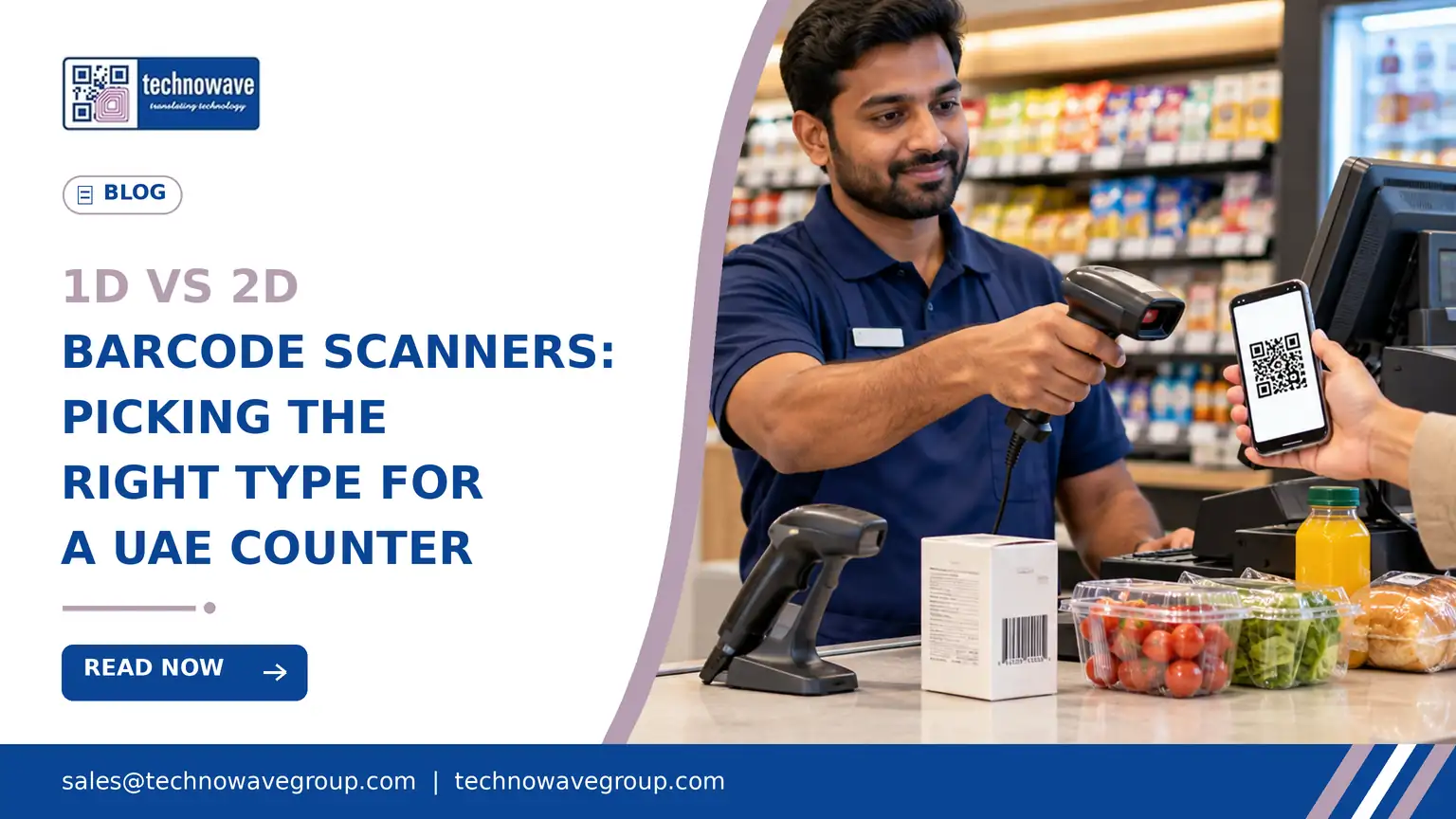
A barcode scanner is the input device that captures a printed or on-screen code and sends that data to a POS, ERP, WMS, or line-of-business application. At counter level, that means the scanner must match the actual codes your staff see every day, not the codes a vendor assumes you use. UAE buyers often discover too late that a low-cost 1D unit is fine for shelf-stocked retail labels but fails the moment a cashier needs to scan a customer QR code from a phone screen.
What 1D and 2D scanners actually change at a UAE counter
The practical difference is not just barcode shape. A 1D scanner reads linear symbologies such as EAN-13, Code 128, and Code 39. A 2D scanner reads those same 1D codes plus matrix formats such as QR Code, Data Matrix, and PDF417, which means one device can support retail items, digital coupons, mobile membership cards, warranty registrations, and serialized labels.
At a UAE sales counter, that changes what staff can process without manual intervention. Electronics stores frequently need to read manufacturer serial labels and customer QR confirmations. Pharmacies may need 2D decoding capability for product traceability workflows, and service desks increasingly scan payment, pickup, or loyalty codes from mobile displays rather than paper.
Counter performance also differs by engine type. Laser scanners are common in older 1D deployments and can be extremely fast on clean linear labels, but they cannot decode true 2D symbols. Imaging scanners, by contrast, capture a picture and decode multiple symbologies, making them better for damaged labels, glossy packaging, and smartphone screens under strong mall lighting.
| Counter requirement | 1D scanner | 2D scanner |
|---|---|---|
| Reads standard retail barcodes | Yes | Yes |
| Reads QR codes and Data Matrix | No | Yes |
| Reads from phone screens | Limited or no | Usually yes |
| Best for low-cost simple checkout | Yes | Sometimes overqualified |
| Handles damaged or low-contrast codes better | Moderate | Better |
| Future-proof for omnichannel counters | Limited | Strong |
For businesses reviewing barcode scanners or purpose-built handheld barcode scanners, the key question is straightforward: what codes appear at the counter today, and what new codes will appear within the next procurement cycle?
When 1D is enough and when 2D is the safer UAE buying decision
1D remains a rational choice in tightly controlled environments. A convenience store, back-office receiving desk, cafeteria till, or internal asset issue counter that scans only printed EAN or Code 128 labels can run very efficiently on a reliable 1D handheld. If there is no need to read from mobile screens and no serialized 2D packaging in the workflow, a basic scanner may be the most economical answer.
2D becomes the safer choice where the counter serves both products and people. Fashion and electronics retailers in the UAE increasingly process app-based promotions, e-gift vouchers, return authorisations, and loyalty IDs shown on phones. In those cases, a 1D scanner creates hidden cost: slower transactions, manual code entry, abandoned promotions, and more cashier training.
Sector-specific counter examples
Pharmacy: 2D is usually the better fit because regulated medicine workflows may involve matrix codes and traceability checks. Luxury retail: 2D helps with serial verification, after-sales service, and digital clienteling journeys. Hospitality front desks: 2D is useful for vouchers, event tickets, and guest confirmations. Internal asset counters: if labels are simple and controlled, 1D may still be sufficient, especially where the process resembles the asset-labelling approach used in asset tagging services.
Warehouse and dispatch counters deserve separate treatment. If staff scan courier labels, location labels, and shipment QR codes, 2D typically wins. If the station handles only pallet IDs or internal carton labels, 1D may remain acceptable, but buyers should avoid confusing a warehouse requirement with a customer-facing counter requirement; the latter usually evolves faster.
This is why many UAE buyers now standardise on 2D for customer-facing counters and reserve 1D only for highly predictable internal stations. That split keeps capex under control while avoiding the operational risk of under-specifying the front end.
Technical selection criteria that matter more than brochure features
What should buyers check before choosing scanner type in the UAE? Start with five technical realities: barcode symbology, scan source, decode distance, host interface, and physical duty cycle. A scanner that supports the wrong symbologies will fail regardless of brand. A scanner that reads paper but struggles with OLED phone screens will create counter delays even if it passed a bench test.
For a fixed or cashier-held counter scanner, look closely at image sensor quality, illumination, motion tolerance, and presentation mode. Presentation mode matters in high-volume counters because staff can keep both hands on merchandise while the scanner reads automatically. Decode distance matters for bulky items that cannot be lifted easily across the counter.
Questions that expose a mismatch quickly
- Will it read codes from dim or cracked phone screens? Important for loyalty and coupon use.
- Does it support USB-HID, USB-COM, RS-232, or keyboard wedge? This affects POS integration effort.
- Can it decode high-density small labels? Critical for electronics accessories, cosmetics, and pharmacy packs.
- Is the housing sealed enough for dust, spills, and frequent disinfection? Relevant for grocery, healthcare, and service desks.
- Can it be centrally configured? Useful for chain retail rollouts across multiple UAE branches.
Ruggedness is often misunderstood. A rugged barcode device is not only for warehouses. In the UAE, open-plan counters near entrances, food areas, or high-footfall mall environments can expose devices to drops, dust, cleaning chemicals, and long operating hours. If the counter runs all day, ask for actual drop ratings, trigger life, cable strain protection, and warranty terms rather than generic durability claims.
Integration should also be checked before purchase, not after delivery. If your software stack includes POS, ERP, pharmacy applications, or Android tablets, validate scanner compatibility in the live environment. Buyers needing sector-specific software context can also review scanner considerations for Tatmeen integration and compare them against their own counter process.
Security, compliance, and operational planning for UAE deployments
Barcode scanners do not usually store sensitive data for long, but they still sit inside a wider transaction environment. That means security is mainly about interface control, device management, and process design. If a scanner injects data into a POS exactly like a keyboard, your software must validate format, field length, and allowed characters so bad scans or unintended inputs do not create posting errors.
For healthcare, government, and corporate counters, compliance concerns are less about the scanner itself and more about what the scanned data triggers. Patient identifiers, visitor records, or serialized medicine events should move into authorised systems only. Buyers should ask whether configuration changes are password-protected, whether firmware updates are vendor-managed, and whether device settings can be standardised across branches.
UAE operating conditions also matter. Multilingual interfaces are common, but barcode data remains machine-readable; the larger issue is software mapping into Arabic or English POS fields correctly. Bright ambient lighting, reflective packaging, and heavy use of mobile apps at the counter all favour modern 2D imagers over legacy 1D laser units.
How long does implementation usually take? For a small site using USB scanners on an existing POS, deployment can be quick once symbologies and suffix settings are confirmed. The timeline extends when buyers need testing with custom software, tablet cradles, serial interfaces, branch imaging standards, or operator training. The fastest projects are the ones that begin with actual sample labels, real phone screens, and a live counter workflow, not a catalogue comparison alone.
Pricing, ROI, and common buying mistakes in the UAE market
What does scanner type typically cost in the UAE? Pricing varies by decode engine, brand, ruggedness, stand type, cable or cordless design, and service coverage, so a serious comparison should be made by class rather than by headline unit price. Entry-level 1D devices cost less upfront, but that saving disappears quickly if the counter later needs QR scanning, app-based promotions, or service-desk workflows that require 2D decoding.
ROI is usually operational rather than dramatic on paper. The return comes from fewer manual entries, fewer failed scans, faster cashier onboarding, and lower replacement frequency when the right housing and cable design are chosen. For chain operators, standardising on fewer scanner profiles also reduces support effort, especially when paired with a supplier that can provide rollout, repair, and configuration consistency across branches.
The most common mistake is buying by label alone: “retail scanner,” “rugged barcode,” or “anti theft scanner.” A barcode scanner is not an EAS gate and should not be specified as one. Another mistake is testing only pristine printed labels; UAE counters often deal with wrinkled packaging, glossy surfaces, faded shelf labels, and customer phone screens at odd angles.
A second major error is separating the scanner decision from the wider data-capture workflow. If you are also reviewing inventory management barcode workflows, or considering future branch upgrades through a provider such as Technowave International, specify the counter scanner as part of that larger operating model. The right next step is a live-use assessment with your actual POS software, barcode samples, and front-counter process. Technowave International can help UAE businesses compare scanner classes, validate compatibility, and deploy the right fit with local implementation and after-sales support.
FAQ: barcode scanner types UAE buyers ask before purchase
Q: What should buyers check before choosing barcode scanner types in UAE?
A: Check the exact symbologies you scan, whether codes appear on paper or phones, required interfaces to POS or ERP, scan distance, lighting conditions, and device duty cycle. If any customer-facing process involves QR or Data Matrix, a 2D scanner is usually the safer specification.
Q: How can businesses compare barcode scanner types providers?
A: Compare providers on live-demo quality, compatibility testing, local support, configuration assistance, warranty handling, spare availability, and rollout experience. A strong provider should test your real labels, phone screens, and POS workflow rather than recommending a model purely from a price list.
Q: What does barcode scanner types pricing in UAE usually depend on?
A: Pricing depends on 1D versus 2D decode capability, corded or cordless design, ruggedness, stand or presentation mode, brand tier, and support package. Integration effort can also affect total cost, especially where custom software settings, serial interfaces, or branch-wide configuration are required.
Q: How long does barcode scanner implementation usually take?
A: A basic USB scanner rollout can be completed quickly if the POS already accepts keyboard-input scanning and no custom parsing is needed. Timelines become longer when buyers need pilot testing, software mapping, chain-wide configuration control, user training, or staged deployment across multiple UAE sites.
Q: What security or compliance factors matter for barcode scanners in UAE?
A: Focus on the application environment, not only the hardware. Validate input rules in the POS or business software, control who can change scanner settings, and standardise firmware and configurations. In pharmacy, healthcare, and government workflows, ensure scanned identifiers flow only into authorised systems.
Q: Is a 2D scanner always better than a 1D scanner?
A: Not always. If your counter scans only standard printed 1D retail labels and the workflow is unlikely to change, a 1D model can be cost-effective. But if there is any chance of scanning mobile coupons, serialized labels, or QR-based customer journeys, 2D usually avoids replacement later.
If you are unsure which scanner class fits your UAE counter, start with a short on-site workflow review and sample-code test. That will settle the 1D versus 2D question far more reliably than a generic spec sheet.
Related Articles
- Barcode Scanners
- Handheld Barcode Scanners
- Rugged Barcode Scanners
- Presentation Barcode Scanners
- Wearable Barcode Scanners
- Fixed Mount Barcode Scanners
Barcode Scanner Types UAE: 1D vs 2D Guide
Compare barcode scanner types UAE buyers need for retail counters, pharmacies, and service desks. Practical 1D vs 2D selection guide.