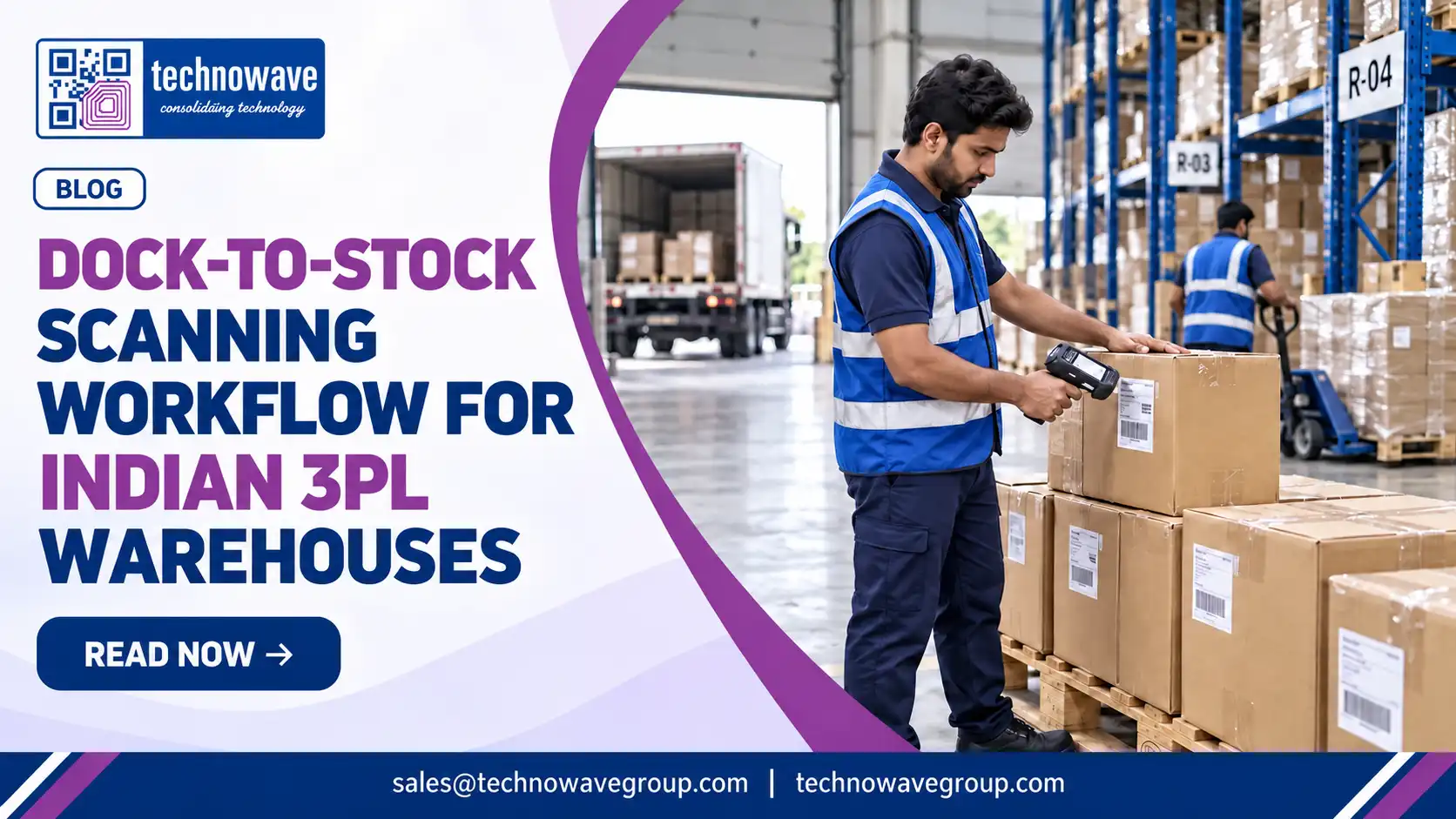
A reliable warehouse scanning workflow India for 3PL operations should start at truck arrival and end only when every pallet, carton, or inner pack is system-confirmed in its final storage location. In Indian 3PL warehouses handling mixed clients, GST-linked documentation, batch-sensitive SKUs, and high inbound variability, the goal is not just faster receiving; it is clean data at each scan point so stock becomes sellable, allocatable, and auditable immediately.
What is a dock-to-stock scanning workflow? It is the sequence of barcode or RFID capture events that validates receipt, identifies mismatches, assigns putaway, and confirms inventory into a warehouse management system. Unlike a general warehouse automation discussion, this workflow is specifically about the operational path from gate entry to bin confirmation, where most inbound errors begin.
1. Map the dock-to-stock workflow before buying devices
Indian 3PLs often run multi-client inbound with very different packing standards: one principal sends SSCC pallet labels, another sends carton-only labels, and a third still relies on supplier part numbers printed in small text. That is why the first design task is not hardware selection; it is process mapping by scan event. If the workflow is unclear, scanners only digitise bad receiving habits.
A practical dock-to-stock sequence usually includes five checkpoints: appointment or vehicle arrival, unloading and dock assignment, receipt scan against ASN or PO, exception segregation, and putaway confirmation. Each checkpoint needs a defined system status. For example, received is not the same as quality hold, and quality hold is not the same as available-to-pick stock.
For 3PL environments, ask a direct question: what should be scanned at each touchpoint? The answer should be specific. At unloading, scan pallet ID or carton ID. At verification, capture SKU, quantity, batch, serial, expiry, or MRP only if the client contract requires those attributes. At putaway, scan both the handling unit and the destination location barcode so the system records an unambiguous movement.
If your operation is evaluating a Warehouse Management System, configure inbound rules around client-specific receipt profiles rather than one standard receiving screen for all accounts. This is especially important in Indian 3PL contracts serving ecommerce, pharma-adjacent, electronics, and modern retail in the same building.
| Workflow stage | Primary scan event | Typical device | Control objective |
|---|---|---|---|
| Dock arrival | Vehicle or appointment ID | Mobile computer | Link inbound load to expected receipt |
| Unload | Pallet or carton label | Handheld scanner | Count physical handling units |
| Verification | SKU, batch, serial, expiry | 2D scanner or mobile computer | Match client-specific compliance fields |
| Exception handling | Damage or variance code | Mobile computer | Separate non-conforming stock |
| Putaway | Handling unit plus location barcode | Mobile computer | Create final stock visibility |
2. Build the scanning logic for Indian 3PL inbound complexity
The biggest inbound mistake in India is treating all receipts as simple quantity confirmation. In reality, many 3PL contracts require attribute capture that affects billing, traceability, or dispatch eligibility. Consumer goods may need batch and MRP. Electronics may need serial validation. B2B distribution may need carton hierarchy preservation for fast cross-docking. Your workflow should enforce only the data fields the client needs, not every field for every receipt.
When should you scan 1D, 2D, or RFID?
Use 1D barcode scans where labels are clean, line-item detail is basic, and speed matters more than dense data. Use 2D barcode scanning when the label contains batch, serial, or expiry in a compact format, or where print space is limited on small packs. RFID makes sense when receiving high volumes of tagged items or reusable assets, but for most Indian 3PL dock operations, barcode remains the first control layer because suppliers are more likely to comply with it.
Another practical buyer question is: should receiving be carton-based or item-based? For mixed-SKU cartons, item-based verification is often unavoidable. For uniform pallets or vendor-labelled master cartons, carton-based receiving can be much faster if the system trusts the label hierarchy and audits by exception. That design choice directly affects labour, scanner count, and dock congestion.
Device selection should match shift length, wireless coverage, and operator movement. A receiving clerk doing repeated scans at one bay has different needs from a putaway operator travelling long aisles on a reach truck. The most useful planning reference is not a brochure but the workflow itself, then the device form factor; this is why a guide on mobile computers and PDT devices is still relevant conceptually even when the market is India, because the same screen, battery, and ruggedness trade-offs apply.
3. Validation rules, exception lanes, and compliance controls
A strong warehouse scanning workflow India project succeeds because it defines what happens when data does not match. If a scanned SKU is absent from the expected receipt, the operator must not be allowed to continue casually. The system should force an exception code such as excess, short, unknown item, damaged, wrong batch, or label unreadable, and route that stock physically into a marked lane.
What security or compliance factors matter? First, role-based access is essential so users cannot backdate receipts, edit quantities after putaway, or close variances without approval. Second, time-stamped scan history is critical for client claims, especially where detention, shortages, or supplier disputes arise. Third, handheld devices should sync scan data with the host system using controlled user authentication rather than shared logins.
Indian 3PLs serving regulated or quality-sensitive sectors should also separate operational receiving from inventory release. A scan can confirm physical arrival, but quality inspection, sample hold, or documentation review may still be required before stock becomes available. That status discipline protects both client inventory accuracy and downstream dispatch performance.
How do you prevent duplicate or ghost stock?
Prevent duplicate stock by enforcing unique handling unit IDs and mandatory destination scans. Prevent ghost stock by disallowing manual location entry where possible. If the operator scans the pallet but types the bin, errors rise sharply. If both the item and location are barcode-validated, reconciliation becomes far cleaner. For related visibility and tracking concepts, the broader resource on inventory management in India is useful, even though retail and 3PL workflows differ operationally.
4. Implementation timeline and rollout planning for Indian warehouses
How long does warehouse scanning workflow implementation usually take? For a single-site 3PL inbound process, the real answer depends less on software installation and more on data readiness. If client masters, location barcodes, label formats, and receiving rules are already documented, pilot deployment moves faster. If each client uses different SKU codes and inconsistent pack labels, timeline risk shifts to mapping and exception design.
A practical rollout sequence starts with one client account, one dock cluster, and one shift. Do not start with every client and every receipt type. Pilot the workflow on a controlled inbound profile, validate scan screens, then stress-test the exception process during peak receipt windows. Most failures appear not in clean inbound but in mixed or non-compliant deliveries.
Training in Indian warehouses should be role-based and bilingual where needed. Receiving staff need fast screen prompts, supervisors need variance dashboards, and client-service teams need visibility into why a receipt is pending. The best UAT script is not a conference-room checklist; it is a live simulation using actual supplier labels, poor print quality, and damaged cartons because that reflects the real dock environment.
Buyers comparing cloud and on-premise models should ask a direct operational question: what happens if Wi-Fi drops in one receiving zone? If the site has patchy RF coverage or older buildings, offline caching and transaction re-sync matter more than abstract deployment debates. During rollout planning, also include label printers for exception tags, replacement location labels, and temporary inbound IDs, because receiving breaks down quickly when damaged labels cannot be reissued on the floor.
5. Pricing, ROI, and common mistakes in provider selection
Warehouse scanning workflow pricing India is rarely a single line item. Buyers should separate costs into four buckets: software or configuration, handhelds and scanners, wireless and label infrastructure, and support services such as integration, training, and AMC. A low entry quote often excludes barcode relabelling, client-specific workflows, or ERP integration, which are the very items that determine go-live stability.
How can businesses compare warehouse scanning workflow providers? Compare them on workflow fit, not only device brand. Ask for a receipt-to-putaway process map, sample exception screens, integration method with ERP or client portals, local support model, spare device policy, and post-go-live response commitments. In 3PL operations, after-sales support matters because one failing dock process can affect multiple principals at once.
Common mistakes include scanning only at receipt and not at putaway, using generic item masters for different clients, accepting manual quantity overrides without reason codes, and underestimating label governance. Another frequent mistake is buying rugged devices before confirming whether the main bottleneck is actually poor supplier labelling. Better labels and workflow logic often deliver more value than adding more hardware.
For teams assessing providers, it helps to review the broader capabilities of Technowave International and its warehouse automation approach, then use the contact page for a workflow consultation tied to your inbound process, client mix, and site layout. If you also need adjacent services such as tagging support, the company’s asset tagging services page gives a clear view of implementation support beyond software alone.
FAQ
Q: What should buyers check before choosing warehouse scanning workflow in India?
A: Check whether the provider can map your actual inbound flow by client account, not just install scanners. Review label standards, batch or serial capture needs, offline behaviour, putaway confirmation logic, exception handling, and support for multi-client billing or reporting.
Q: How can businesses compare warehouse scanning workflow providers?
A: Ask each provider to demonstrate the same receipt scenario: expected receipt, mismatch, damage, and putaway confirmation. Compare how much is handled by configuration versus custom coding, how quickly variances are visible, and whether local support is available after go-live.
Q: What does warehouse scanning workflow typically cost in India?
A: Cost depends on user count, number of docks, devices, label printing needs, integration scope, and whether the site needs client-specific workflows. Buyers should request a line-by-line commercial split for software, hardware, implementation, training, and annual support.
Q: How long does warehouse scanning workflow implementation usually take?
A: Simple single-client receiving can be deployed faster than a multi-client 3PL setup. The timeline is mainly driven by master data readiness, location barcode preparation, integration complexity, and the number of exception scenarios that must be tested before go-live.
Q: What security or compliance factors matter for warehouse scanning workflow in India?
A: Prioritise role-based access, audit trails for edits, user authentication on handhelds, secure data sync, and controlled release statuses for quality-hold inventory. If you serve regulated sectors, confirm that the system can preserve batch, serial, and traceability history clearly.
Q: Is RFID necessary for dock-to-stock scanning in Indian 3PL warehouses?
A: Not always. Barcode-based workflows remain the practical starting point for many 3PLs because supplier adoption is wider and implementation is simpler. RFID becomes stronger where clients already tag inventory, volumes are very high, or touchless bulk reads improve throughput.
For Indian 3PL operators, the right next step is to validate the workflow on your real inbound conditions: supplier labels, client rules, putaway paths, and exception volume. Technowave International can help design, supply, integrate, and support a dock-to-stock scanning process using barcode, RFID, mobile computers, printers, and warehouse software. Contact the team on WhatsApp or by email to review your site requirements and rollout plan.
Related Articles
- RFID & Barcode-Based Warehouse Management System for Indian Warehouses: Implementation Guide
- The Ultimate Guide to Choosing Mobile Computers and PDT Devices for UAE Warehouses
- Smart Retail Technology ROI Calculator: What Indian Businesses Can Expect from RFID, ESL & Analytics Investment
- RFID Technology for Indian Retail: Complete Implementation Guide & ROI Analysis
- Inventory Management Crisis in Indian Retail: How RFID + Smart Technology Solves the ₹50,000 Crore Problem
- Dynamic Pricing in Indian Retail: How ESL Technology Makes It Possible
Warehouse Scanning Workflow India for 3PLs
Practical guide to warehouse scanning workflow India for 3PL warehouses: dock-to-stock steps, devices, costs, rollout planning, and controls.