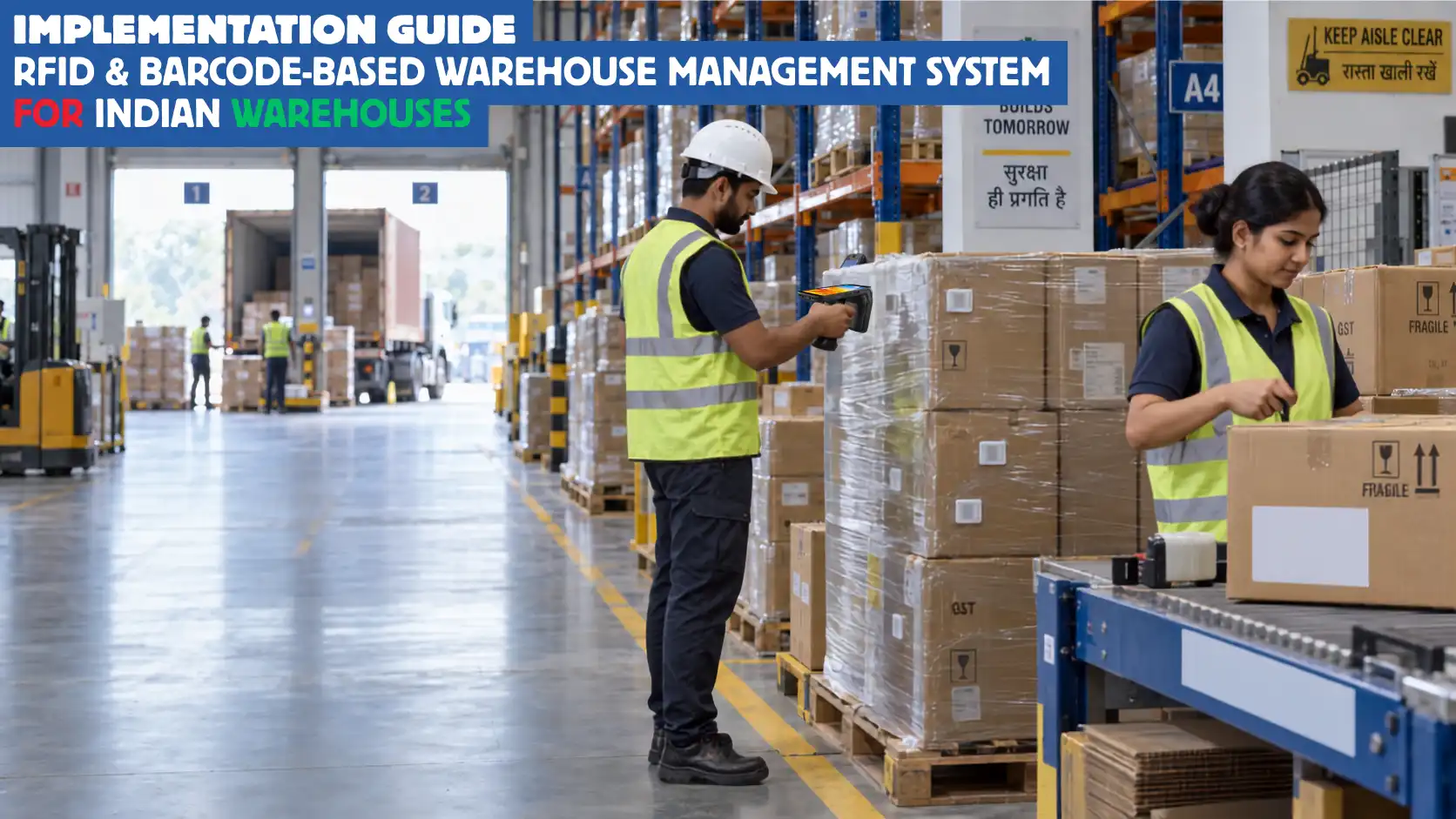
A warehouse management system India buyers can rely on is not just software for stock visibility. In Indian warehouse operations, the right WMS must connect barcode and RFID data capture with receiving, put-away, replenishment, picking, dispatch, returns, and audit control across high-SKU, high-transaction environments. If you are evaluating implementation, the key decision is not whether to automate, but which workflows should use barcode, which should use RFID, and how the system will fit your ERP, workforce, and site constraints.
What is a warehouse management system? It is the operational control layer that manages inventory location, movement, task allocation, scanning rules, and transaction accuracy inside a warehouse. When paired with handheld terminals, label printers, RFID readers, and integration logic, it becomes the execution engine for real-time inventory discipline rather than a simple stock register.
Why Indian warehouses need a different WMS implementation approach
India buyers usually face a mix of challenges that generic WMS articles overlook: multi-client 3PL handling, high rates of piece-picking for e-commerce, carton and inner-pack variance, reverse logistics, regional fulfillment models, and uneven warehouse digitization maturity across cities. A practical implementation must account for how work is actually done on the floor, not just how the process looks in a standard software demo.
Barcode remains the default identification method for most Indian warehouses because it is low-cost, easy to print, and effective for receiving, bin confirmation, picking, packing, and dispatch checks. RFID becomes valuable where manual line-by-line scanning slows operations or where non-line-of-sight reading improves throughput, such as pallet movement, cage tracking, returnable transport items, high-value inventory, and rapid cycle counting. For many sites, the best model is hybrid rather than barcode-only or RFID-only.
What should buyers ask first? Answer: Start with transaction complexity, not vendor branding. Count your inbound types, storage logic, order profiles, return flows, and exception handling. If your operation includes batch control, serial tracking, FEFO, quality hold, or cross-docking, these must be configured in the WMS from day one.
Another India-specific issue is infrastructure consistency. Warehouses outside major metros may have variable Wi-Fi quality, power interruptions, mixed device fleets, and rapid seasonal labour onboarding. That is why implementation planning should include device ruggedness, offline tolerance, label media suitability, and supervisor dashboards that reduce training dependency. A deployment built around the Warehouse Management System should be judged on floor execution discipline, not presentation slides.
Core features that matter more than a long feature list
Many buyers compare WMS products by counting modules. That is the wrong approach. The better method is to evaluate whether the system enforces the transactions that matter to your operation: scan validation at receipt, directed put-away based on location attributes, replenishment triggers, wave or batch picking, packing verification, shipment confirmation, and cycle count reconciliation. A shorter feature list with stronger process control is often operationally better than a bloated platform.
Must-have workflow controls
For Indian warehouses, the most important controls are usually these:
- GRN-linked receiving with barcode or RFID validation
- Location master by zone, rack, level, and bin
- Lot, batch, serial, and expiry tracking where required
- Task-based picking with exception prompts
- Returns handling with disposition status
- Label printing for inbound, shelf, tote, pallet, and dispatch units
How do you choose between barcode and RFID at process level? Answer: Use barcode where the operator naturally handles one unit at a time and can present the label to a scanner. Use RFID where assets or inventory move in groups, where visibility through portals or handheld bulk reads saves labour, or where items are difficult to scan individually. Buyers exploring RFID-heavy processes can also review RFID inventory management systems for Indian businesses to align technology choice with throughput goals.
Selection should also include integration depth. Ask whether the system supports ERP master sync, ASN imports, dispatch status updates, user-role control, and hardware interoperability across scanners, mobile computers, printers, and RFID readers. If your broader operation also manages equipment, cages, or IT assets, there is value in evaluating how warehouse execution can align with an asset management system instead of creating disconnected tracking databases.
| Evaluation Area | Barcode-Based WMS Fit | RFID-Enabled WMS Fit | Best Use in India |
|---|---|---|---|
| Receiving accuracy | Strong for carton and item scans | Strong for bulk reads and tagged assets | Barcode for standard SKU intake; RFID for pallets, RTIs, high-value goods |
| Cycle counting | Accurate but labour-intensive | Faster for zone sweeps and asset-rich areas | Hybrid model for mixed operations |
| Hardware cost | Lower entry cost | Higher initial tagging and reader cost | Barcode-first for most warehouses |
| Exception handling | Simple operator prompts | Needs stronger read-rule design | Barcode better for detailed item exceptions |
| Scalability | High with standard labelling discipline | High where movement volume justifies automation | RFID for targeted process bottlenecks |
Security, compliance, and system architecture decisions
Security in warehouse software is often discussed too narrowly as password control. In practice, buyers should assess three layers: transaction integrity, infrastructure security, and data governance. Transaction integrity means the WMS prevents unauthorised adjustments, records who performed each scan, and preserves a clear movement history by user, device, and timestamp. Without that, shrinkage investigations and audit trails become unreliable.
What security controls matter most? Answer: Role-based access, approval workflows for stock adjustments, device authentication, audit logs, and encrypted communication between mobile devices and the application server. If the WMS exchanges data with ERP, TMS, or e-commerce platforms, API security and field-level validation also matter because bad integration logic can create silent inventory errors.
Compliance requirements vary by sector. Pharma and healthcare warehouses may require stronger lot and expiry traceability. Electronics and high-value distribution centres may prioritise serial-level control and exception logging. Food and cold chain operators often need disciplined FIFO or FEFO movement supported by temperature or batch-related process checkpoints. According to Wikipedia’s overview of GST in India, GST replaced multiple indirect taxes with a unified framework; in warehouse operations, this has reinforced the need for cleaner documentation, location-level inventory visibility, and system-led dispatch accuracy across interstate distribution.
Architecture choices should be guided by site realities. If internet reliability is inconsistent, confirm how the application handles interrupted sessions, queued transactions, and device reconnect. If multiple warehouses share one inventory pool, ask how the WMS separates users, stock ownership, and transfer logic. Buyers wanting implementation references can review real project examples to understand how process design and data discipline affect deployment success.
Implementation timeline, floor readiness, and change management
A successful warehouse management system implementation India project usually fails or succeeds before go-live. The most common reason is poor master data: inconsistent SKU codes, duplicate unit-of-measure logic, undefined bin naming, weak label standards, and missing handling rules for damaged or returned stock. Before software configuration, clean the item master, location structure, supplier codes, and transaction exception list.
Recommended rollout sequence
- Process mapping by inbound, storage, picking, packing, dispatch, returns, and counts
- Master data preparation and bin codification
- Hardware selection for scanners, printers, mobile computers, and RFID points
- ERP and middleware integration testing
- Pilot in one zone or one transaction family
- Supervisor training, then operator training by role
- Parallel run, cutover, and post-go-live hypercare
How long does implementation take? Answer: It depends less on software installation and more on process complexity, data quality, and integration scope. A single-site barcode rollout with disciplined masters can move relatively quickly, while a multi-warehouse deployment with RFID gates, serialisation, and ERP customisation requires a longer validation cycle. Buyers should insist on a written UAT script and cutover checklist rather than broad timeline promises.
Floor readiness is equally important. Print samples should be tested for scan distance, adhesive performance, and durability under dust, abrasion, shrink-wrap, and temperature conditions. Wi-Fi surveys, charging routines for handheld devices, and spare equipment planning should be completed before operator training starts. For sector-specific automation context, Indian businesses in healthcare or retail can also compare adjacent workflows through RFID healthcare implementation guidance and Indian retail RFID implementation practices.
Pricing, ROI, and the mistakes that distort budgets
When buyers ask about warehouse management system pricing India, the right answer is that budgets are shaped by scope, not just licenses. Costs typically come from software, configuration, integrations, mobile devices, scanners, printers, RFID readers if used, labels and tags, training, AMC support, and on-site rollout effort. A low quoted license can become an expensive project if the warehouse still needs custom reports, rule changes, or hardware replacement.
What should buyers compare between providers? Answer: Compare process fit, integration method, hardware expertise, support coverage, change request discipline, and post-go-live service responsiveness. A vendor that understands both software and data capture hardware usually resolves issues faster than one that only supplies the application layer. This matters in Indian warehouses where labels, readers, network conditions, and operator behaviour all affect system accuracy.
ROI should be measured in operational terms: fewer picking errors, faster cycle counts, better dispatch confirmation, cleaner stock visibility, reduced manual reconciliation, and improved space utilisation. For RFID components, evaluate whether the gain comes from eliminating repetitive scanning, improving asset visibility, or speeding stock verification in specific zones. Avoid forcing RFID into every workflow; selective deployment often delivers stronger payback than full-site tagging.
The most common budgeting mistakes are underestimating data cleansing, ignoring label media quality, buying consumer-grade devices for industrial use, skipping supervisor training, and treating support as optional. A serious implementation partner should discuss these risks early. For Indian buyers looking for an end-to-end provider with software, barcode, RFID, integration, installation, and after-sales capability, Technowave International can help assess the right rollout model and guide the next step through consultation, WhatsApp, or email.
FAQ
Q: What should buyers check before choosing Warehouse Management System in India?
A: Check process fit first: receiving, put-away, picking, returns, cycle count, batch or serial tracking, and integration with your ERP. Then verify hardware compatibility, user roles, reporting, support capability, and whether the provider understands Indian warehouse realities such as reverse logistics, multi-location fulfillment, and mixed labour skill levels.
Q: How can businesses compare Warehouse Management System providers?
A: Ask each provider to map your real workflows rather than present generic features. Compare implementation method, UAT discipline, hardware expertise, support SLAs, integration ownership, and post-go-live service. A strong warehouse management system provider India buyers can trust should explain exception handling clearly, not just dashboard screens.
Q: What does Warehouse Management System typically cost in India?
A: Pricing varies by warehouse count, users, transactions, integrations, and whether RFID is included. Budget for software, scanners, mobile computers, printers, labels, training, and support. The most accurate way to estimate cost is to define workflows and hardware scope first, then request a structured bill of materials and implementation plan.
Q: How long does Warehouse Management System implementation usually take?
A: Timelines depend on data readiness, process complexity, and integration depth. A straightforward single-site barcode deployment can move much faster than a multi-site project with RFID gates, serial tracking, and ERP customisation. Buyers should request milestone-based planning covering configuration, testing, pilot, cutover, and hypercare support.
Q: What security or compliance factors matter for Warehouse Management System in India?
A: Focus on role-based access, audit trails, stock adjustment approvals, device authentication, secure API integration, and reliable transaction logs. Compliance needs differ by industry: pharma may require stronger batch and expiry tracking, while electronics or high-value warehousing may require serial-level traceability and tighter exception controls.
Q: Is RFID always better than barcode for warehouse management?
A: No. Barcode is usually better for controlled item-level scans at lower cost. RFID is better where goods move in groups, where non-line-of-sight reading saves time, or where frequent audits are labour-intensive. Most Indian warehouses benefit from a hybrid design that applies each technology only where it adds measurable operational value.
Related Articles
- RFID Technology for Indian Retail: Complete Implementation Guide & ROI Analysis
- On-Premise vs. Cloud-Based Warehouse Management System: 2026 Migration & TCO Guide
- How RFID Inventory Management Systems Transform Businesses in India
- RFID for Healthcare Industry in India: 2026 Implementation Guide
- Smart Retail Technology ROI Calculator: What Indian Businesses Can Expect from RFID, ESL & Analytics Investment
- The Complete Guide to Digital Transformation in Indian Retail: RFID, ESL & Smart Analytics
Warehouse Management System India Implementation Guide
Learn how to plan, select, and deploy a warehouse management system India buyers can scale with RFID and barcode workflows.