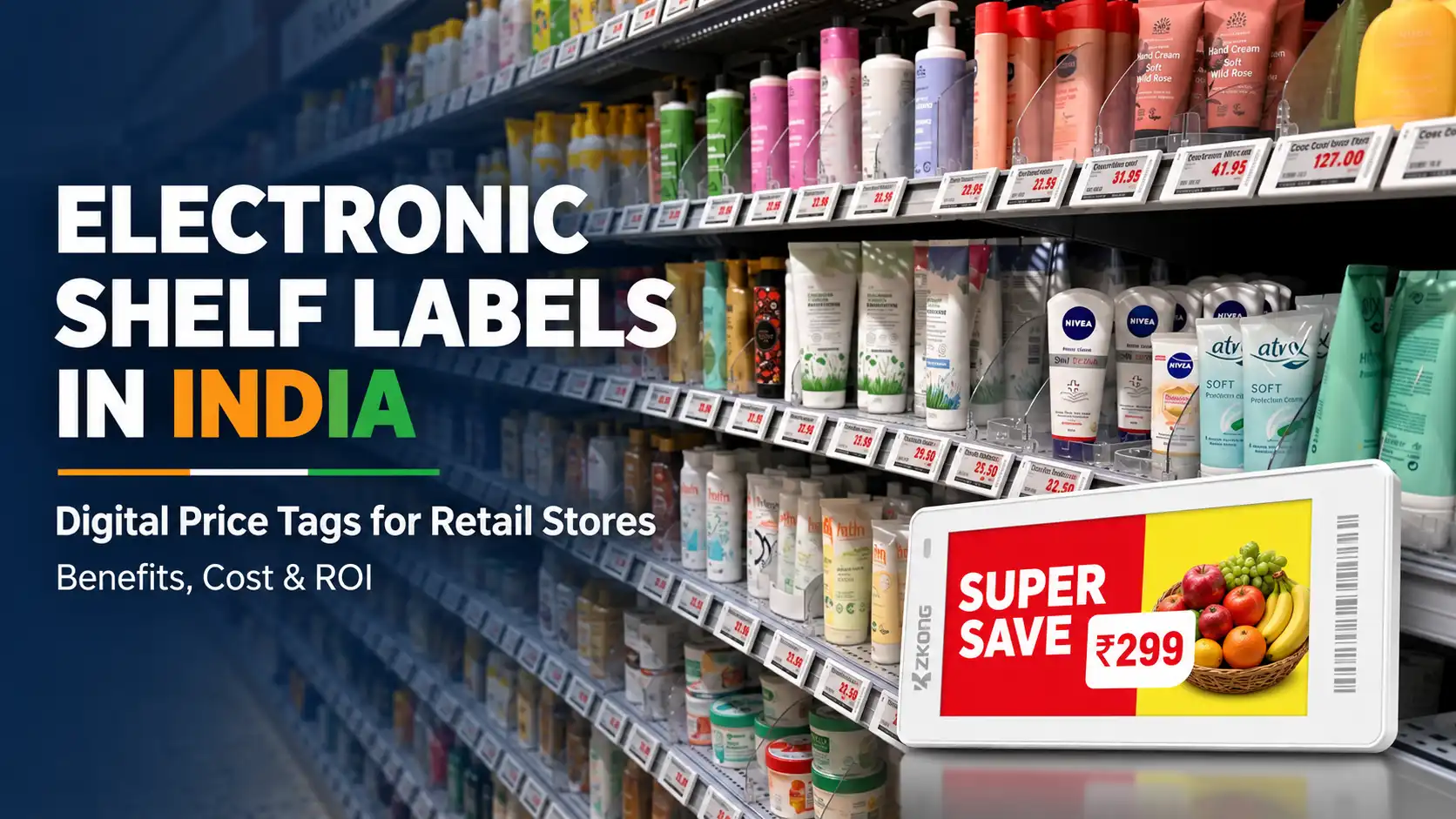
Electronic shelf labels India buyers are evaluating are no longer just a modern alternative to paper tags; they are a pricing control system for stores that need faster updates, better promotion execution, and fewer shelf-edge errors. For Indian retailers, the main question is not whether ESL works, but whether the system fits store format, POS workflow, staffing model, and rollout budget.
What are Electronic Shelf Labels? Electronic Shelf Labels are network-connected digital price tags fixed to shelves, hooks, tables, or display fixtures. They receive price, promotion, and product content updates from a central software platform, usually integrated with POS, ERP, merchandising, or inventory systems. If you are exploring Electronic Shelf Labels or broader digital shelf labels, the commercial decision depends on operational fit more than on display hardware alone.
Why electronic shelf labels matter in Indian retail operations
In India, retail pricing is operationally complex. Chains often run city-specific offers, festival campaigns, membership pricing, weekend markdowns, pack-size variations, and supplier-funded promotions across supermarkets, electronics stores, pharmacies, and lifestyle outlets. Manual paper replacement slows this process and creates mismatch risk between shelf price and billing price.
Electronic shelf labels solve a very specific problem: they synchronize the shelf edge with the system of record. When connected properly, a price revision approved in the back office can appear on the shelf without waiting for print cycles, store staff availability, or late-night tag changes. That matters in high-SKU stores where even a small error rate creates customer disputes, billing corrections, and audit issues.
Different Indian formats also need different ESL outcomes. Grocery chains usually care about rapid promotional turnover and category-wide updates. Fashion retailers often care more about graphic promotion visibility for tables, end caps, and campaign zones than frequent single-item price changes. Pharmacies value legibility, stock-location discipline, and reduced pricing confusion around regulated and fast-moving products.
Can ESL work in small and mid-sized stores, not only large chains? Yes—if the deployment scope is selective. Many Indian buyers start with promotion-heavy aisles, electronics accessories, health and beauty, premium grocery, or pilot stores before chain-wide rollout. This staged approach lets teams validate integration, battery performance, mounting standards, and store SOPs before larger investment.
Core benefits by store type: where ROI actually comes from
The biggest ROI driver is usually labour reallocation, not just paper savings. Store teams spend time printing labels, sorting them by aisle, replacing misplaced tags, checking promotional dates, and correcting billing complaints. ESL reduces this repetitive work and shifts staff time toward replenishment, merchandising, and customer-facing tasks.
For supermarkets and convenience chains, the strongest benefit is pricing agility. Multi-buy offers, hourly promotions, private-label price changes, and supplier campaigns can be scheduled centrally and executed store-wide with better consistency. In electronics retail, ESL is valuable for specification display, QR-led product discovery, warranty messaging, and synchronized accessory bundles. In pharmacy and health retail, clear display formatting helps reduce confusion where shelf information must remain readable and current.
Another under-discussed benefit in India is rollout discipline across multi-city retail. When a chain grows through franchise, regional operations, or mixed ownership structures, paper tagging quality becomes inconsistent. ESL standardizes shelf communication templates, pricing hierarchy, font size, barcode placement, and promotion logic across stores.
Which retail formats gain the fastest operational value?
Formats with frequent shelf changes, dense assortments, or staff-heavy ticketing gain value earliest. That includes supermarkets, electronics, pharmacies, liquor retail, beauty chains, and department stores. Hospitality buyers should assess Digital Buffet Tags separately, because buffet display requirements differ from shelf-edge retail tags; this distinction is explained further in this cost-benefit comparison.
Do ESL only improve customer experience? No. Customer-facing clarity matters, but buyers usually justify the project through process control: fewer manual interventions, cleaner promotion compliance, improved auditability, and less dependence on store-level printing routines. For Indian chains managing uneven staffing across locations, that operational predictability is often the real business case.
How to choose the right ESL system in India: labels, software, network, and integration
Indian buyers should evaluate ESL as a four-layer solution: display hardware, communication infrastructure, middleware/software, and business-system integration. Focusing only on label size or battery claims is a common mistake. A strong deployment depends on how reliably the base stations communicate, how pricing jobs are queued, how exceptions are reported, and how quickly stores can verify completion.
Display selection should follow merchandising use case. Small labels are suitable for standard shelf-edge price display, while larger formats suit feature bays, electronics counters, promotional islands, and end caps. Some stores need black-white-red e-paper for promotion highlights; others need HD graphic labels for richer product communication. Retailers comparing category-specific visual needs can review Smarttag HD Graphic Labels and also study merchandising ideas from fashion retail digital shelf label deployments.
Integration matters more than appearance. Buyers should ask whether the ESL platform can connect to POS, ERP, inventory, promotion engines, and store master data without manual CSV dependence. If your chain uses multiple billing systems across regions, confirm how the provider handles mapping, fallback logic, failed updates, and data normalization.
| Selection area | What to check | Why it matters in India |
|---|---|---|
| Display format | Size mix, color support, viewing angle, template flexibility | Different store formats need different shelf communication styles |
| Mounting | Rails, clips, freezer mounts, peg hooks, table stands | Fixture types vary widely across supermarkets, pharmacies, and electronics stores |
| Software | Central control, user roles, scheduling, audit logs, exception alerts | Regional teams need controlled updates without unauthorized price changes |
| Integration | POS/ERP/API support, promotion sync, barcode mapping | Prevents mismatch between shelf and billing counters |
| Store connectivity | Base station planning, signal survey, offline recovery | Physical layouts and RF conditions differ from store to store |
| Support model | Installation, training, AMC, spare handling, rollout governance | Multi-city execution needs local service discipline, not just hardware supply |
What should buyers check before choosing a provider? Ask for a live workflow demonstration: price creation, approval, update push, exception handling, and proof-of-update at shelf level. Also ask how the provider manages damaged labels, battery replacement policy, fixture compatibility, and pilot-to-rollout transition.
Security, compliance, and implementation planning for Indian chains
Security in ESL projects is often misunderstood. The real risk is not the display tag itself; it is unauthorized pricing data, uncontrolled access to templates, or weak integration between pricing source systems and store execution. Buyers should insist on role-based access, approval workflows, update logs, and the ability to trace who changed what, when, and for which store cluster.
For chains with franchise or distributed operations, governance matters. Price updates should not depend on ad hoc spreadsheets moving between merchandising, IT, and store teams. A controlled ESL environment should support central templates, scheduled campaigns, rollback options, and exception reporting when a label fails to update or is physically missing from its mapped SKU location.
How long does electronic shelf labels implementation usually take?
Implementation time depends on store count, SKU density, integration complexity, fixture variety, and whether the chain starts with a pilot. A typical sequence includes site survey, fixture assessment, label-size planning, network design, software setup, POS/ERP integration, data mapping, installation, template testing, user training, and go-live support. The fastest projects are those with clean item masters and clearly assigned ownership between retail operations and IT.
Physical planning is equally important. Indian stores may have mixed shelving, local fixture modifications, freezer sections, glass displays, and promotional furniture that require different holders and installation methods. Before rollout, buyers should define label naming standards, replacement SOPs, planogram linkage, and escalation rules for price discrepancies. For practical examples of execution quality, reviewing real ESL case studies is more useful than comparing brochures.
Electronic shelf labels pricing India: cost drivers, ROI, and common buying mistakes
What does electronic shelf labels pricing India usually depend on? Pricing is driven by label quantity, screen size mix, color capability, mounting accessories, communication infrastructure, software licensing, integration scope, installation effort, and after-sales support. A pilot with basic shelf labels is priced very differently from a chain rollout that includes larger promotional displays, central management software, and custom POS integration.
ROI should be calculated at store-process level, not as a generic technology upgrade. Buyers should model labour hours spent on printing and replacing labels, frequency of promotion changes, shelf-billing mismatch resolution effort, markdown execution delay, and the operational value of faster campaign deployment. If your stores run frequent offers, seasonal campaigns, or centralized pricing changes, the business case usually becomes much clearer than it does in low-change specialty formats.
Common mistakes in India include overbuying large labels, underestimating mounting complexity, ignoring item-master cleanup, and selecting a vendor based only on hardware quotation. Another mistake is piloting in the wrong store. A low-complexity showroom may look successful but reveal little about supermarket-style volume, pharmacy compliance discipline, or festival-period promotional pressure.
The better approach is phased adoption: choose one representative store, define measurable operational goals, validate integration, document SOPs, then roll out by store archetype. In the closing decision stage, buyers should compare provider capability in hardware, software, installation, and support—not just tag price. For businesses evaluating an experienced Technowave International team with proven implementation capability, it is worth reviewing their digital price label case study and requesting a solution discussion tailored to Indian retail workflows. You can contact the team via WhatsApp or email for a pilot assessment, integration review, or rollout plan.
FAQ: Electronic Shelf Labels in India
Q: What should buyers check before choosing Electronic Shelf Labels in India?
A: Check four areas: store use case, integration capability, mounting compatibility, and support coverage. Ask the provider to demonstrate how prices are created, approved, pushed, and verified. Also review battery policy, exception reporting, damaged-label replacement, and how the system handles promotions across different store formats.
Q: How can businesses compare Electronic Shelf Labels providers?
A: Compare providers on end-to-end delivery, not hardware alone. Evaluate label quality, software usability, POS or ERP integration experience, installation capability, rollout governance, and after-sales support. A strong provider should explain store survey method, project ownership, escalation process, and how they manage pilots, training, and change control.
Q: What does Electronic Shelf Labels typically cost in India?
A: There is no single market price because cost depends on label count, sizes, communication infrastructure, software, accessories, integration, and services. Buyers should request a structured bill of scope separating hardware, software, installation, integration, and support so pilot costs and full-rollout costs are not mixed together.
Q: How long does Electronic Shelf Labels implementation usually take?
A: Timelines vary by store count and system complexity. A pilot is usually faster when item masters are clean and fixture types are known. The longest delays usually come from integration questions, inconsistent product data, and late decisions on mounts, templates, or operational ownership between merchandising and IT teams.
Q: What security or compliance factors matter for Electronic Shelf Labels in India?
A: The key factors are access control, approval workflows, audit logs, integration security, and update traceability. Retailers should know who can change prices, who approves promotions, and how failed updates are reported. For chains with distributed operations, governance is essential to prevent local workarounds and pricing inconsistency.
Q: Are Electronic Shelf Labels suitable for hospitality or buffet applications in India?
A: Yes, but buyers should not treat buffet tags and retail shelf labels as the same project. Hospitality environments need different content layouts, stands, and update workflows. If the requirement is food display, allergen visibility, or buffet presentation, a purpose-built digital buffet tag setup is usually the better option.
Related Articles
- Electronic Shelf Labels vs Paper Price Tags: What Indian Retailers Are Losing Every Day
- Digital Buffet Tags vs. Traditional Paper Labels: Cost-Benefit Analysis for Event Caterers
- How Dynamic Pricing via ESL Solutions Can Drive Sales in UAE Electronics Stores
- Electronic Shelf Labels for Electronics Stores in UAE
- 5 Key Benefits of Implementing Digital Shelf Labels in Fashion Retail
- Top 10 Reasons to Upgrade to Digital Buffet Food Tags with Electronic Shelf Labels
Electronic Shelf Labels India: Benefits, Cost & ROI
Electronic shelf labels India guide for retailers: benefits, pricing factors, implementation steps, and ROI considerations for store rollouts.