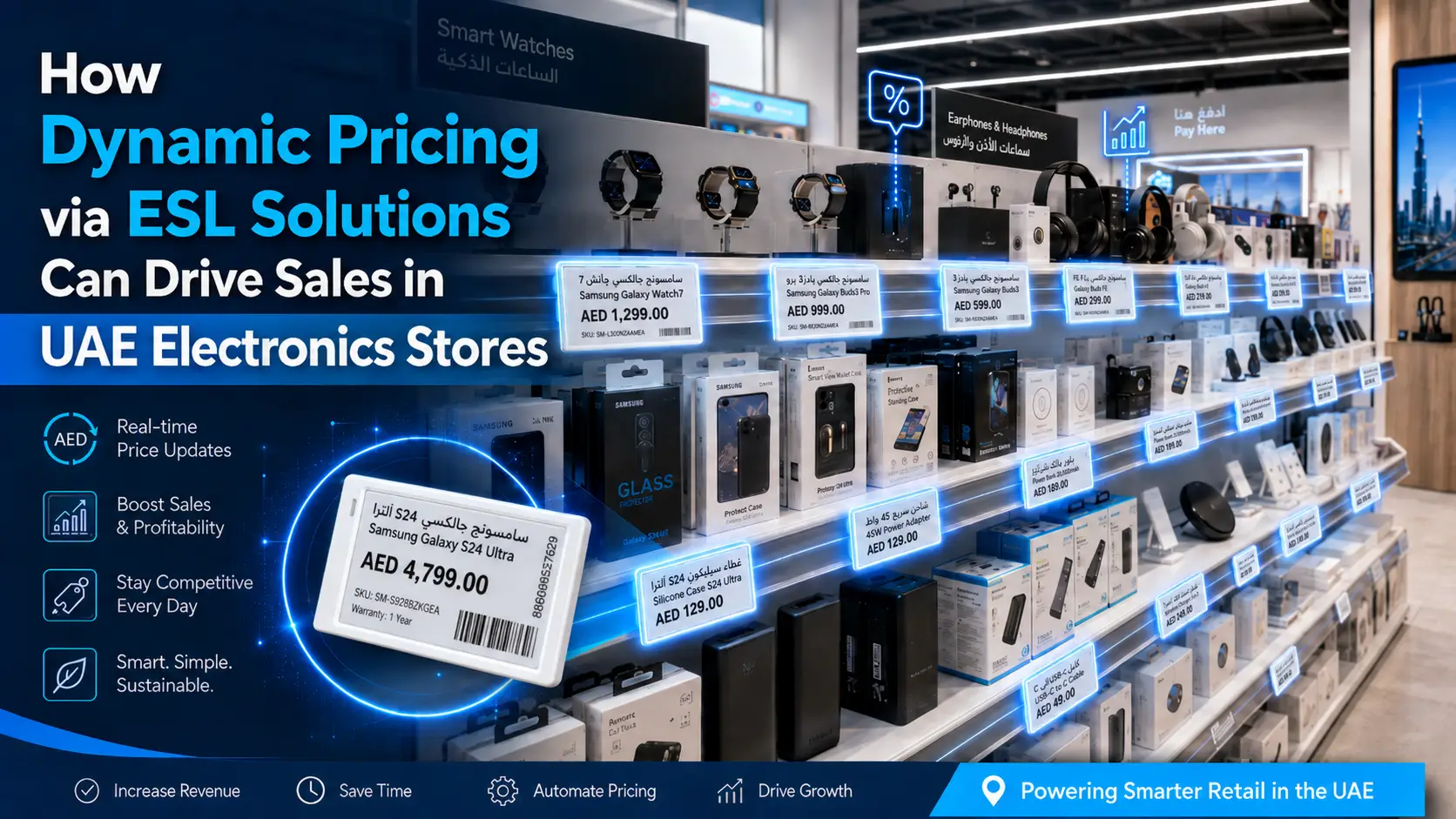
Electronic shelf labels help UAE electronics retailers change prices instantly, reduce shelf-to-POS mismatches, and respond faster to online competition. In a category where smartphone launches, accessory bundles, and festival promotions change weekly, sometimes hourly, electronic shelf labels give store teams a controlled way to execute dynamic pricing without sending staff down every aisle with printed tickets.
For electronics chains in Dubai, Abu Dhabi, Sharjah, and the wider UAE, the commercial value is not just labor reduction. It is faster promotional execution, cleaner technical product presentation, better compliance with displayed-price expectations, and the ability to defend margin while matching market prices selectively.
Why dynamic pricing matters more in electronics than in most retail categories
Consumer electronics pricing in the UAE is unusually volatile because demand is shaped by global product launches, distributor rebates, exchange-rate effects, and high-visibility sales periods such as Ramadan, Dubai Shopping Festival, and Gitex. According to Statista, the UAE consumer electronics market is projected to generate more than USD 9.1 billion in revenue by 2028. That scale increases pricing pressure for physical stores competing against marketplaces and brand-owned online channels.
The real operational problem is not deciding a new price; it is updating that price accurately across every shelf edge, promotional endcap, demo table, and branch. In electronics retail, a single category refresh can affect phones, wearables, cables, chargers, TVs, laptops, gaming accessories, and service plans at once. Manual ticket replacement creates delay, inconsistency, and a poor customer interaction when the shelf price differs from the POS price.
Showrooming makes this issue more urgent. According to PwC Middle East Consumer Insights, more than 67% of GCC consumers research online while inside a physical store. When a shopper compares your shelf tag against a live marketplace listing, pricing latency becomes a sales risk, not just an admin issue.
That is why dynamic pricing in electronics is fundamentally a response-speed problem. The retailers that win are not the ones discounting everything; they are the ones adjusting the right SKUs, at the right branches, for the right duration, while keeping the store floor accurate and credible.
What electronic shelf labels are and how they work in an electronics store
Electronic shelf labels are low-power digital displays mounted at shelf edge, peg hooks, tables, and promotional fixtures. Each label is assigned to a SKU and receives updates from a central platform through a wireless base station network. In practice, that means your merchandise team changes a price or message once in the retail system, and the display updates across the relevant locations automatically.
For electronics, the display requirement is more complex than a simple price card. A label may need to show current price, previous price, promotion badge, storage capacity, color variant, energy rating, warranty period, installment information, barcode, and a QR code linking to detailed specifications or product reviews. High-resolution graphic ESLs are designed for exactly this use case, which is why they suit premium device showrooms better than paper labels.
If your team is asking, How do electronic shelf labels work in electronics stores? The answer is straightforward: the POS or ERP remains the system of record, the ESL middleware maps SKU data to the label template, and the wireless network pushes updates to the label. A store can also use different templates by zone, such as one format for smartphone counters and another for large home appliances.
Retailers evaluating the category should review actual deployment examples, not just generic vendor brochures. This is where content such as Electronic Shelf Labels for Electronics Stores in UAE and the comparison in Electronic Shelf Labels vs Paper Price Tags: What Indian Retailers Are Losing Every Day can help procurement and IT teams frame the business case correctly for high-value electronics environments.
How ESL supports real-time dynamic pricing, promotion control, and margin protection
Dynamic pricing with ESL is most effective when it is rule-driven rather than ad hoc. Retailers can trigger updates from ERP or pricing software based on category, branch, stock age, supplier funding, or event calendar. That allows the business to lower prices on older smartphone models, bundle slow-moving accessories with best sellers, or run branch-specific promotions in response to nearby competitor activity.
One practical buyer question is: Can ESL integrate with our POS and ERP systems in the UAE? Yes, provided the deployment includes SKU mapping, template configuration, API or file-based data exchange, and exception handling. The integration model normally follows four steps:
- Price, promotion, and product attributes originate in POS, ERP, or merchandising software.
- ESL middleware validates the data and assigns the correct display template.
- Base stations transmit the update to labels in the target branch or zone.
- Confirmation logs show which labels updated successfully and which require attention.
This process matters because electronics retailers often need timed campaigns. A flash sale on earbuds from 6 pm to 9 pm, an Abu Dhabi-only TV promotion, or a DSF installment-plan message can all be scheduled centrally. According to Zkong, retailers using automated ESL platforms report up to an 80% reduction in labor associated with manual price labeling and a near-100% reduction in shelf-to-POS pricing errors. Those outcomes are particularly relevant where stores run dense assortments with frequent price changes.
Dynamic pricing use cases that fit UAE electronics retail
Three use cases stand out. First, price matching against e-commerce on selected hero SKUs without reprinting labels across the store. Second, timed seasonal promotions during DSF, Ramadan, Back to School, or Gitex. Third, inventory-led markdowns on overstocked accessories or end-of-life models while protecting margin on newly launched devices.
How dynamic pricing via ESL can directly improve sales conversion
Dynamic pricing drives sales when it removes hesitation at the shelf and lets the store present a stronger offer at the exact moment of purchase. In electronics, the shopper is often deciding between near-identical alternatives: 128 GB versus 256 GB, one headphone brand versus another, cash price versus installment plan. A static paper tag cannot adapt to that decision context quickly enough.
The first sales impact is competitive relevance. If a customer standing in a Dubai mall compares your price online, the ability to adjust selected labels quickly can recover deals that would otherwise be lost to marketplaces. The second is promotional clarity: graphic labels can show limited-time offers, bundled savings, warranty inclusions, or finance terms in a structured format that sales staff do not have to explain from scratch.
The third impact is confidence. Electronics shoppers care about specification accuracy because minor differences affect buying decisions. When the shelf label reliably shows the correct model, memory size, feature icons, and QR-linked details, the customer is less likely to defer the purchase. That is especially useful for self-guided browsing on accessories, smart-home devices, and laptop comparison tables.
| Store scenario | Paper labels | Electronic shelf labels |
|---|---|---|
| New smartphone launch | Manual relabeling across variants and accessories | Central update of price, specs, launch badge, and QR code |
| Weekend flash promotion | Requires staff printing and replacement before opening | Timed start and stop across selected branches |
| Competitor price response | Slow, inconsistent, hard to audit | Fast branch-level adjustment with update logs |
| Accessory bundle messaging | Often handled by separate signage | Can appear directly on shelf labels or promo templates |
| Premium showroom presentation | Curling paper, mixed formats, outdated tags | Uniform digital display with cleaner brand presentation |
For chains exploring broader store modernization, ESL should be viewed as one layer of a connected in-store stack alongside Electronic Shelf Labels FAQs, price verification tools, and item visibility systems. In electronics environments with large assortments, that stack often expands into price-check and inventory workflows.
Operational benefits beyond sales: accuracy, compliance, rollout, and evaluation criteria
Sales is the visible outcome, but many electronics retailers approve ESL projects because of operational control. Price accuracy is the first benefit. UAE retailers are expected to display correct product prices clearly, and consumer-facing disputes over shelf versus billed price can create friction that is avoidable with better synchronization. Retailers should review the guidance published by Dubai Consumer Protection when assessing pricing governance.
The second benefit is staff redeployment. Instead of spending peak trading hours replacing paper labels, store teams can focus on assisted selling, warranty upsell, click-and-collect handling, and merchandising checks. In electronics retail, that reallocation matters because the highest-margin interactions often require human consultation rather than back-office label work.
The third benefit is multi-branch consistency. A retailer with stores in Dubai, Abu Dhabi, Sharjah, Ajman, or Ras Al Khaimah needs branch-level control with centralized oversight. Good ESL architecture supports zone-based updates, audit logs, user permissions, and rollback capability if a pricing file is incorrect. That is essential during heavy promotional calendars when errors can spread quickly.
When comparing suppliers, decision-makers should evaluate: display readability under showroom lighting, battery life under frequent updates, ERP and POS integration capability, Arabic and English template support, branch rollout methodology, and local after-sales support. They should also consider how ESL fits with adjacent retail systems such as RFID barcode solutions for inventory accuracy and in-store product traceability. For retailers that want a full retail automation layer, price verification points and Technowave International can also align ESL with broader store processes, including Electronic Shelf Labels deployments and customer-facing device lookup workflows.
For UAE electronics retailers ready to move from manual shelf pricing to centrally controlled execution, Technowave International brings the practical capabilities that matter: ESL supply, installation, POS and ERP integration, rollout support, and local after-sales service across the region. The right project starts with a site survey, label-format design, and integration review so the commercial promise of dynamic pricing translates into daily store performance.
FAQ
Q: How do electronic shelf labels work in electronics stores?
A: Each label is linked to a SKU and updated from a central software platform through wireless base stations. In electronics stores, labels can show price, technical specifications, warranty information, barcodes, and QR codes, allowing the shelf display to stay synchronized with the POS or ERP without manual ticket replacement.
Q: Can ESL solutions integrate with POS and ERP systems in the UAE?
A: Yes. Most serious ESL projects use API-based or file-based integration with POS, ERP, or merchandising systems. The key requirements are clean SKU masters, promotion rules, template mapping, and update monitoring so that price and product data move accurately from the source system to the shelf edge.
Q: How does dynamic pricing using ESL help increase sales?
A: It helps stores react faster to market prices, launch time-bound promotions, and present clearer offers at the shelf. In electronics retail, that can improve conversion on comparison purchases such as smartphones, accessories, and appliances where customers often check online alternatives before committing in store.
Q: Are electronic shelf labels suitable for multi-branch retail chains in Dubai and Abu Dhabi?
A: Yes. ESL platforms are well suited to multi-branch chains because pricing, templates, and campaigns can be controlled centrally while still allowing branch-level targeting. That is valuable for retailers running regional promotions, mall-specific offers, or selective markdowns based on stock levels and local competition.
Q: What should electronics retailers consider before implementing ESL solutions?
A: Evaluate integration readiness, display type, battery performance, Arabic and English support, mounting options, branch rollout plan, and local support capability. Also define which workflows the system must support from day one: dynamic pricing, specification display, promotional scheduling, QR content, or compliance-focused price synchronization.
Q: What is the typical ROI timeline for an electronics retailer moving from paper labels to ESL?
A: ROI depends on store count, update frequency, labor cost, and promotion intensity, so it should be modeled case by case. Electronics chains usually justify ESL through a combination of faster campaign execution, fewer pricing disputes, reduced manual relabeling, and better conversion on high-traffic promotional periods.
Related Articles
- Electronic Shelf Labels for Electronics Stores in UAE
- Electronic Shelf Labels for Retail Electronics in UAE: Transforming the Shopping Experience
- Dynamic Pricing in Indian Retail: How ESL Technology Makes It Possible
- Electronic Shelf Labels (ESL) in India: Revolutionizing Retail Pricing & Customer Experience
- Cost-Benefit Analysis of Electronic Shelf Labels: Is It Worth the Investment in 2026?
- Enhancing Customer Experience with Electronic Shelf Labels: Insights and Case Studies from 2026
Electronic Shelf Labels for UAE Electronics Stores
See how electronic shelf labels help UAE electronics stores use dynamic pricing to improve sales, accuracy, promotions, and compliance.