
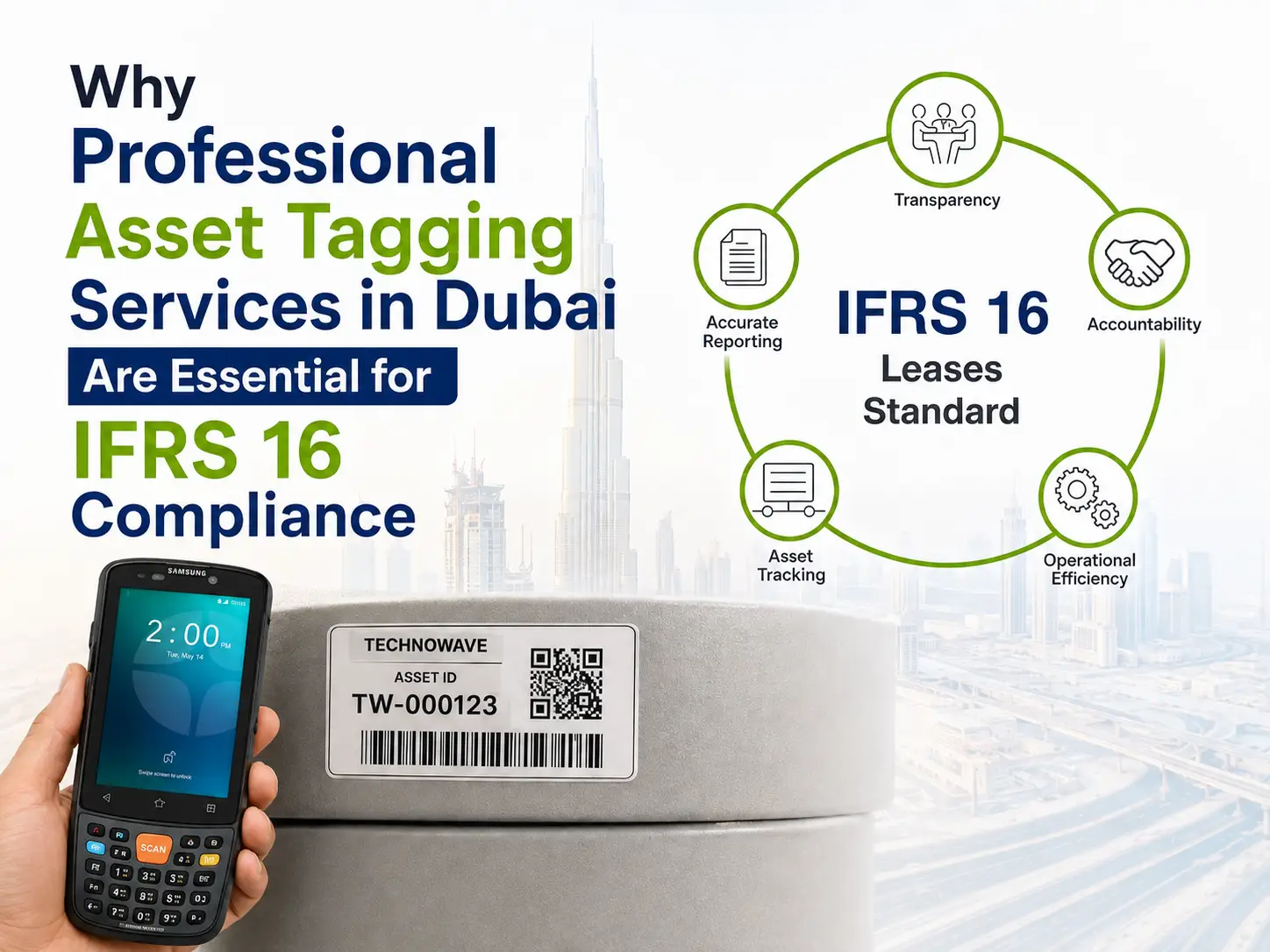
Asset tagging services in Dubai are essential for IFRS 16 compliance because finance teams cannot defend a lease asset register if the physical assets behind it cannot be identified, verified, and reconciled during audit. For UAE businesses with leased equipment, vehicles, IT assets, fit-out items, or warehouse infrastructure, professional tagging creates the physical evidence layer that connects the right-of-use asset in the ledger to a real asset on the ground.
In practical terms, professional tagging means assigning a unique identifier, applying a durable barcode or RFID label, capturing serial number and location data, and mapping that record into a digital register such as an fixed asset management system UAE teams can use for reporting and audits. According to the IFRS Foundation, IFRS 16 requires lessees to recognize most leases on the balance sheet as right-of-use assets and lease liabilities, which makes physical verification far more important than it was under older practice.
What IFRS 16 Means for Asset-Heavy Businesses in Dubai
IFRS 16 changed lease accounting from a finance-only exercise into an operations-and-finance data discipline. If your Dubai business uses leased forklifts, office equipment, warehouse racking, manufacturing devices, retail fixtures, or IT hardware, your reporting accuracy depends on whether each leased item can be located and matched to the lease schedule. A spreadsheet with vague descriptions such as “office equipment” or “warehouse assets” is not enough during review.
A simple definition helps here: asset tagging is the process of giving each physical asset a unique, scannable identity tied to a digital record. For IFRS 16 asset tracking Dubai teams, that identity supports existence checks, asset condition reviews, custodian allocation, branch-level verification, and easier reconciliation between finance, procurement, and facilities records. This is especially relevant in Dubai, where many groups operate across head office, free zone, warehouse, retail, and project sites.
The compliance risk is not theoretical. According to the IFRS Foundation, more than 85% of global lease liabilities were previously off balance sheet under IAS 17. That scale explains why IFRS 16 implementation exposed weaknesses in asset registers, ownership records, and lease master data across many organizations.
For Dubai companies, the key takeaway is direct: IFRS 16 reporting is only as reliable as the asset identification process behind it. Businesses that treat leased asset verification as a one-time finance exercise often struggle later with renewals, impairment review, relocation tracking, and annual external audit testing.
Why Accurate Physical Asset Identification Matters Under IFRS 16
Finance teams often ask a direct question: How does physical asset tagging help with IFRS 16 lease audits? The answer is that it provides traceability. When an auditor selects a sample from the lease register, the business must show that the asset exists, where it is, who uses it, and whether the description in the register matches the item physically deployed. Without a visible tag and a standardized data capture process, that verification becomes slow and inconsistent.
Accurate identification also improves depreciation logic for right-of-use assets tied to branches, departments, and practical use locations. A professional tagging exercise records data fields such as serial number, model, asset class, cost center, custodian, floor, room, GPS-relevant site reference, and operational status. These fields make the digital registry more than an accounting list; they make it operationally usable.
Poor tracking creates measurable implementation friction. According to PwC Middle East, inadequate asset tracking and weak inventory control can account for up to 30% of compliance failures and audit delays during first-time IFRS 16 implementations. That aligns with what multi-site organizations in Dubai see in practice: duplicates, missing serial numbers, inconsistent branch naming, and unclear lease-versus-owned classification.
For businesses that want stronger controls, physical verification should be paired with standardized label production. Durable tag materials, correct barcode symbology, and readable print quality matter, especially in industrial, logistics, and outdoor conditions. This is where asset tagging services and proper barcode labels and asset tag printing workflows become a compliance tool, not just an inventory convenience.
What Professional Asset Tagging Services in Dubai Typically Include
Not all fixed asset tagging Dubai projects are the same. A proper engagement usually starts with data normalization before any label is printed. That means reviewing the asset register, removing duplicate entries, defining tag format, confirming mandatory data fields, and separating owned assets from leased or right-of-use assets. If this preparation is skipped, the project produces tags but not a clean compliance record.
Field execution then covers on-site verification, asset identification, tag application, and data capture using handheld devices. Teams record the asset description, manufacturer, serial number, branch, room, custodian, and condition. For lease-related assets, they may also capture lease reference, contract ID, supplier, and useful-life notes needed by finance and operations teams.
Professional providers also define the right tag technology for each environment. Typical options include:
- Polyester barcode tags for offices, schools, clinics, and light-use indoor assets.
- Metalized or tamper-evident labels for higher-value laptops, networking devices, and mobile equipment.
- RFID labels or hard tags for faster audits, non-line-of-sight scanning, and multi-asset verification in stores, warehouses, and industrial zones.
The final deliverable should be a structured register export ready for ERP or asset software integration. If the project stops at spreadsheets, the compliance value is limited. Better outcomes come when tagging feeds directly into an auditable platform such as an asset management system or an ERP workflow. Businesses comparing delivery models should also review the operational trade-offs in in-house tagging vs. professional asset tagging service before deciding.
How Asset Tagging Improves Audit Readiness and ERP Integration
Audit readiness improves when the physical asset register can be tested quickly and consistently. During external review, auditors typically sample assets from the register and ask the business to prove existence, location, and linkage to financial records. A tagged environment lets staff scan the item, pull the record, and show the corresponding branch, custodian, and lease reference without manual searching.
That same control structure reduces internal disputes between finance, IT, facilities, and procurement. If a tagged printer is moved from Dubai head office to a Jebel Ali warehouse, the movement can be logged instead of being discovered months later during financial close. For multi-location groups, this is the difference between a live asset register and a stale one.
Barcode vs RFID for Right-of-Use Asset Verification
| Criteria | Barcode asset tagging Dubai | RFID asset tagging services Dubai |
|---|---|---|
| Read method | Line-of-sight scan, one item at a time | Non-line-of-sight reading, multiple assets in one pass |
| Best use case | Offices, schools, clinics, controlled environments | Warehouses, retail backrooms, dense asset rooms, faster audits |
| Tag cost | Lower initial media cost | Higher tag cost, stronger automation value |
| Audit speed | Good for smaller volumes | Better for large-scale verification rounds |
| Data capture discipline | Highly dependent on manual scan sequence | Supports bulk verification and exception reporting |
Can tagging integrate with existing systems? Yes, if the provider structures the data properly. Professional projects typically map tag IDs into SAP, Oracle, or specialized platforms, including easyTRACK-style fixed asset management workflows. Where faster verification is required, businesses may also pair the register with RFID asset tracking solutions UAE to reduce manual counting effort.
For organizations preparing for first-time tagging, standardization before deployment is critical. A useful starting point is defining one naming convention, one location hierarchy, and one ownership status logic before field teams begin. That preparation is explained well in how to standardize your fixed asset register before hiring an asset tagging service.
Common Compliance Challenges in Dubai and What to Look for in a Provider
Multi-branch organizations in Dubai usually face the same four compliance obstacles: incomplete master data, physically unmarked assets, branch relocations that were never updated in the register, and labels that fail in heat, cleaning, or industrial handling conditions. These issues affect retailers, hospitality groups, healthcare providers, logistics operators, schools, and corporate offices alike. The more locations involved, the more important process discipline becomes.
Another common problem is treating tagging as a one-off event instead of an ongoing control. Leased assets are added, transferred, renewed, returned, or retired throughout the year. If the tagging program is not supported by periodic verification and maintenance, the IFRS 16 register drifts away from reality. That is why service continuity matters almost as much as the initial survey.
When evaluating an asset tagging company in Dubai, buyers should check for five capabilities:
- Field execution experience across offices, warehouses, retail, and industrial sites.
- Material knowledge to select tags suitable for UAE heat, abrasion, chemicals, and cleaning routines.
- Data integration ability for ERP, asset software, and import templates.
- Audit-focused reporting with exception lists, missing assets, duplicates, and branch-level summaries.
- Post-project support for re-tagging, annual verification, handheld devices, and software upkeep.
A credible provider should also be able to show evidence of delivery quality. One relevant example is this case study on a turnkey asset tagging service that reduced audit drift for a multi-branch corporation. Ongoing support is equally important, especially when scanners, printers, or mobile terminals are part of the control process, so buyers should also assess available AMC and local technical support for Auto ID systems.
FAQ
Q: What are asset tagging services and how do they help with IFRS 16 compliance?
A: Asset tagging services identify, label, and register physical assets using barcode or RFID tags linked to a digital asset database. For IFRS 16, this helps businesses prove asset existence, location, serial details, and lease linkage during audit, making the right-of-use register more accurate and defensible.
Q: Why is physical asset tagging important for leased asset tracking in Dubai?
A: Dubai businesses often operate across multiple offices, warehouses, stores, and project sites. Physical tagging creates a verifiable connection between the leased asset on the balance sheet and the actual item in use, reducing confusion caused by relocations, duplicate records, and incomplete asset descriptions.
Q: Should businesses use barcode or RFID asset tags for fixed asset audits?
A: Barcode tags are suitable for controlled environments and moderate asset volumes where line-of-sight scanning is practical. RFID is better when faster audits, bulk verification, and non-line-of-sight reading are needed, especially in warehouses, storage rooms, retail back areas, and high-density asset environments.
Q: How often should companies conduct asset verification for compliance purposes?
A: At minimum, businesses should perform scheduled physical verification annually to support financial reporting and audit readiness. Higher-risk environments, multi-location operations, and frequently moved assets often benefit from quarterly or event-based checks, especially after branch moves, renewals, or major procurement cycles.
Q: Can asset tagging services be integrated with fixed asset management software?
A: Yes. A professional provider should deliver structured tag data that can be imported into ERP platforms or specialized asset systems. Integration works best when the project includes standardized asset classes, location codes, custodian fields, and unique tag IDs that match the organization’s reporting model.
Q: What type of asset tags are durable enough for industrial and warehouse environments in the UAE?
A: Industrial environments usually require tougher materials than standard office labels. Common choices include metalized polyester, tamper-evident labels, chemical-resistant tags, or hard RFID tags, selected according to surface type, heat exposure, cleaning process, abrasion risk, and whether the asset is indoor, outdoor, or mobile.
For Dubai organizations that need IFRS 16-ready asset visibility rather than just labels on equipment, Technowave International combines on-site tagging, barcode and RFID expertise, software alignment, and local support. If you are reviewing leased assets across multiple branches, warehouses, retail stores, or office facilities, engage the team for a structured assessment of your tagging scope, audit requirements, and system integration path.
Related Articles
- 7 Mistakes to Avoid When Hiring Asset Tagging Services in Dubai
- asset tagging and asset management services in abu dhabi
- In-House Tagging vs. Professional Asset Tagging Service: Cost, Speed, and Accuracy Analysis
- Best asset management software in Dubai (UAE)
- Best RFID asset management system Dubai (UAE)
- How to Standardize Your Fixed Asset Register Before Hiring an Asset Tagging Service
Asset Tagging Services in Dubai for IFRS 16
Learn why asset tagging services in Dubai are essential for IFRS 16 compliance, audit readiness, and accurate fixed asset tracking.