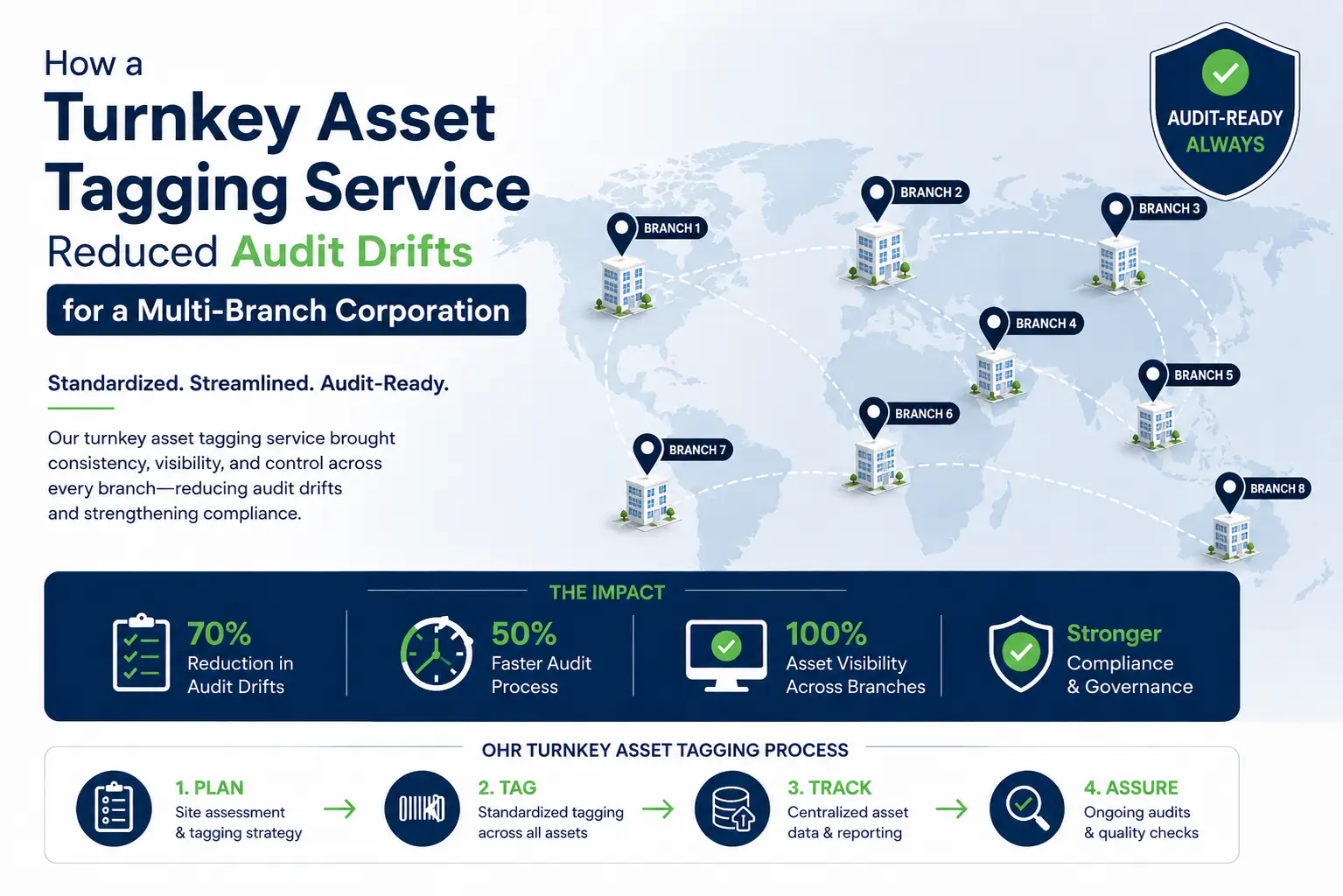
A turnkey asset tagging service reduces audit drift by standardizing how assets are identified, tagged, recorded, verified, and reconciled across every branch. In this case-study style guide, you will see the exact rollout model a multi-branch corporation used to bring scattered records under control and make future audits faster, cleaner, and more defensible.
What is an asset tagging service? It is a structured service that assigns a unique identity to each fixed asset using barcode or RFID tags, captures the right asset data in software, and validates that data through branch-level physical verification. When delivered as a turnkey project, the provider handles tag selection, data preparation, on-site tagging, software setup, reconciliation logic, and support.
This article focuses on the real buyer problem behind many search queries such as asset tagging company, asset tagging services in Dubai, and asset management software deployments: not simply placing labels on items, but creating a repeatable control process that finance, IT, operations, and facility teams can all trust. The outcome is not cosmetic labeling; it is a stronger asset register.
Why Audit Drift Becomes a Serious Problem in Multi-Branch Organizations
Audit drift happens when the physical reality of assets slowly diverges from the fixed asset register. In multi-branch environments, that drift typically starts with branch-by-branch variations in naming conventions, missing serial numbers, undocumented transfers, and inconsistent capitalization rules. Over time, even a disciplined finance team ends up reconciling exceptions instead of managing a reliable baseline.
The problem is amplified when different departments touch the same asset lifecycle. IT may deploy laptops, networking equipment, and tablets; facilities may move furniture or UPS units; operations may reassign handheld devices or printers between sites. If each team records changes differently, the register no longer reflects location, custodian, condition, or status with enough certainty for audit purposes.
Manual spreadsheets make this worse because they rarely enforce field validation, branch hierarchies, or change history. A branch may list an asset by model name, another by internal code, and another by serial number alone. During annual verification, auditors then spend time proving identity before they can even confirm existence.
Buyer question: How does asset tagging reduce audit drift across multiple branches? It creates one controlled identification method for every asset, one capture template for required fields, and one verification workflow for future audits. That standardization is the real value behind projects built on asset tagging services, especially where branches have grown through expansion rather than central design.
The Client Challenge: Inconsistent Asset Records Across Locations
In this anonymized case, the corporation operated multiple branches with a mix of office assets, IT equipment, security devices, storage units, and shared infrastructure. Some locations had old barcode labels, some had handwritten asset IDs, and some had no visible identifier at all. The finance team could not rely on a single rule for matching a physical item to an accounting record.
The operational pain was not limited to audits. Branch teams raised repeated questions about whether an item was active, transferred, under repair, written off, or simply misplaced. Small mismatches such as duplicate descriptions, missing room locations, and inconsistent cost-center mapping created large reconciliation workloads during closing cycles and insurance reviews.
Another issue was lifecycle opacity. Assets replaced under warranty or swapped during maintenance were often physically present but administratively invisible. This is a common pattern in organizations that delay formal tagging until after years of procurement growth, and it is why many buyers research both tagging and software together rather than as separate purchases.
For organizations in distributed environments, the challenge is rarely solved by labels alone. The real fix combines governance, field execution, and system control. That is why many asset teams review implementation guidance such as RFID and barcode best practices for asset tagging before starting a branch-wide or region-wide deployment.
What a Turnkey Asset Tagging Service Included
The corporation chose a turnkey model because it needed one accountable partner to handle planning, execution, and post-tagging validation. The scope included site surveys, asset categorization, barcode and RFID tag selection, data collection templates, tagging teams, software configuration, exception handling, and audit-ready reporting. That reduced the coordination burden on internal teams that were already managing daily operations.
A key part of the service was data normalization before fieldwork began. Existing registers were cleaned to reduce duplicate entries, define mandatory fields, and align branch codes, department names, and location structures. Without this stage, field teams would tag quickly but produce a poor-quality database.
The next part was hardware and media selection. Not every asset needs the same tag material, adhesive, laminate, or read method. Desks, routers, metal cabinets, medical carts, storage racks, and handheld devices behave differently in the field, which is why a competent fixed asset tagging service evaluates environment, surface type, expected wear, and scan distance before finalizing labels.
The corporation also required software alignment from day one. Instead of treating verification as a one-time exercise, it linked the project to a central fixed asset management system so future audits could reuse branch structures, custodian records, movement history, and exception queues. That design decision is what turned the project from a tagging event into an ongoing control process.
How the Tagging Rollout Was Planned and Executed Branch by Branch
The rollout followed a numbered implementation model because consistency matters more than speed when several branches are involved. Each step had a clear owner, a validation rule, and a branch sign-off point so the project did not create fresh discrepancies while trying to remove old ones.
Step 1: Define the asset scope and audit rules
The team first agreed which asset classes would be tagged, which fields were mandatory, and which exceptions required finance review. Typical fields included asset ID, description, model, serial number, branch, room, department, custodian, condition, and status. Common mistake to avoid: starting fieldwork before agreeing whether low-value peripherals, spares, or leased items belong in scope.
Step 2: Clean the master register before printing tags
Legacy spreadsheets and ERP exports were normalized so each branch used the same location syntax and naming structure. Duplicate records, blank serial numbers, and obsolete branch codes were flagged before any tag was issued. Practical tip: lock the master file version during rollout, otherwise parallel edits from branches create fresh mismatches.
Step 3: Select the right tag technology by asset type
Barcode labels were assigned to most visible, individually scanned assets, while RFID was reserved for higher-speed verification zones or assets that benefited from non-line-of-sight reading. Tag material, print durability, and adhesive were matched to plastic, metal, painted, or textured surfaces. Common mistake to avoid: using one low-cost label stock across all asset classes regardless of heat, cleaning chemicals, or abrasion.
Step 4: Conduct on-site tagging and data capture branch by branch
Field teams moved location by location, physically identifying each asset, applying the label, scanning the new ID, and capturing missing metadata at the point of verification. Discrepancies such as unregistered items, moved items, and unreadable serial plates were logged immediately rather than left for later memory-based correction. Practical tip: require branch escorts for restricted areas so tagging teams do not skip storerooms, server rooms, or executive offices.
Step 5: Reconcile exceptions and approve the branch baseline
After each branch visit, tagged assets were matched against the existing register and broken into categories such as matched, transferred, surplus, missing, retired, and needs-review. Finance and operations then approved the branch baseline before the team moved to the next location. Common mistake to avoid: closing a branch without clearing ownership for exception decisions.
Step 6: Train branch users for future audits and movements
Once the baseline was stable, selected users were trained to perform transfers, check-outs, spot audits, and condition updates inside the system. This prevented the organization from falling back into spreadsheet side records after go-live. Practical tip: define who may create, move, and retire assets so the register stays controlled after implementation.
This phased method works especially well for organizations comparing external support across locations, including teams researching providers by geography such as asset tagging service provider options in Bahrain or broader GCC deployment models. The lesson is the same everywhere: branch-level discipline must be built into the service design.
The Role of RFID, Barcode Labels, and Asset Management Software
One of the most important decisions in any asset tagging project is whether barcode, RFID, or a hybrid model fits the asset mix. Barcode remains the most practical option for many offices, schools, clinics, and branch facilities because it is cost-effective, visually inspectable, and simple for controlled audits. RFID becomes valuable where faster sweeps, reduced line-of-sight dependency, or denser asset populations justify the extra design work.
Buyer question: Should businesses use RFID or barcode for asset tagging? If the priority is straightforward fixed asset verification with moderate audit frequency, barcode is often sufficient. If the priority is speed, movement visibility, or bulk reading in selected zones, RFID can improve operational efficiency when paired with the right read points and tagging media.
| Decision Area | Barcode Asset Tagging | RFID Asset Tagging |
|---|---|---|
| Read method | Requires line-of-sight scan | Can be read without direct line of sight |
| Best for | Routine audits, office assets, branch verification | Faster counts, selected automation workflows, denser environments |
| Tag visibility | Human-readable and easy to inspect | May still include printed text but designed for radio reading |
| Infrastructure needs | Handheld scanner or mobile device | Handheld or fixed readers, tuning for environment |
| Implementation complexity | Lower | Higher, especially around metal and placement |
| Typical project fit | Most fixed asset audits | Hybrid projects or higher-throughput verification |
Software is what turns either tagging method into a controlled asset process. The system should support branch hierarchies, asset classes, status changes, movement logs, custodian allocation, exception review, and audit trails. Without that layer, tags only make identification easier; they do not preserve governance.
This is also where integration matters. A well-designed deployment can align field verification with accounting records, procurement references, and maintenance status. Organizations exploring asset tagging services should evaluate not just labels and handhelds, but also future compatibility with asset management system workflows and, where needed, broader RFID asset tracking solutions in operational environments.
Results After Implementation: Lower Audit Drift and Better Asset Visibility
After rollout, the corporation achieved the result most buyers care about: a cleaner, more reliable baseline for future audits. Branch records no longer depended on local naming habits or memory-based transfer logs. Every verified asset had a visible identifier, standardized record structure, and traceable branch location.
The immediate impact was procedural clarity. Finance could distinguish missing assets from unmatched records, operations could validate branch holdings faster, and IT could track deployed equipment with less ambiguity. Instead of reopening the same unresolved discrepancies each audit cycle, teams worked from one approved baseline and a live exception process.
Visibility also improved across non-finance workflows. Maintenance visits became easier because field teams could identify the exact item under service, while internal transfers could be recorded against a known asset ID rather than free-text descriptions. That matters in organizations where asset movement is frequent but informal.
Buyer question: What information should be captured during an asset tagging project? At minimum, capture a unique asset ID, description, model, serial number where available, branch, exact location, department or cost center, custodian if relevant, condition, status, and verification date. Many organizations also capture supplier reference, warranty details, or linked document identifiers where governance requirements are stricter.
Key Lessons for Finance, IT, Operations, and Facility Teams
Finance teams should treat asset tagging as a control framework, not a labeling exercise. The register must support capitalization, verification, retirement, transfer, and exception evidence. If field teams do not capture data in a format finance can validate, audit drift will return even after a well-run project.
IT teams should insist on serial number logic and device class rules early in the design phase. Laptops, access points, printers, tablets, rugged handhelds, and network devices often have manufacturer identifiers that need structured capture, especially where warranty, lease, or security records are involved. Tagging teams must know when the visible serial plate is authoritative and when an internal device name is not enough.
Operations and facility teams should focus on physical realities that affect long-term readability. Tag placement, cleaning exposure, heat, abrasion, and user handling all influence label survival. A low-cost label that fails after routine use creates hidden rework and undermines future audit trust.
Cross-functional ownership is the final lesson. Projects succeed when finance defines control objectives, IT validates technical identity, operations enables site access, and facilities confirm room-level accuracy. That coordination is one reason businesses often pair implementation with ongoing maintenance support such as AMC, installation, and local technical support rather than leaving post-project discipline unmanaged.
When to Choose a Turnkey Asset Tagging Service Instead of Managing It Internally
A turnkey model is the stronger choice when records are already inconsistent, branches are geographically dispersed, or internal teams cannot spare trained staff for site-by-site verification. It is also valuable when the project must align with software, audit evidence, and future operational workflows rather than end as a one-time count. In those cases, outsourcing the execution reduces coordination gaps.
Internal tagging can work for small, single-site environments with clean registers and stable asset populations. It becomes risky when different branches apply different standards, when exceptions need structured reconciliation, or when label durability and scan workflow have not been properly specified. The hidden cost is usually not printing labels; it is fixing inconsistent data after the fact.
Buyer question: How long does a multi-branch asset tagging rollout usually take? The honest answer depends on asset volume, branch readiness, access constraints, data cleanliness, and the amount of exception reconciliation needed after each visit. Projects move faster when the master register is normalized before fieldwork and when each branch provides a responsible coordinator during execution.
For organizations that need one provider to combine field tagging, software alignment, and long-term support, Technowave International is well positioned to deliver that model across distributed environments. Its experience in tagging, Auto ID, RFID, barcode, deployment, and after-sales support makes it a practical partner for businesses that want lower audit drift and a more defensible asset register.
FAQ: Asset Tagging Service Questions Buyers Commonly Ask
Q: What is an asset tagging service and how does it work?
A: An asset tagging service identifies physical assets, applies barcode or RFID tags, captures key data, and links each item to a central register. In a turnkey model, the provider also handles data preparation, field verification, reconciliation, and software setup so the result is operational, not just labeled.
Q: How does asset tagging reduce audit drift across multiple branches?
A: It reduces drift by enforcing one asset ID structure, one data capture template, and one audit workflow across every site. That prevents branches from maintaining conflicting descriptions, locations, and status notes for the same asset.
Q: Should businesses use RFID or barcode for asset tagging?
A: Most organizations start with barcode for routine fixed asset audits because it is simple and cost-effective. RFID is appropriate when faster counts, selected automation, or non-line-of-sight reading materially improves the verification process.
Q: What information should be captured during an asset tagging project?
A: Capture the unique asset ID, description, model, serial number, branch, room or area, department or cost center, custodian where required, condition, status, and verification date. Additional fields depend on accounting, warranty, maintenance, or compliance needs.
Q: How long does a multi-branch asset tagging rollout usually take?
A: Duration depends on the number of assets, branch access, data quality, and exception handling effort. A phased branch-by-branch approach is usually more reliable than trying to tag everything at once without reconciliation gates.
Q: Is a fixed asset tagging service only for large enterprises?
A: No. Mid-sized businesses with multiple offices, clinics, schools, warehouses, or hospitality locations often benefit just as much because branch inconsistency appears well before enterprise scale.
Q: Can asset tagging integrate with asset management software?
A: Yes. The strongest projects connect tagging to an asset management platform so future audits, transfers, write-offs, and condition updates follow one governed workflow instead of disconnected spreadsheets.
Q: What is the difference between asset tagging and asset audit service?
A: Tagging creates and applies a consistent identification method, while an asset audit verifies existence, location, and status against records. In practice, many organizations combine both in one asset tagging and audit service to establish a reliable baseline.
Summary Checklist for Planning a Multi-Branch Asset Tagging Project
- Define scope: decide which asset classes, branches, and mandatory fields are included.
- Clean the register: remove duplicates, align branch names, and freeze the source file version.
- Choose the tag type: select barcode, RFID, or hybrid based on audit workflow and environment.
- Standardize field capture: use one template for identity, location, custodian, and status.
- Tag branch by branch: verify physically, log exceptions immediately, and avoid memory-based corrections.
- Reconcile before sign-off: close each branch only after finance and operations review unmatched items.
- Train users: define who can move, retire, and verify assets after go-live.
- Plan support: keep labels, devices, software, and post-project maintenance under clear ownership.
If your organization is dealing with asset management delays, repeated verification exceptions, or inconsistent records across locations, a turnkey asset tagging service is often the fastest route to a reliable baseline. The important decision is not whether to label assets, but whether the project will leave you with a controlled process that stays accurate after the first audit cycle.
Related Articles
- Asset Tagging Service Vs In House Tagging
- Asset Tagging Service Rfid Barcode Best Practices
- Asset Tagging Service Provider In Bahrain 2026
- Asset Tagging Services
- Fixed Asset Tagging Audit Uae 2026
- Rfid Asset Management Solutions For Multi Location Businesses
Case Study: Asset Tagging Service Reduced Audit Drift
See how a turnkey asset tagging service reduced audit drift, improved asset visibility, and simplified multi-branch verification.