
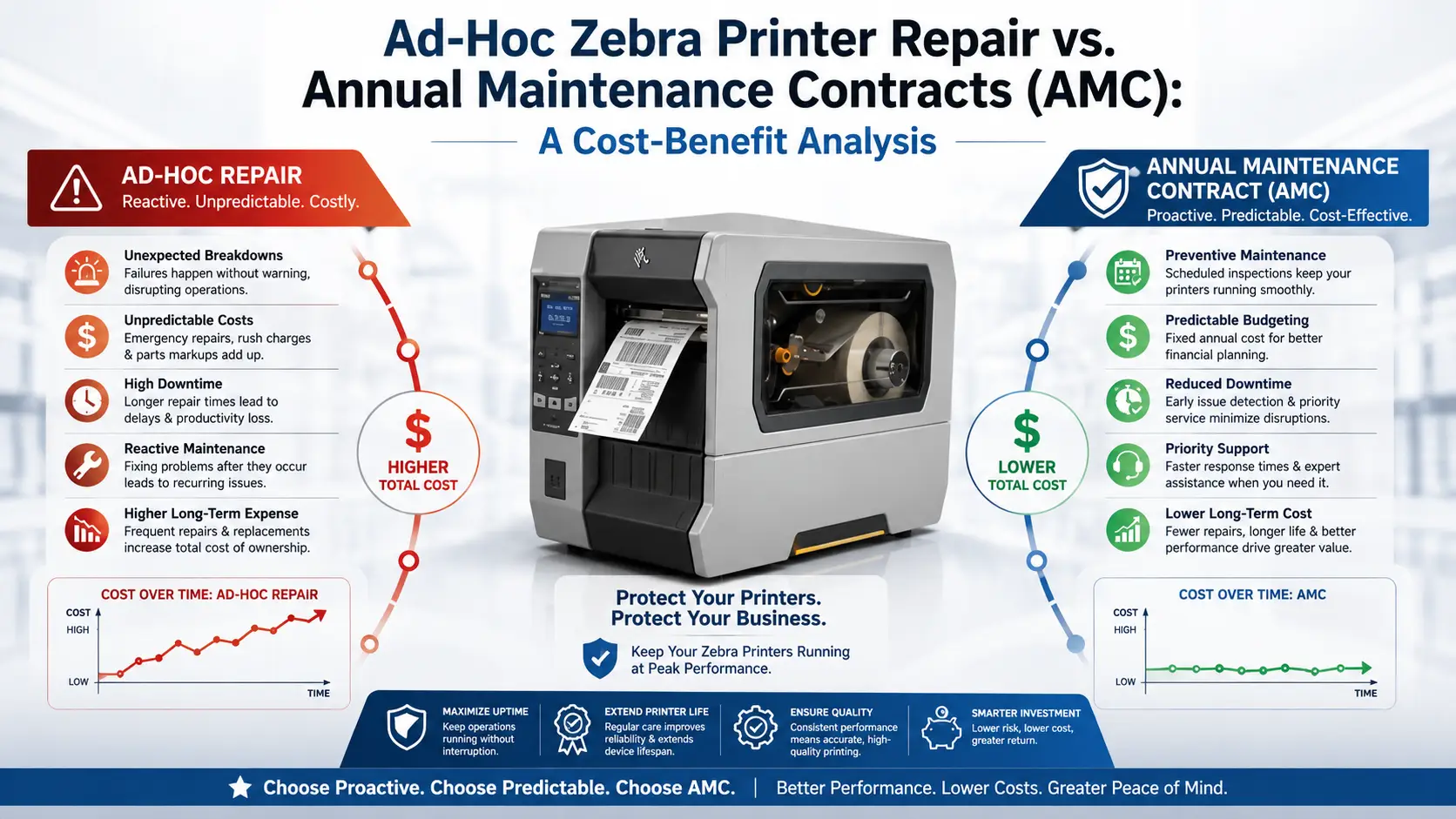
If your operation depends on daily label printing, ad-hoc Zebra Printer repair is usually cheaper only when failures are rare, printers are non-critical, and you can tolerate delays. For warehouses, retail chains, healthcare sites, and manufacturing environments where labels drive receiving, picking, shipping, pricing, or patient identification, a structured maintenance contract often reduces total cost of ownership by controlling downtime, preventing repeat faults, and extending printhead life.
Decision-makers should evaluate this choice as an uptime and risk question, not just a repair price question. A single failed printer can stop carton labeling, shelf-edge ticketing, asset tagging, or goods dispatch, which then affects scanners, WMS workflows, and downstream customer service.
What Is Ad-Hoc Zebra Printer Repair and What Is an AMC?
Ad-hoc Zebra printer repair means you call for service only after a fault appears. The service provider diagnoses the issue, quotes labour and parts, and repairs the unit either on-site or at a depot. This model works like an unplanned maintenance event: cost, turnaround time, and parts availability vary from case to case.
An Annual Maintenance Contract, by contrast, is a planned support agreement covering scheduled preventive maintenance, technical support, and defined response procedures. Depending on scope, it may include labour only, labour plus selected parts, or a comprehensive plan that covers major components under agreed terms. For buyers reviewing AMC and preventive maintenance services, the key distinction is that an AMC is designed to prevent breakdowns, not just react to them.
What is an AMC in practical terms? It is a service framework that typically includes inspection, cleaning, calibration, firmware checks, sensor alignment, media path cleaning, and wear-part review. According to Zebra Technologies, correct maintenance practices are central to preserving print quality and device reliability in enterprise printing environments.
The buying mistake many organisations make is comparing a single repair invoice with a full-year AMC fee without considering printer criticality. The better comparison is ad-hoc spending plus downtime exposure over twelve to thirty-six months. That is where the economics become clearer, especially for larger fleets or multi-site operations.
Why Zebra Printer Uptime Matters in Daily Operations
Zebra industrial and desktop barcode printers are not isolated office devices; they sit inside operational workflows. In warehouses, a failed printer can interrupt receiving labels, bin labels, carton labels, pallet IDs, and shipping documents. In retail, delayed shelf labels or backroom ticketing can slow replenishment, price updates, and stock movement.
Downtime matters because barcode quality affects the next step in the process. If print darkness, pressure, or sensor calibration drifts, labels may still print but scan poorly, creating exceptions at packing stations, store receiving points, or courier handover. According to AIM Global, barcode quality and readability are fundamental to reliable automatic identification workflows.
There is also a direct cost to operational disruption. According to Gartner, the average cost of IT downtime across sectors is often cited at around $5,600 per minute, though actual losses vary significantly by process and scale. For a business printing shipment labels or patient wristbands, even short interruptions can create queues, manual workarounds, and compliance risk.
This is why printer uptime should be evaluated together with your Zebra industrial printer deployment, label media selection, and process dependency. If labels are business-critical, support cannot be treated as an afterthought.
Direct Cost Comparison: One-Time Repair vs Annual Contract
The visible cost of ad-hoc repair includes diagnostics, labour, travel, shipping if the device is sent off-site, and replacement parts such as printheads, platen rollers, power supplies, or logic boards. Emergency work can also attract premium call-out rates, especially when a same-day or urgent response is requested. These costs are manageable when incidents are infrequent, but they become unpredictable across a fleet.
AMC pricing converts a variable service burden into a planned operating budget. That predictability matters for finance and operations teams because it reduces surprise approvals, emergency procurement, and repeated vendor comparisons. It also gives service teams a reason to intervene early, before poor print quality becomes a functional outage.
Printheads are a major factor in this analysis. According to VDC Research, printhead replacement can account for a substantial share of the total purchase price of a mid-range industrial barcode printer, making premature failure an expensive ad-hoc event. In high-volume sites, that single component can determine whether repair spend stays moderate or escalates quickly.
The table below shows how buyers should compare the two models.
| Evaluation Factor | Ad-Hoc Zebra Printer Repair | Annual Maintenance Contract |
|---|---|---|
| Cost structure | Variable, event-driven, difficult to forecast | Predictable annual budget with defined coverage |
| Response process | Starts after breakdown is reported and approved | Defined SLA path and support priority under contract terms |
| Preventive maintenance | Usually not included | Scheduled cleaning, calibration, inspection, firmware review |
| Parts management | Subject to quote, approval, and availability | May include parts or pre-negotiated rates depending on scope |
| Downtime risk | Higher, especially for critical sites | Lower, because issues are identified earlier |
| Best fit | Low-volume, non-critical, small fleets | High-usage, business-critical, multi-device environments |
Hidden Costs Businesses Often Overlook
The first hidden cost is poor barcode quality that does not immediately trigger a service call. A printer with dust buildup, adhesive contamination, worn rollers, or incorrect pressure may continue operating while producing labels that scan inconsistently. That creates soft losses: operator reprints, rejected cartons, manual key-entry, delayed dispatch, and disputes with logistics partners.
The second hidden cost is internal labour. When maintenance is unmanaged, supervisors, IT staff, or warehouse leads spend time troubleshooting media jams, darkness settings, sensor errors, or connectivity problems. Those employees are rarely allocated as a line item in repair accounting, but their time has an operational cost, especially during peak periods.
The third hidden cost is premature consumable and component wear. Zebra technical guidance indicates that regular cleaning and proper setup can materially improve printhead life; Zebra technical whitepapers state preventive maintenance and calibration can extend operational life of thermal printheads by up to 100% in suitable conditions. That means maintenance is not only a service cost decision; it is also a component longevity decision.
Finally, there is the media compatibility issue. Using low-quality labels or incorrect ribbons can accelerate wear, cause residue buildup, and reduce scan performance. Buyers comparing service models should review not only repair support but also their barcode labels and ribbons solutions, because media quality often sits behind recurring printer faults.
Service Coverage, Response Time, and Preventive Maintenance
What preventive maintenance tasks are performed during a scheduled AMC visit? A competent visit should include internal cleaning of dust and adhesive residue, printhead inspection, platen roller assessment, media path cleaning, sensor cleaning, pressure and alignment checks, print quality testing, and calibration of label sensing. Firmware review and configuration backup are also valuable, particularly where multiple printers must remain standardised.
Does an AMC cover expensive components like the printhead, platen roller, and main logic board? The answer is: sometimes, but not always. Buyers must read coverage definitions carefully because some contracts include labour only, some include wear parts but exclude electronics, and others provide a full parts-and-labour model with exclusions tied to misuse or non-approved media.
What is the average turnaround time for ad-hoc repair versus AMC support in the UAE and GCC? There is no universal number because service levels depend on the provider, site location, fleet size, and contract terms. However, ad-hoc support typically involves an extra diagnosis-and-quote cycle before approval, while AMC customers usually benefit from a pre-defined escalation route and faster dispatch under SLA terms.
Local spare parts access matters more than many buyers realise. In GCC markets, lead times for OEM parts can become a serious delay under ad-hoc repair if stock is not already positioned. AMC customers often benefit from priority parts planning or pre-negotiated procurement handling, which reduces the risk of printers sitting idle while awaiting a printhead or logic board.
When Ad-Hoc Zebra Printer Repair Makes More Sense
Ad-hoc repair is a rational option when the printer is lightly used, not business-critical, and there is built-in redundancy. A small office that prints occasional asset labels or internal barcodes may not need a full service contract if another device can temporarily cover demand. In that situation, paying only when a fault occurs can be financially sensible.
This model can also work when your internal team is technically capable of first-line maintenance. If staff know how to clean printheads properly, configure media settings, identify ribbon mismatch issues, and replace simple consumable parts, the number of external service calls may remain low. The more mature your internal support capability, the stronger the case for selective ad-hoc intervention.
Another good fit is short-term or low-volume project work. If a printer is used for a limited deployment, event, or seasonal operation, committing to a yearly contract may not deliver enough value. The same logic can apply to specialised devices such as mobile or clinical printers like the Zebra ZQ 610/620/630 mobile printer or the Zebra ZD510-HC wristband printer, where usage patterns may differ significantly from fixed industrial print stations.
Still, ad-hoc only remains efficient if faults are genuinely infrequent. If the same device needs repeated intervention for print quality, feed issues, or electronics faults, the economics usually shift away from one-time repair and toward a structured maintenance model.
When an AMC Is the Better Long-Term Investment
An AMC is usually the stronger investment when the printer fleet supports high-throughput or customer-facing operations. Warehouses, distribution centres, manufacturers, healthcare providers, and retail chains often depend on labels as transaction controls, not just physical identifiers. When labels drive inventory accuracy and process completion, preventing outages becomes more valuable than minimising a single invoice.
How many unscheduled printer breakdowns per year make an AMC more cost-effective than individual repair bills? There is no single threshold because it depends on fleet size, parts cost, labour rates, and the cost of downtime. In practice, if you have recurring failures, high print volumes, repeated printhead replacements, or any operation where downtime blocks shipping or receiving, the total cost case for an AMC becomes much stronger.
AMC value also increases in multi-device environments where standardisation matters. Sites using printers together with scanners, mobile computers, and WMS processes gain more from coordinated support because one weak device can disrupt the whole chain. That is especially relevant where barcode printing supports inventory accuracy and retail automation programmes or warehouse execution integrated with tracking and operational technology systems.
Can a multi-brand AMC cover Zebra printers alongside barcode scanners and PDT devices? Yes, many service providers structure agreements that cover mixed fleets under one governance model, though service scope and exclusions vary. For operations teams, that can simplify vendor management, budgeting, and preventive maintenance scheduling across the wider Auto ID environment.
How to Evaluate the Right Support Model for Your Printer Fleet
Start with usage intensity. Document print volumes, application types, shift patterns, and the business consequence of failure for each device. A printer producing shipping labels in a 24/7 warehouse should not be evaluated the same way as a backup unit in an administrative department.
Next, assess failure history and quality symptoms, not just formal breakdowns. Repeated reprints, fading, skipped labels, sensor drift, and barcode scan complaints are early indicators of support needs. These issues often look minor until they accumulate into labour waste and dispatch delays.
Then review support logistics: site geography, spare availability, local technical coverage, and approval process speed. If your locations cannot tolerate depot delays or long procurement cycles, the service model must reflect that operational reality. This is where regional support capacity often matters as much as the contract price.
Finally, compare options on three-year TCO, not on first-year invoice alone. Include ad-hoc parts, travel, emergency service, internal troubleshooting time, lost output, and replacement acceleration. If your printers support broader store automation and operational efficiency initiatives or integrated warehouse workflows, stable printing becomes part of system reliability, not a standalone maintenance line.
FAQ: Zebra Printer Repair and AMC Decisions
Q: What is the difference between ad-hoc Zebra Printer repair and an AMC?
A: Ad-hoc repair is pay-as-you-go support after a failure occurs. An AMC is a planned support agreement that typically includes preventive maintenance, technical support, and defined response terms, with coverage varying by contract.
Q: When is an annual maintenance contract better than one-time printer repair?
A: It is usually better when printers are heavily used, operationally critical, or part of a larger warehouse, retail, or healthcare workflow where downtime creates immediate delays. It is also preferable when faults repeat or parts lead times are a concern.
Q: How much does Zebra Printer downtime typically cost a business?
A: The cost depends on the process affected. Industry-wide downtime benchmarks are often high, but the real business impact should be calculated from delayed shipments, labour idle time, rework, missed dispatch cut-offs, or compliance disruption in your own operation.
Q: What services are usually included in a Zebra printer AMC?
A: Common inclusions are scheduled cleaning, calibration, print quality checks, firmware review, remote support, and repair labour. Some contracts also include replacement parts or discounted parts pricing, but buyers must confirm the exact scope.
Q: Can an AMC reduce repeat Zebra Printer repair issues?
A: Yes. Regular maintenance addresses root causes such as contamination, worn rollers, incorrect settings, and poor calibration before they turn into repeated service incidents.
Q: Does an AMC always include printheads and logic boards?
A: No. Some AMCs cover labour only, while others include selected parts or comprehensive parts-and-labour coverage. Always verify exclusions related to wear, misuse, or third-party consumables.
Q: What turnaround time should I expect for service?
A: It depends on SLA, location, and stock availability. AMC customers generally receive faster handling because diagnosis, approval path, and service terms are already defined, while ad-hoc repairs usually require a new quote and approval step.
Q: Can one contract cover printers, scanners, and mobile computers together?
A: Yes, many enterprise support providers offer multi-brand and multi-device agreements. This can simplify support administration for businesses with mixed Auto ID infrastructure.
Final Verdict: Choosing the Best Option for Cost and Reliability
For a low-volume site with a backup device and limited operational dependency, ad-hoc Zebra Printer repair can be perfectly reasonable. For organisations that print labels every day to move stock, ship orders, identify assets, or support frontline transactions, the real comparison is not repair price versus contract price. It is unplanned disruption versus controlled uptime.
The strongest buying decision comes from mapping printer criticality, failure frequency, internal technical capability, and parts exposure. If any printer failure can stop receiving, dispatch, shelf labeling, or patient identification, a maintenance contract should be evaluated as operational risk control rather than discretionary service spend.
Technowave International supports businesses that need a practical service model for Zebra and broader barcode infrastructure, including hardware support, preventive maintenance, repair handling, and operational guidance across retail, warehouse, healthcare, and industrial environments. If you are reviewing repair history, AMC scope, or fleet support strategy, connect with the Technowave team for a technical assessment and recommendation aligned to your actual usage profile.
Related Articles
- Zebra Zc 10l Large Format Card Printer
- Zebra Zq 610 620 630 Mobile Printer
- Zebra Zd510 Hc Wrist Band Printer
- <a href=”https://technowavegroup.com/product/