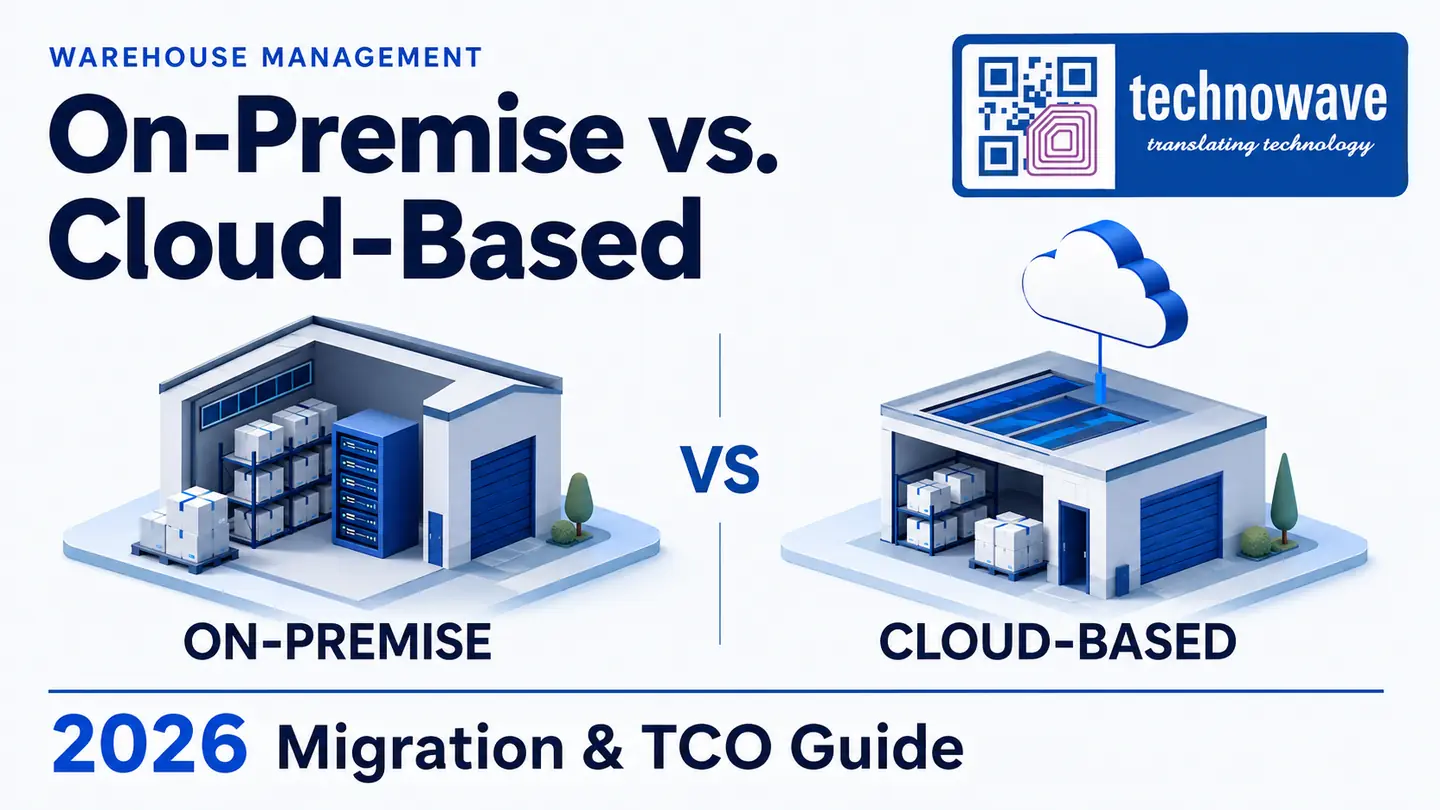
For most UAE warehouse operators, the right answer to on premise vs cloud warehouse management system is not ideological; it depends on transaction volume, ERP complexity, uptime tolerance, and how much internal IT capacity you want to carry for the next five years. Cloud WMS now fits a large share of new distribution, retail, and 3PL projects in the UAE, while on-premise still makes sense for organizations with strict internal hosting rules, heavily customized workflows, or sensitive legacy integrations.
What is the difference? An on-premise WMS runs on servers and databases controlled by the customer, usually inside a local data center or facility. A cloud-based WMS is hosted by the software provider or a cloud infrastructure partner and is accessed over secure internet connections, often with subscription pricing, managed updates, and API-led integration.
This comparison matters because UAE operations teams are no longer selecting software in isolation. They are choosing an architecture that must work with warehouse management system UAE solutions, barcode mobility, RFID gates, Zebra printing, and ERP workflows across Dubai, Abu Dhabi, JAFZA, and fast-scaling e-commerce nodes. The deployment model directly affects project speed, cost visibility, resilience, and future expansion.
Key Differences Between On-Premise and Cloud WMS in the UAE
The practical gap between the two models is not just where the software sits. It changes who owns patching, disaster recovery, performance tuning, database administration, cyber hardening, and version control. In UAE operations, where warehouses often need to support multi-site transfers, omnichannel retail, and supplier ASN processing, those differences become operational rather than theoretical.
On-premise platforms usually offer deeper control over infrastructure and may suit businesses already standardized on internal server policies. Cloud platforms usually reduce implementation friction, especially when the project includes handheld data capture, browser dashboards, or rapid site rollout. According to Mordor Intelligence, the UAE warehousing market is projected to exceed USD 10 billion by 2026, which explains why many operators are rethinking whether legacy architectures can scale fast enough.
| Criteria | On-Premise WMS | Cloud-Based WMS |
|---|---|---|
| Cost model | Higher upfront CAPEX for servers, database, implementation | Lower upfront cost, recurring OPEX subscription |
| Deployment speed | Slower due to infrastructure setup and approvals | Faster, especially for multi-site rollout |
| Software updates | Planned internally, often delayed | Managed by vendor, typically scheduled and automated |
| IT dependency | Requires in-house or outsourced infrastructure support | Lower internal infrastructure burden |
| Customization control | Usually higher, but harder to maintain | Often configuration-first, with controlled extensibility |
| Offline resilience | Strong local continuity inside site network | Depends on architecture, local caching, and device workflows |
| Scaling for peak season | May require hardware expansion in advance | Usually easier to scale users and processing |
| Data residency choices | Full internal control if hosted locally | Depends on region selection and vendor hosting model |
| Upgrade risk | Higher testing and downtime planning effort | Lower infrastructure effort but requires release governance |
When On-Premise WMS Still Makes Sense
On-premise is not obsolete; it remains a rational choice for specific UAE enterprises. If your organization has a central IT mandate requiring local server control, an older ERP with brittle point-to-point integrations, or highly customized wave logic built over years, replacing that architecture with SaaS may create more risk than value in the short term. This is common in mature industrial groups, regulated environments, and organizations with internal cybersecurity policies that move slowly.
The biggest strength of on-premise is infrastructure control. Your IT team can define patch windows, network segmentation, database tuning, storage policy, backup retention, and inter-system traffic routing. For sites using fixed local automation, such as RF access points, conveyor-linked print-and-apply, or latency-sensitive station logic, internal hosting can also simplify troubleshooting because every layer sits under one governance model.
Best-fit use cases
On-premise usually fits operations with one or more of these conditions:
- Complex legacy ERP customization where APIs are limited or unavailable
- Strict internal rules on keeping operational data inside customer-controlled infrastructure
- Very stable workflows with low pressure for rapid functional change
- Existing sunk investment in servers, Microsoft SQL or Oracle licensing, and warehouse IT staff
The limitations are equally important. On-premise WMS often accumulates hidden project drag: server refresh cycles, database upgrades, antivirus exceptions, failover testing, backup storage, VPN overhead for remote sites, and delayed version upgrades because every change requires coordinated testing. If the operation depends on automated warehouse management workflows across multiple facilities, those delays can become a strategic constraint rather than a technical inconvenience.
Where Cloud WMS Has the Advantage in 2026
Cloud WMS is strongest where the warehouse must change quickly. That includes omnichannel retail fulfillment, 3PL onboarding, seasonal labor expansion, dark stores, and distribution centers that open new zones or clients with little warning. In these environments, the ability to add users, create new workflows, expose dashboards remotely, and push updates without rebuilding local infrastructure is a material advantage.
For UAE operators, cloud is especially attractive when warehouses are part of a wider digital stack rather than a closed local system. A modern deployment may need browser access for supervisors, API integration to e-commerce or marketplace middleware, mobile access on rugged devices, and event data from RFID portals. Cloud platforms are generally better aligned to this architecture, particularly when paired with asset and tracking platforms that already rely on centralized visibility across sites.
Cloud does not mean fragile if designed correctly
A common buyer question is: How does a cloud WMS handle internet loss in an industrial area? The answer depends on design. Well-implemented systems use a hybrid edge model: handhelds, printers, and local access points continue essential scan-and-store or task execution functions, then synchronize when connectivity returns. Critical warehouses should also separate WAN risk from device workflow by using redundant internet links, buffered label queues, and local rules for receiving, picking confirmation, or cycle count capture.
Cloud also reduces one major source of long-term pain: version stagnation. On many on-premise projects, upgrades are postponed because they require database testing, infrastructure compatibility checks, and weekend cutovers. In cloud, releases still need governance, but the infrastructure burden is smaller, which makes security patching and incremental feature adoption far easier.
5-Year TCO: CAPEX, OPEX, and the Hidden Costs Buyers Miss
The real financial question is not license price; it is WMS total cost of ownership UAE over three to five years. On-premise starts with visible capital items such as servers, storage, database licensing, backup systems, virtualization, implementation, and sometimes disaster recovery hardware. What many buyers underestimate is the operational tail: IT labor, uptime monitoring, patch management, hardware support contracts, and the cost of delaying upgrades because internal resources are unavailable.
Cloud shifts much of that into recurring subscription spend. That improves budget predictability, but subscription-only comparisons can be misleading if buyers ignore user growth, API usage, integration middleware, premium support tiers, or data storage policies. The right comparison is a line-by-line model covering software, hosting, implementation, interfaces, support, user expansion, reporting, and change requests over the full project horizon.
A practical UAE TCO checklist
- On-premise cost blocks: server and storage procurement, database licensing, backup tools, cyber controls, internal IT time, remote access, DR environment, hardware refresh, and upgrade testing
- Cloud cost blocks: subscription fees, implementation, connectors, mobile device management, internet redundancy, sandbox environments, and support SLAs
- Shared costs: process design, master data cleansing, barcode labeling standards, training, device rollout, and change management
A second buyer question is: What are the hidden costs of upgrading an on-premise WMS? Typically they include consultant retesting, custom script rework, downtime planning, interface regression testing, and security review across every connected device from handheld terminals to print stations. By contrast, cloud upgrades are not free of effort, but they generally reduce infrastructure-specific cost and compress the testing surface.
Which Should You Choose? Migration, Integration, and UAE Decision Criteria
If your business is evaluating warehouse management system migration UAE, start with operational dependency mapping, not vendor demos. Document receiving, putaway, replenishment, wave picking, packing, dispatch, returns, cycle counting, serial or lot controls, and inter-branch transfers. Then map every touchpoint: ERP, e-commerce, transport systems, barcode devices, RFID readers, and label formats. Only after that should you decide whether on-premise or cloud better supports the target state.
Can a cloud-based warehouse system integrate with RFID portals, barcode scanners, and Zebra printers? Yes, if the design uses standard APIs, middleware, or device services rather than hard-coded station logic. The integration checklist should cover scanner symbologies, PDT operating environment, printer command language, RFID event filtering, label templates, exception handling, and whether the ERP owns item master, inventory truth, or ASN validation. This is where links between WMS software and compliance-oriented tracking controls become important for governance.
Which should you choose? Choose on-premise if you need strict local infrastructure control, already maintain strong internal IT capability, and rely on legacy customizations that are expensive to replatform. Choose cloud if speed, scalability, remote visibility, easier updates, and multi-site expansion matter more than owning the server stack. Choose a hybrid path if you need cloud analytics and centralized management but want local device continuity during outages.
For UAE buyers, the final screen is supportability. Ask who will handle device staging, printer setup, RFID commissioning, user training, and post-go-live issue resolution. A technically sound WMS can still fail operationally if support for scanners, labels, wireless coverage, and break-fix service is fragmented. In practice, many operators reduce risk by working with one partner for software, Auto-ID hardware, integration, and local technical support rather than splitting accountability across multiple vendors.
FAQ
Q: What is the difference between an on-premise and cloud-based warehouse management system?
A: An on-premise WMS runs on customer-controlled servers and is maintained by internal or contracted IT teams. A cloud WMS is vendor-hosted, accessed securely over the internet, and usually delivered as a subscription with managed updates, lower infrastructure ownership, and faster rollout.
Q: Which is more cost-effective in the UAE: cloud WMS or on-premise WMS?
A: Cloud is often more cost-effective for new or expanding operations because it avoids server CAPEX and reduces infrastructure maintenance. On-premise can still be economical if the business already owns the IT stack, has low change frequency, and does not expect rapid user or site growth.
Q: How long does it take to migrate from legacy warehouse software to a cloud WMS?
A: Timing depends on process complexity, master data quality, and integration scope. A straightforward operation with standard receiving, picking, and dispatch can move relatively quickly, while projects involving ERP customization, RFID event logic, or multi-site inventory harmonization take longer and need phased cutover planning.
Q: Is cloud warehouse management secure enough for UAE logistics and distribution operations?
A: Yes, if security is designed properly. Buyers should evaluate hosting region, identity management, encryption, audit logs, backup policy, disaster recovery, and role-based access. The main issue is not cloud versus on-premise alone; it is whether the chosen architecture meets the company’s security and governance standards.
Q: What integrations should be considered before choosing a warehouse management system?
A: Review ERP, e-commerce, transport, barcode scanners, rugged handhelds, RFID readers, label printers, ASN flows, item master rules, and reporting tools. Also confirm ownership of inventory data, error handling logic, and whether interfaces are API-based or dependent on fragile custom file exchanges.
Q: How should UAE warehouses handle offline operations in a cloud WMS model?
A: Use a hybrid design with resilient wireless coverage, redundant internet connectivity, local print buffering, and device workflows that can queue transactions when WAN access drops. The goal is controlled continuity for critical tasks, followed by clean synchronization when connectivity is restored.
For organizations comparing deployment models in the UAE, the best choice is the one that fits your process complexity, internal IT posture, and expansion plan over the next five years. Technowave International supports this decision with warehouse software, barcode and RFID integration, device deployment, and local post-go-live support, helping operations teams move from comparison to a workable implementation roadmap.
Related Articles
- The Ultimate Guide to Choosing the Right Asset Management System for UAE Enterprises
- The Ultimate Guide to Choosing Mobile Computers and PDT Devices for UAE Warehouses
- Complete Guide to Digital Shelf Label in UAE in 2026
- CCTV & Surveillance Systems in Oman – Complete Security Guide for 2026
- 20 Reasons Why You Need an Automated Warehouse Management System
- Asset Compliance and Regulatory Tracking in Enterprises
On Premise vs Cloud Warehouse Management System UAE
Compare on premise vs cloud warehouse management system options in the UAE with 2026 TCO, migration, integration, and decision criteria.