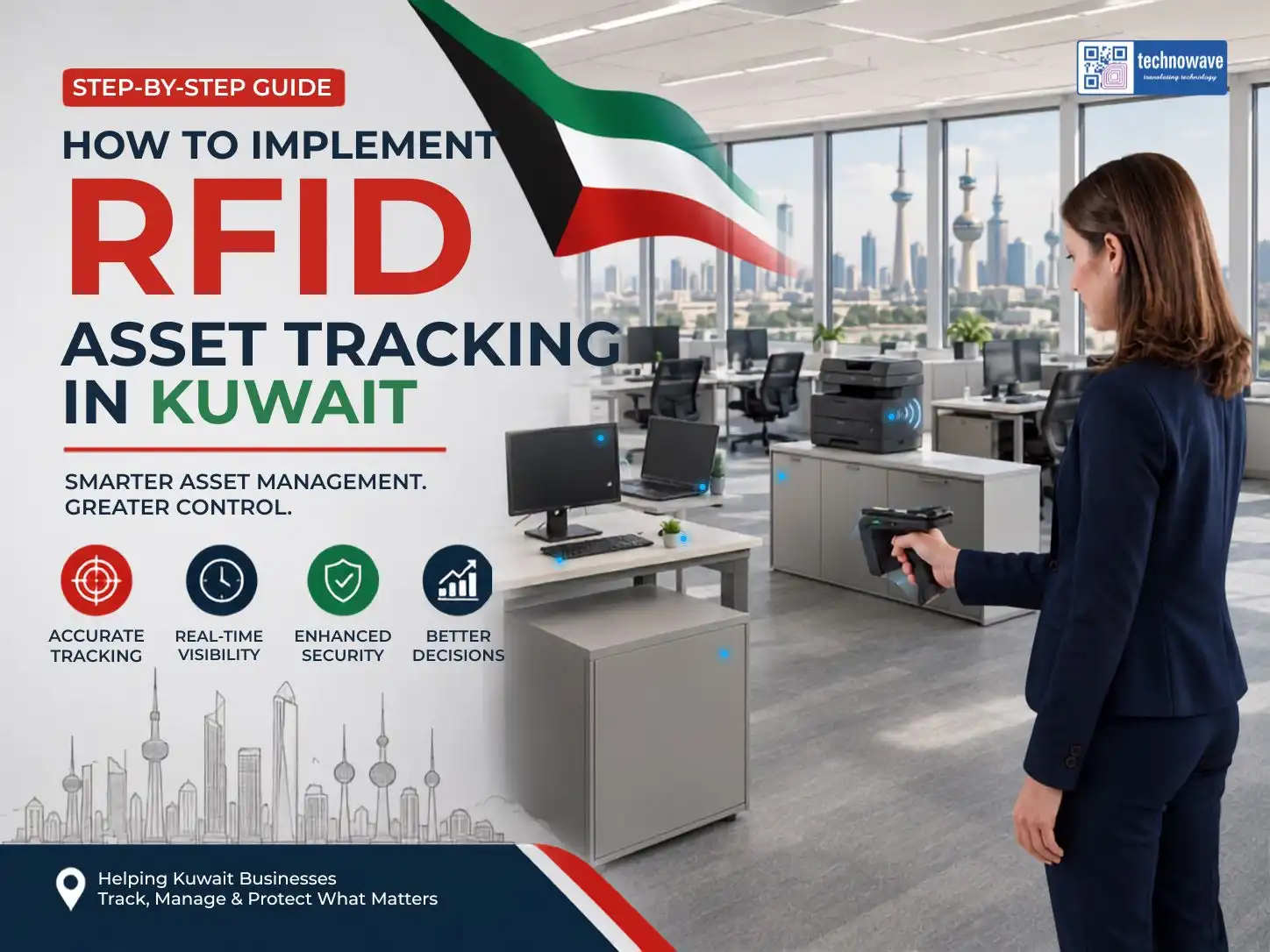
To implement RFID asset tracking Kuwait projects successfully, start with a defined asset scope, choose hardware rated for Kuwait’s operating environment, build a clean asset data structure, integrate with ERP or finance systems, and validate performance through a pilot before full rollout. For Kuwaiti businesses, the difference between a successful deployment and an expensive hardware exercise usually comes down to site survey quality, tagging standards, bilingual workflows, and local support.
RFID asset tracking is the use of RFID tags, readers, printers, and asset software to identify, locate, audit, and manage physical assets with less manual effort than spreadsheet- or barcode-only processes. That matters in Kuwait because ministries, oil and gas operators, healthcare groups, schools, logistics sites, and multi-branch enterprises need faster annual verification, stronger accountability, and better visibility across offices, warehouses, and outdoor yards.
Step 1: Define the assets, locations, and audit goals before you buy anything
The best way to implement an RFID asset management system Kuwait businesses can rely on is to begin with operational scope, not hardware catalogs. List exactly which assets will be tagged: laptops, servers, tools, AV equipment, medical devices, office furniture, returnable containers, or industrial equipment. Then separate them by environment: air-conditioned office floors, warehouse racks, retail backrooms, vehicles, or exposed outdoor storage.
Next, define the business objective in measurable terms. Common Kuwait use cases include faster annual fixed asset verification for finance teams, movement control across multiple branches, reduced ghost assets in ministry or contractor environments, and better chain-of-custody for high-value IT equipment. If your goal is only periodic audit speed, passive RFID may be enough; if you need live location visibility across large compounds, the design may require active RFID or a hybrid approach.
Ask a direct question early: Which assets should be tracked with RFID? The answer is assets that are numerous, mobile, high-value, audit-sensitive, or difficult to verify manually. For many organizations, that includes IT assets, office equipment, maintenance tools, lab devices, and shared assets moving between departments. For broader planning context, many teams start by reviewing how an asset tracking system works for businesses before finalizing scope.
Practical tip: create three categories before procurement: audit-only assets, movement-controlled assets, and exception assets such as metal-rich or heat-exposed items. Common mistake to avoid: trying to tag every asset in phase one. Over-scoping delays approval, complicates data cleanup, and weakens pilot accuracy.
Step 2: Choose the right RFID model, tags, readers, and software for Kuwait conditions
Hardware selection should match the site, not generic product claims. In Kuwait, exposed industrial locations can experience extreme summer temperatures above 50°C, so tag adhesive, tag encapsulation, and handheld reader operating range matter as much as read performance. Office environments typically use standard passive UHF labels for laptops, monitors, and furniture, while industrial plants may require on-metal tags, rugged hard tags, or tamper-evident formats.
Do you need active or passive RFID? For IT equipment and office furniture across multiple floors, passive RFID is usually the right starting point because it supports fast room-to-room audit, lower tag cost, and simpler deployment. Active RFID becomes more relevant when assets move across wide areas and you need automated visibility without close-proximity scanning, but it brings higher infrastructure and tag costs.
| Tracking option | Best fit in Kuwait | Main advantage | Main limitation |
|---|---|---|---|
| Barcode only | Low-volume offices with basic audit needs | Lowest entry cost | Line-of-sight scanning and slower audits |
| Passive UHF RFID | Fixed assets, IT equipment, furniture, warehouse items | Fast bulk reading and scalable audit workflows | Requires careful tag selection near metal or liquids |
| Active RFID | Large yards, critical mobile assets, wide-area tracking | Longer-range automated visibility | Higher tag and infrastructure cost |
Your software should support bilingual Arabic-English screens and reports, user roles, audit sessions, exception handling, and integration APIs. It should also work with enterprise fixed asset management strategies rather than acting as a standalone scan repository. Practical tip: test tags on your real asset surfaces before ordering in volume. Common mistake to avoid: buying standard labels for metal cabinets, electrical assets, or outdoor tools without read testing.
Step 3: Set asset tagging standards and complete a proper site survey
A strong RFID asset tracking Kuwait deployment depends on repeatable tagging rules. Define what each label must contain in software and on the printed face: asset ID, department, site code, serial number reference, and asset class. Decide where each tag should be placed on each asset type so field teams can tag consistently and readers can capture data with minimum shadowing or signal reflection.
Site survey is where most hidden issues appear. Reader performance changes around metal shelving, server racks, lift lobbies, dense electrical rooms, liquid-filled storage, and outdoor compounds. In a multi-floor office, you may need handheld-based audit workflows; in a warehouse or gated store, fixed readers at chokepoints may add movement capture. If imported equipment will be used in Kuwait, confirm local wireless and frequency compliance requirements with the relevant authorities before deployment approval.
What should the survey document include?
- Asset categories and material composition
- Reader test points and expected read distance
- Interference risks from metal, liquid, and electrical equipment
- Indoor and outdoor temperature exposure
- Power, network, and mounting requirements for fixed readers
- Workflow maps for audit teams and asset custodians
This is also the stage to plan asset tagging services, printing, and commissioning sequence. If your project includes tagging thousands of assets, align physical tagging with finance master data cleanup first; otherwise you will encode bad records faster. Relevant planning guidance can be found in asset tagging services and how asset tracking improves operational control in Kuwait. Practical tip: document approved tag positions by asset type with photos. Common mistake to avoid: treating the site survey as a quick demo instead of a structured engineering task.
Step 4: Configure the asset management software and clean the master data
Once the hardware model is confirmed, set up the data architecture before full tagging starts. The asset tracking software Kuwait businesses choose should map each asset to entity, branch, building, floor, room, department, custodian, cost center, purchase reference, depreciation reference if needed, and lifecycle status. If these fields are inconsistent, the RFID layer will expose data problems rather than solve them.
How should the system be structured? Build a hierarchy that mirrors how your finance and operations teams already manage accountability. A practical model is company > site > building > floor > room/zone > custodian. Then define transaction types such as issued, transferred, under maintenance, retired, missing, found, and pending verification. Audit sessions should capture both expected and unexpected reads so exceptions can be investigated immediately.
For many Kuwait organizations, cloud policy is not the only consideration. Government bodies, banks, and regulated entities often require stricter control over where asset data is stored and who can access support sessions, which makes on-site implementation and controlled integration particularly important. Review asset compliance and regulatory tracking when designing approval workflows, audit logs, and exception reports.
One market indicator supports the long-term case for investment: according to RFID Journal, organizations implementing RFID-enabled asset tracking can achieve physical asset audit accuracy of up to 99% and reduce asset write-offs significantly when processes are disciplined. Practical tip: cleanse duplicates, missing room codes, and retired assets before migration. Common mistake to avoid: importing years of inconsistent asset records into the new platform without a validation pass.
Step 5: Integrate RFID with ERP, finance, service desk, and facilities workflows
Integration is usually the real operational hurdle, especially where SAP, Oracle, HR, procurement, or service-desk systems are already established. RFID should not become a disconnected audit island. Instead, it should exchange master data, cost center structures, user references, and approved movement transactions with the systems that own financial accountability and maintenance history.
How does RFID asset software integrate with SAP or Oracle? Typically through API-based exchange, scheduled imports, or middleware connectors that synchronize asset masters, location codes, departments, and status changes. In many deployments, ERP remains the financial source of truth while the RFID system becomes the operational source for verification, movement history, and exception tracking. That split works well when governance rules are defined early.
For facilities and IT operations, useful integration points include helpdesk tickets, maintenance dispatch, warranty lookup, and user handover forms. If a laptop is scanned in a branch audit but assigned to another location in ERP, the system should generate an exception rather than silently overwrite ownership. This is where a structured RFID solutions provider and a well-designed fixed asset management framework add more value than hardware supply alone.
Practical tip: define which system owns each field before integration begins. Common mistake to avoid: letting multiple systems edit the same location, custodian, or status field without rules, which creates reconciliation problems during audit close.
Step 6: Run a pilot, train users, then roll out across Kuwait with local support
A pilot should be small enough to control but broad enough to reveal real exceptions. Good pilot candidates in Kuwait include one head office floor, one branch, one warehouse zone, or one department with mixed assets such as laptops, monitors, furniture, and shared devices. Include at least one difficult asset class, such as metal cabinets or mobile equipment, so the pilot tests actual field conditions rather than only ideal reads.
Measure pilot success using practical indicators: read reliability, time required for an audit round, percentage of unmatched assets, number of duplicate or bad records found, and user adoption by finance, IT, or facilities teams. If fixed readers are part of the design, validate network stability, power protection, mounting positions, and calibration under normal site activity. Pilot outputs should end with a revised tagging guide, finalized SOPs, and a go-live checklist for each branch.
Training must be role-specific. Auditors need scan patterns, exception handling, and recount methods. Administrators need import templates, location creation rules, and reconciliation procedures. Managers need dashboard interpretation and approval workflows. For multi-site deployments, ongoing AMC, spare device planning, and calibration support are important because handheld reader batteries, printer settings, and tag performance all affect audit consistency over time.
When the project moves from pilot to rollout, local implementation capability becomes critical. Technowave International supports GCC organizations with RFID solutions for asset tracking and inventory management, asset software, tagging, installation, integration, AMC, repair, and on-site technical support. Practical tip: expand site by site using a standard rollout pack. Common mistake to avoid: scaling immediately after a pilot without locking SOPs, training materials, and support ownership.
FAQ: RFID Asset Tracking Kuwait
Q: What is the best way to implement RFID asset tracking in Kuwait?
A: Start with a scoped pilot, not a full enterprise rollout. Define asset classes, test tags on real materials, validate Arabic-English reporting needs, map the data structure to your finance system, and confirm local compliance for readers before procurement. Kuwait projects succeed when engineering and process design come before volume purchasing.
Q: Which assets can be tracked using RFID in Kuwait businesses?
A: Common asset classes include laptops, desktops, monitors, printers, AV devices, office furniture, tools, medical equipment, lab devices, files, and warehouse assets. RFID is most effective where assets are numerous, mobile, high-value, audit-sensitive, or difficult to verify manually across multiple rooms or branches.
Q: What hardware is required for an RFID asset tracking system?
A: A typical setup includes RFID tags, handheld readers for audit, optional fixed readers for gates or chokepoints, RFID printers for in-house encoding, labels suited to the asset surface, and asset management software. Industrial sites may also require ruggedized tags, on-metal formats, protective housings, and spare batteries.
Q: How much does an RFID asset tracking solution cost in Kuwait?
A: Cost depends on the number of assets, tag type, reader count, software scope, integration complexity, and whether the site needs industrial-grade hardware. Passive RFID for office assets is usually more economical than active RFID. The biggest budget variables are ERP integration, field tagging labor, and rugged hardware for harsh environments.
Q: Can passive RFID tags survive Kuwait’s extreme summer heat?
A: Standard office-grade labels may not be suitable for exposed outdoor sites. For industrial yards and oilfield-related environments, use tags rated for the expected temperature range, surface type, and adhesive performance. Always run a live environmental test before volume tagging, especially on metal assets stored outdoors.
Q: Can RFID asset tracking be integrated with ERP or existing asset software?
A: Yes. Most deployments integrate RFID workflows with ERP, finance, procurement, or facilities systems through APIs, middleware, or scheduled data exchange. Best practice is to keep ERP as the financial master while the RFID platform handles verification, movement events, exception tracking, and audit execution.
Implementation checklist
- Define asset scope by type, value, mobility, and audit risk
- Separate office, warehouse, and outdoor environments
- Select passive or active RFID based on workflow, not marketing claims
- Test tag types on metal, plastic, and heat-exposed assets
- Complete a documented site survey with read tests
- Clean master data before migration
- Configure bilingual fields, locations, roles, and exception workflows
- Plan ERP or finance integration ownership field by field
- Run a controlled pilot and measure real audit performance
- Roll out site by site with training, AMC, and local support
If your organization is planning fixed asset tracking Kuwait projects across offices, warehouses, healthcare sites, retail branches, or industrial locations, work with a provider that can handle hardware, software, integration, tagging, training, and post-go-live support as one delivery model. Technowave International can help you assess the right RFID design for Kuwait and build a rollout plan that fits your operational and compliance requirements.
Related Articles
- Asset Compliance and Regulatory Tracking in Enterprises
- Enterprise Fixed Asset Management: Key Strategies, Challenges, and Emerging Trends
- Asset Tracking System: How It Works and Why Businesses Need It
- Barcode Asset Tracking System: How It Works and Its Limitations
- Asset Management Solution Implementation Challenges in UAE: Overcoming Obstacles for Success
- How RFID is Enhancing Patient Care and Asset Visibility in Hospitals
How to Implement RFID Asset Tracking in Kuwait
Learn how to implement RFID asset tracking Kuwait projects with the right tags, readers, software, ERP integration, and rollout steps.