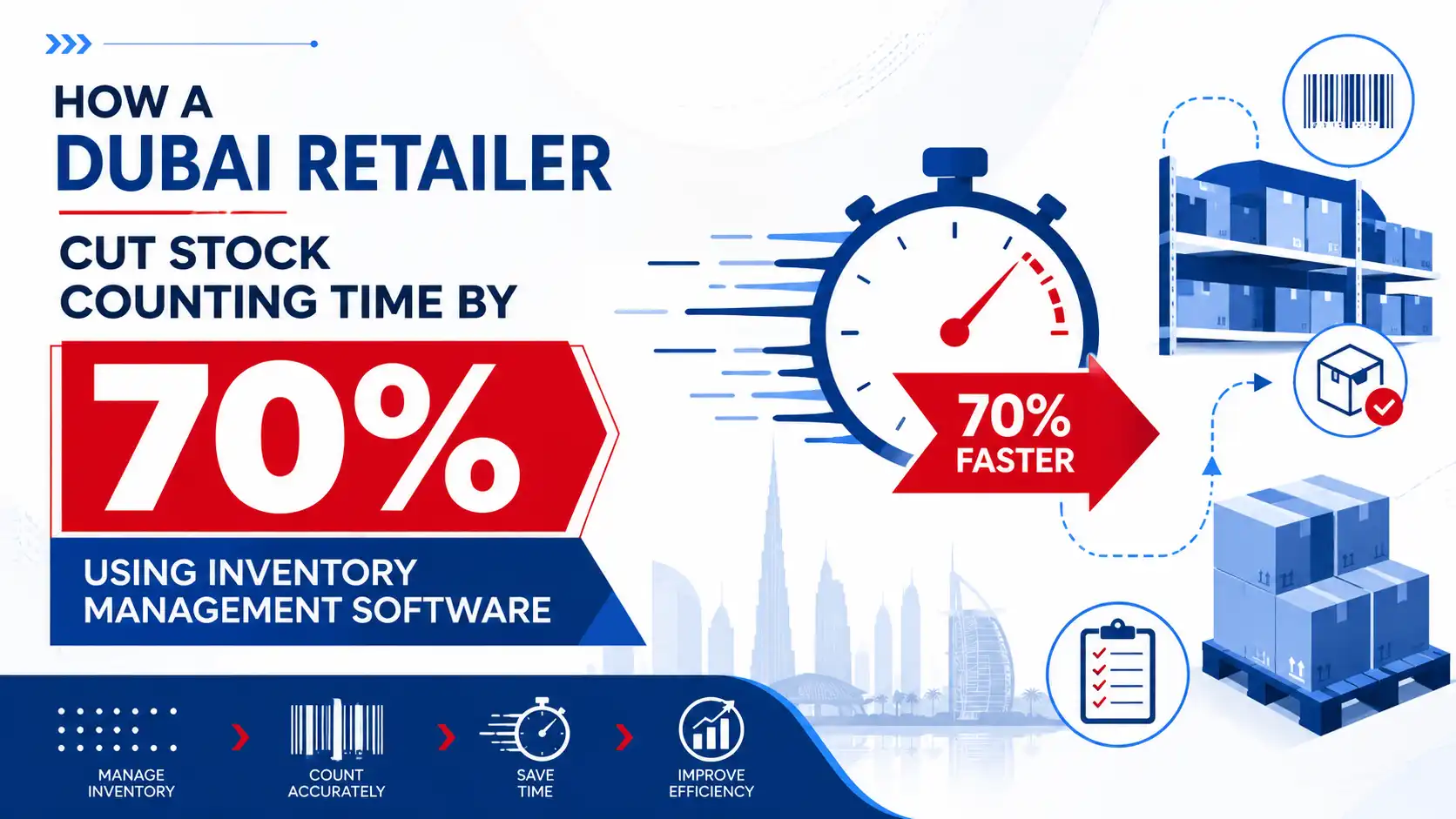
A small retailer in Dubai can cut stock counting time dramatically by replacing paper counts and spreadsheet reconciliation with inventory management software small business teams can use on handheld devices. In practice, the result comes from a structured rollout: standardize item masters, connect barcode or RFID data capture, run mobile cycle counts, and sync results back to POS or ERP without delaying store operations.
What is inventory management software for small business? It is a system that tracks stock movement, quantity on hand, receiving, transfers, returns, and count adjustments across one or more locations. For UAE retailers, the best deployments also support offline counting in stockrooms, Arabic- and English-friendly workflows, and integration with barcode scanners, rugged Android mobile computers, or RFID readers.
Why does this matter in Dubai? Manual retail counts often break down under weekend traffic, high SKU variety, and frequent staff changes. According to Zebra Technologies, retailers are prioritizing real-time inventory visibility to reduce out-of-stocks, while Dubai Chamber retail reporting continues to reflect the sector’s expansion and digitalization across the UAE.
1. Start by measuring where stock counting time is really being lost
If you want a 70% reduction, first identify the delays that make current counts slow. In most Dubai stores, the problem is not counting alone; it is preparation, rechecking, exception handling, and posting results back into the system. Paper sheets, unclear SKU descriptions, duplicate barcodes, and delayed approvals usually create more waste than the physical act of scanning items.
Break the existing process into five timed stages: pre-count preparation, shelf count, stockroom count, variance review, and final posting. This makes the business case clearer for owners who are considering small business inventory software Dubai but want to know where labor hours will actually be saved. If one store needs four staff after closing to count and reconcile, the software project should target those exact bottlenecks instead of promising generic automation.
A useful benchmark is available from Auburn University’s RFID Lab: RFID-enabled inventory management can lift inventory accuracy from average levels around 65% to above 95% while reducing stock count time by up to 70% to 80%, according to Auburn University RFID Lab. That does not mean every store needs full RFID on day one. For many UAE SMB retailers, a barcode-first deployment with mobile cycle counts already removes the biggest delays.
Common mistake to avoid
Do not map a new system on top of bad item data. If the same product has inconsistent naming, unit measures, or missing variants, faster scanning will only produce faster confusion. Clean the item master before software rollout.
2. Build the right counting workflow before choosing devices
The fastest retail inventory projects begin with workflow design, not hardware shopping. Ask three direct questions: Will staff count by barcode, RFID, or both? Will counts happen during store hours, after hours, or continuously through cycle counting? Will the software post automatically to POS and ERP, or wait for approval? These answers determine whether you need entry-level Android PDTs, rugged enterprise mobile computers, or hybrid RFID handhelds.
For small format stores, barcode inventory management software UAE businesses use is often enough when products already carry readable manufacturer barcodes. For fashion, footwear, and luxury goods with high SKU density, selective RFID can accelerate wall-to-wall counts and improve item-level visibility. GS1 standards also matter here; barcode and RFID data should follow recognized structure to reduce integration and labeling issues, as outlined by GS1 UAE.
The workflow should also define exception rules. Examples include items without labels, damaged tags, products found in the wrong location, and returns not yet posted. This is where integration with an inventory tracking and warehouse management system becomes valuable, because store counts, backroom transfers, and replenishment tasks can be coordinated rather than corrected later through spreadsheets.
| Counting approach | Best fit in UAE retail | Main advantage | Limitation |
|---|---|---|---|
| Manual paper count | Very small stores with few SKUs | Low initial cost | High error risk and slow reconciliation |
| Barcode mobile count | Pharmacy, electronics, grocery, convenience, SMB retail | Fast deployment on Android PDT devices | Needs line-of-sight scanning |
| Hybrid barcode plus RFID | Fashion, footwear, luxury, multi-branch retail | Very fast cycle counts and better stock accuracy | Requires tagging strategy and reader setup |
Practical tip
Choose software that works offline in basement stockrooms and syncs later. Purely cloud-only counting apps can fail in malls or back areas where Wi-Fi is inconsistent.
3. Connect the software to POS, ERP, and shelf operations without disrupting trade
One of the most common buyer questions is: How does inventory management software integrate with our existing ERP and POS systems in the UAE? The practical answer is through item master synchronization, stock movement APIs, flat-file exchange, or middleware depending on the retailer’s environment. Small businesses often do not need a large ERP replacement; they need a retail inventory management software Dubai teams can layer onto their current POS with minimal downtime.
The core integrations should include products, barcodes, selling units, branch locations, current stock, goods receipt, transfer orders, stock adjustments, and promotional status. If the retailer already uses digital pricing, integration can extend into Electronic Shelf Label deployments in Dubai supermarkets, where backend price and stock updates can be aligned more closely. That matters in the UAE because price accuracy on shelf and in POS directly affects customer trust and cashier exception handling.
Implementation should happen in phases. Start with one store, one stockroom, and one count type such as weekly cycle counting. After validating count variance, duplicate scans, and exception handling, expand to branch transfers and receiving. This phased approach reduces risk for SMB retailers trying to compete with larger chains using lighter, cost-effective automation.
Integration planning should also account for analytics. If management wants stock visibility by branch, category, and aging, define those reports before go-live. A store that also tracks shopper behavior through people counting systems can later compare footfall, conversion, and stock availability to improve replenishment decisions.
Common mistake to avoid
Do not push live stock adjustments directly into the sales system on day one without approval rules. Start with supervised variance review until staff are consistent.
4. Equip store teams with the right scanners, PDTs, and selective RFID tools
Software alone does not reduce count time; the data capture layer does. For most UAE small retailers, the winning combination is an Android-based mobile app running on rugged handheld terminals with integrated 1D and 2D scanners. These devices support receiving, shelf count, stockroom count, transfer, and spot-check tasks from one screen, which lowers training overhead in high-turnover mall environments.
Can the software run on standard Android PDT devices and rugged mobile computers? Yes, if the application is designed for enterprise Android and supports camera or dedicated scan engines. The difference is reliability: rugged scanners and mobile computers handle longer shifts, repeated drops, and faster trigger-based scanning better than consumer phones. That is why retailers evaluating retail automation and mobile data capture solutions should assess battery life, screen readability, and scan performance, not just software license cost.
RFID enters the picture where item density is high or cycle counts must happen very quickly. A handheld RFID reader can capture many tagged items without line-of-sight, which is useful in fashion backrooms, hanging garments, or boxed inventory. For stores not ready for full RFID rollout, a hybrid model works well: use barcode for receiving and exceptions, RFID for periodic counts, and retain one data model inside the same inventory platform. For context on broader retail tagging strategy, see this guide on how RFID inventory systems transform businesses.
Practical tip
Train staff on three fast actions only at first: scan item, confirm quantity, resolve exception. Overloading screens with extra fields slows adoption and increases miscounts.
5. Roll out in stages, train quickly, and measure ROI beyond labor savings
A realistic implementation plan for inventory management software small business UAE projects usually runs through pilot, training, stabilization, and expansion. Staff training is often shorter than buyers expect because the mobile workflow is narrower than a full ERP screen. In many retail projects, frontline users only need to learn login, location selection, scanning, quantity confirmation, and exception codes.
How long does it take to train retail store staff in Dubai to use the mobile inventory app? For barcode-led counting workflows, initial user training is typically measured in hours rather than weeks when screens are simplified and the item master is clean. The more important factor is supervisor training: branch managers must know how to review variances, approve adjustments, and monitor count completion by zone.
ROI should be measured in four categories, not one: labor time, stock accuracy, stock availability, and shrink reduction. Better counting does more than reduce audit pain. It supports omnichannel promises, improves replenishment, and helps small retailers compete with larger chains by knowing exactly what is on the shelf and in the stockroom. Where stores also modernize pricing, projects like the Danube Home digital price label case study in Dubai show how retail automation can extend beyond inventory into operational consistency.
At the provider level, local support matters as much as software features. Hardware replacement, scanner repair, relabeling, and on-site troubleshooting are often the difference between a system that looks good in a demo and one that works during actual stock counts. For UAE retailers that need a combined software, hardware, integration, and support partner, Technowave International brings regional deployment experience across barcode, RFID, inventory tracking, and retail automation.
Summary checklist
- Measure current count time by stage, not as one total number.
- Clean item master data before deploying mobile counts.
- Choose barcode, RFID, or hybrid based on SKU type and store format.
- Require offline-capable mobile software for stockroom reliability.
- Integrate products, stock, transfers, and adjustments with POS or ERP.
- Pilot in one store before expanding chain-wide.
- Train supervisors on variance approval, not just staff on scanning.
- Track ROI through labor, accuracy, availability, and shrink.
FAQ
Q: What is the best inventory management software for a small retail business in the UAE?
A: The best option is one that matches your store process, not just your budget. UAE retailers should prioritize offline counting, barcode and optional RFID support, POS or ERP integration, Arabic- and English-friendly usability, and local hardware support for scanners, PDT devices, and printers.
Q: How can inventory management software reduce stock counting time?
A: It removes manual steps such as writing counts, re-entering data, and reconciling spreadsheets. Mobile apps guide staff by location, validate scanned items instantly, and upload results directly for supervisor review, which speeds cycle counts and reduces repeated checking.
Q: Is barcode or RFID better for small business inventory management?
A: Barcode is usually the best starting point for SMB retailers because it is lower cost and easier to deploy. RFID becomes more attractive when the retailer needs very fast counts, item-level visibility, or operates fashion, footwear, luxury, or multi-branch environments.
Q: Can inventory management software integrate with POS or ERP systems?
A: Yes. Most implementations sync item masters, stock balances, receipts, transfers, and adjustments through APIs, middleware, or file exchange. The key is to define which system is the master for each transaction before go-live so stock updates remain controlled.
Q: How much does inventory management software cost for retailers in Dubai?
A: Total cost of ownership includes software licenses, handheld devices, scanners, labels, implementation, integration, training, and local support. A barcode-first approach is typically more affordable than immediate full RFID, but the right structure depends on SKU count, branches, and process complexity.
Q: Does the software support both barcode scanning and RFID tag reading for fast cycle counts?
A: Many modern systems do, especially those built for retail mobility. Hybrid support is useful because retailers can keep barcode workflows for receiving and exceptions while using RFID handheld readers for fast cycle counts in selected departments.
If you want to shorten stock counts without replacing your entire retail system, start with a workflow audit and a one-store pilot. Technowave International can help UAE retailers design the right mix of software, barcode, RFID, mobile devices, integration, and local support for a practical rollout.
Related Articles
- How Poor Asset Visibility Impacts Business Productivity
- Best asset management software in Dubai (UAE)
- How RFID Inventory Management Systems Transform Businesses in India
- How an RFID Inventory Systems Can Solve Stock Management Challenges in UAE Logistics
- The Benefits of Using Barcode Scanners for Inventory Management
- Top 5 IT Asset Management Software Solutions for 2026: A Comprehensive Comparison
Inventory Management Software Small Business UAE
Learn how inventory management software small business UAE setups cut stock count time and improve retail accuracy in Dubai stores.