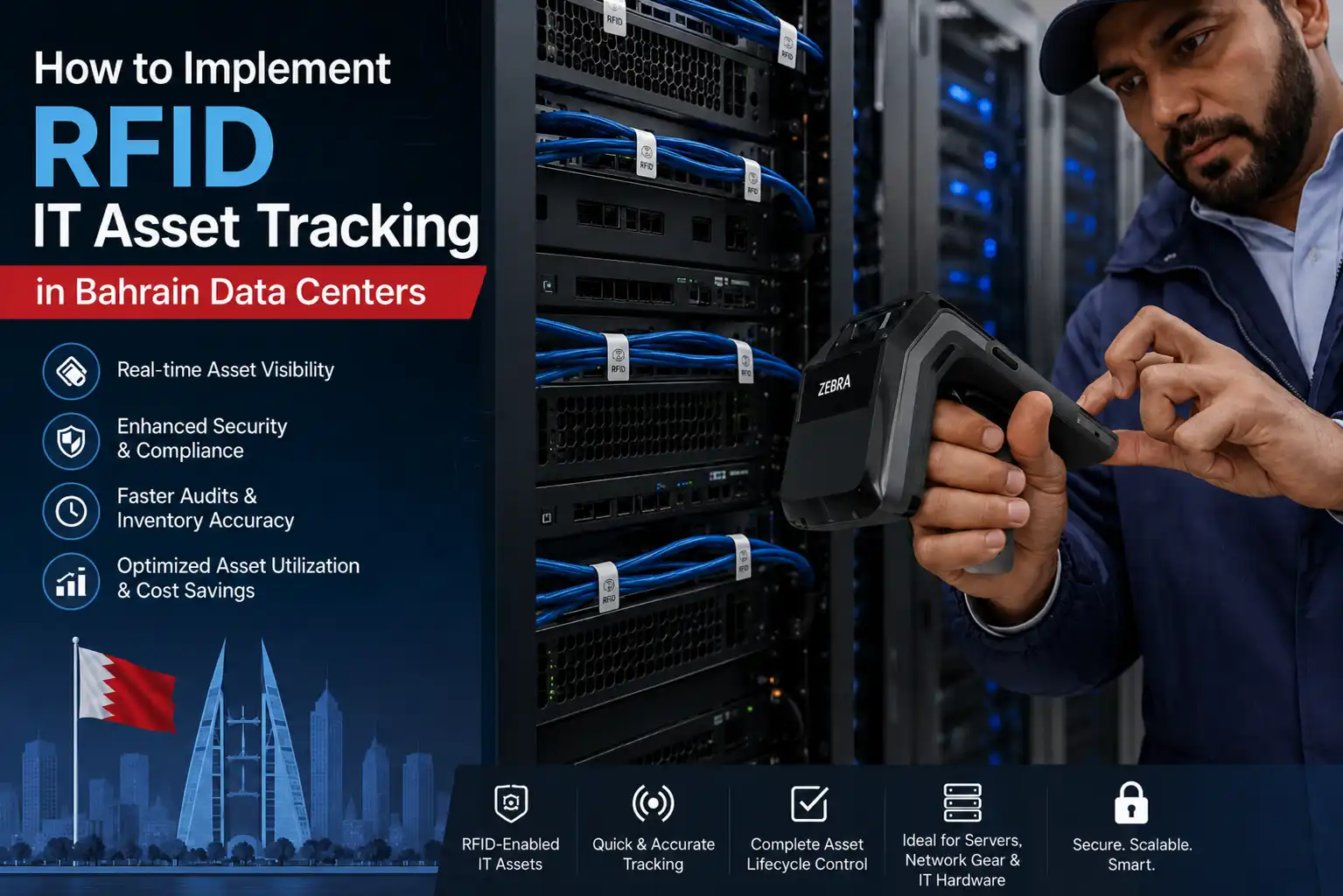
To implement RFID server tracking Bahrain data centers can rely on, start with the right metal-mount tags, map each rack and asset position, validate read zones in live server rooms, and integrate events into asset management or DCIM workflows. When designed correctly, RFID IT asset tracking gives Bahrain operators faster audits, stronger chain-of-custody control, and automatic alerts when servers move outside approved locations.
In a data center, RFID server tracking means assigning an RFID identity to servers, switches, storage units, spare parts, and even rack positions so asset movement can be detected without depending only on manual barcode scans. That matters in Bahrain, where operators serving regulated sectors must maintain accurate records for audits, access control, and data handling practices aligned with guidance from the Kingdom of Bahrain TRA and technology governance expectations under the Central Bank of Bahrain Rulebook.
Why Bahrain Data Centers Need RFID IT Asset Tracking
Bahrain has become a serious location for cloud, colocation, and enterprise hosting, which changes the asset-control problem inside server rooms. Dense racks, frequent maintenance activity, mixed ownership environments, and strict documentation requirements make spreadsheet-based audits too slow for many operators. The result is not just poor visibility; it is delayed incident response when an asset is misplaced, decommissioned incorrectly, or moved without approval.
For financial institutions, government entities, and managed service providers, the issue is also compliance. If an auditor asks where a specific server, blade chassis, or network appliance is located, the answer must be current and defensible. A proper RFID asset management system creates a time-stamped movement history that supports internal controls, disposal verification, and custody reporting.
Question: Why not rely on barcodes alone? Answer: barcode works when someone can physically access and scan each device one by one, but that becomes impractical in high-density racks or during restricted maintenance windows. The limitations are well explained in this guide on barcode asset tracking system limitations, especially where non-line-of-sight reading and faster audits are required.
RFID also helps reduce operational risk without touching active IT equipment. Security teams can monitor movement events, operations teams can verify assets by zone, and facilities teams can reconcile installed equipment against approved rack plans. That is why data center asset tracking Bahrain operators increasingly evaluate is less about theory and more about control, auditability, and uptime protection.
What RFID Server Tracking Means in a Data Center Environment
RFID in a live data center is not a generic warehouse deployment. The objective is to identify exactly which IT asset is present, where it belongs, and whether it has moved through an approved path. That normally means tagging servers, top-of-rack switches, storage arrays, PDUs, spare devices, and sometimes cabinets or cage zones as location references.
For server rooms, metal-mount passive UHF tags are usually the practical choice because standard labels perform poorly on metal surfaces. Quality on-metal tags use a spacer or specialized antenna structure so the tag can reflect energy correctly even when attached to steel server chassis. When selected properly, they do not interfere with active IT equipment because they are passive identifiers, not powered transmitters mounted into the server electronics.
Question: Can RFID accurately track racks and networking equipment? Answer: yes, if the deployment is designed around the physical environment. Fixed readers can monitor rack exits or room choke points, while handheld readers support scheduled validation of individual rack contents, switch panels, and spare inventory shelves. Many teams combine both methods for movement detection plus periodic audit verification.
The trackable estate usually includes installed assets, loose spares, repair stock, loan equipment, and decommissioned items awaiting disposal. This is where disciplined asset tagging services matter: every tag must map to a clean asset record, ownership status, rack position, serial number, and lifecycle stage. Without that data structure, even good RFID hardware will produce weak operational value.
Core Components Needed for RFID Server Tracking Implementation
A Bahrain data center deployment typically needs five layers: RFID tags, readers, antennas, middleware, asset software, and workflow rules. The software layer is what converts a read event into a business event such as “server removed from rack A12” or “asset entered quarantine zone.” For many projects, RFID data feeds into an existing ITAM, ERP, or DCIM stack through APIs rather than replacing those platforms.
The tag decision is the most critical hardware choice. Use purpose-built asset management RFID tags rated for metal surfaces, readable at the required distance, and durable enough for cleaning, servicing, and long equipment life. Reader selection depends on workflow: handheld readers for audits, fixed readers for exits, cages, and rack-level control points.
| Option | Best Use in Data Centers | Advantages | Limits |
|---|---|---|---|
| Passive UHF on-metal RFID | Servers, switches, storage, spares, rack audits | No battery, scalable, cost-effective, suitable for handheld and fixed reads | Requires careful reader and antenna tuning around metal-rich environments |
| Active RFID | Large campuses, long-range zone tracking | Longer read range and automatic beaconing | Higher tag cost, battery maintenance, often unnecessary for rack-level control |
| Barcode only | Basic room inventory and low-change environments | Low entry cost, simple labels | Line-of-sight scanning, slower audits, weaker movement control |
Question: Which is more cost-effective, active or passive RFID? Answer: for most Bahrain server rooms, passive on-metal RFID is the stronger commercial fit because it delivers asset-level identification without battery maintenance. Active RFID becomes relevant when the requirement is broad area location tracking across multiple rooms or buildings rather than cabinet and asset verification.
Beyond hardware, plan for software integration early. A robust inventory tracking platform or asset system should support asset hierarchies, rack-location mapping, audit sessions, exception reports, and role-based alerts. It should also preserve historical movement logs for compliance review.
Step-by-Step Implementation Process for RFID Server Tracking
The safest way to deploy RFID IT asset tracking Bahrain facilities can trust is a phased implementation. Do not start by tagging every device in every room. Start with one room, one asset class, or one control objective such as rack audits or unauthorized removal detection.
- Define the control objective. Decide whether the first goal is faster audits, movement alerts, tenant visibility, or disposal control. Common mistake: buying readers before deciding what operational event the system must detect.
- Survey the physical environment. Document rack density, cabinet materials, cable congestion, restricted aisles, and reader mounting options. Practical tip: include hot aisle and cold aisle conditions because they affect mounting and maintenance access.
- Select and test on-metal tags. Trial several tag formats on 1U servers, blades, switches, and storage units before full rollout. Common mistake: choosing a tag based only on datasheet range instead of real rack performance.
- Map locations and naming standards. Standardize room, row, rack, and unit-position naming so software records match physical reality. Practical tip: freeze naming conventions before mass tagging to avoid data cleanup later.
- Deploy readers and middleware. Configure handheld readers for audits and fixed read points for exits, cage doors, or rack-level checkpoints where justified. Common mistake: creating oversized read zones that capture neighboring assets and generate false exceptions.
- Integrate, train, and pilot. Connect RFID events to asset workflows, train IT and security teams, then run parallel audits before go-live. Practical tip: keep barcode or manual verification available during the pilot until exception rates are understood.
Question: How do you implement RFID asset audits without disrupting operations? Answer: schedule the pilot in a controlled room, use handheld readers first, validate reads from aisle level, and avoid any installation requiring rack shutdown unless a site-specific test proves it is necessary. Most audit workflows can be introduced with minimal operational disruption if tagging and reader placement are planned around maintenance windows.
Where chain-of-custody matters, define exception states from the start: moved, missing, found in wrong rack, pending service, in quarantine, or approved for disposal. These states determine who receives alerts and what evidence is stored. The implementation succeeds when RFID reads drive action, not when they simply accumulate in a dashboard.
How to Integrate RFID with IT Asset Management and Audit Workflows
RFID should not sit beside your existing data; it should enrich it. Integration usually connects reader events with an asset register containing serial number, hostname, owner, business service, rack position, warranty status, and lifecycle stage. If your organization already uses DCIM, ERP, or service management tools, the RFID platform should exchange location and status events through API or file-based workflows.
Question: Can existing DCIM or ERP software integrate with easyTRACK? Answer: in most projects, yes, provided the integration scope is defined clearly. The purpose-built platform should act as the RFID event engine and asset repository while syncing key fields, approvals, and reports with external enterprise systems. This is where a system such as easyTRACK fixed asset management becomes useful because it combines asset records, audit workflows, and RFID-enabled verification in one operational layer.
Audit workflow design is especially important in Bahrain’s regulated environments. A useful pattern is: planned audit list, handheld verification by rack or zone, automatic mismatch report, supervisor review, and closed-loop correction with approval notes. For broader governance requirements, this article on asset compliance and regulatory tracking is relevant because the same principles apply to custody evidence and exception handling.
Alerts should be role-based rather than generic. Security may need immediate notice if a tagged server crosses an exit read point; infrastructure teams may need a daily report of assets found in wrong locations; finance or compliance may need monthly reconciliation history. That separation keeps the RFID asset management system Bahrain enterprises deploy operationally useful instead of noisy.
Key Challenges in Data Centers and How to Solve Them
The main technical challenge is read reliability in metal-dense spaces. Servers, rails, cable managers, blanking panels, and adjacent cabinets all affect RF behavior, so tuning is mandatory. The solution is not more power by default; it is better tag placement, narrower read zones, and validation against specific rack layouts.
A second challenge is mixed asset form factors. A 1U rack server, blade enclosure, firewall appliance, and loose spare drive caddy do not behave the same way in an RF field. Tag templates should be defined per asset family, including exact placement position, orientation, and expected read method. This is why pilot testing must include the smallest and most difficult devices, not just standard servers.
Operational governance is the third challenge. If RFID events are not tied to approved moves, maintenance tickets, and decommissioning processes, teams will not trust the exceptions. Best practice is to document who can move assets, how temporary removals are handled, and what evidence closes a discrepancy. A structured asset framework like the one discussed in enterprise fixed asset management strategies helps align RFID with policy rather than treating it as a standalone tool.
Finally, supportability matters. Readers need firmware management, tags need replenishment standards, and the system needs ongoing calibration after room changes. Local installation, preventive maintenance, and post-deployment support are not optional in a live Bahrain data center; they are part of sustaining asset accuracy over time.
Best Practices for Long-Term Accuracy and Choosing the Right Partner in Bahrain
For long-term success, keep the operating model simple. Tag assets at receipt or before deployment, validate rack assignment during installation, run scheduled handheld audits, and review movement exceptions daily. Accuracy usually degrades when organizations postpone tagging, allow ad hoc naming, or skip exception closure.
Use fixed readers only where they add control value. Exit doors, loading areas, cage boundaries, and selected rack or aisle checkpoints are common locations. Handheld readers remain essential because they provide flexible verification without redesigning the room each time the environment changes.
Buyers in Bahrain should also ask for evidence of regional implementation capability, not just product supply. A suitable partner should understand metal-mount tags, rack-level testing, software integration, and local support expectations. Technowave International combines RFID hardware, software, deployment experience, and after-sales support across the GCC, with solutions spanning RFID asset tracking, tagging, integration, and maintenance; its real project experience includes organizations such as the University of Bahrain.
If your priority is tighter server control, audit-ready asset records, and practical deployment in live facilities, map the workflow first and then build the RFID layer around it. For Bahrain data centers, the best results come from phased implementation, disciplined tag selection, and software-driven exception handling rather than hardware-only procurement.
FAQ: RFID Server Tracking Bahrain
Q: How does RFID server tracking work in a Bahrain data center?
A: Each server or IT asset receives a metal-mount RFID tag linked to its asset record, rack position, and status. Handheld or fixed readers capture tag events, and software converts them into audit results, movement logs, or alerts when equipment appears in the wrong location.
Q: What hardware is needed for RFID IT asset tracking in server rooms?
A: Most projects need on-metal passive UHF tags, handheld RFID readers for audits, fixed readers for exits or control points, antennas, and asset management software. The exact design depends on whether your priority is inventory validation, unauthorized movement detection, or both.
Q: Can RFID be used to track servers, racks, and networking equipment accurately?
A: Yes, provided the deployment uses the correct tag type and is tested in the real rack environment. Accuracy depends on tag placement, reader tuning, and a clean location model covering room, row, rack, and unit position in the software.
Q: How do you implement RFID asset audits without disrupting data center operations?
A: Start with a pilot room, use handheld readers, and test scans from the aisle rather than opening or powering down equipment unnecessarily. Parallel-run RFID with current audit methods first, then move to full workflow automation once exception handling is proven.
Q: What are the benefits of RFID over barcode tracking for IT assets in Bahrain?
A: RFID removes the need for direct line-of-sight scanning, speeds up audits in dense racks, and supports movement detection through fixed read points. Barcode still has value for simple environments, but RFID is stronger where audit speed and custody control are operational priorities.
Q: How does the system alert teams if a server is removed from its designated rack position?
A: The software compares reader events against approved rack assignments and move workflows. If a tag appears at an exit point, in another rack zone, or outside its expected location without an approved task, the system can trigger an exception for security or IT review.
Need a deployment plan tailored to a Bahrain server room, colocation site, or enterprise data center? Work with Technowave International for RFID design, asset tagging, software integration, installation, and long-term support built around real operational workflows.
Related Articles
- Asset Tagging Service Provider in Bahrain: Barcode & RFID Tagging for Faster Audits in 2026
- Best RFID asset management system in Bahrain
- African Eastern Bahrain Esl Case Study
- How Asset Tracking Improves Operational Control in KUWAIT
- Asset Compliance and Regulatory Tracking in Enterprises
- Enterprise Fixed Asset Management: Key Strategies, Challenges, and Emerging Trends
RFID Server Tracking Bahrain: Implementation Guide
Learn how to deploy RFID server tracking Bahrain data centers for audits, movement control, compliance, and accurate IT asset visibility.