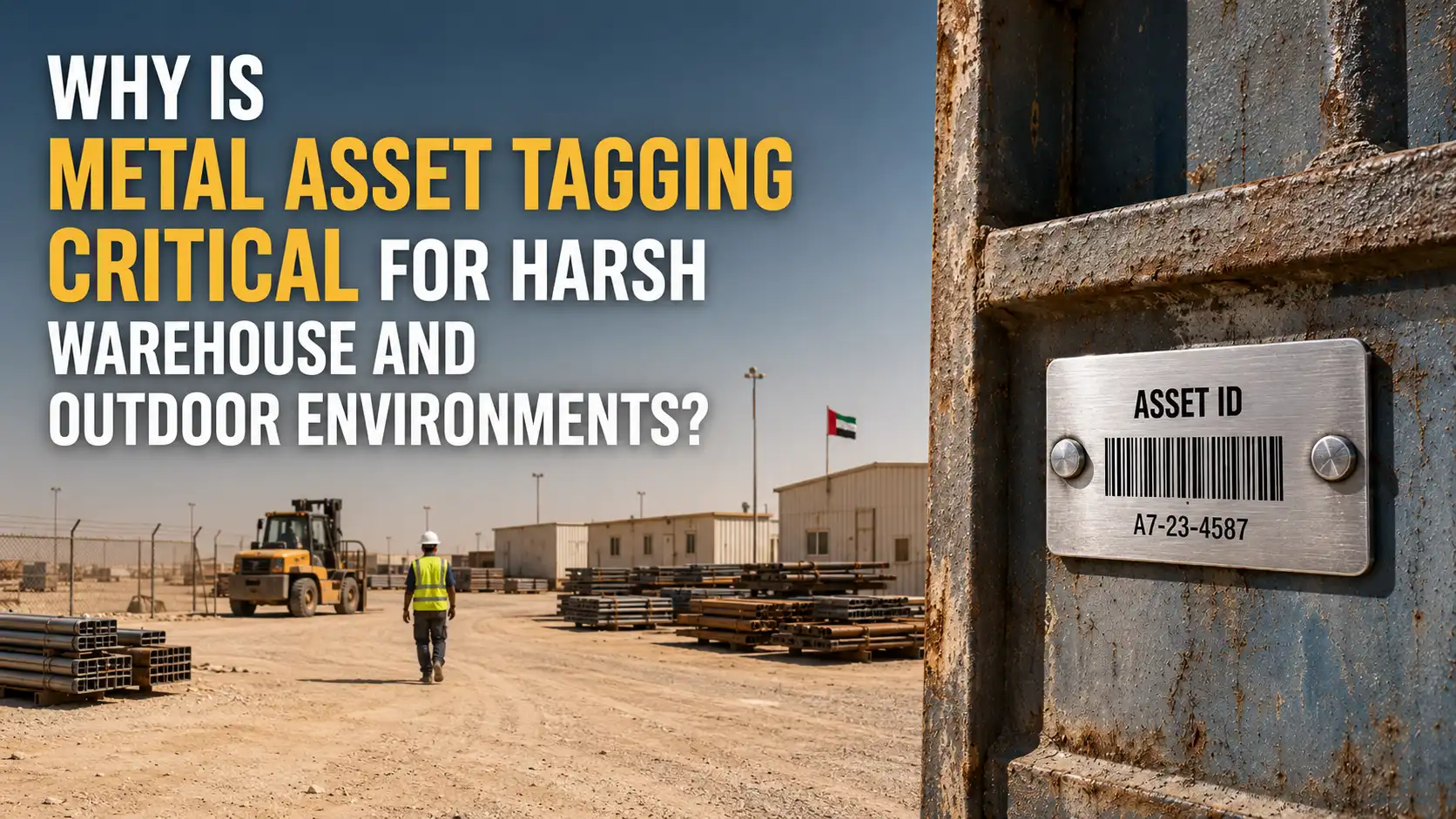
Metal asset tagging is critical in UAE operations because standard paper or polyester labels often fail under heat, UV exposure, abrasion, washdowns, and outdoor dust. For warehouses, yards, industrial plants, and facility teams, metal asset tagging provides durable identification that stays readable for years, supports faster audits, and reduces the operational delays caused by missing or damaged labels.
What is metal asset tagging? It is the practice of marking assets with durable metal nameplates or labels, usually anodized aluminum or stainless steel, carrying a serial number, barcode, QR code, or embedded RFID inlay. In UAE conditions, this is not a cosmetic upgrade. It is a control measure for fixed asset tracking, maintenance history, compliance, and inventory accuracy.
What fails in UAE environments, and why standard labels are not enough
In an air-conditioned office, a printed synthetic label may last acceptably. In a Dubai yard, a steel rack exposed to summer heat, forklift contact, and dust is a different use case entirely. According to Zebra Technologies, rugged labeling selection must account for heat, chemical exposure, abrasion, and surface material rather than assuming one label construction fits all environments.
UAE warehouses and outdoor sites combine several failure drivers at once: high ambient temperatures, direct sunlight, rough handling, periodic washdowns, and metal substrates. Research published in Polymer Degradation and Stability shows UV exposure can degrade standard synthetic labels within months in severe climates, which is why many operations discover barcode readability problems long before the asset itself reaches midlife.
When identification fails, maintenance and audit teams lose time searching, cross-checking spreadsheets, or re-tagging equipment. The Federal Highway Administration has noted in asset management studies that identification failure and asset search time can materially increase maintenance labor burden. For businesses already facing audit pressure, this is why durable identification becomes part of governance, not just storekeeping.
For this reason, companies evaluating asset tagging services in Abu Dhabi, Dubai, or Sharjah should start by defining environmental stress, not by comparing tag prices alone. The cheapest label is often the most expensive tag once replacement cycles and audit disruption are considered.
How metal asset tags improve traceability, compliance, and audit performance
Metal asset tags are designed for assets that must remain identifiable throughout relocation, servicing, or long operational life. Typical examples include warehouse racking, MEP equipment, chillers, generators, steel containers, forklifts, outdoor cabinets, reusable transport assets, and field tools. A well-specified tag can carry a human-readable asset ID, a 1D or 2D code, and in some cases RFID for non-line-of-sight reading.
The business case is straightforward. If a tag remains readable through years of handling, the asset record stays connected to maintenance events, depreciation schedules, ownership, and location history. In practice, this improves physical verification quality and supports serialized tracking requirements often requested in internal audits, insurance reviews, and public-sector asset checks.
There is also a strong cost-benefit angle in UAE operations. A one-time investment in anodized aluminum or stainless steel metal asset tags can be more economical than repeatedly replacing surface-printed labels on high-value equipment. According to RFID Journal, ruggedized tracking environments consistently prioritize tag survivability because inventory accuracy depends first on the identifier remaining on the asset.
For organizations already using an asset management system, metal asset tagging is what makes the software reliable in the field. The database can only be as accurate as the identifier that technicians scan during audits, movement tracking, and preventive maintenance workflows.
RFID vs barcode metal asset tags: which option fits your operation?
The right choice depends on how assets are audited, how fast teams must work, and whether line-of-sight scanning is practical. Barcode metal tags are cost-effective and highly readable at close range when the printed code is deeply engraved, etched, or protected in an anodized layer. RFID metal asset tags are better when staff must scan many assets quickly, read tags at a distance, or access items in hard-to-reach positions.
Direct buyer question: Can RFID tags work reliably on metal surfaces?
Yes, but only if they are designed specifically for metal. Standard RFID inlays detune on conductive surfaces because metal reflects RF energy and alters antenna behavior. Best practice, referenced in EPC Gen2 guidance under ISO/IEC 18000-6C standards and industry deployment advice from RFID Journal, is to use purpose-built on-metal tags with a spacer, ferrite layer, or engineered housing.
| Criteria | Barcode metal tag | RFID metal asset tag |
|---|---|---|
| Read method | Line-of-sight scan | Non-line-of-sight radio read |
| Best for | Fixed assets audited one by one | Bulk audits, yards, rack rows, hard-to-reach assets |
| Tag cost | Lower | Higher |
| Speed in field audits | Moderate | High |
| Performance on metal | Excellent when engraved properly | Requires on-metal design |
| Typical integration | Mobile barcode app or handheld terminal | RFID handheld, fixed readers, asset software |
Many UAE businesses use both. A dual-technology strategy gives teams visual identification and barcode backup while enabling RFID-based audits with rugged handhelds. This model fits especially well with RFID asset tracking solutions where speed matters but maintenance teams still want a visible serial plate.
Choosing the right metal substrate, attachment method, and data format
Not all metal tags are equal. Anodized aluminum is widely used for general industrial assets because it is lightweight, durable, and supports clear barcode imaging with sealed subsurface printing. Stainless steel, especially 316 grade, is preferred in coastal, corrosive, or chemical environments where saline air, washdowns, or harsh cleaners accelerate corrosion in lower-grade materials and fasteners.
Direct buyer question: Which adhesive survives 50°C+ outdoor conditions?
For UAE outdoor storage, buyers should not rely on generic foam tapes or low-grade peel-and-stick labels. High-shear acrylic adhesive systems are typically specified for high-temperature applications, but suitability still depends on substrate, texture, surface preparation, and dwell time. For heavy machinery, steel beams, and movable assets, mechanical fixing such as rivets or screws is usually more reliable than adhesive alone.
Customization is another important evaluation point. Yes, a metal asset tag can be produced with a human-readable serial number, DataMatrix code, company branding, and embedded RFID chip, but layout discipline matters. The code size must match scanner optics, the engraving depth must survive abrasion, and the RFID construction must match the mounting surface and required read distance.
Companies planning long-term deployment should also consider printer and consumable compatibility for non-metal supplementary labels, especially where stores, bins, and documents are tracked alongside capital assets. This is where asset tags for asset management and related barcode or RFID media strategy need to be aligned from the start.
Where metal asset tagging delivers the strongest operational return
In warehouses, metal asset tagging is most valuable on assets that move, get hit, get cleaned, or stay outdoors: forklifts, pallets cages, reusable trolleys, racking uprights, dock equipment, compressors, gensets, and maintenance tools. In logistics yards, it helps track containers, trailers, and heavy equipment that are otherwise hard to verify quickly during physical counts.
Facilities and corporate environments use metal tags on chillers, pumps, fire safety assets, server racks, UPS units, and branch infrastructure because these items need auditable identity over many years. Government, education, and healthcare buyers also use durable tagging for serialized verification across multiple sites, where missing or duplicated labels create reconciliation problems during audits.
For businesses asking how audits become faster, the answer is simple: durable tags reduce exception handling. Instead of re-identifying unreadable assets, teams scan and move on. Industry research summarized by RFID Journal indicates ruggedized automated asset tracking environments can achieve much higher inventory accuracy than manual or weakly tagged processes, particularly when combined with handheld RFID readers and disciplined asset master data.
Implementation should therefore combine the physical tag, the scan workflow, and the system of record. A practical deployment often links rugged handhelds to warehouse management and inventory tracking solutions or fixed asset software so each read updates status, location, and audit history. The real gain is not the tag itself; it is dependable field data.
Deployment best practices: from pilot to system integration
Start with a site survey, not a catalog order. Review asset categories, substrate materials, environmental exposure, expected read distance, and attachment constraints. Then pilot on a representative set: one outdoor group, one warehouse group, and one maintenance-critical group. This quickly exposes whether engraved barcode, on-metal RFID, or a hybrid tag is the better fit.
Next, define the audit process. Who scans the tag, with which device, at what distance, and into which software? If the answer is still a spreadsheet, the value of durable tagging will be limited. A better approach is to connect tags to a structured fixed asset tagging and audit workflow so location changes, custodian updates, and verification history are captured in the same system.
Integration matters particularly for RFID. Readers must be tuned for the tag type, metal proximity, and real read zone required in the yard or warehouse aisle. Handheld integration with fixed asset software such as easyTRACK AMS allows field teams to read metal tags, validate the asset record, and reconcile missing items without rekeying. That is how tag durability turns into operational control.
For UAE businesses that need local implementation, tagging, software setup, and post-deployment support, Technowave International combines durable asset identification, RFID and barcode hardware, and in-house asset tracking software. Buyers evaluating metal asset tags UAE projects should involve the team early to validate substrate, attachment method, scan technology, and integration before a full rollout.
FAQ
Q: What is metal asset tagging and how does it work?
A: Metal asset tagging uses durable aluminum or stainless steel tags to mark assets with a serial number, barcode, QR code, or RFID chip. Staff scan or read the tag during audits, movement tracking, and maintenance, linking the physical item to its digital asset record.
Q: Why are metal asset tags better for warehouses and outdoor assets?
A: They resist heat, UV, abrasion, chemicals, and impact far better than standard labels. In warehouses and yards, this means the identifier stays attached and readable, so teams spend less time re-tagging items or investigating assets with missing labels.
Q: Can RFID tags work reliably on metal surfaces?
A: Yes, if they are purpose-built on-metal RFID tags. Standard RFID labels usually perform poorly on steel or machinery surfaces, but tags designed with spacers or shielding can maintain usable read performance when matched correctly to the reader and mounting surface.
Q: Which assets should use metal asset tags in UAE operations?
A: Prioritize high-value, long-life, mobile, or outdoor assets such as racking, forklifts, generators, HVAC equipment, containers, pumps, tools, cabinets, and vehicles. These are the items most likely to suffer label failure and the ones where traceability matters most.
Q: How do metal asset tags improve fixed asset audits and tracking?
A: They make asset IDs consistently readable during physical verification. That reduces exceptions, helps auditors reconcile records faster, and supports more accurate location and custodian updates when used with handheld scanners and asset management software.
Q: What is the difference between anodized aluminum and 316 stainless steel tags?
A: Anodized aluminum is lighter and commonly used for general industrial tracking. 316 stainless steel is preferred where corrosion risk is high, such as coastal or chemical environments. The right choice depends on exposure, cleaning methods, asset life, and mounting conditions.
If your operation depends on accurate asset visibility in warehouses, yards, plants, or outdoor facilities, metal asset tagging should be treated as infrastructure, not a consumable. Assess the environment, choose the right tag construction, and connect it to a proper tracking workflow. Technowave International can help you evaluate the right barcode or RFID approach, validate field performance, and build a durable asset tracking program for UAE conditions.
Related Articles
- Why Professional Asset Tagging Services in Dubai Are Essential for IFRS 16 Compliance
- 7 Mistakes to Avoid When Hiring Asset Tagging Services in Dubai
- asset tagging and asset management services in abu dhabi
- How to Standardize Your Fixed Asset Register Before Hiring an Asset Tagging Service
- Case Study: How a Turnkey Asset Tagging Service Reduced Audit Drifts for a Multi-Branch Corporation
- In-House Tagging vs. Professional Asset Tagging Service: Cost, Speed, and Accuracy Analysis
Metal Asset Tagging for Harsh UAE Environments
Learn why metal asset tagging is critical in UAE warehouses and outdoor sites for durability, traceability, and accurate fixed asset tracking.