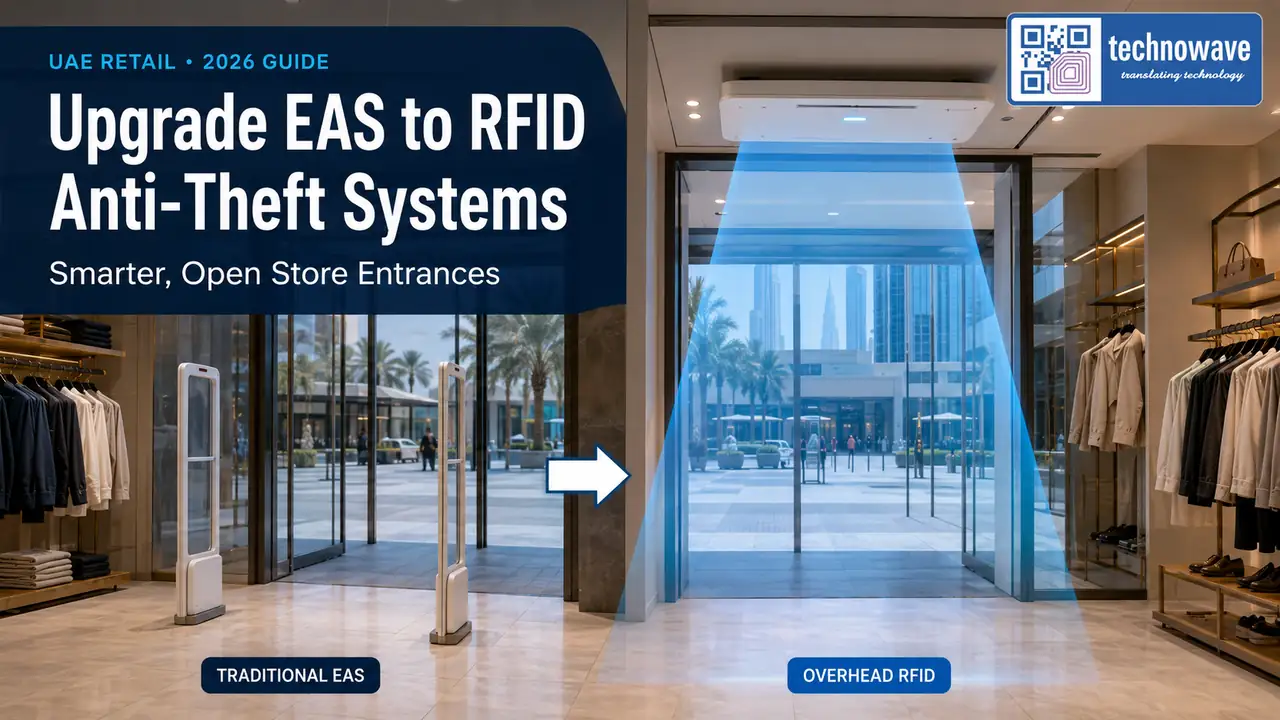
EAS to RFID migration UAE projects should be planned as an operational upgrade, not just a security replacement. The right migration path lets UAE retailers reduce shrink risk, identify the exact item moving through the exit, and use the same tag data for cycle counts, replenishment, and store accuracy. This guide explains how to assess your current setup, choose a phased migration model, and deploy RFID with minimal trading disruption.
What is an EAS to RFID migration? It is the process of moving from alarm-only anti-theft infrastructure to item-level detection that links gates, tags, handheld readers, store software, and POS or ERP systems. In practice, that means replacing or augmenting traditional EAS RF systems with an RFID anti-theft system that supports both loss prevention and inventory workflows.
Step 1: Build the business case before you touch any hardware
UAE retailers are moving to RFID because legacy EAS only tells security that something passed the exit; it does not tell operations what item left, whether the item was sold, or whether the stock file is now wrong. RFID closes that gap by connecting exit detection with item identity, which matters in fashion, cosmetics, electronics accessories, and luxury retail where size, color, and variant accuracy drive replenishment decisions.
The strongest business case is usually not shrink alone. It is the combined value of loss prevention, faster stock counts, better receiving accuracy, cleaner omnichannel inventory, and less manual effort on store audits. According to McKinsey & Company, RFID can improve inventory accuracy to more than 95 percent, which is why finance and IT teams increasingly treat migration as shared infrastructure rather than a pure security spend.
Step action: define the outcome by store format. For a luxury boutique, the priority may be open entrances and discreet overhead detection. For a value fashion chain, the priority may be faster cycle counts and source tagging. For supermarkets, RFID anti-theft is usually more selective by department than full-store.
Practical tip: do not justify the project only on “theft reduction.” If the board sees RFID as a single-use security upgrade, budget approval becomes harder than if you position it as dual-purpose retail infrastructure.
Step 2: Compare your current EAS environment with the RFID target architecture
Before planning rollout, map the technical difference between today’s environment and the future state. AM or RF EAS labels trigger an alarm when active labels cross the gate. RFID tags, by contrast, allow the system to read an item identifier and check whether that item has been sold, transferred, or still belongs inside the store. That distinction changes software, tagging, and store procedures.
| Area | Traditional EAS | RFID anti-theft |
|---|---|---|
| Exit event | Alarm only | Alarm plus item identity |
| Inventory use | None | Supports counts, lookup, receiving, replenishment |
| Tag data | No item detail | SKU or item-level EPC data |
| Migration path | Standalone security | Can be phased with dual-technology tags |
| Store design | Usually floor pedestals | Pedestals or overhead ceiling readers |
| Operational value | Loss alert | Loss alert plus stock visibility |
Can you reuse existing gates? Sometimes yes, but not always. Some retailers keep their current pedestals temporarily and introduce dual-technology hard tags or labels during rollout, then move to RFID-capable lanes later. Others switch directly to overhead systems such as the Sensormatic RFID overhead EAS system when storefront aesthetics and wide entrances are key, especially in premium malls.
Step action: document gate type, lane width, ceiling height, power, network points, POS logic, detacher process, and tag disposal flow. Common mistake to avoid: assuming that a successful EAS gate location is automatically a successful RFID read zone; read performance depends on product mix, orientation, and environmental noise.
Step 3: Assess item tagging, store readiness, and data quality
The migration succeeds or fails at the tag level. Start by classifying merchandise into simple, moderate, and difficult read environments. Apparel, footwear, and boxed accessories are usually straightforward. Cosmetics with foil packs, metal-rich products, and liquids require more careful tag placement, spacer materials, or packaging redesign. Jewellery and very small accessories may need specialized labels or hard tags rather than generic stickers.
Step action: run a tagging workshop before procurement. Test sample items at the fitting room, stockroom, receiving area, POS desk, and exit. Verify not only whether the item reads, but whether it reads consistently in realistic orientations and densities. If source tagging from the manufacturer is possible, align EPC structure and label specification early to reduce in-store labor.
Data readiness matters just as much as radio performance. RFID relies on clean item masters, unique identifiers, barcode-to-EPC mapping rules, and correct sellable-unit definitions. If your ERP or merchandising file has duplicate SKUs, inconsistent size-color matrices, or unclear pack hierarchies, RFID alerts become operational noise. This is why buyers often combine migration planning with a broader RFID retail solution review rather than treating gates as a standalone project.
Practical tip: create a short “exception item” list before pilot launch. Difficult categories should have approved tag positions, not ad hoc decisions by store staff, otherwise read rates vary from store to store.
Question: How do you handle liquids, metals, and cosmetics?
Answer: do not use one universal label. Use category-specific tags, keep distance from metal where possible, validate orientation near exit antennas, and retest after packaging changes. A small pilot set with real products is more reliable than a desktop lab assumption.
Step 4: Plan the integration, pilot, and phased migration model
Once the item and infrastructure assessment is complete, design the software flow. The RFID event engine must know whether an item is sold, reserved, transferred, returned, or still expected in the store. That requires integration with POS and often with ERP platforms such as Oracle, SAP, or Microsoft Dynamics. The key design question is not “can it integrate?” but “which system is the master for sale status, stock status, and exception handling?”
Step action: define the minimum viable integration for the pilot. In many UAE projects, phase one includes item master sync, tag commissioning, POS deactivation or sale-state update, alert dashboard, and handheld verification. Broader workflows such as receiving automation or omnichannel fulfillment can follow later using RFID detection systems and handheld tools around the same data model.
A phased migration is usually the safest approach for a 10-store chain. Start with one pilot store and one reference store profile, then validate tag performance, alert logic, staff process, and reporting accuracy. If existing EAS cannot be replaced immediately, dual-technology tags allow continuity while stores are converted in waves. That reduces downtime and avoids a “big bang” hardware cutover during peak trade periods.
Common mistake to avoid: overbuilding the pilot. If you try to connect every warehouse, finance, and omnichannel process before proving store-level anti-theft logic, the project slows and internal confidence drops.
Step 5: Execute rollout, train store teams, and measure post-go-live performance
Implementation is where many technically good RFID projects lose value. The rollout plan should cover civil work, device staging, network validation, tag supply, store kit shipment, training, go-live support, and hypercare. For multi-branch UAE retailers, weekend and overnight windows are common because entrance zones, POS counters, and back-room workflows must be adjusted without affecting trade.
Step action: create role-based SOPs for security, cashiers, stock controllers, and store managers. Cashiers need sale-state handling and exception clearing. Security teams need alert response by item identity. Stock teams need count procedures with handhelds and daily exception review. A pilot can also be paired with connected retail tools such as Electronic Shelf Labels when the retailer wants cleaner price accuracy and faster floor execution from the same store digitization program.
Measure success with a controlled set of KPIs: false alarm rate, unread rate by category, sell-state exceptions, count duration, stock accuracy trend, and shrink investigation quality. Use real case references to pressure-test the design; for example, this fashion retail RFID automation case study and this UAE RFID retail automation case study show how item-level tracking is applied in live retail environments rather than as a lab concept.
Practical tip: plan support after go-live, not just go-live itself. Stores need tag replenishment, reader health checks, staff refreshers, and exception review. That is why retailers usually prefer one partner for installation, software coordination, and ongoing AMC rather than splitting accountability across multiple vendors.
FAQ
Q: What is the difference between EAS and RFID anti-theft systems in retail?
A: Traditional EAS mainly tells you that an active tag crossed the exit. RFID tells you which item crossed, whether it was sold, and whether stock records should change. That makes RFID useful for both anti-theft and inventory operations, while EAS is primarily a security layer.
Q: How much does it cost to upgrade from EAS to RFID in the UAE?
A: Cost depends on gate type, store count, tag volumes, software integration, and whether you choose pedestals, overhead readers, or a phased dual-tag model. The largest cost drivers are usually recurring tag strategy and integration scope, not only the entrance hardware.
Q: Can existing EAS gates be reused in an RFID migration project?
A: In some cases, yes. Retailers may keep legacy gates during transition and use dual-technology tags while pilot stores move to RFID-capable infrastructure. Reuse depends on the existing hardware model, lane geometry, and whether the business needs item-level identification at the exit immediately.
Q: How long does an RFID anti-theft deployment take for a UAE retail store?
A: A single store pilot can move quickly once tag testing, network readiness, and POS integration are confirmed. A chain-wide rollout takes longer because item master cleanup, supplier tag alignment, staff training, and phased installation across branches are usually the critical path, not the gate mounting itself.
Q: Does RFID improve both loss prevention and inventory accuracy at the same time?
A: Yes, if the deployment includes proper item master mapping, sale-state updates from POS, and disciplined counting procedures. RFID does not deliver that value automatically; it must be tied to daily store processes so the same item identity supports both alerts and stock visibility.
Q: What is the typical mistake UAE retailers make when upgrading EAS to RFID?
A: The most common mistake is treating RFID as a gate replacement only. That ignores tag engineering, difficult product categories, software rules, and store operations. Projects perform better when buyers plan the migration as a combined security, stock accuracy, and retail automation program.
If you are planning an EAS anti theft system replacement UAE project, work with an implementation partner that can handle hardware, tags, software integration, pilot execution, and post-go-live support locally. Technowave International supports UAE retailers with RFID design, deployment, retail integration, installation, and ongoing service across the region.
Related Articles
- Rfid Anti Theft Detection Systems
- Why Sensormatic EAS Systems Are the Best Choice for Retail Security in Bahrain
- CCTV & Surveillance Systems in Oman – Complete Security Guide for 2026
- Comparing the Best People Counting Systems for Retail in the UAE: Which One Fits Your Needs?
- People Counting Systems: Are They Worth the Investment for UAE Retailers?
- How Integrated Retail Automation & People Counting Systems Are Redefining Customer Experience in UAE Malls
EAS to RFID Migration UAE: 2026 Retail Guide
Learn how to plan EAS to RFID migration UAE retail projects for better loss prevention, inventory accuracy, integration, and rollout control.