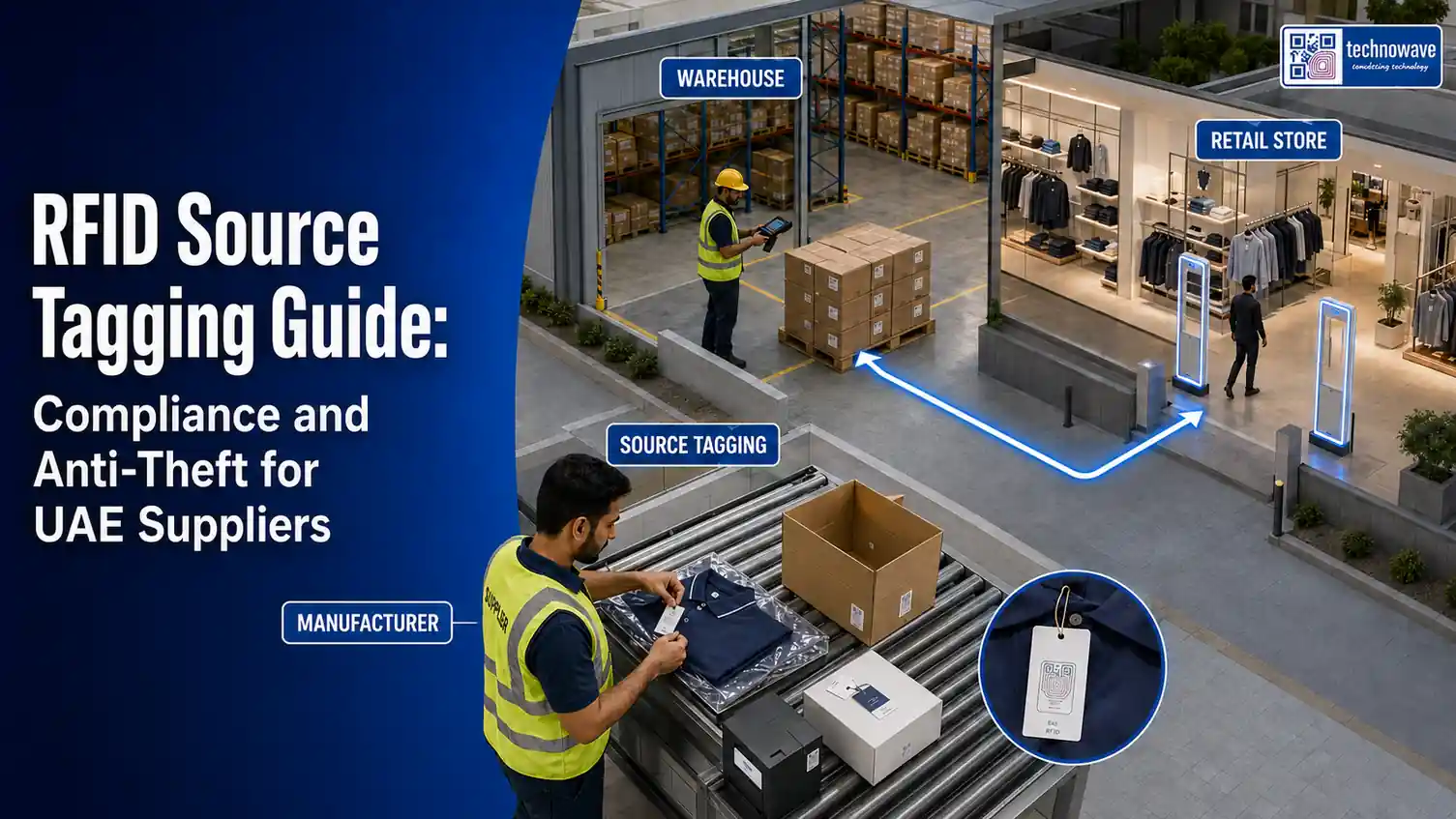
RFID source tagging UAE projects are no longer limited to pilot programs. For suppliers serving large retailers in Dubai and across the Emirates, source tagging has become a practical requirement for faster receiving, better inventory visibility, and stronger loss prevention. The core decision is not whether tags can be applied, but how to deploy the right tag, printer, encoding workflow, and system integration without disrupting packaging operations.
What is RFID source tagging? It is the process of applying and encoding an item-level RFID tag at the factory, packing line, or distribution point before goods reach the retailer. That means each product arrives retail-ready, already carrying a unique identifier that can be read in bulk at warehouse docks, back rooms, sales floors, and exit gates.
For UAE suppliers, this matters because retail groups increasingly expect tagged products to move through receiving and store operations with minimal manual handling. Source tagging also creates a dual-purpose asset: the same label can support item visibility and, in many cases, function within an RFID anti-theft system at store exits.
What RFID Source Tagging Means in the UAE Retail Supply Chain
In the UAE, RFID source tagging usually sits between brand packaging and retail compliance. A supplier encodes a unique EPC to each item, verifies readability, then ships cartons that can be checked by bulk reading rather than piece-by-piece barcode scanning. This is especially relevant in apparel, cosmetics, luxury accessories, consumer electronics, and pharmacy-adjacent retail where speed and item-level accuracy matter.
Industry studies consistently show why retailers push this model. According to Auburn University RFID Lab, item-level RFID can improve inventory accuracy to above 95% and reduce out-of-stocks significantly when deployed correctly. In practical terms, that means fewer stock mismatches between the ERP, stock room, and sales floor.
For a UAE supplier, the business value goes beyond compliance. Once products are tagged at source, the same identifier can support internal dispatch verification, carton aggregation, returns control, and shipment reconciliation. Companies already using asset tagging services or serialized warehouse processes often find source tagging easier to adopt because the discipline around master data and label governance already exists.
Why local conditions change the design
Middle East deployment conditions affect tag choice more than many buyers expect. Heat exposure, adhesive performance on imported packaging, metallic foils in cosmetics, and dense mixed-SKU cartons can all reduce read performance if testing is skipped. That is why UAE projects should start with sample validation across real packaging materials, not just datasheet comparisons.
How Source Tagging Supports Retail Compliance and Anti-Theft
When a UAE retailer mandates RFID, the requirement is usually operational, not theoretical. The supplier may be asked to encode tags to a specific EPC structure, place the label in an approved product location, use defined carton labeling rules, and meet read-rate thresholds at receiving. If those conditions are missed, goods may require rework at the distribution center or store, shifting cost back to the supplier.
Question: What does compliance usually include? The answer is four parts: standards, placement, readability, and data consistency. Standards typically align with GS1 EPC structures and UHF/Rain RFID practices; placement determines whether the tag can be read on shelf and at exit; readability affects dock-door performance; and data consistency ensures the encoded EPC matches the product master and shipment records.
Anti-theft is the second driver. Traditional EAS only answers whether an item passed the gate. RFID-based retail security can identify which item triggered the alarm and also link that event back to stock records. This is why many retailers and suppliers compare pure EAS deployment with broader next-generation RFID anti-theft approaches when evaluating long-term store modernization.
| Requirement Area | Basic EAS Label | RFID Source Tag | Operational Impact |
|---|---|---|---|
| Exit alarm | Yes | Yes | Supports theft deterrence |
| Item identification | No | Yes | Faster investigation of shrink events |
| Bulk receiving | No | Yes | Reduces manual scanning workload |
| Inventory counting | No | Yes | Enables rapid cycle counts |
| Supplier compliance value | Limited | High | Supports retail mandates and analytics |
For suppliers, the key insight is that compliance spending should be evaluated as infrastructure, not just as a customer-specific labeling cost. Once the line is set up properly, the same process can improve dispatch accuracy and reduce exceptions across multiple retail accounts.
How the RFID Source Tagging Process Works from Supplier to Store
A typical RFID source tagging workflow starts with SKU mapping. Each product family is assigned the correct tag type, print template, EPC logic, and placement rule. Encoding then happens at the packaging station, either through print-and-apply automation or operator-driven printing, followed by verification to catch dead tags, duplicate EPCs, or print quality defects before cartons are sealed.
Question: What information is encoded into the tag? Usually the encoded data is an EPC identifier linked in software to item attributes such as SKU, size, color, batch, or serial. The tag does not need to store every business field on-chip; in many deployments, the EPC acts as the key that connects the physical item to ERP, WMS, or retail stock systems.
At carton level, suppliers may also create parent-child relationships so item tags are associated with a carton or shipment ID. This improves receiving because the retailer can compare expected shipment data against actual reads at the dock. Companies evaluating broader RFID reader infrastructure should consider where fixed readers, handheld verification, and printer validation fit across packing, staging, and dispatch.
Where projects usually fail
Most failures come from process design, not radio physics alone. Common problems include using one tag inlay for every SKU, ignoring packaging materials that detune the tag, poor printer calibration, and no exception-handling workflow for unreadable labels. UAE importers and manufacturers should also plan for retailer-specific onboarding documents, sample approvals, and cutover timing before high-volume seasonal shipments.
For retail operations teams, source tagging changes store receiving as well. Tagged items can move directly into stock handling, replenishment, cycle counting, and gate-based security checks without a second labeling step. That reduces labor at the store level and avoids the inconsistency that appears when some items are tagged centrally and others on site.
Choosing Tags, Printers, Readers, and Software for UAE Deployment
The first technical choice is tag form factor. Soft labels work well for boxed goods and many packaged consumer items; hangtags are common in apparel and soft goods; hard tags suit reusable or high-value items where durability matters. The right selection depends on read performance, aesthetics, deactivation or detachment requirements, and whether the tag must survive logistics friction or store handling.
Question: Can existing barcode printers be upgraded? Sometimes, but not reliably for enterprise source tagging. If the current fleet lacks RFID encoding modules, antenna calibration, and RFID print verification, a specialized RFID printer is normally required. For suppliers managing large volumes, dedicated RFID printing reduces encoding errors and supports consistent EPC serialization across shifts and production lines.
Reader strategy should match the process. Fixed readers are useful for automated checkpoints, while handheld RFID readers are often the fastest way to manage exception handling, sample audits, and dispatch verification. On the consumables side, buyers should validate adhesive grade, face stock, chip sensitivity, memory requirements, and the suitability of RFID tags and labels UAE solutions for heat, curved surfaces, foil packaging, or dense carton stacking.
Software is the layer that turns encoded tags into a usable business process. At minimum, suppliers need serialization control, print management, read-event filtering, and integration with ERP or WMS transactions. Better projects also include dashboards for failed encodes, duplicate EPC prevention, shipment reconciliation, and retailer-specific label logic so operations teams can switch customer profiles without manual data manipulation.
Business Benefits, Implementation Risks, and Why UAE Suppliers Should Act Now
The operational upside of RFID source tagging is straightforward: faster receiving, fewer scan bottlenecks, better stock accuracy, and stronger traceability from dispatch to store. Industry reporting indicates source-tagged goods can move through receiving far faster than manual barcode-only handling, which is why major chains continue extending mandates beyond apparel into cosmetics, electronics, and other controlled retail categories. For suppliers, this creates a compliance pressure point but also a chance to improve internal warehouse discipline.
The main buying criteria should be practical and measurable: tag read performance on real products, encoding stability at production speed, standards alignment, software integration effort, and support responsiveness inside the UAE. Buyers should ask vendors to prove performance on problematic SKUs, show how EPCs map into current ERP fields, and define what happens when tags fail verification or retailers update compliance rules.
Risk reduction depends on phased implementation. A sensible rollout usually starts with a small SKU group, a verified tag matrix, and packaging-line testing under live operating conditions. From there, suppliers can expand to more product classes, introduce fixed validation points, and align source tagging with broader retail RFID automation use cases such as stock counts, replenishment, and store audit workflows.
For UAE organizations that need both compliance readiness and local deployment support, Technowave International can help with RFID tags, printers, readers, software integration, testing, installation, and after-sales support across retail and warehouse environments. If you are planning a retailer onboarding program or replacing manual tagging at store level, now is the right time to validate your SKUs, packaging workflow, and security requirements before the next high-volume buying cycle.
FAQ
Q: What is RFID source tagging and how does it work for UAE suppliers?
A: RFID source tagging means applying and encoding the RFID label before goods reach the retailer, usually at the factory or packing line. UAE suppliers use it to ship retail-ready products with unique EPC identifiers that can be read in bulk for receiving, stock checks, and anti-theft workflows.
Q: How does RFID source tagging help with retail compliance and anti-theft?
A: It helps suppliers meet retailer requirements for item-level visibility, approved tag placement, and faster receiving. In many retail environments, the same RFID tag also works with exit gate systems, giving the retailer both stock intelligence and theft deterrence from one labeling process.
Q: What information is encoded into RFID tags for retail products?
A: Most deployments encode an EPC number rather than full product details. That EPC is linked in software to SKU, size, color, batch, serial, or shipment data. This keeps tag memory use efficient while allowing ERP and WMS platforms to retrieve the full product record.
Q: Which industries in the UAE benefit most from RFID source tagging?
A: Apparel remains the most mature use case, but cosmetics, electronics, luxury retail, pharmacy-related retail, footwear, and selected packaged goods also benefit. The best fit is any category where item accuracy, shrink control, and high-volume receiving create measurable operational pressure.
Q: What hardware and software are required to implement RFID source tagging?
A: A complete setup usually includes RFID tags, RFID printers or print engines, verification tools, handheld or fixed readers, serialization software, and ERP or WMS integration. The exact design depends on SKU volume, packaging materials, production speed, and retailer compliance rules.
Q: How do we calculate ROI for RFID tagging for suppliers in the UAE?
A: Start with direct costs such as tags, printer infrastructure, and integration, then compare them with avoided store tagging labor, reduced receiving delays, fewer chargebacks or rework events, better shipment accuracy, and lower shrink exposure. A pilot across representative SKUs gives the most realistic business case.
Related Articles
- Rfid Anti Theft Detection Systems
- The Enterprise Guide to Deploying an Asset Tagging Service: RFID and Barcode Best Practices
- Why Professional Asset Tagging Services in Dubai Are Essential for IFRS 16 Compliance
- Barcode scanners Online Dubai Leading Supplier in UAE
- Asset Compliance and Regulatory Tracking in Enterprises
- Why is Metal Asset Tagging Critical for Harsh Warehouse and Outdoor Environments?
RFID Source Tagging UAE Guide for Suppliers
Learn RFID source tagging UAE requirements for retail compliance, anti-theft, faster receiving, and inventory accuracy for suppliers.