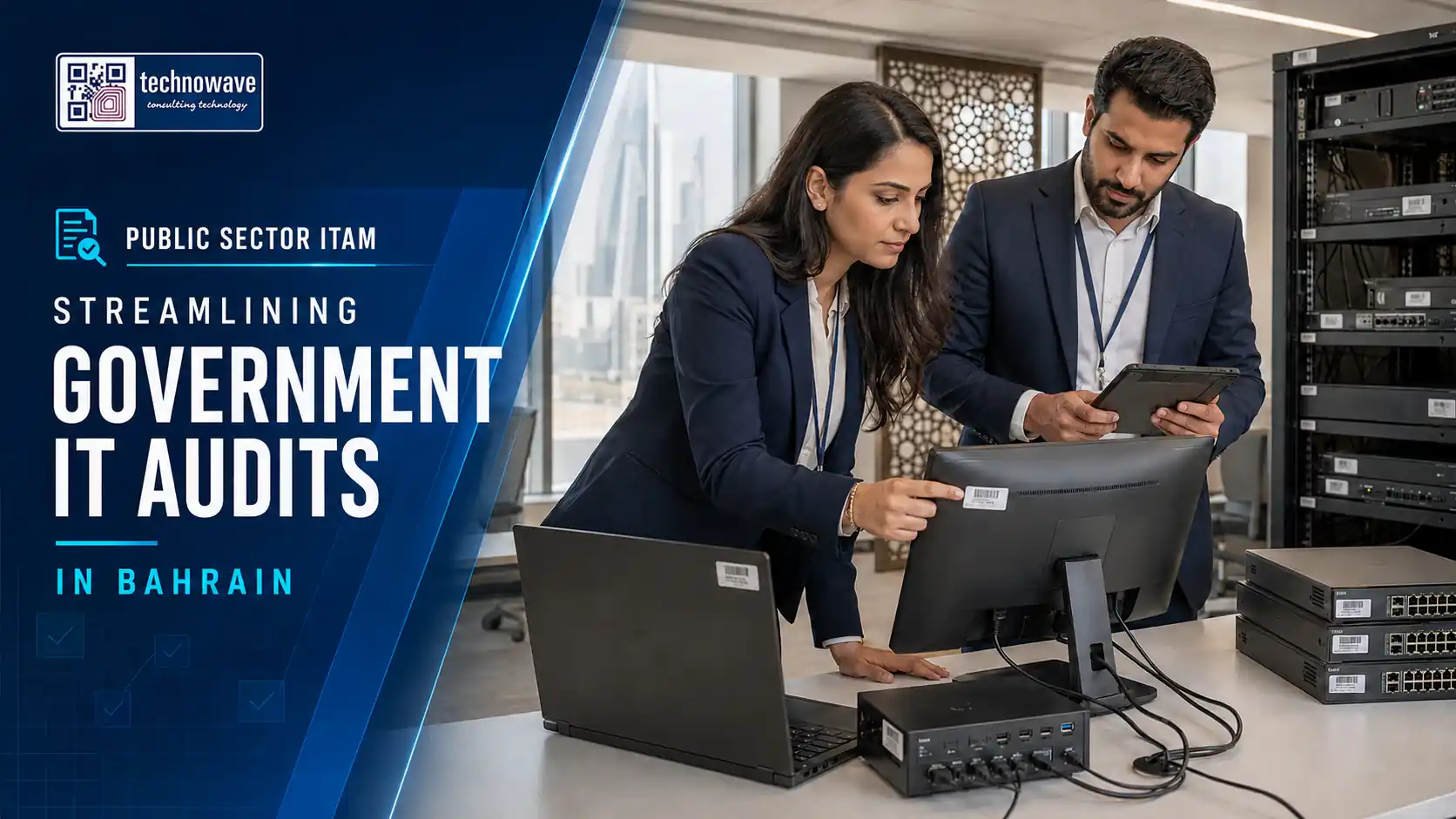
Government IT asset management Bahrain programs are no longer optional for ministries, municipalities, universities, and healthcare entities that need audit-ready records, secure hardware control, and accurate lifecycle visibility. In Bahrain, the combination of stricter audit scrutiny, hybrid infrastructure, and growing device volumes means spreadsheet-based registers are too slow and too error-prone for public sector audits.
What is government IT asset management in Bahrain? It is the disciplined process of tagging, recording, verifying, tracking, transferring, maintaining, and retiring government-owned IT assets across their full lifecycle, using software plus physical identification methods such as barcode and RFID. For Bahraini entities, the practical goal is simple: every laptop, server, switch, printer, tablet, license-bearing device, and retired asset should be identifiable, accountable, and auditable at any time.
Why government IT asset management matters in Bahrain
Bahrain’s public sector is operating in a more complex technology environment than it did even a few years ago. Ministries now manage on-premise systems, cloud subscriptions, field devices, remote user equipment, and specialized endpoint hardware across multiple offices. That operational spread makes manual registers unreliable because changes happen faster than audit teams can reconcile them.
This matters directly for governance. The National Audit Office has repeatedly emphasized internal control quality, record accuracy, and traceability in public entities. At the same time, national digital transformation programs are increasing the number and diversity of assets that must be tracked, not reducing them. According to Information & eGovernment Authority (iGA) Bahrain, more than 70% of government operations have moved under the cloud-first direction, which makes hybrid asset and software oversight materially harder.
For decision-makers, the risk is not just “missing equipment.” It is also duplicate procurement, unauthorized redeployment, unrecorded disposals, unsupported devices still on secure networks, and audit exceptions caused by mismatched serial numbers or location data. A robust fixed asset management system gives public entities a controlled master record rather than disconnected spreadsheets maintained by different departments.
Direct answer to a common buyer question: How does IT asset management help public sector audits? It reduces the gap between what finance records, what IT deploys, and what auditors physically verify. That alignment is what shortens audit cycles and reduces disputes during inspection.
Common public sector IT audit failures and where manual control breaks down
The first failure point is fragmented ownership. In many government environments, procurement buys the asset, IT deploys it, facilities moves it, and finance depreciates it. If those functions are not connected to a single record, auditors find inconsistencies in custodian assignment, room location, serial details, or service status.
The second failure point is weak physical verification. Auditors do not accept a register simply because it exists; they need evidence that the listed device is present, tagged, and attributable. When labels are missing, handwritten, duplicated, or unreadable, verification slows dramatically. Teams then spend days room-by-room reconciling spreadsheets instead of validating exceptions.
The third issue is lifecycle blind spots. Public entities often maintain active records for assets that were cannibalized for parts, moved to a remote branch, sent for repair, or retired without a documented chain of custody. Sensitive hardware is particularly problematic because retirement requires more than status updates; it requires proof of collection, secure data sanitization, and disposal authorization.
Question: How can Bahraini government departments ensure compliance with NAO expectations? The practical answer is to maintain a continuously updated asset baseline, run scheduled verification cycles, preserve movement history, and store auditable evidence such as scan logs, transfer approvals, and disposal records. That is why entities increasingly combine software with asset tagging services instead of relying on administrative data entry alone.
What a government IT asset management system should track
Many buyers evaluate ITAM only as a register of device names and serial numbers. That is too narrow for Bahrain’s public sector. A proper system should track identity, ownership, location, technical attributes, maintenance state, and lifecycle events in a way that supports both operations and audits.
Core public-sector asset fields
- Asset identity: tag ID, barcode or RFID code, serial number, model, manufacturer, and classification.
- Organizational ownership: ministry, department, cost center, custodian, and approval authority.
- Physical context: building, floor, room, rack, branch, or field site location.
- Technical status: warranty, AMC, repair history, software association, network role, and risk category.
- Lifecycle events: procurement date, deployment, transfers, audit scans, storage, retirement, and disposal.
For public entities, the most valuable records are often the ones created after deployment. Movement history shows who had the asset, when it changed location, and whether the transfer was approved. Exception reporting then highlights assets not seen during verification, devices found without records, or records still marked active after retirement.
This is where physical identification matters. Durable asset tags for asset management create a direct bridge between the database and the real-world device. On laptops and monitors, tamper-evident barcode labels may be sufficient. For stores, depots, labs, or campuses where speed matters, RFID can support rapid, non-line-of-sight bulk verification. The system should also support role-based access, Arabic/English-friendly reporting where required, and export formats compatible with finance and audit teams.
How barcode and RFID improve audit speed, accuracy, and security
Barcode asset management Bahrain projects are often the right starting point because barcode labels are cost-effective, easy to print, and reliable for controlled room-by-room audits. A staff member uses a handheld terminal or mobile device to scan the tag, confirm the asset, and update its status instantly. That alone removes common errors caused by typing serial numbers manually.
RFID asset tracking for government Bahrain use cases become stronger when entities need faster bulk verification, periodic sweeps of large inventories, or better handling of dense environments such as IT stores, training centers, or multi-building campuses. RFID readers can capture tagged items more quickly than barcode in many audit scenarios because they do not require direct line-of-sight. That reduces interruption to operational areas and makes full verification cycles more achievable.
| Criteria | Barcode-based tracking | RFID-based tracking |
|---|---|---|
| Read method | Line-of-sight scan of each tag | Non-line-of-sight reading of tagged items |
| Best use case | Rooms, offices, desks, controlled audits | High-volume audits, stores, labs, campuses |
| Tag cost | Lower | Higher than barcode |
| Verification speed | Sequential item-by-item | Faster bulk capture |
| Exception handling | Very clear for close inspection | Strong for finding missing presence patterns |
| Typical public sector fit | Most ministries and admin offices | Large estates or higher-frequency audits |
Question: Can RFID improve government asset tracking in Bahrain? Yes, when the pain point is verification speed, campus-wide visibility, or repetitive counting of large asset populations. However, RFID is not automatically the best choice for every entity. Many public projects use a mixed model: barcode for standard devices and RFID for critical, mobile, or high-volume categories. The hardware layer usually includes barcode scanners, mobile computers, readers, and software integration to make physical audits operationally practical.
Implementation, integration, and compliance considerations for Bahraini entities
The best IT asset management for government Bahrain projects are designed around workflows, not only software screens. Before deployment, the entity should define asset classes, tagging standards, naming logic, custodianship rules, transfer approvals, and retirement procedures. Without those policies, even a strong platform will inherit inconsistent data.
Integration is usually the next buying criterion. Can the platform integrate with SAP, Oracle, or another ERP used for procurement and finance? In most public sector scenarios, the answer should be yes through imports, APIs, scheduled synchronization, or structured data exchange. The key is to define which system is authoritative for each field: finance may own capitalization values, while ITAM owns live location, custodian, and verification history.
Security and retirement control are equally important. Sensitive laptops, storage devices, and networking hardware should move through a documented retirement workflow that records retrieval, quarantine, data sanitization status, and disposal approval. For secure public environments, supply chain control also matters; tagged assets should be distinguishable from unapproved devices so field teams can identify anomalies quickly during audits or network-related investigations.
Localized support materially reduces risk. Public sector deployments need on-site tagging, user training, handheld configuration, preventive maintenance, and issue resolution during audit periods. Buyers should therefore assess software capability together with AMC, repair, and local technical support. A system that is technically sound but weak in field execution usually struggles during annual verification and ministry-wide rollout.
Best practices and why public entities should act now
For ministries, municipalities, universities, and healthcare entities, the most effective path is phased implementation. Start with an authoritative baseline: validate procurement records, standardize tag formats, clean duplicate entries, and classify assets by criticality. Then run an initial wall-to-wall verification so the opening database reflects reality rather than legacy assumptions.
Next, focus on operational controls that keep the database accurate after go-live. Every movement should require a transaction, every repair should update status, and every disposal should close with evidence. Scheduled audits should be risk-based: mobile assets, high-value equipment, and sensitive endpoint devices usually need more frequent verification than static infrastructure.
Public entities should also choose metrics that matter to auditors and administrators: percentage of assets physically verified, unresolved exceptions, untagged items found, overdue returns, and disposal records pending closure. These indicators are more useful than generic dashboard visuals because they expose control weaknesses early. Teams looking for implementation benchmarks can also review practical GCC examples such as this fixed asset management case study and this asset tagging project focused on reducing audit drift.
The reason to act now is operational, not promotional. Bahrain’s public sector is adding devices, not simplifying them; cloud adoption is increasing hybrid accountability requirements; and audit expectations are unlikely to become lighter. For organizations still relying on spreadsheets, each quarter adds more reconciliation work, more exception risk, and more time lost during verification cycles.
FAQ
Q: What is government IT asset management in Bahrain?
A: It is the controlled process of identifying, tagging, tracking, auditing, maintaining, and retiring government-owned IT assets across ministries and public entities in Bahrain. It combines software records with barcode or RFID-based physical verification so auditors and administrators can confirm what exists, where it is, and who is responsible for it.
Q: How does IT asset management help public sector audits?
A: It creates a single auditable record for each asset and links that record to physical scan evidence, transfer history, custodian details, and retirement status. This reduces discrepancies between finance, IT, and operational departments, making audit preparation faster and exception handling far more precise.
Q: Can RFID improve government asset tracking in Bahrain?
A: Yes. RFID is particularly useful where public entities need faster bulk verification, frequent audits, or better visibility across large buildings, stores, or campuses. It is often deployed alongside barcode rather than replacing it entirely, because different asset classes require different control methods.
Q: What features should a public sector asset management system include?
A: It should include asset tagging support, location and custodian tracking, movement history, audit workflows, exception reporting, lifecycle status, repair and maintenance records, disposal documentation, role-based access, and integration options for ERP or finance systems used by the entity.
Q: How can Bahrain government entities reduce missing or unverified IT assets?
A: They should standardize tags, cleanse legacy records, run a full baseline verification, enforce transfer transactions, and schedule periodic physical audits for high-risk assets. Missing assets usually result from poor movement control, weak retirement workflows, or inconsistent record ownership across departments.
Q: Why does local support matter for public sector ITAM in Bahrain?
A: Local support helps with on-site tagging, user adoption, handheld setup, integration troubleshooting, and urgent assistance during audit periods. It also lowers total cost of ownership because issues can be resolved faster without relying entirely on remote teams unfamiliar with the site layout or government workflow requirements.
For Bahraini public sector teams that need stronger audit readiness, better asset visibility, and field-proven tagging and verification workflows, Technowave International can support the full project scope: software, barcode or RFID hardware, tagging, integration, rollout, and after-sales support. If your entity is planning a new government IT asset management Bahrain initiative, this is the right time to assess current audit gaps and define a practical deployment roadmap.
Related Articles
- Asset Tagging Service Provider in Bahrain: Barcode & RFID Tagging for Faster Audits in 2026
- Streamlining Operations with RFID Warehouse Management in India
- Case Study: How a Turnkey Asset Tagging Service Reduced Audit Drifts for a Multi-Branch Corporation
- 2026 in UAE: Why fixed asset tagging & Auditing readiness have become a silent risk for uae businesses
- How to Implement RFID IT Asset Tracking in Bahrain Data Centers
- Buy IT Asset Management Software: Enterprise Pricing, Licenses, and Integration Guide
Government IT Asset Management Bahrain Guide
Learn how government IT asset management Bahrain improves audit accuracy, compliance, and control across ministries and public entities.