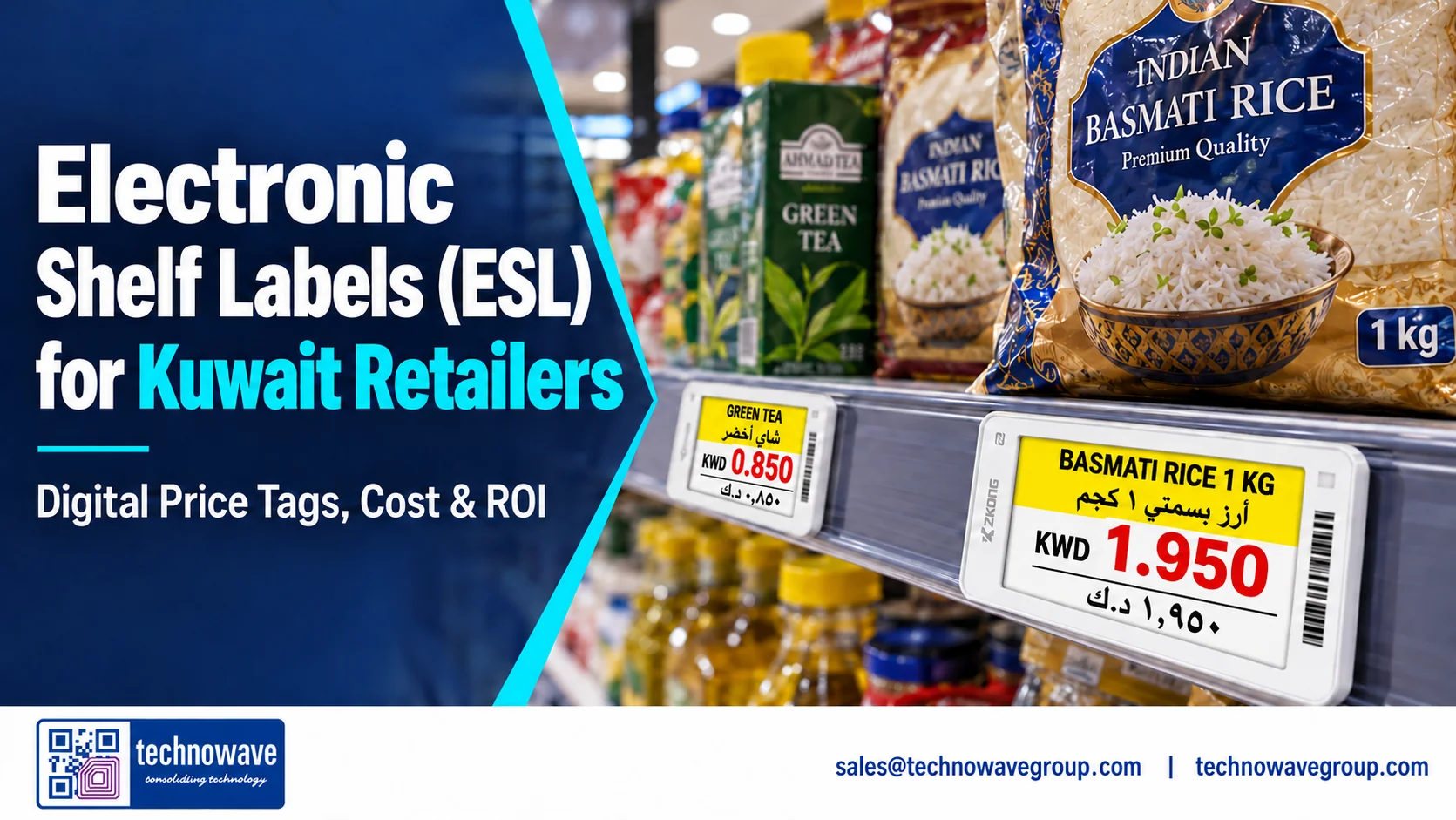
Electronic shelf labels Kuwait projects are worth evaluating when a retailer needs faster price execution, better shelf-edge accuracy, and less staff time spent replacing paper tags. For Kuwait buyers, the decision is not only about replacing labels with screens; it is about connecting shelf pricing to POS and ERP workflows so stores can manage Arabic and English product information, promotions, and branch-level consistency with far fewer manual steps.
What are electronic shelf labels? Electronic Shelf Labels, or ESL, are low-power digital shelf displays that show item price, barcode, SKU, promotion, and product data received from a central platform. In retail environments, they are typically updated through a gateway and wireless communication layer, allowing stores to change prices or promotional messages across one outlet or multiple branches without physically reprinting shelf tickets.
In Kuwait, that matters most in high-SKU retail formats: supermarkets, electronics stores, pharmacies, home stores, and multi-branch chains operating in malls and mixed-use commercial areas. Buyers comparing Electronic Shelf Labels and Digital Shelf Labels should assess them as an operational system, not a display accessory, because pricing accuracy depends on software integration, shelf mapping discipline, and local support after go-live.
Why electronic shelf labels matter for Kuwait retail operations
Kuwait retailers face a specific shelf-edge challenge: pricing changes are often driven by central buying teams, seasonal campaigns, supplier-funded promotions, and branch-specific markdown decisions, but execution still happens on the shop floor. That gap creates delays between approved price changes and the actual shelf label customers see. ESL closes that gap by synchronizing data directly from the pricing source to the display layer.
The use case differs by retail format. In supermarkets and co-op style food retail, buyers usually care about fast batch updates, promotion timing, and shelf accuracy across thousands of SKUs. In electronics and telecom stores, the value is richer product communication: model details, financing or promo messages, QR codes, and cleaner presentation. In pharmacies, the focus is controlled price updates, product identification, and minimizing shelf-side labeling mistakes.
Do Kuwait fashion retailers need ESL if prices do not change daily? Yes, but for a different reason. In fashion and lifestyle stores, ESL is less about frequent core price changes and more about campaign visibility, multilingual display consistency, markdown events, and store presentation. Larger graphic labels can highlight discount messaging in a more controlled way than paper tags, especially during campaign periods.
Kuwait’s retail environment also includes premium malls, franchise operations, and stores where brand presentation matters almost as much as pricing. In those settings, ESL supports a cleaner fixture design while reducing the operational burden on staff. Retailers exploring newer display formats can review Smarttag HD graphic labels when they need stronger visual promotion than a basic monochrome tag can provide.
Which features Kuwait buyers should prioritize before selecting an ESL platform
The first selection criterion is not screen size; it is integration depth. A serious electronic shelf labels provider Kuwait retailers can rely on must be able to connect with POS, ERP, or merchandising systems so that approved item masters, prices, and promotions flow into ESL software without manual re-entry. If the integration layer is weak, a premium label network still creates pricing risk.
The second priority is display suitability by category. Small labels work for dense grocery shelving, but electronics, pharmacy, and home retail often need mid-size or larger displays for more content. Buyers should check screen readability under strong in-store lighting, font support for Arabic and English, barcode rendering quality, and whether the system supports graphic templates for campaign messages.
Questions buyers should ask vendors
- Can the system support bilingual shelf content? Kuwait retailers frequently need clear English and Arabic presentation.
- How are labels assigned to fixtures and products? Poor shelf mapping causes the wrong item to appear on the wrong label.
- What happens when the network is interrupted? Labels should retain the last approved data rather than go blank.
- Can stores update by category, branch, brand, or campaign? Granular control matters in multi-branch retail.
- What battery and maintenance model applies? Buyers need a practical replacement plan, not only a brochure claim.
Another Kuwait-specific consideration is store fixture diversity. Many chains operate mixed shelving standards across branches due to phased fit-outs, imported gondola systems, and franchise layouts. The chosen ESL platform should have mounting options for peg hooks, rails, freezer edges, baskets, and premium display furniture. For stores wanting to compare shelf-edge modernization paths, the article Electronic Shelf Labels vs Paper Price Tags is useful, but Kuwait buyers should go further and test physical mounting on real fixtures before approving rollout.
Security, pricing control, and compliance risks buyers often underestimate
Electronic shelf labels are not a cybersecurity-heavy system in the same category as payment infrastructure, but they still require governance. The main business risk is not a hacker changing prices on every shelf; it is internal process failure, such as unauthorized edits, unsynchronized promotions, wrong item-to-label assignment, or delayed rollback after a campaign ends. Good ESL implementation therefore starts with pricing permissions and approval workflows.
What security controls matter most? Kuwait retailers should look for role-based access, branch-level permissions, user logs, and clear separation between central pricing control and store-level execution. Audit trails are especially important in chains where merchandising, finance, and operations all touch price data. If a dispute occurs, management should be able to verify who changed what, when, and for which store.
Network design also matters. ESL gateways should be deployed on a managed network segment, with controlled access between the ESL application and source systems. Retail IT teams should ask whether the platform supports encrypted communication, resilient gateway architecture, backup behavior, and exportable logs for troubleshooting. A weak network plan can make a good label system appear unreliable when the real issue is infrastructure.
Compliance in Kuwait is primarily operational rather than theoretical. Shelf price, checkout price, and promotional signage must align. If the store updates POS first but delays shelf execution, customer trust erodes immediately. ESL reduces that risk only when the source data is accurate. In other words, the label is the final display point; it does not fix poor master data. Buyers should therefore include item data cleansing, naming standards, and promotion approval rules in the project scope from day one.
Implementation in Kuwait: timeline, store preparation, and rollout planning
Electronic shelf labels implementation Kuwait retailers succeed with usually follows a phased sequence: site survey, shelf mapping, integration design, pilot setup, staff training, and branch rollout. The biggest cause of delay is rarely the hardware itself. It is preparation work, especially confirming fixture types, branch layouts, item-location accuracy, and how product hierarchies flow from the existing POS or ERP environment.
How long does implementation usually take? A pilot can move quickly if one store has clean data and a cooperative IT team, while chain-wide deployment depends on branch count, SKU volume, integration complexity, and fixture readiness. Buyers should insist on a pilot with live price changes, not only a demo shelf. The pilot should validate refresh speed, template clarity, staff workflow, and rollback procedures for promotions.
Operational planning should also include exception handling. What happens when a product is moved, delisted, or temporarily out of stock? Who reassigns the label? How are promotional templates approved during Ramadan campaigns, weekend offers, or supplier activations? A reliable rollout plan documents these shelf-level processes in advance so store teams are not improvising after launch.
Kuwait retailers can reduce project risk by reviewing live deployment approaches from similar environments. Relevant examples include the Xiaomi UAE Electronic Shelf Label installation and the Danube Home digital price labels case study, which show how ESL is deployed in real retail settings rather than discussed only at product level.
| Retail format | Primary ESL objective | Key implementation concern | Best pilot measure |
|---|---|---|---|
| Supermarket | Fast price synchronization across many SKUs | Shelf mapping accuracy and batch updates | Speed and accuracy of promotion changes |
| Electronics | Rich product display and cleaner presentation | Template design and bilingual readability | Clarity of specs, barcode, and promo content |
| Pharmacy | Controlled price accuracy and item identification | Master data discipline and staff process | Correct item-to-label assignment |
| Fashion | Campaign messaging and markdown execution | Graphic format selection and fixture mounting | Visual consistency during promotions |
Electronic shelf labels pricing Kuwait buyers should expect and how ROI is really measured
Electronic shelf labels pricing Kuwait projects depends on more than the number of labels. Budget is shaped by display size mix, color or graphic capability, gateways, mounting accessories, software licensing, integration scope, store survey work, installation labor, and post-go-live support. A buyer asking only for a per-label price usually receives an incomplete commercial picture.
What does ROI come from? In Kuwait retail, the strongest return usually comes from four areas: lower labor spent printing and replacing paper tags, faster promotional execution, fewer shelf-edge pricing errors, and a better in-store presentation standard. For multi-branch chains, the governance value can be just as important as labor savings, because central teams gain tighter control over when and how prices appear on shelves.
Buyers should budget in phases. First, define the business case by store format. A hypermarket, pharmacy chain, and electronics showroom will not justify ESL in the same way. Second, estimate total cost of ownership rather than hardware cost alone. That means including software, integration, training, support, spare stock, and any future branch expansion. Third, separate optional visual upgrades from operational essentials so the investment case remains clear.
Common buying mistakes include selecting labels before testing fixture compatibility, underestimating the effort needed for product-location mapping, and treating implementation as an IT-only project. Merchandising, store operations, finance, and IT should all participate. For Kuwait retailers that want an end-to-end partner rather than a box supplier, Technowave International can support consultation, installation, integration, and local after-sales service. Buyers can also review the company contact page to plan a site discussion or pilot assessment before committing to a chain-wide rollout.
FAQ: Electronic Shelf Labels for Kuwait Retailers
Q: What should buyers check before choosing electronic shelf labels in Kuwait?
A: Check integration capability with your POS or ERP, bilingual display support, label sizes by category, fixture mounting compatibility, gateway coverage, user permissions, and local service availability. Also confirm how the vendor handles shelf mapping, pilot testing, and post-installation support.
Q: How can businesses compare electronic shelf labels providers?
A: Compare providers on system architecture, real retail deployment experience, integration capability, software usability, installation methodology, support response, and whether they can manage hardware, software, and rollout together. Ask for a live pilot, not only a showroom demonstration.
Q: What does electronic shelf labels typically cost in Kuwait?
A: Cost varies by label volume, display size, color capability, gateway count, software, integration work, mounts, and installation scope. A serious budget review should consider total project cost and ongoing support rather than comparing only the unit price of each label.
Q: How long does electronic shelf labels implementation usually take?
A: A pilot can be completed relatively quickly when store data is clean and infrastructure is ready, while multi-branch rollouts take longer because of surveying, mapping, integration, training, and staged deployment. Timeline depends more on preparation quality than on label delivery alone.
Q: What security or compliance factors matter for electronic shelf labels in Kuwait?
A: The most important factors are role-based access, pricing approval workflows, audit logs, controlled network deployment, and accurate synchronization between source systems and shelf labels. Compliance risk usually comes from bad process design or poor data, not from the label screen itself.
Q: Are electronic shelf labels suitable only for supermarkets?
A: No. Supermarkets are a strong use case, but electronics stores, pharmacies, home retail, department stores, and fashion chains can also benefit. The reason differs by format: price synchronization, promotional display, product communication, or store presentation standardization.
If you are evaluating electronic shelf labels provider Kuwait options, the next step should be a branch-level assessment covering fixtures, systems, pricing workflows, and rollout priorities. Technowave International can help Kuwait retailers plan the right ESL architecture and implementation path, and your team is welcome to contact them via WhatsApp or email to discuss a pilot or commercial review.
Related Articles
- Electronic Shelf Labels vs Paper Price Tags: What Indian Retailers Are Losing Every Day
- Why Pharmacies and Cosmetics Retailers are Fast-Tracking ESL Adoption in the GCC
- Top 10 Reasons to Upgrade to Digital Buffet Food Tags with Electronic Shelf Labels
- Digital Buffet Tags vs. Traditional Paper Labels: Cost-Benefit Analysis for Event Caterers
- Cost-Benefit Analysis of Electronic Shelf Labels: Is It Worth the Investment in 2026?
- How Dynamic Pricing via ESL Solutions Can Drive Sales in UAE Electronics Stores
Electronic Shelf Labels Kuwait: Cost & ROI Guide
Electronic shelf labels Kuwait guide for retailers. Compare features, pricing factors, implementation steps, and ROI considerations.