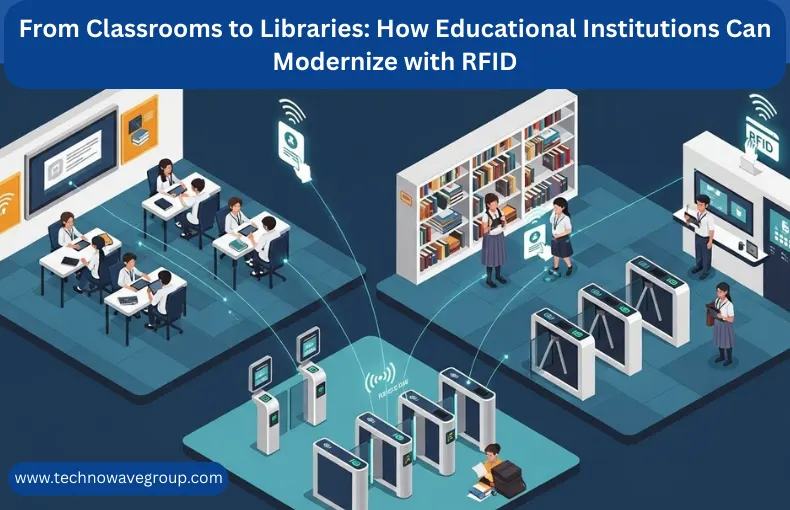
Introduction
Educational institutions today face mounting challenges in managing assets, tracking library resources, and ensuring campus security. RFID for educational institutions has emerged as a transformative solution that addresses these challenges while improving operational efficiency. Schools, colleges, and universities are increasingly adopting RFID technology to automate processes, reduce manual workload, and create smarter learning environments that benefit both students and administrators.
Key Takeaways
- RFID technology revolutionizes library management through automated check-in/check-out systems and real-time inventory tracking, reducing manual work by up to 75%
- Educational institutions can track thousands of assets—from laboratory equipment to IT devices—with 99% accuracy using RFID readers and tags
- RFID for educational institutions in India is gaining momentum as schools modernize their infrastructure to compete globally and improve operational transparency
What is RFID Technology for Educational Institutions?
RFID (Radio Frequency Identification) technology uses electromagnetic fields to automatically identify and track tags attached to objects. In educational settings, this means each book, equipment piece, or ID card carries a small chip that communicates with readers throughout the campus.
Unlike traditional barcode systems that require line-of-sight scanning, RFID works through materials and can read multiple items simultaneously. A library staff member can scan an entire stack of books in seconds, or administrators can conduct inventory checks of computer labs without physically handling each device. The technology operates on different frequencies—Low Frequency (LF), High Frequency (HF), and Ultra-High Frequency (UHF)—each suited for specific applications. Educational institutions typically use HF RFID for library books and student cards, while UHF works better for asset tracking across large campus areas. The system includes three main components: RFID tags (attached to items), handheld RFID readers or fixed readers (that capture tag data), and backend software (that processes and stores information).
RFID Applications in Libraries and Learning Centers
Library management represents one of the most successful applications of RFID in educational settings. The technology transforms how institutions manage their collections, serve patrons, and maintain accurate inventory records.
Automated Check-In and Check-Out Systems: Students and faculty can borrow books through self-service kiosks that read RFID tags, verify user credentials, and update the database automatically. This reduces queue times from several minutes to under 30 seconds per transaction. Libraries in major Indian universities report processing up to 500 transactions daily with just two self-service stations, freeing librarians to focus on research assistance and collection development. The system works 24/7, allowing extended access hours without additional staffing costs.
Inventory Management and Shelf Reading: Manual inventory in large libraries traditionally took weeks and required closing sections to the public. With portable RFID readers, staff can walk through aisles and scan thousands of books per hour without removing them from shelves. The system identifies misplaced books, generates reports on missing items, and helps maintain proper shelving order. Educational institutions with collections exceeding 50,000 volumes complete full inventory checks in 2-3 days instead of months. The real-time data helps librarians understand circulation patterns, identify popular subjects, and make informed decisions about acquisitions and space allocation.
Anti-Theft Security Gates: RFID security gates at library exits detect any items that haven’t been properly checked out, triggering alerts without false alarms from student ID cards or personal electronic devices. This reduces book theft by up to 80% according to implementation studies, while creating a more welcoming environment than traditional electromagnetic detection systems. The gates integrate with the library management system, providing detailed logs of attempted unauthorized removals and helping administrators identify security gaps.
Asset Tracking and Equipment Management with RFID
Educational institutions invest heavily in equipment—computers, projectors, laboratory instruments, sports gear, and furniture. Managing these assets efficiently is crucial for budget planning and ensuring resources are available when needed.
RFID-based asset management systems provide complete visibility into institutional property. Each item receives an RFID tag during procurement, and its movement across campus is tracked automatically. When a laptop leaves the IT department for classroom use, the system records who took it, when, and for which purpose. Maintenance schedules, warranty information, and depreciation data are linked to each asset, creating a comprehensive lifecycle management tool. Schools report reducing asset loss by 60-70% after RFID implementation, translating to significant cost savings over time.
Real-Time Location Tracking: Large campuses with multiple buildings struggle to locate equipment quickly. RFID fixed readers installed at strategic points throughout the campus create a network that tracks asset movement in real-time. When a science teacher needs a specific microscope model, the system shows its exact location—whether in storage, another classroom, or out for maintenance. This eliminates hours spent searching and reduces duplicate purchases caused by assuming equipment is lost. Universities implementing this solution report 40% improvement in asset utilization rates as equipment that was previously “missing” becomes accessible again.
Maintenance and Calibration Scheduling: Laboratory equipment and specialized instruments require regular calibration and maintenance. RFID systems automate these workflows by tracking last service dates and generating alerts when maintenance is due. The technology ensures compliance with safety standards and accreditation requirements while preventing equipment failures during critical academic activities. Detailed maintenance histories help institutions plan budgets more accurately and extend asset life through proper care.
Campus Security and Access Control Using RFID
Safety and security remain top priorities for educational institutions, especially in India where campuses often accommodate thousands of students. RFID technology provides sophisticated yet user-friendly security solutions that protect people and property.
RFID-enabled student and staff ID cards serve multiple purposes beyond identification. They control access to buildings, computer labs, hostels, and restricted areas based on authorized permissions. A student’s card might allow entry to their department building and library at any time, but only permit hostel access during designated hours. The system creates detailed audit trails of who entered where and when, invaluable for investigating incidents and ensuring accountability. During emergencies, administrators can quickly determine who is in each building and guide evacuation efforts more effectively.
Visitor Management: Temporary RFID badges for guests, contractors, and substitute teachers provide controlled access while maintaining security. The system automatically deactivates these badges after the authorized visit period ends, preventing unauthorized return visits. Schools can restrict visitor access to specific zones—a guest lecturer might access only the auditorium area, while maintenance contractors get access to designated work zones. This layered security approach, combined with RFID automation, balances openness with safety more effectively than traditional sign-in logs.
Attendance Tracking: While not replacing traditional roll calls in classrooms, RFID attendance systems help monitor overall campus presence. Students scan their cards when entering campus gates or specific buildings, creating automatic attendance records. This helps identify patterns of absence early, allowing intervention before academic performance suffers. Parents can receive notifications when their children arrive at or leave school, providing peace of mind. The technology also helps institutions comply with regulations regarding student presence and funding based on attendance.
RFID Implementation: Best Practices for Schools and Universities
Successfully implementing RFID for educational institutions in India requires careful planning, stakeholder engagement, and phased deployment. Institutions that rush implementation often face technical challenges and user resistance that undermine the technology’s benefits.
Start with a Pilot Project: Begin with one application area—such as the library or IT equipment—before expanding campus-wide. This allows staff to gain experience with the technology, identify potential issues, and demonstrate value to skeptical stakeholders. A successful pilot creates advocates who champion broader adoption and helps refine processes before scaling up. Choose a pilot area that will show measurable results quickly, such as reducing library processing time or improving equipment accountability in a frequently-used lab.
Choose the Right RFID Technology: Different applications require different RFID frequencies and tag types. Library books need thin, flexible HF tags that don’t damage bindings, while outdoor equipment might require rugged UHF tags resistant to weather and rough handling. Work with experienced vendors who understand educational environments and can recommend appropriate solutions. Consider future scalability—the system should accommodate growth in student population, additional buildings, and new applications without requiring complete replacement. Interoperability with existing campus management systems is crucial for smooth integration.
Address Privacy Concerns: Students, parents, and faculty may worry about tracking and privacy implications. Establish clear policies about what data is collected, how it’s used, who can access it, and how long it’s retained. RFID systems should track items and access, not continuously monitor individual locations. Communicate these policies transparently and build privacy protections into the system design from the start. Many institutions form committees including students, faculty, and parents to develop acceptable use policies before implementation begins.
Provide Comprehensive Training: Technology only succeeds when people use it correctly. Librarians, security staff, administrators, and IT personnel need thorough training on system operation, troubleshooting, and maintenance. Create simple user guides and provide ongoing support as people adjust to new workflows. Student orientation should include RFID card usage, explaining benefits while addressing any concerns. Regular refresher training helps maintain proficiency as staff turns over and system features expand.
Measure and Communicate Results: Track metrics like transaction processing time, equipment loss rates, security incident response times, and staff productivity before and after implementation. Share these results with the school community to demonstrate value and justify continued investment. Quantifiable improvements help secure funding for additional phases and encourage other departments to adopt the technology. Document case studies of specific problems solved—such as recovering lost equipment or reducing library staffing needs—to illustrate concrete benefits.
Cost Considerations and Return on Investment
While RFID implementation requires upfront investment, the long-term benefits typically justify the costs. A medium-sized school with 2,000 students might spend $50,000-100,000 for a comprehensive system covering library, asset tracking, and access control. This includes RFID tags, readers, gates, software, and installation.
However, the return on investment becomes clear within 2-3 years through multiple savings streams. Libraries reduce staffing needs or reallocate personnel to higher-value services, saving salary costs. Equipment loss prevention saves thousands in replacement purchases—a single laptop saved pays for dozens of RFID tags. Improved asset utilization means institutions can delay or avoid purchases they would have made to replace “lost” equipment that was simply misplaced. Enhanced security may reduce insurance premiums and definitely reduces losses from theft. Automated processes free staff time for educational activities rather than administrative tasks, improving service quality without proportional cost increases.
Schools in India implementing RFID for educational institutions report efficiency gains of 30-50% in tracked processes. These improvements compound over time as the technology enables new capabilities—such as detailed analytics about resource usage that inform strategic planning and budget allocation.
Future Trends: AI Integration and Smart Campus Evolution
RFID technology continues evolving, with new capabilities emerging that will further transform educational institutions. Integration with artificial intelligence and Internet of Things (IoT) platforms promises even more sophisticated solutions.
AI-powered analytics can process RFID data to predict maintenance needs before equipment fails, identify optimal library collection composition based on usage patterns, and detect unusual access patterns that might indicate security concerns. Machine learning algorithms help institutions understand resource utilization in ways impossible with manual analysis, supporting data-driven decision making about space allocation, staffing, and budget priorities.
The concept of “smart campuses” integrates RFID with other technologies—environmental sensors, video analytics, and mobile applications—creating cohesive systems that improve experiences for everyone. A student’s RFID card might interact with room sensors to adjust lighting and temperature in study spaces, while helping administrators optimize energy usage across campus. Integration with learning management systems could eventually provide insights into how physical resource access correlates with academic outcomes.
As costs continue decreasing and capabilities expanding, even smaller educational institutions will find RFID technology accessible and beneficial. The question is shifting from “Should we implement RFID?” to “How quickly can we adopt it to remain competitive and serve our community effectively?”
Conclusion
The transformation of educational institutions through RFID for educational institutions represents more than technological upgrade—it’s a fundamental shift toward smarter, more efficient operations that better serve learning objectives. From libraries that process transactions in seconds to campuses where every asset is accounted for, RFID technology delivers measurable improvements in efficiency, security, and resource management. Schools and universities adopting these solutions position themselves at the forefront of educational innovation, creating environments where technology enhances rather than distracts from the core mission of learning. As institutions across India and the UAE embrace modernization, RFID stands out as a proven investment with clear returns and expanding capabilities. Contact Technowave Group to explore how customized RFID solutions can transform your educational institution and prepare it for the future of learning.
Frequently Asked Questions
1. What is RFID for educational institutions and how does it work?
RFID for educational institutions uses radio frequency technology to automatically identify and track assets, books, and ID cards across campus. The system includes RFID tags, readers, and management software that communicate wirelessly, enabling real-time tracking of thousands of items without line-of-sight scanning or manual processes.
2. How much does it cost to implement RFID in schools and colleges?
A comprehensive RFID system for a medium-sized school with 2,000 students typically costs $50,000-100,000, covering tags, readers, security gates, and software. Most institutions achieve ROI within 2-3 years through reduced labor costs, prevented asset loss, and improved operational efficiency across library and campus management.
3. Can RFID technology improve library management in educational institutions?
Yes, RFID dramatically transforms library operations by enabling automated check-in/check-out through self-service kiosks, reducing transaction times from minutes to under 30 seconds. Libraries can complete full inventory checks in 2-3 days instead of months, while RFID detection systems reduce book theft by up to 80%.
4. Is RFID for educational institutions in India gaining popularity?
RFID for educational institutions in India is rapidly growing as schools modernize infrastructure to compete globally. Universities and colleges across major cities are implementing RFID for library automation, asset tracking, and campus security, reporting 30-50% efficiency improvements and significant reductions in equipment loss and administrative overhead.
5. What assets can schools track using RFID technology?
Schools can track computers, tablets, projectors, laboratory equipment, sports gear, furniture, library books, and maintenance tools using RFID. Each asset receives a unique tag during procurement, enabling automated tracking throughout its lifecycle. Institutions report 60-70% reduction in asset loss and 40% improvement in equipment utilization rates.
6. How does RFID enhance campus security for students?
RFID-enabled ID cards control building access based on permissions, create detailed entry/exit logs, and enable rapid emergency response by showing who’s in each building. Combined with warehouse management systems principles, schools implement layered security that balances safety with accessibility while providing parents real-time arrival notifications.
7. What’s the difference between RFID and barcode systems in schools?
Unlike barcodes requiring line-of-sight scanning one item at a time, RFID reads multiple tags simultaneously through materials without physical contact. RFID tablets enable staff to inventory entire shelves in seconds, while RFID security gates detect unauthorized items automatically, making operations significantly faster and more accurate than traditional barcode systems.
8. Can RFID systems integrate with existing school management software?
Modern RFID solutions integrate seamlessly with student information systems, library management platforms, and mobile computers for administrative tasks. The technology works alongside existing infrastructure through APIs and standard protocols, allowing schools to enhance current systems without complete replacement, ensuring smooth data flow and unified campus management.
9. What are the privacy concerns with RFID in educational settings?
RFID systems in schools track items and access points, not continuous student locations. Proper implementation includes clear data retention policies, restricted access to tracking information, and transparent communication with parents and students. Schools should establish acceptable use policies before deployment to address privacy concerns and build trust.
10. How long does it take to implement RFID across an entire campus?
Full campus RFID implementation typically takes 3-6 months depending on institution size and scope. Most schools start with pilot projects in libraries or specific departments, taking 4-8 weeks to demonstrate value before expanding. Phased deployment allows staff training, process refinement, and stakeholder buy-in while minimizing operational disruption.