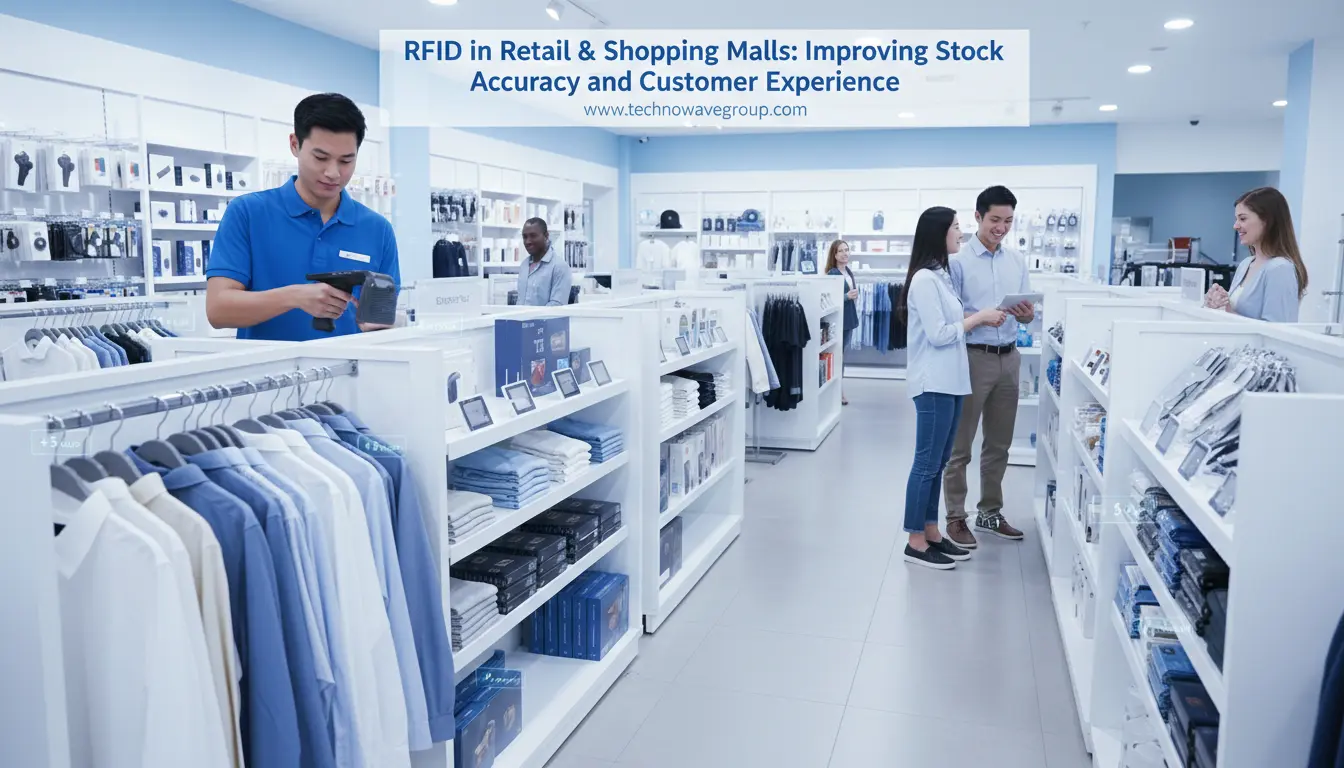
Shopping malls and retail stores face constant pressure to maintain accurate inventory while delivering exceptional customer experiences. RFID in retail & shopping malls has emerged as a transformative solution that addresses both challenges simultaneously. By implementing Radio Frequency Identification technology, retailers can achieve near-perfect stock accuracy, reduce shrinkage, and create seamless shopping experiences that keep customers coming back.
Key Takeaways
Modern retail environments demand precision and efficiency. RFID technology delivers real-time inventory visibility with 99% accuracy compared to traditional barcode systems at 65-75%. Shopping malls implementing retail RFID solutions experience reduced stockouts by up to 80%, while simultaneously cutting labor costs associated with manual inventory counts by 60%. The technology enables faster checkout processes, personalized shopping experiences, and data-driven insights that transform how retailers operate and serve their customers.
Understanding RFID Technology in Modern Retail
RFID technology uses electromagnetic fields to automatically identify and track tags attached to products, creating an intelligent inventory ecosystem that operates continuously without human intervention.
Unlike traditional barcode systems that require line-of-sight scanning, RFID readers can simultaneously capture data from hundreds of tagged items within seconds. This capability proves invaluable in busy retail environments where speed and accuracy determine success. Modern RFID systems operate across various frequencies, with UHF (Ultra-High Frequency) RFID being the preferred choice for retail applications due to its longer read range of up to 12 meters. The technology consists of three core components: RFID tags attached to merchandise, readers strategically positioned throughout the store, and software that processes and analyzes the collected data. When implemented correctly, RFID for improving stock and accuracy becomes the backbone of efficient retail operations.
How RFID Improves Stock Accuracy in Retail Environments
RFID for improving stock and accuracy delivers measurable results that directly impact a retailer’s bottom line through automated tracking and real-time visibility across all inventory touchpoints.
Traditional inventory management relies on periodic manual counts that are time-consuming, error-prone, and provide only snapshot views of stock levels. RFID transforms this paradigm by enabling continuous, automated inventory tracking with unprecedented accuracy. Research from Auburn University’s RFID Lab demonstrates that retailers achieve 99% inventory accuracy with RFID compared to 65% with manual processes. This dramatic improvement occurs because RFID systems automatically track items from receiving docks through storage areas to sales floors and finally to customer purchases.
The technology identifies discrepancies immediately, whether from theft, misplacement, or administrative errors. Real-world implementation examples include:
- Receiving accuracy: Automated verification of shipments against purchase orders reduces receiving errors by 90%
- Replenishment efficiency: RFID triggers automatic reordering when stock levels drop below predetermined thresholds
- Shrinkage reduction: Continuous monitoring detects unauthorized item movements, reducing theft by up to 75%
- Omnichannel accuracy: Real-time inventory visibility across all channels prevents overselling and improves customer satisfaction
Major retailers report return on investment within 12-18 months of RFID implementation, primarily driven by improved stock accuracy. The retail automation in UAE market has witnessed significant growth as shopping malls recognize these tangible benefits. Labor savings alone justify the investment, with stores reducing inventory counting time from days to hours. One luxury retail chain reported completing full store inventory in 2 hours with RFID versus 40 hours with traditional methods.
Enhancing Customer Experience Through RFID Integration
Shopping mall visitors expect personalized, frictionless experiences, and RFID technology enables retailers to meet and exceed these expectations through innovative customer-facing applications.
Smart fitting rooms equipped with RFID readers automatically detect items customers bring in and display product information, available sizes, and complementary items on interactive mirrors. This technology reduces frustration associated with finding different sizes or colors while creating opportunities for upselling. Self-checkout systems powered by RFID eliminate the need for individual item scanning, allowing customers to simply place their basket on a reader platform that instantly tallies all items. Stores implementing RFID-enabled checkout report 40% faster transaction times and significantly shorter queues during peak hours.
Clienteling applications leverage RFID data to provide sales associates with real-time customer preferences and purchase history, enabling personalized recommendations. Some innovative retailers use RFID to create interactive displays that trigger product information and promotional content when customers approach specific items. The technology also powers mobile apps that help shoppers locate products within large shopping malls through indoor navigation. Additional customer-centric benefits include:
- Endless aisle capabilities: Access to inventory from all locations, not just items physically present in the store
- Real-time availability: Accurate stock information prevents disappointment from out-of-stock situations
- Faster returns processing: Automated verification speeds up return transactions
- Personalized promotions: Behavior tracking enables targeted offers based on shopping patterns
According to a study by Retail Systems Research, 72% of consumers say they’re more likely to shop at stores offering real-time inventory visibility. Implementing RFID retail automation in Dubai has helped shopping malls differentiate themselves in competitive markets by delivering superior customer experiences.
Key Benefits of RFID Implementation in Shopping Malls
Shopping mall operators and retail tenants gain competitive advantages through RFID adoption that extend beyond inventory management to encompass operational efficiency and strategic decision-making.
The comprehensive benefits of RFID technology create value across multiple dimensions of retail operations. Loss prevention improves dramatically as RFID-enabled anti-theft systems detect tagged items leaving stores without authorization, alerting security in real-time. Supply chain visibility increases as retailers track merchandise from manufacturers through distribution centers to individual stores, identifying bottlenecks and inefficiencies. Data analytics derived from RFID systems reveal shopping patterns, popular product combinations, and optimal store layouts that drive sales.
Key operational and strategic benefits include:
- Labor optimization: Employees spend less time on manual inventory tasks and more time assisting customers
- Reduced markdowns: Accurate inventory prevents overstocking and understocking that lead to excessive markdowns
- Improved product availability: Stores maintain optimal stock levels, reducing lost sales from stockouts
- Enhanced security: Real-time tracking deters theft and identifies security vulnerabilities
- Better space utilization: Data-driven insights optimize floor layouts and product placement
- Faster fulfillment: Buy-online-pickup-in-store (BOPIS) orders are located and prepared quickly
- Supply chain efficiency: Automated receiving and tracking streamline backroom operations
- Compliance documentation: Automated tracking provides audit trails for regulatory compliance
Fashion retailers particularly benefit from RFID implementation, with studies showing 5-10% sales increases attributable to improved product availability and reduced stockouts. The technology investment typically pays for itself through shrinkage reduction alone, with additional savings from labor efficiency and reduced inventory carrying costs. Shopping malls implementing asset management systems with RFID capabilities report improved tenant satisfaction as common area assets and equipment are tracked more effectively.
Real-World Applications and Success Metrics
Leading retailers worldwide demonstrate RFID’s transformative impact through measurable performance improvements and innovative applications that redefine shopping experiences.
Zara, the global fashion retailer, equipped all stores with RFID technology and now tracks every item from production to sale. The company reports 98% inventory accuracy and can replenish stores twice weekly instead of twice monthly. Spanish fashion group Inditex, Zara’s parent company, attributed a 6% sales increase partly to improved stock availability enabled by RFID. Macy’s implemented RFID across 500+ stores, achieving significant improvements in omnichannel fulfillment accuracy and reducing out-of-stock situations by 30%.
Decathlon, the sporting goods retailer, uses RFID-enabled self-checkout kiosks that process entire shopping baskets in seconds. The system increased checkout speed by 40% while maintaining security and accuracy. Luxury retailer Burberry integrated RFID into its customer experience strategy, using smart mirrors and personalized mobile experiences powered by item-level tracking. The company reports enhanced customer engagement and improved conversion rates.
Statistical success metrics from various implementations include:
- 99.9% inventory accuracy achieved by leading fashion retailers using RFID systems
- 15-25% increase in same-store sales attributed to improved stock availability and reduced stockouts
- 40-60% reduction in labor costs for inventory-related tasks through automation
- 75-90% decrease in shrinkage from theft and administrative errors
- 30-50% faster order fulfillment for online orders picked from stores with RFID
According to recent market research, the global retail RFID market is projected to reach $5.8 billion by 2027, growing at 14.2% annually. This growth reflects increasing recognition of RFID’s value proposition. Shopping malls in the Middle East are rapidly adopting these technologies, with RFID retail inventory management implementations expanding across the region. The technology’s scalability makes it suitable for small boutiques and large department stores alike, with cloud-based solutions reducing implementation barriers.
Conclusion
RFID in retail & shopping malls represents more than technological advancement—it’s a fundamental shift in how modern retailers manage inventory, serve customers, and compete in dynamic markets. The technology delivers quantifiable benefits through improved stock accuracy, reduced operational costs, enhanced customer experiences, and actionable business intelligence. As consumer expectations continue rising and competition intensifies, RFID adoption transitions from competitive advantage to operational necessity. Retailers and shopping mall operators who implement RFID for item tracking position themselves for sustainable growth in an increasingly digital retail landscape. Contact Technowave Group to learn how our comprehensive RFID solutions can transform your retail operations and deliver measurable results.
Frequently Asked Questions
1. What is RFID technology in retail stores?
RFID (Radio Frequency Identification) technology uses electromagnetic fields to automatically identify and track tags attached to products. It enables retailers to monitor inventory in real-time without manual scanning, improving accuracy and operational efficiency significantly.
2. How does RFID improve stock accuracy in shopping malls?
RFID for improving stock and accuracy works by automatically tracking every tagged item throughout the store. It provides 99% inventory accuracy compared to 65% with manual methods, reducing stockouts and ensuring products are always available for customers.
3. What are the main benefits of RFID in retail operations?
RFID in retail & shopping malls reduces labor costs by 60%, decreases shrinkage by 75%, and speeds up checkout processes by 40%. It also enables real-time inventory visibility, personalized customer experiences, and data-driven business decisions.
4. How much does RFID implementation cost for retail stores?
RFID implementation costs vary based on store size and complexity, typically ranging from $50,000 to $500,000. Most retailers achieve ROI within 12-18 months through reduced theft, labor savings, and improved inventory accuracy with RFID readers.
5. Can RFID technology prevent theft in shopping malls?
Yes, RFID systems detect unauthorized item movements and alert security in real-time. The technology reduces retail theft by 75-90% by monitoring tagged merchandise continuously and triggering alarms when items leave without proper checkout authorization.
6. What types of products benefit most from RFID tracking?
High-value items like fashion apparel, jewelry, electronics, and luxury goods benefit most from RFID tracking. The technology is particularly effective for inventory-intensive categories where stock accuracy directly impacts sales and customer satisfaction in warehouse management systems.
7. How does RFID enhance customer experience in retail?
RFID enables smart fitting rooms, faster self-checkout, and real-time product availability information. Customers experience shorter wait times, personalized recommendations, and seamless omnichannel shopping across physical stores and online platforms with improved RFID warehouse management.
8. Is RFID technology suitable for small retail businesses?
Yes, cloud-based RFID solutions make the technology accessible for small retailers. Scalable systems allow businesses to start with basic inventory tracking and expand features as they grow, with significant benefits even for single-location stores.
9. What is the difference between RFID and barcode systems?
RFID reads multiple items simultaneously without line-of-sight at distances up to 12 meters, while barcodes require individual scanning. RFID offers faster processing, automated tracking, and 99% accuracy compared to barcode systems at 65-75% accuracy rates.
10. How long does RFID implementation take in shopping malls?
RFID implementation typically takes 3-6 months depending on store size and system complexity. The process includes hardware installation, software integration, staff training, and pilot testing before full deployment to ensure optimal performance and accuracy.