
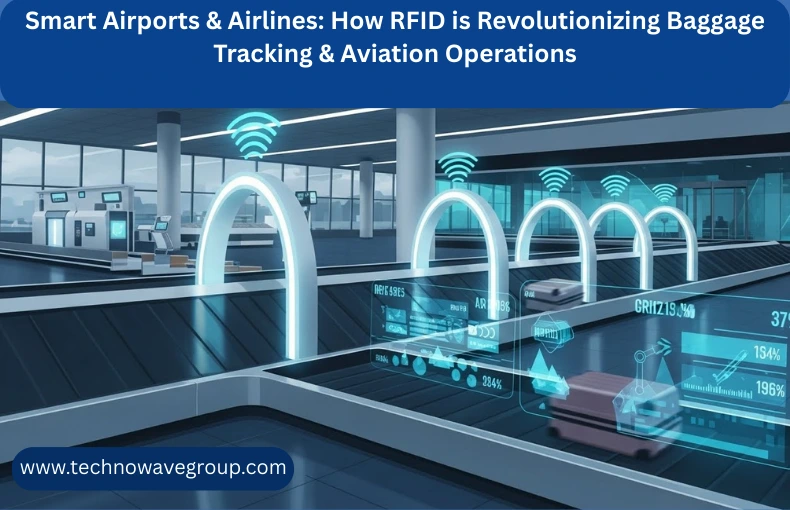
The aviation industry is experiencing a digital transformation, and RFID for smart airports and airlines is at the forefront of this revolution. Modern airports are leveraging Radio Frequency Identification (RFID) technology to address critical challenges in baggage handling, passenger flow management, and operational efficiency. As air travel continues to rebound and grow, airports worldwide are discovering that RFID technology isn’t just an upgrade—it’s becoming essential for competitive operations. This comprehensive guide explores how RFID is reshaping the future of aviation, from check-in counters to arrival carousels.
Key Takeaways
- Enhanced Baggage Tracking: RFID for baggage tracking delivers 99.9% accuracy rates, virtually eliminating lost luggage incidents and reducing mishandling costs by up to 25% compared to traditional barcode systems.
- Operational Efficiency: RFID for aviation operations streamlines multiple processes including passenger check-in, security screening, and aircraft turnaround times, reducing operational delays by an average of 15-20 minutes per flight.
- ROI and Cost Savings: Airlines implementing RFID for smart airports and airlines report significant cost reductions through decreased baggage mishandling claims, improved asset utilization, and enhanced passenger satisfaction scores.
The Baggage Tracking Revolution: How RFID Eliminates Lost Luggage
RFID for baggage tracking transforms traditional luggage handling by providing real-time visibility from check-in to final destination, reducing mishandling rates from 5.57 bags per thousand passengers to less than 0.1%.
Traditional barcode-based baggage systems have long plagued the aviation industry with accuracy rates averaging only 80-85%, resulting in millions of mishandled bags annually. RFID technology fundamentally changes this equation by using radio waves to automatically identify and track bags throughout their journey without requiring line-of-sight scanning. When a passenger checks in their luggage, an RFID tag is attached that contains a unique identifier linked to the passenger’s itinerary. As the bag moves through the airport—from the check-in belt to the sorting facility, onto the aircraft, and finally to the destination carousel—RFID readers automatically capture its location and status.
The impact is transformative. Delta Air Lines reported that after implementing RFID across their network, they achieved a 99.9% baggage tracking accuracy rate, dramatically reducing customer complaints and compensation costs. The system works even in challenging environments: tags can be read through other bags, while stacked on carts, and even when moving at high speeds on conveyor belts. This reliability stems from RFID’s ability to read multiple tags simultaneously—up to 200 tags per second—compared to barcodes which require individual scanning. For airports handling millions of bags annually, this efficiency translates to faster processing times and significantly reduced labor costs.
Moreover, passengers benefit from unprecedented transparency. Many airlines now offer mobile apps that leverage RFID data to show customers exactly where their bags are in real-time, from the moment of check-in until baggage claim. This transparency builds trust and reduces anxiety, particularly for travelers with tight connections or valuable items in their luggage. The technology also enables proactive interventions: if a bag is at risk of missing a connection, ground staff receive automatic alerts, allowing them to prioritize its transfer and prevent mishandling before it occurs.
Optimizing Aviation Operations: Beyond Baggage Handling
RFID for aviation operations extends far beyond baggage, enabling comprehensive asset management systems that track everything from catering carts and wheelchairs to aircraft parts and ground support equipment, reducing asset loss by up to 30%.
While baggage tracking garners the most attention, RFID’s applications across airport operations are equally impressive. Airports are complex ecosystems requiring precise coordination of thousands of assets. RFID enables real-time tracking of ground support equipment (GSE) such as tow tractors, luggage carts, passenger boarding bridges, and refueling trucks. Singapore’s Changi Airport implemented RFID tracking for their GSE fleet and discovered they could reduce their equipment inventory by 20% while actually improving service levels—the equipment was there all along, just difficult to locate without real-time tracking.
Maintenance operations also benefit significantly from RFID implementation. Aircraft components, tools, and spare parts can be tagged with RFID fixed readers positioned at maintenance hangars and warehouses to automatically log inventory movements. This creates an accurate, real-time inventory system that ensures critical parts are always available when needed, reducing aircraft downtime. Emirates Airlines uses RFID to track over 100,000 items in their maintenance facilities, cutting inventory search times from hours to minutes and ensuring compliance with strict aviation maintenance regulations.
The technology also enhances passenger experience in subtle but important ways. RFID-enabled boarding passes speed up gate processing, reducing queue times. Some airports use RFID to track wheelchairs and medical equipment, ensuring they’re positioned where needed most. Catering services benefit from RFID tracking of trolleys and containers, reducing loss rates and ensuring proper sanitation cycles are followed. These operational improvements compound: faster boarding means better on-time performance, which improves passenger satisfaction, reduces fuel consumption from idling aircraft, and allows airports to handle more flights with existing infrastructure.
Security and Compliance: RFID’s Critical Role in Aviation Safety
RFID technology strengthens aviation security by creating comprehensive audit trails for baggage, cargo, and critical assets while helping airports meet International Air Transport Association (IATA) Resolution 753 requirements for end-to-end baggage tracking.
Aviation security remains paramount, and RFID for smart airports and airlines provides capabilities that enhance safety protocols without slowing operations. The technology creates detailed chain-of-custody records for every piece of baggage and cargo, documenting exactly when and where items were scanned throughout their journey. This audit trail is invaluable for security investigations and regulatory compliance. If a suspicious item is detected, security personnel can quickly trace its entire path through the airport, identifying all touchpoints and personnel who handled it.
IATA’s Resolution 753, which requires airlines to track baggage at four key points (acceptance, loading, transfer, and arrival), has accelerated RFID adoption worldwide. RFID systems automatically capture these tracking events without requiring manual intervention, ensuring consistent compliance across all flights and stations. The technology also supports secure baggage matching protocols, verifying that every bag loaded onto an aircraft has a corresponding boarded passenger—a critical security measure that RFID accomplishes more reliably than legacy systems.
Cargo operations benefit similarly. High-value shipments, pharmaceuticals requiring temperature control, and hazardous materials can be tagged with specialized RFID labels that not only track location but also monitor environmental conditions. The tracking solutions and RFID automation enable airports to maintain detailed records proving compliance with handling protocols, essential for both safety and liability protection. Access control systems integrated with RFID ensure that only authorized personnel can access restricted areas, with automatic logging of all entry and exit events.
Implementation Strategy and ROI: Making the Business Case
Successful RFID implementation for smart airports requires strategic phasing, stakeholder alignment, and careful infrastructure planning, but delivers measurable ROI typically within 18-24 months through reduced mishandling costs, improved asset utilization, and enhanced operational efficiency.
Implementing RFID across an airport ecosystem represents a significant investment, but the business case is increasingly compelling. Initial costs include RFID readers and antennas at key touchpoints throughout the airport, RFID tags for baggage and assets, software integration with existing airport systems, and staff training. However, these costs must be weighed against substantial ongoing expenses that RFID eliminates: baggage mishandling compensation (averaging $100 per incident), manual tracking labor, asset replacement due to loss, and opportunity costs from operational delays.
Leading airports typically adopt a phased implementation approach. Phase one often focuses on baggage tracking at key points (check-in, bag drop, sorting, loading, and arrival), delivering immediate improvements in passenger satisfaction and operational efficiency. Phase two expands to asset tracking for ground support equipment and maintenance inventory. Phase three might include advanced applications like real-time passenger flow optimization or predictive maintenance. This staged approach spreads capital costs while building organizational expertise and demonstrating value at each phase.
The ROI extends beyond direct cost savings. Airlines report that improved baggage handling directly correlates with higher Net Promoter Scores and customer loyalty. Airports with reputation for reliable baggage handling attract more airline partners and routes. Operational efficiency gains allow airports to handle increasing passenger volumes without proportional infrastructure expansion—a critical advantage as many major hubs face physical growth constraints. Environmental benefits also accrue from reduced fuel consumption due to shorter turnaround times and decreased waste from better asset management.
Successful implementations require collaboration across multiple stakeholders: airlines, ground handlers, airport authorities, and technology providers must align on standards, data sharing protocols, and operational procedures. Organizations like IATA and ACI (Airports Council International) provide valuable guidance and implementation frameworks. Partnering with experienced RFID solution providers who understand aviation’s unique requirements—like harsh environmental conditions, strict regulatory compliance, and 24/7 operational demands—significantly increases success probability and accelerates time-to-value.
Future Trends: The Next Generation of Smart Airports
Emerging technologies including IoT integration, artificial intelligence, and blockchain are converging with RFID to create fully autonomous airport operations where predictive analytics optimize everything from staffing levels to aircraft gate assignments in real-time.
The future of RFID for aviation operations extends well beyond current applications. Integration with Internet of Things (IoT) platforms enables RFID data to feed into comprehensive airport management systems that use artificial intelligence to predict and prevent operational disruptions. For example, by analyzing historical RFID tracking data combined with flight schedules and weather forecasts, AI systems can predict baggage handling bottlenecks hours before they occur, automatically reallocating resources to maintain smooth operations.
Battery-assisted passive (BAP) RFID tags represent an emerging technology offering extended read ranges and embedded sensors. These advanced tags can monitor temperature, humidity, shock, and other environmental factors—critical for sensitive cargo like pharmaceuticals, artwork, or perishable goods. Airlines are exploring BAP tags for premium luggage services, giving high-value customers detailed tracking and condition monitoring throughout their journey. Some airports are testing tags with embedded displays that show flight information, reducing passenger confusion and speeding up boarding processes.
Blockchain technology is being explored as a complement to RFID for creating immutable baggage handling records. The combination provides unprecedented transparency and accountability across the complex web of airlines, ground handlers, and airports that touch each bag. Smart contracts could automatically trigger service level penalties when baggage handling standards aren’t met or reward high-performing handlers, creating economic incentives aligned with customer satisfaction.
Looking ahead, fully autonomous baggage systems are on the horizon. Robotic carts guided by RFID tracking could transport bags between terminals without human intervention. Automated sorting systems using RFID data could optimize bag loading sequences to speed up aircraft turnaround. Passenger-facing innovations might include RFID-enabled self-service bag drop kiosks that verify weight, destination, and security compliance without staff assistance. These advances will transform airports from labor-intensive operations into highly automated, data-driven logistics hubs that deliver superior reliability and passenger experience at lower operational costs.
Conclusion: Embracing RFID for Competitive Advantage
RFID for smart airports and airlines has evolved from an emerging technology to an operational imperative. The aviation industry’s adoption of RFID technology addresses fundamental challenges in baggage handling, asset management, security compliance, and operational efficiency. Airlines and airports that implement comprehensive RFID solutions position themselves for competitive advantage through superior reliability, enhanced passenger satisfaction, and reduced operational costs. As passenger volumes continue growing and customer expectations rise, RFID technology provides the foundation for the next generation of aviation operations.
The journey toward a fully RFID-enabled airport requires strategic planning, stakeholder collaboration, and phased implementation. However, the business case is clear: improved baggage tracking alone typically justifies the investment, while broader operational benefits create compounding value over time. As costs continue decreasing and capabilities expand, RFID adoption will accelerate from competitive differentiator to industry standard. Airports and airlines that act now will lead the transformation to truly smart aviation operations.
Ready to transform your airport or airline operations with RFID technology? Contact Technowave Group today to explore how our comprehensive RFID solutions can enhance your baggage tracking accuracy, optimize asset management, and deliver measurable ROI. Our team of aviation technology experts will work with you to design and implement a solution tailored to your specific operational requirements and growth objectives.
Frequently Asked Questions
What is RFID technology in airports?
RFID (Radio Frequency Identification) technology in airports uses radio waves to automatically identify and track baggage, assets, and equipment without line-of-sight scanning. It enables real-time visibility of items throughout the airport, improving accuracy and operational efficiency significantly compared to traditional barcode systems.
How accurate is RFID for baggage tracking?
RFID baggage tracking achieves 99.9% accuracy rates, compared to 80-85% with traditional barcode systems. Airlines implementing RFID report reducing mishandled baggage from 5.57 per thousand passengers to less than 0.1%, virtually eliminating lost luggage incidents and associated compensation costs.
What are the benefits of RFID in aviation operations?
RFID benefits include enhanced baggage tracking accuracy, real-time warehouse management for maintenance inventory, improved asset utilization reducing equipment needs by 20%, faster turnaround times, and compliance with IATA Resolution 753 requirements. Airlines report ROI within 18-24 months through reduced operational costs and improved customer satisfaction.
How does RFID improve airport security?
RFID strengthens security by creating detailed audit trails for baggage and cargo, enabling quick tracing during investigations. It automates baggage-passenger matching protocols, monitors high-value shipments with environmental sensors, and integrates with access control systems to log personnel movements in restricted areas automatically.
What is IATA Resolution 753 and how does RFID help?
IATA Resolution 753 requires airlines to track baggage at four key points: acceptance, loading, transfer, and arrival. RFID systems automatically capture these tracking events without manual intervention, ensuring consistent compliance across all flights and reducing the operational burden on ground staff significantly.
Can passengers track their luggage in real-time with RFID?
Yes, many airlines offer mobile apps leveraging RFID data to show passengers exactly where their bags are from check-in to baggage claim. This transparency reduces anxiety for travelers, builds trust, and enables proactive alerts if bags risk missing connections.
How much does RFID implementation cost for airports?
Initial costs include RFID antennas, readers, tags, and system integration, varying based on airport size. However, airlines typically achieve ROI within 18-24 months through reduced mishandling compensation (averaging $100 per incident), improved asset utilization, and operational efficiency gains that offset implementation expenses.
What is the difference between RFID and barcode baggage systems?
RFID doesn’t require line-of-sight scanning and can read multiple tags simultaneously at high speeds, while barcodes need individual scanning. RFID works through other bags and in challenging conditions, achieving 99.9% accuracy versus barcodes’ 80-85%. RFID readers can process up to 200 tags per second.
Which airports are successfully using RFID technology?
Major airports including Singapore Changi, Hong Kong International, Dubai International, and Amsterdam Schiphol use comprehensive RFID systems. Airlines like Delta, Emirates, and Lufthansa have implemented RFID across their networks, reporting significant improvements in baggage handling accuracy and operational efficiency.
What is the future of RFID in aviation?
Future applications include AI-powered predictive analytics, battery-assisted RFID tags with environmental sensors, blockchain integration for immutable tracking records, and fully autonomous baggage systems with robotic handlers. These innovations will transform airports into highly automated, data-driven logistics hubs delivering superior reliability.