
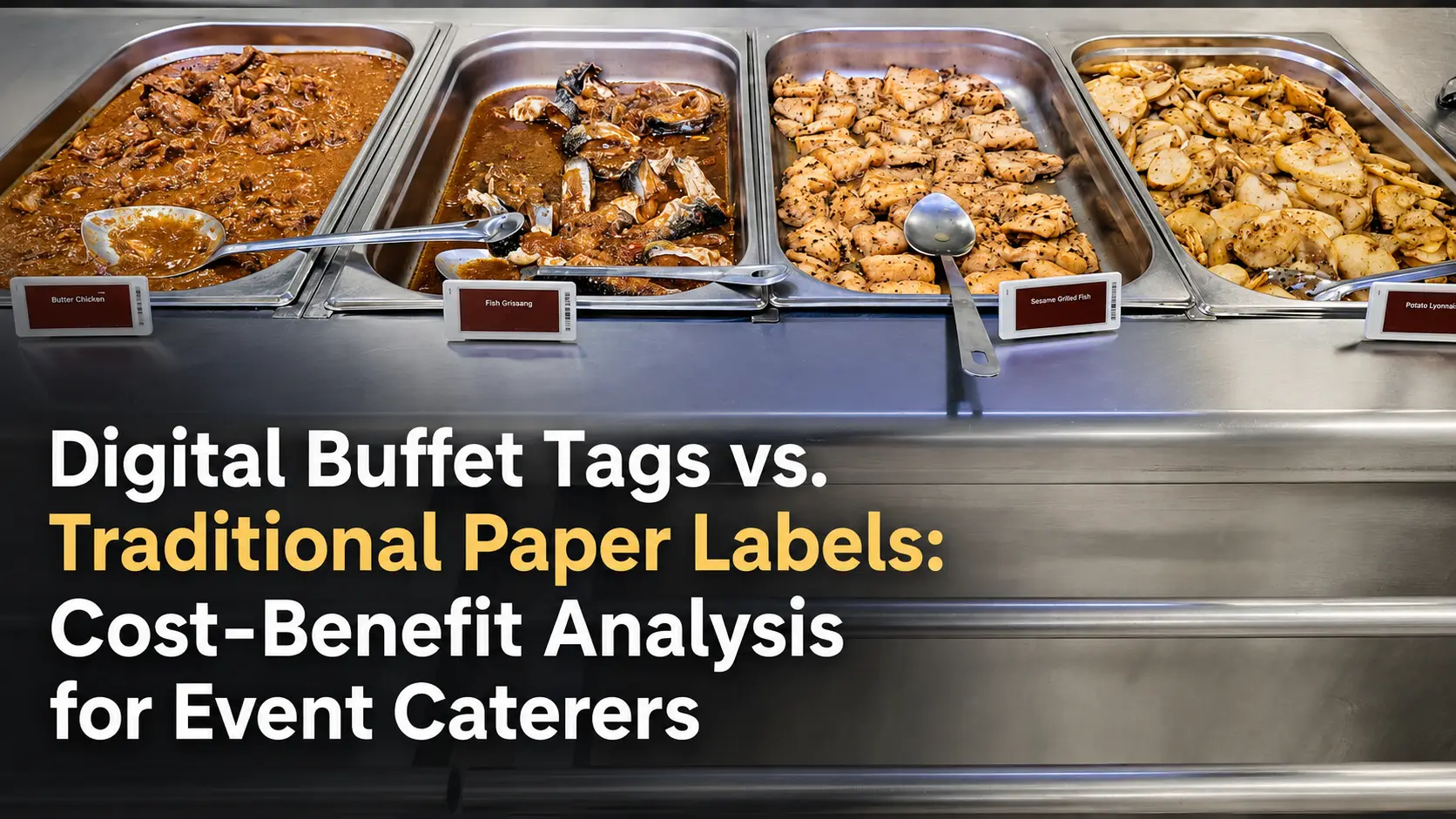
Digital buffet tags are usually the better long-term choice for event caterers that manage frequent menu changes, allergen labeling, premium presentation, or multi-site operations. Traditional paper labels still work for small, low-change setups, but once labor, reprints, errors, and brand consistency are measured properly, digital systems often deliver stronger operational control.
In catering, buffet labeling is not a cosmetic detail. It affects allergen compliance, guest trust, speed of service, and the ability to update menu information when dishes change minutes before opening. That is why many operators are now comparing paper vs digital buffet labels as a real cost and risk decision rather than a stationery purchase.
What are digital buffet tags? They are compact electronic display labels, typically based on e-ink technology, that show dish names, allergens, dietary icons, pricing, QR codes, and event-specific branding. Similar to Electronic Shelf Labels used in retail, they can be updated centrally or through a local transmitter setup at the venue, making them well suited to high-change buffet service.
What Are Digital Buffet Tags and How Do They Compare to Paper Labels?
Digital buffet labels for catering replace printed cards with reusable electronic displays. The practical difference is not just the screen. It is the workflow: instead of designing, printing, cutting, inserting, and replacing cards, staff update menu content in software and push changes to all labels at once.
Traditional paper labels are simple and cheap to start with. They require no hardware, no onboarding, and no battery management. Their weakness appears when menus rotate often, allergen details vary by event, or the same catering business serves multiple banquet halls, hotels, or off-site events with tight setup windows.
Digital food display labels are stronger where version control matters. If the kitchen swaps one sauce, one garnish, or one protein due to stock availability, the labeling team can update the dish title and allergen icons immediately. This is particularly important because, according to the UK Food Standards Agency, clear allergen information strongly influences guest trust and dining decisions.
| Criteria | Digital Buffet Tags | Traditional Paper Labels |
|---|---|---|
| Initial setup | Higher hardware and software investment | Low immediate cost |
| Menu change speed | Instant or near-instant updates | Manual redesign and reprint |
| Allergen accuracy | Centralized control reduces mismatch risk | Higher risk of outdated cards |
| Brand presentation | Consistent, premium, multilingual layouts | Depends on print quality and staff preparation |
| Waste generation | Reusable displays with minimal consumables | Recurring paper, ink, sleeves, and holders |
| Best fit | Hotels, event caterers, banquets, multi-site operators | Small, low-frequency, budget-led setups |
Why Buffet Labeling Matters More Than Many Caterers Assume
For event caterers, buffet labels are an operational control point. A wrong dish name can embarrass the brand, but a wrong allergen label creates a much more serious exposure. Food service publications such as Food Safety Magazine repeatedly emphasize that labeling failures and allergen communication gaps are a major risk area for hospitality operators.
Question: why is this especially important for catering rather than fixed restaurants? Answer: because catering environments change constantly. Menus are customized per client, dishes may be moved between stations, and event teams often work in temporary spaces where paper cards are updated under pressure.
Question: can digital buffet tags help with compliance? Answer: yes, because they let operators standardize approved dish names, ingredient notes, halal or vegan icons, and allergen symbols from a single template. That reduces the chance that one venue prints an older version while another uses the revised one.
There is also a clear brand image factor. Premium weddings, executive lunches, and VIP events expect polished presentation, not curled paper inserts or handwritten replacements. A buffet label system for hotels or corporate catering should match the visual standard of the rest of the event. Operators already investing in display quality through Digital Shelf Labels and other presentation technologies increasingly view buffet tags as part of the guest journey, not just a back-of-house task.
Upfront Costs: Hardware Investment vs. the Hidden Cost of Cheap Labels
The biggest argument for paper is obvious: the upfront purchase cost is low. A caterer can design cards in-house, print on demand, and use inexpensive holders. For a small operator with a limited menu and few events per month, that may be entirely rational.
Digital buffet tags require hardware, software configuration, charging or battery planning, and a venue-ready communications setup. That can include a localized base station or transmitter if the venue does not offer reliable network access. Buyers should ask three technical questions early: how many tags are needed per event, how will updates be pushed on-site, and who controls templates and permissions?
However, the comparison becomes misleading if buyers stop at purchase price. The true capital decision is whether the business wants reusable infrastructure or recurring manual work. A caterer running multiple banquet setups every week is effectively buying labor and consumables again and again when it stays with paper.
A real-use reference is Technowave’s Digital Buffet Tags UAE catering case study, which highlights deployment for Procate Catering across more than 20 locations. That matters because scale changes the economics: the more sites, menus, and events involved, the harder it becomes to control printing, consistency, and last-minute changes with paper workflows alone.
Ongoing Operating Costs: Labor, Reprints, Waste, and Service Reliability
The strongest financial case for electronic buffet tags is usually operating cost, not hardware depreciation. Traditional labels consume design time, printer consumables, replacement sleeves, transport handling, and staff effort at setup and strike. If a dish changes after cards are printed, that work is repeated.
Question: how much labor can caterers save? Answer: the exact figure varies by event complexity, but digital systems remove several manual steps entirely: print preparation, cutting, card sorting, insertion, and emergency reprinting. Zkong argues in its materials that electronic labeling can significantly reduce manual update effort, and the underlying logic is clear even without using a universal ROI number for every operator.
Waste is another cost line often ignored because it is spread across paper stock, ink, plastic sleeves, and disposables. For sustainability-led venues and corporate clients asking about greener events, reusable smart buffet tags for events create a more defensible answer than simply claiming the event used recycled paper. They also reduce transport friction because operators carry reusable tags rather than boxes of printed inserts.
Service reliability still matters. Buyers should evaluate screen readability under warm lights, battery life during long service windows, and enclosure durability near steam or chilled displays. Good electronic buffet tags are not placed directly in a heat source, but they are designed for hospitality handling. Ongoing support also matters, which is why some caterers prefer providers that can combine product supply with installation, integration, and support services rather than only shipping hardware.
Operational Benefits During Live Events and the Guest Experience Impact
During a live event, speed and control matter more than theory. Digital buffet tags can be updated when a vegetarian option replaces a meat dish, when a station runs out and switches menu sequence, or when a client asks to rename a dish for brand or cultural reasons. Staff do not need to search for a printer, laptop, scissors, and spare cards in the middle of service.
Question: can digital buffet tags display multiple languages, QR codes, and allergen icons? Answer: yes, modern systems typically support multilingual content, icon libraries, and QR codes linking to full ingredients or event microsites. That makes them useful for hotels, international conferences, and venues serving mixed guest profiles.
The visual benefit is not just neatness. E-ink displays give a sharp, high-contrast appearance that suits luxury buffets better than laminated paper cards of inconsistent size. For high-end operators, this supports the premium brand image angle: labels look deliberate, uniform, and modern rather than improvised. Buyers who want a broader view of the category can compare this use case with how hotels are rethinking paper buffet labels.
Digital tags also help reconcile front-of-house and back-of-house information. When integrated with menu management or inventory workflows, the labels can reflect approved content from the same source used by kitchen teams. That is where digital buffet tags begin to overlap with wider asset tracking and inventory management software thinking: one controlled data source serving multiple operational touchpoints.
Which Should You Choose? Decision Criteria, Trade-Offs, and Best-Fit Scenarios
Choose traditional paper labels if your operation is small, event frequency is low, menus rarely change, and premium presentation is not a major buying factor for your clients. Paper is also acceptable for one-off events where the labor is internal, the menu is fixed early, and there is minimal allergen complexity beyond basic standard cards.
Choose digital buffet tags if you operate hotel buffets, executive catering, banquet halls, institutional dining, or multi-site catering where menu variations happen often. They are especially compelling where allergen accuracy, multilingual labeling, brand consistency, and rapid on-site changes are normal rather than exceptional. They are also a better fit when your sales team wants premium presentation as part of the event package.
Simple decision checklist
- Menu volatility: frequent changes favor digital.
- Site count: more venues increase the value of central control.
- Compliance sensitivity: allergen-heavy environments favor digital.
- Brand positioning: premium hospitality favors digital.
- Budget model: low capex favors paper; lower recurring labor favors digital.
For most serious caterers, the real question is not whether digital buffet labels for catering cost more on day one. It is whether paper remains cheaper after months of repeated labor, rework, consumables, and avoidable errors. If your team runs enough events to feel those pains weekly, the answer is usually no. For buyers planning a structured rollout, Technowave International can help evaluate tag sizes, software workflow, deployment model, and support approach for hospitality operations.
FAQ
Q: What are digital buffet tags and how do they work at events?
A: Digital buffet tags are reusable electronic labels, usually e-ink based, used to display dish names, allergens, dietary icons, prices, or QR codes. Event teams update them through software and push changes wirelessly or through a localized on-site setup, avoiding manual reprinting.
Q: Are digital buffet tags more cost-effective than printed paper labels?
A: For low-volume catering, paper can remain cheaper. For operators with frequent menu changes, multiple venues, or premium service standards, digital tags often become more cost-effective over time because they reduce reprints, setup labor, consumables, and labeling errors.
Q: How much labor can caterers save by switching to digital buffet labels?
A: Savings depend on event size and workflow, but digital systems eliminate repeated tasks such as design edits, printing, cutting, sorting, and replacing cards during service. The biggest labor gains appear in high-change buffets, banqueting teams, and multi-location catering businesses.
Q: Can digital buffet tags display allergens, QR codes, and menu updates in real time?
A: Yes. Most electronic buffet tags support allergen icons, multilingual text, dietary markers, and QR codes for detailed ingredients or nutrition pages. Updates can usually be sent centrally, which helps keep the physical buffet display aligned with current menu information.
Q: Are digital buffet tags suitable for hotels, banquet halls, and corporate events?
A: Yes. They are particularly suitable where operators need polished presentation, repeatable branding, and last-minute flexibility. Hotels, resorts, conference venues, and contract caterers benefit most because they typically handle larger guest volumes and more frequent menu variations.
Q: How do digital buffet tags handle battery life and humid buffet conditions?
A: E-ink tags consume power mainly when the screen updates, so battery life is generally measured in long operating cycles rather than hours of constant display. Buyers should still confirm enclosure quality, placement rules near heat or steam, and the service model for replacements and maintenance.
If you are comparing paper cards with a scalable buffet labeling system, the best next step is a site-specific cost review: event volume, tag count, update frequency, allergen complexity, and branding requirements. Technowave International provides digital buffet tag supply, integration, rollout support, and after-sales expertise for hospitality operators that want a practical, support-backed deployment.
Related Articles
- 5 Key Benefits Digital Shelf Labels Fashion Retail
- Why Uae Hotels Still Using Paper Buffet Labels Are Falling Behind In 2026
- Digital Buffet Tags Uae Catering Case Study
Digital Buffet Tags vs Paper Labels: Cost Analysis
Compare digital buffet tags vs paper labels for catering. Learn costs, labor savings, ROI, branding, and accuracy benefits for events.