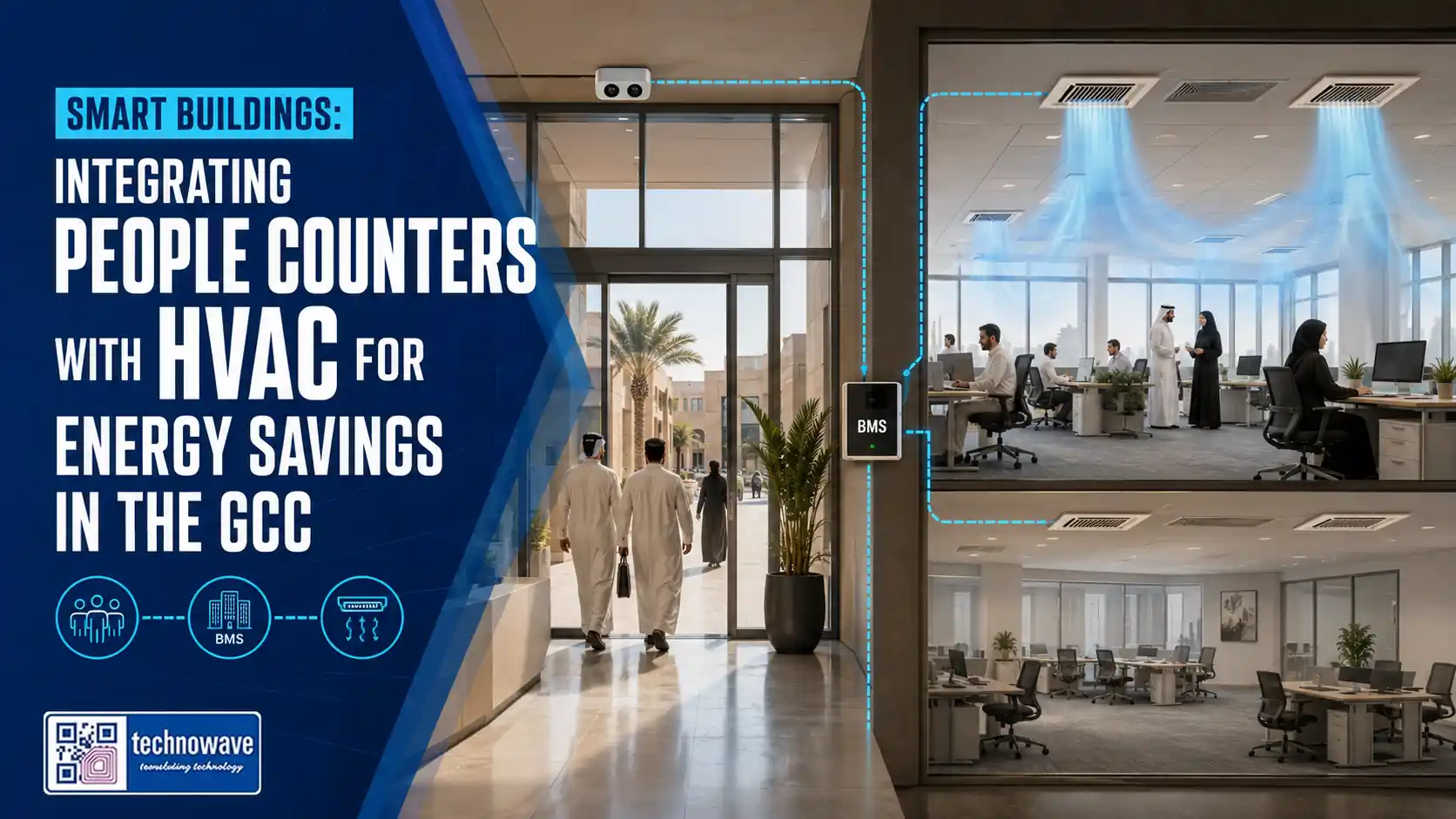
An occupancy monitoring system UAE helps commercial buildings reduce HVAC waste by adjusting cooling and ventilation to actual room usage instead of fixed schedules. For facility managers, operations heads, and developers, the value is straightforward: less over-cooling, better indoor comfort, more reliable occupancy visibility, and a clearer path to smart building performance.
In practice, this means connecting people-counting sensors, zone analytics, and building controls so meeting rooms, lobbies, retail floors, classrooms, and public spaces are conditioned only when needed. The strongest business case is not generic sustainability messaging; it is operational control over energy-heavy spaces that fluctuate throughout the day.
What an occupancy monitoring system does in a smart building
An occupancy monitoring system measures how many people are present in a defined area and when those numbers change. In smart buildings, that data is used beyond security or retail analytics. It becomes a control signal for HVAC, fresh-air management, cleaning schedules, staffing, and space planning.
The most useful systems do more than count entries at a front door. They provide zone-level visibility across multiple entrances, corridors, meeting rooms, halls, or tenant areas. For HVAC use, the system must identify occupancy patterns with enough granularity for the Building Management System to decide whether to reduce airflow, raise or lower setpoints, or trigger demand-controlled ventilation.
For decision-makers comparing options, the distinction matters. A basic visitor tally is not the same as a people counting system designed for smart building automation. If you are assessing sensor types, installation models, or analytics logic, it is also useful to review how AI-based people counter cameras replace traditional counters in environments where precision and zone intelligence are more important than simple door counts.
What is it, in one sentence? It is a sensor-and-software layer that converts real-world human movement into actionable occupancy data for building operations.
Why HVAC optimisation depends on real-time occupancy data
Most HVAC inefficiency in commercial buildings comes from conditioning spaces as if they were fully occupied all the time. That assumption fails in offices with fluctuating meeting room use, malls with uneven tenant traffic, universities with class-based peaks, and hospitality venues that swing between empty and crowded within minutes.
Real-time occupancy data changes the control model. Instead of running cooling based on time schedules alone, the BMS can respond to live load conditions. Low-occupancy zones can receive less cooling or fresh air, while busy areas can be prioritised before occupants start complaining about temperature, humidity, or air quality.
This is especially important in large buildings where occupancy is not evenly distributed. A lobby may be busy while upper-floor rooms are empty. A food court may peak while adjacent retail corridors remain light. According to ASHRAE, integrating occupancy sensors with demand-controlled ventilation can reduce HVAC energy consumption by 20% to 40% in commercial buildings. That is why buyers increasingly treat occupancy data as an HVAC input, not just a reporting dashboard.
Answering a common buyer question directly: How does occupancy monitoring reduce HVAC energy consumption? It prevents conditioning of underused space and allows ventilation and cooling intensity to track actual population levels rather than assumptions.
How people counters integrate with HVAC and existing BMS platforms
Integration usually follows a simple chain: sensors capture counts, analytics software converts counts into occupancy logic, and the BMS consumes that output through a standard interface. In many projects, the existing HVAC plant and controllers remain in place. The upgrade happens at the data and control layer, not through a full mechanical replacement.
Buyers often ask whether legacy infrastructure is a blocker. In most cases, it is not. Modern counting platforms can feed occupancy signals into BMS environments using common protocols or middleware, allowing the engineering team to map thresholds by zone. For example, a boardroom can shift ventilation mode once occupancy passes a set number, while an atrium can trigger staged cooling when sustained traffic exceeds normal baseline.
Typical integration architecture
- Sensor layer: overhead 3D, stereoscopic, or AI vision counters installed at entrances or within zones
- Processing layer: software validates in/out counts, dwell, and occupancy state
- Integration layer: API, BACnet gateway, Modbus mapping, or custom middleware
- Control layer: BMS adjusts airflow, fresh air, scheduling, alerts, and reporting
Sensor choice affects integration quality. A solution such as the FootfallCam Pro1 AI powered 2D vision people counter can be appropriate where wide entrances, high ceilings, or directional counting are involved, while multi-point deployments may be built around broader FootfallCam counters with central analytics. The right question is not only “Can it count?” but “Can it provide a stable control-grade occupancy feed to our BMS?”
| Evaluation area | Basic footfall setup | HVAC-ready occupancy setup |
|---|---|---|
| Primary objective | Traffic reporting | Live building control |
| Data granularity | Entrance totals | Zone-based occupancy states |
| System output | Dashboard only | BMS/API/protocol integration |
| Sensor tolerance | Good enough for trends | High consistency for automation |
| Deployment design | Single-point counting | Multi-zone engineered coverage |
Where occupancy-based HVAC control delivers the strongest operational value
Office buildings benefit first in meeting rooms, training spaces, collaboration areas, cafeterias, and reception zones. These spaces are notoriously misaligned with fixed HVAC schedules. Occupancy analytics helps building teams avoid cooling empty rooms while still delivering comfort in rooms that fill quickly.
Retail and mall environments have a different pattern. Traffic surges shift across entrances, anchor zones, food courts, and event areas. Here, occupancy-driven cooling helps facilities teams manage comfort during peaks without over-conditioning quieter wings. This use case complements broader retail automation and people counting systems, where the same infrastructure can support both operational control and visitor analytics.
Public facilities such as libraries, museums, universities, and municipal buildings often need accurate occupancy visibility for both comfort and governance. A relevant real deployment is the Mohammed Bin Rashid Library people counting case study, which shows how counting infrastructure can support complex public environments with multiple user flows. In these projects, occupancy data is valuable not only for reporting but for managing conditioned spaces more intelligently.
Hotels, exhibition venues, and mixed-use sites gain value where occupancy swings sharply by hour or by event. In those buildings, a visitor management system may complement counters at controlled access points, while the counting layer handles live population changes inside public areas. The result is more precise HVAC response in spaces that are otherwise difficult to schedule.
Implementation requirements, buyer criteria, and why timing matters now
The buying decision should start with engineering scope, not product brochures. First define the spaces where occupancy affects energy spend the most. Then assess ceiling height, entrance width, lighting variation, reflective surfaces, and whether the objective is directional counting, anonymous occupancy estimation, or full zone logic. High-traffic sites need sensor placement designed to avoid double counts, shadowing, or blind spots.
Accuracy is a technical issue, not a marketing checkbox. In GCC commercial buildings, dark interiors, glass-heavy architecture, and sunlight transitions can affect some sensor types more than others. Ask vendors for deployment methodology, validation process, and how they maintain count integrity during crowd surges. Also ask whether the platform can process sustained high traffic without lag if you operate malls, transit-adjacent sites, or exhibition halls.
Data governance is equally important. Many buyers prefer anonymous overhead sensors that do not require facial identification because the use case is occupancy state, not personal surveillance. The practical question is: can the system provide useful control data while keeping privacy risk low and security architecture manageable? For many organisations, that answer should be yes.
Why act now? Because occupancy-based control is one of the few building upgrades that can improve comfort, support green-building operations, and reduce avoidable HVAC runtime without waiting for a full infrastructure replacement. If you are evaluating deployment, the key requirement is an integration-led partner that can supply hardware, configure analytics, connect to BMS logic, and back the system with Technowave International style local implementation capability, including installation, AMC, and technical support. For GCC organisations rolling out people counting as part of smart facilities strategy, that end-to-end execution matters more than the sensor alone.
FAQ
Q: How does an occupancy monitoring system help reduce HVAC energy consumption?
A: It gives the building control system live occupancy data so cooling and ventilation can respond to actual use. Instead of conditioning every zone at the same level all day, the BMS can reduce airflow or adjust setpoints in underused spaces and prioritise busy areas.
Q: Can people counting systems integrate with existing HVAC or BMS platforms?
A: In many cases, yes. Modern systems typically connect through APIs, middleware, or standard building protocols. The practical requirement is not replacing the HVAC plant, but ensuring the sensor platform can send stable occupancy outputs that the BMS can map into control rules.
Q: What types of buildings benefit most from occupancy-based HVAC control?
A: Offices, malls, retail chains, universities, libraries, hotels, exhibition centres, and public buildings usually benefit most. The strongest fit is any site where occupancy changes significantly by hour, by zone, or by event and fixed HVAC scheduling causes over-cooling or uneven comfort.
Q: How accurate are modern occupancy monitoring and people counting systems?
A: Accuracy depends on sensor technology, placement, and calibration discipline. Well-designed overhead systems can perform reliably in demanding environments, but buyers should validate results in their own building conditions, especially where ceilings are high, traffic is dense, or glass and lighting variability are significant.
Q: What should businesses consider before deploying occupancy monitoring in multi-site buildings?
A: Standardisation matters. Review sensor consistency, dashboard structure, integration method, network requirements, cybersecurity controls, and support coverage across all locations. Multi-site projects also need clear KPI definitions so each property measures occupancy, comfort response, and HVAC optimisation in the same way.
Q: Does an occupancy monitoring system create privacy concerns?
A: It can, depending on design. For HVAC applications, many organisations choose anonymous overhead counting systems that measure movement and presence without identifying individuals. Buyers should still review data retention, access controls, edge processing, and local compliance requirements before deployment.
If your team is planning a people counting and HVAC automation project, Technowave International can help evaluate sensor selection, integration scope, and deployment support across commercial environments in the GCC. Engage the team for a technical assessment focused on operational fit, not generic product claims.
Related Articles
- People Counters
- How AI-Based People Counter Cameras Can Replace Traditional People Counters
- footfall Counter for Events: Guide for Smarter UAE Shows
- Top 5 Benefits of Implementing a People Counting System in Your UAE Store
- Comparing the Best People Counting Systems for Retail in the UAE: Which One Fits Your Needs?
- People Counting Systems: Are They Worth the Investment for UAE Retailers?
Occupancy Monitoring System UAE for HVAC Savings
Learn how an occupancy monitoring system UAE integrates with HVAC and BMS to reduce energy waste, improve comfort, and support smarter buildings.