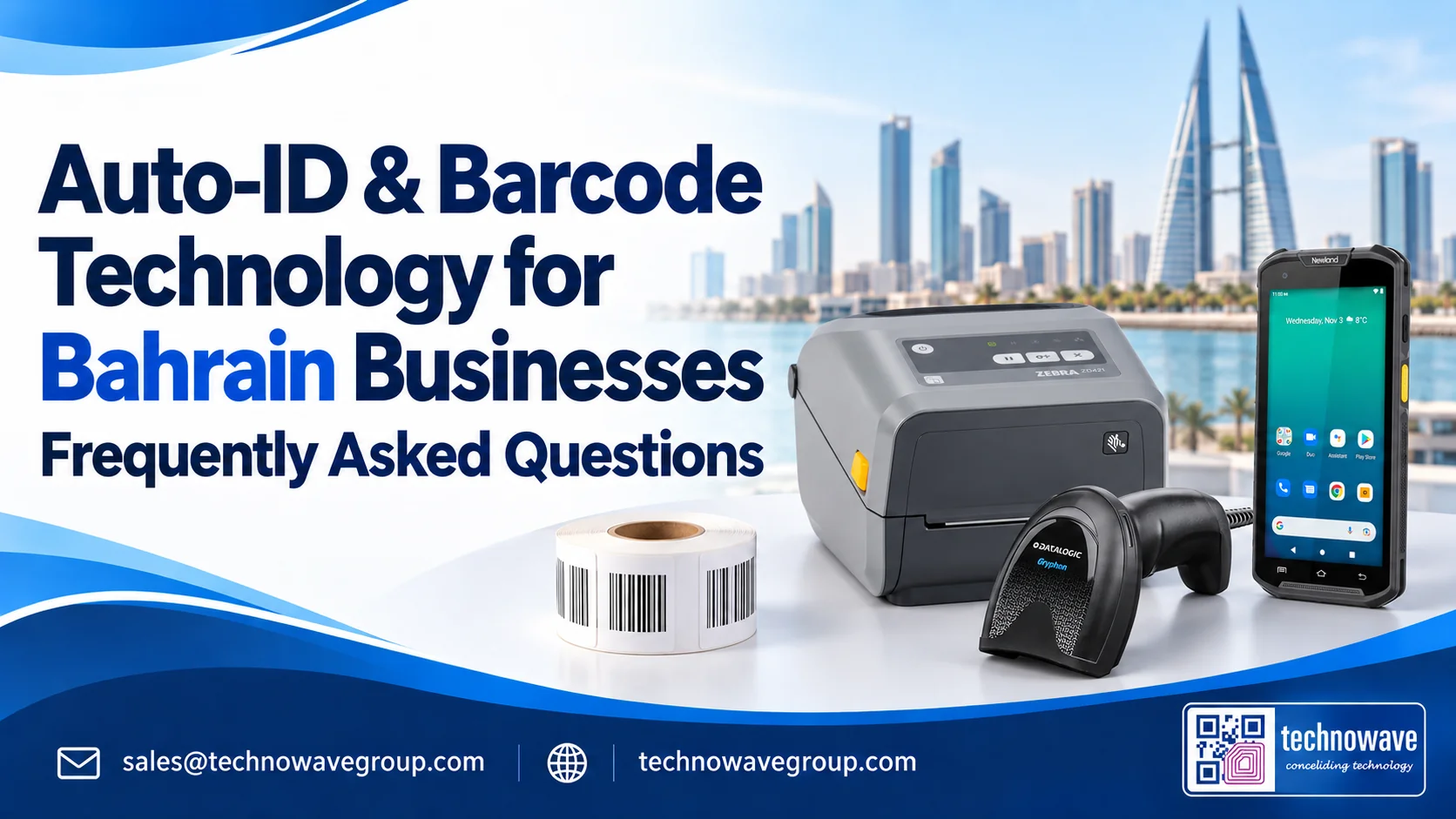
If you are researching auto-id barcode questions Bahrain buyers usually ask, the short answer is this: the right system depends less on the barcode itself and more on workflow fit, device durability, software integration, label quality, and local support. In Bahrain, retailers, warehouses, healthcare providers, universities, and service organizations typically evaluate Auto-ID projects by asking how the system works, what it costs, how long it takes to deploy, and whether it will reduce manual errors without creating IT complexity.
Auto-ID technology is the use of machine-readable identifiers such as 1D barcodes, 2D barcodes, QR codes, and RFID to identify items, assets, cartons, locations, or documents automatically. In practical terms, it connects scanners, mobile computers, printers, labels, and business software so staff can capture data at the point of activity rather than re-entering it later.
1. What exactly do Bahrain businesses mean when they ask for Auto-ID and barcode technology?
Most Bahrain buyers are not asking for a single device. They are asking for a complete data-capture workflow: a barcode label is created, attached to an item or location, scanned by staff, and validated inside ERP, WMS, POS, asset, or inventory software. That workflow can be simple in a small store or highly structured in a warehouse with bin locations, batch tracking, receiving, put-away, picking, dispatch, and cycle counts.
In retail, the common requirement is fast product lookup, stock verification, shelf labeling, receiving, and back-store counts. In warehousing and logistics, the focus is scan accuracy, rugged hardware, long battery life, and readable labels under dust, heat, or repeated handling. In healthcare, education, and facilities, barcode usage often supports fixed asset audits, sample identification, file tracking, and issue/return processes.
Barcode remains the preferred starting point for many Bahrain organizations because it is cost-effective, easy to train, and compatible with existing software. Buyers comparing barcode with RFID should not assume one replaces the other. Barcode is usually best when staff can scan items deliberately one by one, while RFID becomes attractive when bulk reading, non-line-of-sight capture, or faster inventory counts justify the extra infrastructure.
For teams still defining scope, it helps to review actual device categories such as handheld barcode scanners, desktop barcode printers, and mobile barcode printers before requesting quotations. That avoids the common mistake of asking for “barcode solutions” without specifying environment, scan distance, label volume, or software touchpoints.
2. What should buyers check before choosing Auto-ID hardware and labels?
The first question should be: what exactly is being scanned, by whom, and in what environment? A checkout counter, a warehouse aisle, a loading bay, a hospital trolley, and an outdoor yard all impose different requirements. Scanner engine type, decode speed, drop resistance, ingress rating, screen readability, keyboard design, Wi-Fi roaming, Android version, and battery swap options all matter once the system moves from demo to daily use.
Key selection criteria
- Barcode type: 1D laser may suit legacy labels; 2D imagers handle QR and damaged codes better.
- Form factor: cordless scanner, pistol-grip mobile computer, wearable scanner, or vehicle-mounted option.
- Print volume: desktop printers for moderate daily volume; industrial models for high-duty label production.
- Media compatibility: paper, synthetic, polyester, tamper-evident, freezer-grade, or chemical-resistant labels.
- Connectivity: USB, Bluetooth, Wi-Fi, or network print for multi-user operations.
Label quality is often underestimated. A good scanner cannot compensate for poor print contrast, adhesive failure, or the wrong ribbon-material combination. Businesses printing asset labels, shelf labels, carton labels, and outdoor tags should evaluate ribbon type, label topcoat, adhesive surface compatibility, and expected lifespan. This is why barcode printer consumables should be specified at the same time as printers, not purchased later as an afterthought.
| Business need | Typical device fit | What buyers should verify |
|---|---|---|
| Retail checkout and back-store stock checks | Handheld scanner or cordless 2D scanner | Fast decoding of small labels, cable or cradle setup, POS compatibility |
| Warehouse receiving, picking, and dispatch | Rugged mobile computer | Drop rating, Android support, long battery life, Wi-Fi performance |
| On-the-go shelf or delivery labeling | Mobile barcode printer | Label width, battery runtime, Bluetooth pairing, media change speed |
| Office, clinic, or asset tagging | Desktop barcode printer | Print resolution, adhesive match, small-label clarity, network sharing |
| High-volume warehouse or manufacturing labels | Industrial printer | Duty cycle, ribbon capacity, metal chassis, continuous operation |
3. How can Bahrain businesses compare Auto-ID providers properly?
A quotation alone is not a meaningful comparison. The real comparison is between providers that simply supply hardware and providers that validate workflows, configure devices, integrate software, train users, and support the system after go-live. Bahrain buyers should ask whether the vendor can handle device staging, barcode symbology settings, label template design, network setup, user-role mapping, and on-site troubleshooting.
For many organizations, the provider’s service depth matters more than the scanner brand. A good provider should ask for your process map, sample labels, software environment, site layout, and expected transaction volume before proposing models. If the vendor only asks for quantity and brand preference, you may receive hardware that works technically but does not fit operationally.
Questions to ask every vendor
- Do you provide a site survey or workflow assessment?
- Can you configure printers, labels, scanners, and mobile computers as one system?
- Do you support integration with ERP, WMS, POS, or asset software?
- Is local AMC, repair, spare replacement, and preventive maintenance available?
- Can you supply rental devices for stock counts or peak periods?
Buyers in Bahrain should also look for proof of regional execution. Relevant examples matter because they show the provider understands GCC deployment realities such as multilingual labels, branch rollouts, imported hardware lead times, and local support expectations. Reviewing projects like the University Of Bahrain case study can help procurement teams assess whether a vendor has worked in comparable operational environments.
Finally, compare knowledge depth, not just product brochures. A supplier with useful implementation content, such as practical guidance on how asset tracking systems work, is often better prepared to advise on exceptions, audits, relabeling, and user adoption than a reseller focused only on catalog sales.
4. What does Auto-ID barcode implementation usually involve, and how long does it take?
Implementation usually starts with discovery, not installation. The project team should define use cases, barcode standards, label sizes, naming rules, user roles, integration points, and exception handling. For example, receiving workflows need different scan prompts and validation logic than fixed-asset audits or shelf-edge relabeling. This design stage determines whether the project scales cleanly or creates workarounds later.
The technical build then covers label template creation, printer setup, scanner configuration, mobile app setup, and software integration. If the deployment includes mobile computers, there may also be MDM enrollment, Wi-Fi testing, role-based menus, and staged device imaging. Where businesses use Android tablets with barcode scanners or rugged barcode devices, screen flow design becomes critical because poor navigation can slow down otherwise good hardware.
How long does deployment take? It depends on scope. A standalone printer-and-scanner setup for a single site can move quickly once media and templates are approved. A multi-site rollout with ERP integration, branch training, and asset or inventory master-data cleanup will take longer because process validation, user acceptance testing, and change control are the real timeline drivers, not device delivery alone.
Operational planning should include pilot testing, fallback procedures, relabeling strategy, and ownership after go-live. If users find duplicate barcodes, unreadable legacy labels, or inconsistent item masters, those issues must be corrected systematically. Organizations planning wider traceability or audit automation may also benefit from related guidance on scalable asset management for multi-location businesses, especially when barcode is expected to support long-term growth.
5. What affects pricing, ROI, security, and long-term support in Bahrain?
When buyers ask about auto-id barcode questions pricing Bahrain teams should expect the answer to be configuration-based, not one fixed rate. Budget depends on device class, scan engine, ruggedness, printer type, label media, software requirements, accessories, installation, training, and support model. A low entry price can become expensive if it excludes spare batteries, cradles, ribbons, network setup, or onsite support.
ROI usually comes from fewer manual entries, faster counts, cleaner receiving, more accurate labeling, and improved audit traceability. In retail, that may mean faster back-store verification and fewer shelf discrepancies. In warehousing, value often appears through cleaner pick confirmation and dispatch accuracy. In asset-heavy sectors, it can mean more reliable audits and less time spent searching for tagged equipment rather than a headline percentage reduction.
Security and compliance are practical concerns, especially when mobile devices connect to ERP or store operational records. Buyers should ask about device authentication, user permissions, data transmission, local backup behavior, lost-device controls, patching approach, and whether the application stores sensitive data offline. If labels identify internal assets, patient-related items, or controlled inventory, role-based access and audit logs matter just as much as scan speed.
Long-term support is where many projects succeed or fail. Bahrain businesses should confirm preventive maintenance, printhead replacement, scanner repair turnaround, firmware updates, consumables continuity, and annual maintenance options before purchase. For growing operations, the ability to source service, rentals, consumables, and technical support from one provider reduces fragmentation. That is where an established regional specialist such as Technowave International becomes relevant: the value is not only in hardware supply but in consultation, deployment, AMC, repair, and post-sales continuity. For project discussions, buyers can use the contact page or review broader capabilities on the group website.
FAQ
Q: What should buyers check before choosing Auto-ID barcode technology in Bahrain?
A: Start with workflow, not brand. Define what will be labeled, who scans it, the environment, software integration needs, daily print volume, and service expectations. Then verify scanner type, printer duty cycle, label material, consumables compatibility, and whether the provider offers local setup and support.
Q: How can businesses compare Auto-ID barcode providers?
A: Compare on solution depth: site survey, workflow design, device configuration, label template setup, software integration, training, AMC, repair, and consumables continuity. A vendor that only offers a hardware quote may not support operational issues after go-live.
Q: What does Auto-ID barcode technology typically cost in Bahrain?
A: There is no single market price because cost depends on device ruggedness, scan engine, printer category, labels, ribbons, software, installation, and support scope. Buyers should request a line-item quotation that separates hardware, media, integration, training, and maintenance.
Q: How long does implementation usually take?
A: Simple single-site deployments can be completed quickly once labels and device settings are finalized. Multi-site or software-integrated projects take longer because barcode structure, master data cleanup, user testing, and workflow approval usually determine the schedule more than the hardware delivery itself.
Q: What security or compliance factors matter most?
A: Focus on user permissions, secure device access, Wi-Fi and application configuration, lost-device controls, audit logs, and how offline data is stored. If barcode workflows touch patient items, sensitive assets, or regulated inventory, traceability and access control are essential.
Q: Is barcode enough, or should a business move to RFID?
A: Barcode is usually sufficient where users can scan individual items deliberately and cost control is important. RFID becomes more compelling when bulk reading, faster stock counts, non-line-of-sight capture, or automated gate-based tracking are real operational requirements.
If your Bahrain operation is reviewing scanners, printers, labels, mobile computers, or a broader Auto-ID rollout, speak with Technowave International for a requirement-level assessment rather than a generic product quote. The team can help you compare device options, plan implementation, and align support, consumables, and integration with your actual workflow. You can contact the team via WhatsApp or email to discuss your project.
Related Articles
- Smart Retail Technology ROI Calculator: What Indian Businesses Can Expect from RFID, ESL & Analytics Investment
- Can Electronic Shelf Labels Work Without Internet? Understanding Esl System Architecture Vs Traditional Methods: Which Is Better for Businesses in GCC?
- Digital Buffet tags for Catering Businesses
- Ways Businesses Can Minimize Asset Loss and Misplacement
- Why Scalable Asset Management Matters for Multi-Location Businesses
- RFID Asset Management System for Businesses: Features and Benefits
Auto-ID Barcode Questions Bahrain: FAQ Guide
Auto-ID barcode questions Bahrain answered: costs, hardware choices, implementation, support, ROI, and vendor selection for Bahrain businesses.