
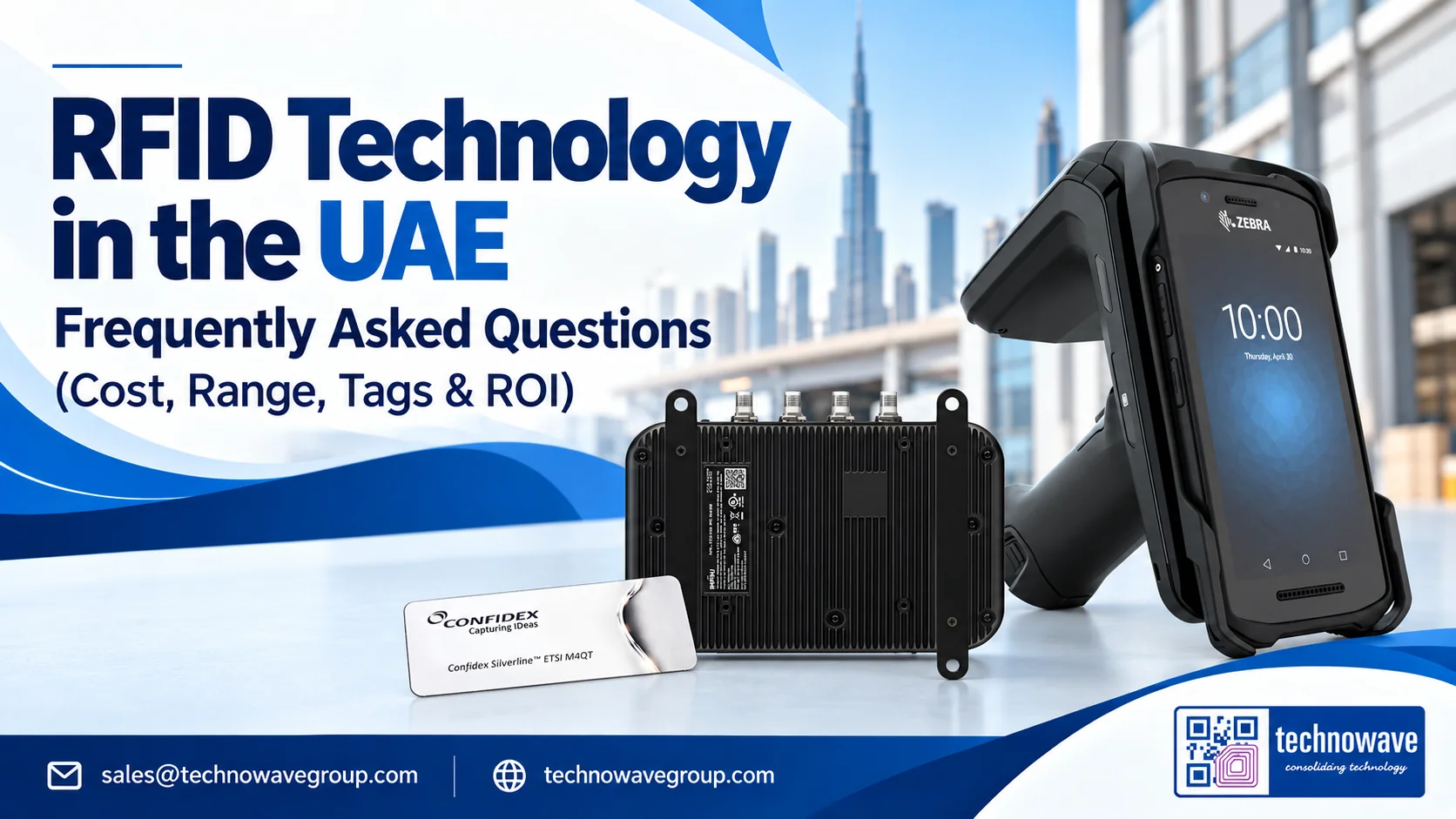
If you are researching RFID questions UAE, the short answer is this: the right RFID system in the UAE depends less on the word “RFID” itself and more on five decision points—use case, tag type, read environment, software integration, and support model. Buyers usually ask about cost, range, tags, rollout time, and ROI first, and those are exactly the questions that should shape the project before any hardware is ordered.
RFID is a wireless identification technology that uses tags and readers to capture item, asset, carton, or equipment data without requiring direct line-of-sight scanning. In the UAE, it is commonly evaluated for retail stock accuracy, warehouse movement visibility, fixed asset audits, jewellery control, event access, and industrial tracking where barcode-only processes become too slow or too manual.
1. What do UAE buyers need to understand first about how RFID actually works?
The first practical question is simple: what exactly will the system identify, where, and at what speed? RFID is not one product. A complete deployment may include passive or active tags, handheld readers, fixed readers, antennas, printers, middleware, and software. In most UAE retail and warehouse projects, buyers are evaluating passive UHF RFID because it supports bulk reading, works well for inventory cycles, and fits item-level or carton-level tracking.
How does data get captured? A reader emits radio energy, the tag responds with its identifier, and the software maps that ID to a stock item, asset record, or movement event. That means RFID performance is always shaped by environment. Metal racks, liquid products, dense shelving, narrow portals, and reader power settings all affect read reliability more than brochure specifications do.
A common buyer question is whether RFID replaces barcode. Usually, no. In many UAE operations, the best architecture is hybrid: RFID for fast, non-line-of-sight counting and movement detection, plus barcode for exception handling, receiving labels, serial number confirmation, or low-cost point scanning. That is why buyers comparing passive RFID tag options should also assess software workflows, not just hardware.
Another early question is whether RFID is only for retail. It is not. The same principles apply across asset audits, returnable transport items, document movement, hospitality equipment control, and educational institutions managing high-value devices. For UAE businesses, the key is matching the read model—handheld, gate, shelf, room, tunnel, or desktop—to the operational event being measured.
2. What should buyers check before choosing tags, readers, and system architecture?
The most frequent technical mistake is selecting tags before testing the surface, orientation, and movement path. Buyers should start with the tagged object: apparel, electronics, files, tools, laptops, jewellery, cartons, pallets, or IT assets. Each behaves differently in radio environments. An asset tag that performs well on office furniture may fail on metal cabinets or compact medical equipment unless a purpose-built on-metal design is used.
Tag choice usually comes down to these questions:
- What material is being tagged? Cardboard, fabric, plastic, glass, and metal require different tag constructions.
- Is the tag disposable or reusable? Retail source tags differ from long-life asset labels.
- Is tamper evidence required? Relevant for retail, evidence control, and high-value assets.
- Does the tag need printing or encoding on site? Important where serialised issuance is required.
Reader selection follows the process. Handheld readers are often preferred for flexible stock counts, exception searches, and asset audits across multiple UAE locations. Fixed readers are better when you need automated reads at dock doors, back-room transitions, or controlled access points. Buyers searching for “rfid handheld reader” or “rfid reader Dubai” should compare antenna configuration, SDK support, ruggedness, battery performance, and integration with ERP, POS, or WMS environments—not only read range.
A useful comparison is below:
| Requirement | Best-fit RFID approach | What to verify before buying |
|---|---|---|
| Retail cycle counting | Passive UHF item tags + handheld reader | Garment density, tag placement, stock file integration |
| Dock door movement capture | Fixed reader + directional antennas | Portal width, false reads, forklift traffic pattern |
| Fixed asset audits | Durable asset tags + handhelds | On-metal performance, asset hierarchy, audit workflow |
| Jewellery tracking | Specialised small-form-factor RFID tags | Read sensitivity, tray design, counting speed |
| High-value equipment zones | Passive or active RFID depending visibility need | Real-time requirement, battery maintenance, zone accuracy |
Where asset identification is the priority, buyers should review durable asset tags for asset management and ask for live tests on the actual object, not a tabletop demonstration. If retail loss prevention is part of the scope, dual-purpose options such as AM RFID dual tags may also be worth evaluating.
3. What does RFID typically cost in the UAE, and what really drives ROI?
The honest answer to “what is RFID questions pricing UAE?” is that there is no single market price because RFID cost is a system cost, not just a device cost. Budget usually includes tags, readers, antennas, printers, software, integration, site survey, installation, training, support, and in some projects ongoing tag consumption. A low hardware quote can become an expensive project if software mapping, middleware logic, or post-go-live support are missing.
Buyers should separate cost into three layers. First is infrastructure cost: readers, antennas, mounts, cabling, printers, and mobile devices. Second is software cost: device management, encoding, middleware, dashboards, asset or inventory workflows, and API integration. Third is operational cost: tag replenishment, AMC, battery replacement for active tags where used, and support for user turnover or process changes.
ROI in the UAE is usually justified by business outcomes, not by the technology label. Retailers look at faster counts, better stock visibility, and fewer manual discrepancies. Warehouses focus on movement accuracy, reduced search time, and more reliable event capture. Asset-heavy organisations evaluate shorter audits, improved location visibility, and less administrative effort in reconciliation. If you need a framework for evaluating investment logic, this RFID ROI planning resource is useful as a methodology reference even though the examples are from another market.
One direct buyer question is whether active RFID is worth the premium. It depends on whether continuous or near-real-time location visibility matters. For many audits and periodic inventory checks, passive RFID delivers stronger value. Active RFID is usually considered when assets move across zones and visibility must happen automatically without staff walking counts with handhelds.
4. How long does RFID implementation usually take in the UAE, and what can delay it?
Implementation time depends on scope. A small pilot with handheld readers and limited software workflow can move quickly once sample tags and test items are available. A multi-site deployment with fixed portals, ERP integration, encoding rules, and branch training naturally takes longer because physical infrastructure, data mapping, and process acceptance all matter. The most common delay is not hardware supply; it is unclear operational design.
What should a realistic rollout plan include? First, a site and use-case assessment: what is being tagged, where reads must happen, what exceptions exist, and what success means. Second, proof-of-concept testing using real products, shelves, racks, carts, doors, and containers. Third, software mapping: item master, asset register, location IDs, event naming, user roles, and reporting outputs. Fourth, controlled pilot, staff training, and acceptance criteria.
Which UAE project factors usually affect timeline?
- Import and deployment coordination: especially for large tag volumes or specialised reader hardware.
- Integration complexity: POS, ERP, WMS, or custom asset databases can extend testing.
- Site conditions: malls, warehouses, hospitals, and campuses each impose different installation windows.
- Tagging readiness: projects often pause because master data is incomplete or assets are not prepared for labeling.
Another buyer question is whether they should start with one site. In most UAE organisations, yes. A pilot branch, one warehouse zone, or one asset class produces better design evidence than a theoretical enterprise rollout. Real examples matter more than generic promises; buyers can review projects such as the UAE RFID retail automation case study to understand how implementation decisions connect to store operations.
5. What security, compliance, maintenance, and vendor-selection issues matter most?
RFID buyers often focus on tags and range, then address governance too late. The right security question is not “is RFID secure?” but “what data is stored on the tag, who can read it, and where is the business logic enforced?” In many systems, the tag carries only an identifier while item details live in secured applications. That reduces exposure, but software permissions, device control, audit logs, and API security still require attention.
In the UAE, compliance review should cover data-handling responsibilities, especially when RFID events are linked to employee assets, visitor movement, or personally attributable workflows. Projects that touch regulated environments such as healthcare, education, or government entities should involve IT and compliance stakeholders early. If the deployment includes networked readers across branches, buyers should also review VLAN design, remote access controls, firmware governance, and patch procedures.
Maintenance is another real buyer concern. Passive tags generally require minimal maintenance after application, but readers, printers, handheld batteries, mounts, cables, and software environments do not maintain themselves. Ask prospective vendors what preventive maintenance includes, how they handle device replacement, how firmware upgrades are scheduled, and whether they support mixed-brand estates. These practical service questions often matter more after go-live than the initial hardware choice.
How should businesses compare RFID questions provider UAE options? Use a weighted checklist: proven UAE deployment experience, testing discipline, software capability, integration depth, after-sales response, tag sourcing flexibility, and ability to support expansion from pilot to multi-site operation. This is where Technowave International becomes relevant: buyers looking for end-to-end RFID services, local installation, asset tagging support, and post-deployment assistance can review its UAE project background and then use the contact page for a practical assessment or pilot discussion.
FAQ: Additional RFID Questions UAE Buyers Commonly Ask
Q: What should buyers check before choosing RFID in the UAE?
A: Check the use case first: item-level retail, carton tracking, fixed asset audit, or real-time equipment visibility. Then verify tag-to-surface compatibility, reader type, software integration path, site constraints, and service support. A live proof-of-concept on actual products is more reliable than catalogue specifications.
Q: How can businesses compare RFID providers in the UAE?
A: Compare providers on solution depth, not hardware brand alone. Ask who handles site survey, tagging strategy, middleware, API integration, training, AMC, and troubleshooting. Also ask for relevant local case references in retail, warehouse, education, hospitality, or asset-management environments similar to your own.
Q: What does RFID typically cost in the UAE?
A: Cost varies by architecture. Handheld-led projects are usually simpler than fixed-reader environments with portals and integrations. The budget should include tags, readers, software, installation, training, and support. Buyers should request a split quotation so they can see infrastructure, software, and recurring operational costs separately.
Q: How long does RFID implementation usually take?
A: Small pilots can move quickly once samples, data, and stakeholder approvals are ready. Broader deployments take longer when fixed infrastructure, ERP or WMS integration, and multi-site training are involved. The biggest avoidable delay is unclear process design before testing starts.
Q: What security or compliance factors matter for RFID in the UAE?
A: Review what data is stored on tags, how user access is controlled, whether reader traffic is segmented on the network, and how audit logs are maintained. If RFID events connect to employee, student, patient, or visitor records, involve internal compliance and IT security teams from the beginning.
Q: Is RFID better than barcode for every process?
A: No. RFID is stronger where speed, bulk reading, and non-line-of-sight capture matter. Barcode remains effective for direct scan confirmation, low-cost labeling, and exceptions. Many UAE businesses get the best result from a combined RFID-plus-barcode workflow rather than replacing one technology completely.
For UAE organisations evaluating retail RFID, asset visibility, warehouse automation, or specialised tag selection, the next step should be a site-specific assessment rather than a generic quotation. Technowave International can help map the right reader model, tag strategy, software workflow, and support scope for your environment, whether the project starts as a pilot or a larger rollout. You may contact the team via WhatsApp or email to discuss requirements.
Related Articles
- Omni Id Iq Range Of Passive Tags
- Digital Buffet Tags vs. Traditional Paper Labels: Cost-Benefit Analysis for Event Caterers
- Smart Retail Technology ROI Calculator: What Indian Businesses Can Expect from RFID, ESL & Analytics Investment
- RFID Technology for Indian Retail: Complete Implementation Guide & ROI Analysis
- The Future of Smart Inventory: How UAE Retailers Can Leverage RFID Inventory Tracking and ESLs for Maximum ROI.
- How to Choose the Right RFID Tags for Retail Store Operations in India
RFID Questions UAE: Cost, Tags, Range & ROI
RFID questions UAE answered: costs, reader range, tags, rollout time, compliance, maintenance, and ROI for UAE buyers.