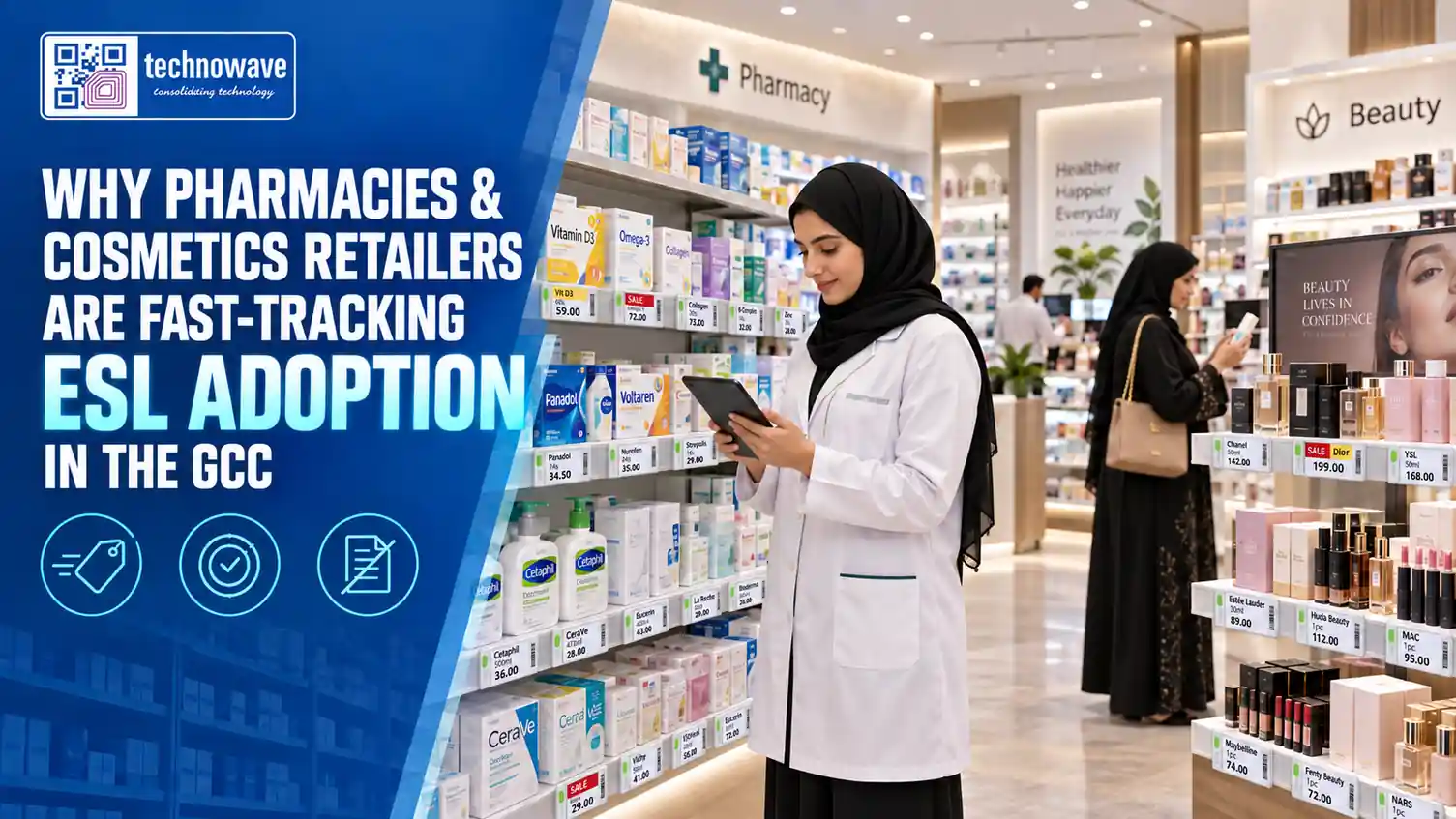
Pharmacies and beauty retailers are accelerating Digital Shelf Labels adoption because shelf-edge pricing has become too dynamic, too regulated, and too operationally expensive to manage with paper. For stores carrying thousands of compact SKUs, frequent promotions, bilingual information requirements, and omnichannel price alignment, digital shelf labels give managers central control over price accuracy, compliance messaging, and staff execution at shelf level.
What are Digital Shelf Labels? Digital Shelf Labels are low-power electronic displays installed on shelves and linked to central software that updates prices, promotions, barcodes, and product information automatically. In pharmacy and cosmetics formats, they are not simply paper replacements; they are part of a wider Electronic Shelf Labels and Digital Shelf Labels infrastructure used to keep shelf data synchronized with POS, ERP, inventory, and store operations.
Why specialty health and beauty retail is a strong fit for ESL retail pricing automation
Pharmacies and cosmetics stores operate under conditions that make manual ticketing unusually inefficient. SKU density is high, facings are narrow, and many lines have small pack sizes with similar packaging, which increases the chance of staff placing the wrong price under the wrong item. When promotions rotate weekly or even daily, paper processes turn into a recurring labor drain.
The category mix also matters. Beauty and personal care assortments combine prestige products, seasonal campaigns, gift bundles, travel sizes, and high-margin impulse items that require rapid shelf communication. A store may need to activate a flash offer across every branch at once, align shelf pricing with e-commerce, and still preserve local language requirements and brand presentation standards.
That is why buyer interest has shifted from simple display hardware to centrally managed shelf-edge automation. According to Fortune Business Insights, the global ESL market was valued at USD 1.5 billion in 2023 and is projected to reach USD 4.8 billion by 2032, at a CAGR of 13.8%. For decision-makers, the significance is not the market number itself; it is the signal that ESL has moved from pilot technology to mainstream retail infrastructure.
Another driver is the changing role of the pharmacy store. Many chains now combine dispensary operations with wellness, dermo-cosmetics, supplements, and beauty consultation zones. In that environment, shelf-edge data accuracy is no longer just an operational concern; it affects trust, regulatory exposure, and whether staff spend their time explaining products or swapping paper labels.
The pricing accuracy problem: where pharmacies lose trust, margin, and control
In pharmacies, a shelf price mismatch is more serious than a routine retail inconvenience. If the displayed price differs from the POS price, the customer experiences it as a trust failure, especially in categories linked to health, prescription support, infant care, or personal treatment. Reconciliation then falls on store supervisors, cashiers, and pharmacists who should be focused on service and clinical queries.
Cosmetics retailers face a similar issue from a different angle. They run multi-buy offers, brand-funded campaigns, loyalty discounts, and bundle promotions that often change faster than store teams can relabel shelves. When promotional execution is inconsistent by branch or by aisle, the retailer not only risks checkout disputes but also loses campaign effectiveness because the offer is not visible at the decision point.
Where paper labels fail most often
- Batch updates: promotional files reach stores late or are printed in the wrong sequence.
- Shelf replenishment: products move during restocking and paper tickets stay behind.
- Price governance: regional or chain-wide price changes are only partially executed.
- Small-format shelves: narrow cosmetic bays leave little room for legible bilingual price communication.
Digital labels address this by synchronizing approved price data from the central system to each display. Managers can ask a direct question and get a direct answer: Will the shelf price match the POS price? If the integration is designed correctly, yes; the shelf reflects the same pricing master that drives checkout. That is also why ESL projects should be evaluated alongside retail automation solutions and not as isolated display procurement.
| Operational issue | Paper labels | Digital Shelf Labels |
|---|---|---|
| Chain-wide price change | Manual print, distribute, replace in each store | Central push to all mapped labels |
| Promotion start/stop timing | Depends on store staff completion | Scheduled activation by date and time |
| Checkout mismatch risk | High when stores lag in updates | Low when POS-linked pricing is synchronized |
| Bilingual shelf data | Limited by paper space and print runs | Template-based Arabic and English layouts |
| Auditability | Hard to prove when change happened | Software logs update history centrally |
How digital price tags for cosmetics stores improve promotions and customer engagement
Promotional agility is one of the most underestimated reasons specialty retailers deploy electronic shelf labels for beauty retail. Unlike categories where prices change occasionally, cosmetics relies heavily on campaign visibility: buy-one-get-one mechanics, dermatologist brand activations, Ramadan and festive gifting, shade launches, and tactical markdowns on aging inventory. The shelf edge must reflect the campaign at the exact moment the campaign goes live.
With digital labels, pricing teams can preload campaigns, schedule future updates, and push a full store or chain refresh without waiting for individual branches to print and install new tags. This is particularly useful when online prices, app offers, and in-store promotions need to stay aligned. A beauty chain can launch a same-day skincare offer and ensure that every branch displays the correct message at opening rather than sometime during the first shift.
Modern labels also add operational cues beyond the screen itself. Multicolor LED indicators can flash to help staff find the exact SKU during replenishment, cycle counts, or click-and-collect picking. On dense cosmetics walls where products differ by shade code more than packaging shape, that feature can materially improve execution speed and reduce search time.
Customer-facing engagement can also be stronger than many buyers expect. QR-enabled labels let shoppers access ingredient details, usage instructions, tutorials, or reviews on their phones without forcing oversized physical shelf talkers into limited space. This creates a practical middle ground: concise on-shelf pricing, deeper digital content on demand, and clearer store presentation than cluttered printed communication. For formats that also use self-service product lookup, integration with a price checker kiosk and micro kiosk solution can further reduce dependency on staff for basic price and product verification.
Compliance, bilingual information, and system integration: the buyer criteria that matter most
Senior buyers evaluating pharmacy shelf label automation usually ask the right question: Can the labels integrate with our current systems? They should. ESL software typically connects to pricing and product masters through APIs, middleware, flat-file exchange, or direct database workflows, depending on the architecture of the retailer’s POS and ERP environment. SAP, Oracle, and Microsoft Dynamics environments are all feasible, but the real evaluation point is the quality of item mapping, promotion logic, rollback control, and exception handling.
Another practical concern is bilingual display on small screens. In pharmacy and cosmetics retail, Arabic and English layouts often need different font priorities, line breaks, and abbreviations to remain legible on narrow shelf rails. Good ESL deployment is therefore a template design exercise as much as a hardware one. Buyers should test live label templates using actual product names, promotional text, and dosage or cosmetic variant descriptors rather than relying on generic demos.
Are digital price tags legal? In most markets they are, provided the displayed information is accurate, readable, and aligned with local retail and consumer protection requirements. For pharmacies, the benefit is not only legal defensibility; it is operational proof. Central software logs who pushed the update, when it was deployed, and whether any labels failed to receive it, creating a stronger audit trail than store-level paper replacement.
Integration with inventory matters too. If the shelf-edge system is linked to an inventory tracking system or replenishment workflow, stores can use shelf labels as execution tools rather than passive displays. That supports faster refill actions, more accurate shelf checks, and better response to low-stock exceptions. For technical buyers who want architecture detail, this is also why understanding gateway placement, RF coverage, and failover behavior is important, as discussed in this overview of ESL system architecture.
Implementation and ROI: how multi-store chains should plan rollout
The return on investment for Digital Shelf Labels in pharmacy and cosmetics retail usually comes from four operational levers: reduced label maintenance labor, fewer pricing disputes, stronger promotional execution, and better use of staff time on consultation or selling. Chains should avoid treating ROI as a simple hardware payback exercise. The larger the network and the higher the promotion frequency, the more software-driven execution value matters.
A disciplined rollout starts with shelf and data readiness. Buyers should validate planogram consistency, SKU-to-label mapping rules, promotion workflows, branch network quality, and ownership of master data. Battery performance, display readability under bright cosmetics lighting, and mount stability on narrow rails should be tested in a live pilot, not only in a showroom. Most modern labels are designed for long battery life, but the true question is whether the update frequency, temperature, and operating profile match your usage pattern.
A practical evaluation checklist
- Store format fit: label sizes for cosmetics bays, gondolas, endcaps, and dispensary shelving.
- Software governance: approval workflows, scheduling, user permissions, rollback capability, and update logs.
- Integration scope: POS, ERP, promotion engine, loyalty system, and stock visibility.
- Deployment model: pilot store first, then phased multi-branch rollout with training and support.
- After-sales support: spare devices, battery strategy, RF tuning, and onsite troubleshooting.
Retailers that want evidence from live deployments can review examples such as the Xiaomi UAE Electronic Shelf Label installation and the New W Mart Dubai Electronic Shelf Label installation to see how digital labeling is being implemented in real store environments. The next step is not to ask whether ESL is relevant, but whether delaying deployment means continued pricing friction, slower promotions, and unnecessary labor in categories where precision matters every day.
FAQ
Q: Why are pharmacies investing in Digital Shelf Labels?
A: Pharmacies use Digital Shelf Labels to keep shelf pricing synchronized with POS data, reduce checkout disputes, and support controlled updates across many SKUs. They also help staff spend less time on manual relabeling and more time on dispensing support, patient interaction, and store service.
Q: How do Digital Shelf Labels help cosmetics retailers manage frequent promotions?
A: Cosmetics stores often run time-bound campaigns, bundles, and brand activations. Digital labels let pricing teams schedule promotions centrally, activate offers at the exact start time, and keep shelf messaging aligned with online channels without waiting for each branch to replace paper tags manually.
Q: Do Digital Shelf Labels improve pricing accuracy and regulatory compliance?
A: Yes. When integrated correctly, the displayed shelf price is driven by the same approved pricing source used at checkout. The software also records update history, user actions, and label status, which gives retailers stronger traceability for audits and internal pricing governance.
Q: Can Digital Shelf Labels integrate with POS and ERP systems?
A: In most deployments, yes. ESL platforms can connect through APIs, middleware, or structured data exchange with POS, ERP, and promotion systems. The key evaluation point is not only connectivity but also how well the system handles item mapping, scheduling, exceptions, and rollback control.
Q: What should retailers consider before deploying Digital Shelf Labels across stores?
A: They should evaluate shelf formats, label sizes, bilingual template design, RF coverage, pricing workflow ownership, and support capability. A pilot should use real SKUs, live promotions, and actual store lighting conditions so the chain can validate readability, update performance, and operating processes.
Q: How do labels perform under bright cosmetics lighting and on small shelves?
A: This depends on display type, screen size, and template design. Buyers should test contrast, font scaling, and mount design on actual cosmetics fixtures. Narrow shelf rails and high-glare lighting make live readability trials essential, especially where Arabic and English must appear clearly together.
For pharmacy chains, health and beauty retailers, and multi-branch operators evaluating shelf-edge modernization, the strongest projects are the ones that combine hardware selection, system integration, store rollout planning, and post-installation support. Technowave International provides Electronic Shelf Labels solutions, integration, installation, and local support for retailers that need pricing accuracy, faster promotions, and scalable deployment across stores.
Related Articles
- Electronic Shelf Labels vs Paper Price Tags: What Indian Retailers Are Losing Every Day
- Real-Time Inventory Visibility: The Game Changer for Indian Supermarkets & Pharmacies
- Can Electronic Shelf Labels Work Without Internet? Understanding Esl System Architecture Vs Traditional Methods: Which Is Better for Businesses in GCC?
- The Future of Smart Inventory: How UAE Retailers Can Leverage RFID Inventory Tracking and ESLs for Maximum ROI.
- 5 Key Benefits of Implementing Digital Shelf Labels in Fashion Retail
- Top 10 Reasons to Upgrade to Digital Buffet Food Tags with Electronic Shelf Labels
Why Digital Shelf Labels Are Rising in Pharmacies
Learn why Digital Shelf Labels are accelerating in pharmacies and cosmetics retail for pricing accuracy, compliance, promotions, and efficiency.