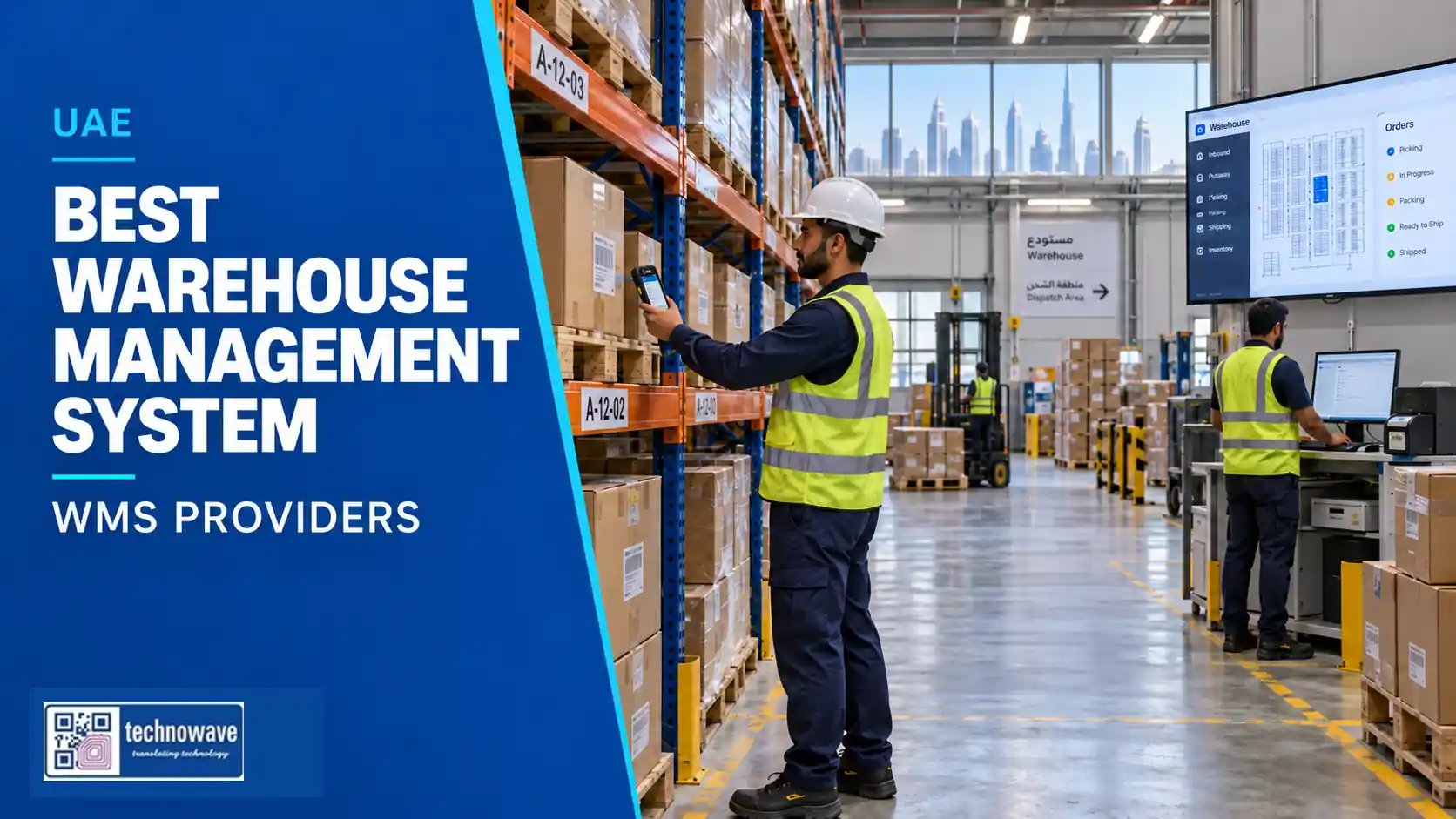
If you are evaluating a warehouse management system UAE businesses can rely on, the right choice is not the platform with the longest feature list. It is the system that matches your warehouse process, integrates cleanly with your ERP and barcode or RFID hardware, and can be implemented and supported locally across UAE operations without disrupting fulfilment.
A warehouse management system is the software layer that controls receiving, put-away, bin locations, replenishment, picking, packing, dispatch, stock accuracy, and traceability inside a warehouse. In the UAE, buyers typically need more than generic inventory software: they need a system that supports fast-moving retail replenishment, 3PL service workflows, multi-branch distribution, bilingual operations, and integration with handheld devices, label printers, and scanning infrastructure.
What UAE Buyers Actually Need from a Warehouse Management System
In the UAE market, WMS demand usually comes from three operational pressures: inventory inaccuracies between branches and warehouses, rising expectations for faster order turnaround, and difficulty managing mixed workflows such as pallet storage, piece picking, returns, and transfer orders in one environment. A spreadsheet or basic ERP stock module rarely handles these warehouse-level transactions with enough discipline.
The first buyer question is simple: Do you need inventory visibility, or do you need warehouse control? Visibility tells you what stock you own. Warehouse control tells you where it is, who moved it, what was picked, whether the item was batch- or serial-controlled, and whether the dispatch was validated before loading. That distinction matters for retail distributors, spare parts suppliers, healthcare stores, and industrial operations across Dubai, Abu Dhabi, Sharjah, and free-zone logistics clusters.
For UAE operators, the strongest WMS use cases are usually specific rather than broad. Examples include directed put-away for mixed inbound containers, barcode-led cycle counting, mobile picking verification, replenishment for showroom or store demand, and real-time stock status for available, reserved, damaged, or in-transit inventory. Businesses planning broader automation often also evaluate related platforms such as asset management systems for fixed assets and mobility-led tracking outside the warehouse.
Another direct buyer question is: Should every warehouse use the same WMS template? No. A fashion distributor, a pharmaceutical stockroom, and a technical spare-parts warehouse have different rules for expiry, lot control, returns, and pick paths. The best warehouse management system provider UAE buyers choose will map operational reality before proposing software.
How to Compare Warehouse Management System Providers in UAE
Most buyer mistakes happen during provider comparison, not during software demos. A polished interface can hide weak implementation capability, limited device integration, or poor support after go-live. UAE buyers should compare providers across software depth, field experience, hardware compatibility, and local service responsiveness rather than only subscription cost.
Ask each vendor to show your actual workflow on screen: receiving against purchase order, bin transfer, cycle count adjustment, picking exception, return to stock, and dispatch confirmation. If the provider cannot demonstrate your process with scanner interaction, barcode labels, user roles, and audit logs, the fit is probably superficial. This is especially important where a WMS must connect to mobile computers, barcode printers, and RFID-enabled processes.
| Evaluation area | What to check | Why it matters in UAE operations |
|---|---|---|
| Process fit | Receiving, put-away, picking, replenishment, returns, transfers | Prevents expensive customization for everyday workflows |
| Integration | ERP, POS, e-commerce, courier, printer, handheld support | Reduces duplicate entry and dispatch delays |
| Mobility | Android handhelds, rugged scanners, offline tolerance | Critical for large warehouses and high-temperature zones |
| Traceability | Batch, lot, serial, expiry, user audit trail | Important for healthcare, electronics, and regulated stock |
| Local support | UAE implementation team, training, AMC, device service | Speeds issue resolution after go-live |
| Scalability | Multi-site, 3PL workflows, role-based access, dashboards | Supports expansion across emirates and GCC branches |
Buyers also ask: How can businesses compare warehouse management system providers objectively? Use a weighted scorecard. Score each provider for process fit, integration depth, reporting, handheld workflow, implementation method, support SLA, and total commercial structure. If your operation may later add RFID or retail automation, review the provider’s wider automation capability as explained in this guide to choosing RFID solution providers, because future expansion should not require a complete platform reset.
Key Features, Integration Requirements, and Security Checks
A serious WMS in the UAE should support location-based inventory, barcode-driven transaction validation, configurable user permissions, and detailed movement history. Beyond that baseline, feature priorities vary by sector. Retail distribution may need wave or store-wise allocation, while industrial operations may prioritise serial traceability, spare-parts searchability, and controlled issue management.
Features that matter more than generic dashboards
Many buyers overvalue dashboards and undervalue transaction controls. The features that usually determine operational success are bin logic, pick validation, replenishment rules, negative stock prevention, cycle count methods, carton or pallet labelling, and exception handling when shortages or damaged items appear mid-process. A clean dashboard is useful; a disciplined transaction engine is what protects stock integrity.
Integration is equally critical. The WMS should define exactly which system is master for items, units of measure, suppliers, sales orders, purchase orders, and stock adjustments. UAE businesses often run mixed environments with ERP, e-commerce storefronts, retail POS, courier interfaces, and multiple brands of mobile hardware. If the provider cannot map integration responsibility line by line, implementation risk rises sharply. For companies evaluating end-to-end automation, the core warehouse management system service should be reviewed together with scanners, printers, labels, and handheld workflows rather than as software in isolation.
Security and compliance questions should be asked before purchase, not after deployment. Buyers should review role-based access control, password policy, audit trails, approval workflows for stock adjustments, backup routines, API security, and hosting responsibility. If your warehouse handles healthcare, electronics, or high-value stock, ask whether the system supports granular user restrictions by transaction type, zone, and approval hierarchy. For organisations with adjacent retail automation requirements, real project experience such as the Ozoon UAE RFID retail automation case study can help validate the provider’s integration depth beyond software brochures.
Implementation Timeline and Operational Planning in UAE Warehouses
How long does warehouse management system implementation usually take? The honest answer is that timeline depends less on software installation and more on process readiness. Master data quality, bin structure, barcode label standards, user roles, integration decisions, and stock cleansing typically decide whether a project moves smoothly or stalls after kickoff.
A practical UAE rollout usually follows six stages: discovery, process mapping, solution design, master data preparation, pilot execution, and phased go-live. Discovery should include physical walkthroughs of receiving docks, staging areas, racks, fast-pick locations, packing benches, and dispatch checkpoints. If a vendor tries to estimate implementation only from a sales call, the proposal may be under-scoped.
Questions buyers should ask before signing
- Who owns item master cleanup? If duplicate SKUs, bad units of measure, or inconsistent barcodes remain unresolved, users will blame the WMS for master-data problems.
- Will stock be relabelled or mapped as-is? This affects cutover complexity, labour planning, and scanner behaviour.
- What is the fallback plan during go-live? UAE warehouses supplying retail stores or projects cannot accept a dispatch freeze without a documented contingency.
- How will training be delivered? Shift-based teams often need role-specific training for receivers, pickers, supervisors, and inventory controllers.
Implementation planning should also reflect UAE operating realities: weekend patterns, Ramadan schedules, multi-language teams, free-zone site access rules, and inter-emirate branch transfers. A good provider will separate configuration issues from operational discipline issues during pilot testing. That distinction matters because many go-live problems are caused by weak location governance, unscannable labels, or untrained supervisors rather than the software itself.
Warehouse Management System Pricing UAE, ROI, and Common Buying Mistakes
What does warehouse management system pricing UAE buyers should expect usually include? Commercial models differ, but total budget normally consists of software licences or subscription, implementation services, integration work, handheld devices, barcode printers, labels, network readiness, training, and ongoing support. The lowest software quote is rarely the lowest project cost if hardware compatibility, report customization, or support response is weak.
Instead of asking for a single headline price, ask for a bill of scope. Buyers should request separate line items for workflow design, API integration, data migration support, user training, UAT assistance, go-live support, and annual maintenance. That makes providers easier to compare and exposes proposals that are inexpensive only because they exclude operational essentials. It also helps procurement teams evaluate long-term warehouse management system services UAE businesses will need after launch.
ROI should be evaluated operationally, not just financially. Look for fewer shipping errors, cleaner stock reconciliation, faster cycle counts, reduced manual checking, better slotting discipline, and clearer accountability for every inventory movement. These gains are especially important when warehouse issues affect retail replenishment, project delivery, or service-level commitments to customers. Businesses expanding into broader analytics may also review adjacent resources such as UAE technology provider comparisons to assess whether the vendor can support multiple operational systems over time.
The most common buying mistakes in the UAE are predictable: selecting on price alone, ignoring device workflow during evaluation, underestimating label and barcode standards, treating ERP stock modules as full WMS replacements, and skipping post-go-live support planning. The right next step is to shortlist providers that can prove process understanding, integration capability, and local support depth. For businesses that want a partner combining software, hardware, implementation, and after-sales service, Technowave International is positioned to support UAE warehouse projects with practical rollout planning. To discuss your warehouse workflow, contact the team via WhatsApp or email for a solution review.
FAQ
Q: What should buyers check before choosing a warehouse management system in UAE?
A: Check process fit first: receiving, put-away, picking, replenishment, returns, and stock counting. Then review ERP integration, handheld compatibility, barcode labelling, user permissions, audit trails, and local implementation support. A strong demo should reflect your real warehouse workflow, not a generic sample database.
Q: How can businesses compare warehouse management system providers?
A: Use a weighted scorecard covering workflow fit, integration depth, reporting, support model, implementation method, and total cost structure. Ask each provider to demonstrate exception scenarios such as short picks, damaged stock, and inter-warehouse transfers. That reveals operational maturity better than a feature checklist alone.
Q: What does warehouse management system typically cost in UAE?
A: Costs vary based on user count, site count, integration complexity, hardware requirements, and whether barcode or RFID workflows are included. Buyers should budget for software, implementation, mobile devices, printers, labels, training, and ongoing support. Always request a detailed scope breakdown instead of a single headline price.
Q: How long does warehouse management system implementation usually take?
A: Timelines depend on process complexity, data quality, and integration readiness more than software installation alone. Projects move faster when item masters, barcode standards, bin structures, and user roles are defined early. A pilot phase is strongly recommended before full go-live, especially for multi-site UAE operations.
Q: What security or compliance factors matter for warehouse management system UAE projects?
A: Review role-based access, audit logs, approval controls for adjustments, backup procedures, API security, and hosting responsibility. If you handle regulated or high-value stock, verify batch, serial, and user-level traceability. Security should be designed into daily transactions, not added later as an afterthought.
Q: Is a basic ERP inventory module enough instead of a dedicated WMS?
A: Sometimes for very small and simple stores, but not for warehouses with bins, mobile picking, cycle counts, replenishment, and dispatch validation. ERP inventory records ownership of stock; a WMS controls warehouse execution. When operational errors are costly, dedicated warehouse logic becomes necessary.
Related Articles
- RFID Solution Providers: How to Choose the Right One
- Choosing the Right Electronic Shelf Labels Provider Saudi Arabia
- Best RFID asset management system Dubai (UAE)
- The Ultimate Guide to Choosing the Right Asset Management System for UAE Enterprises
- On-Premise vs. Cloud-Based Warehouse Management System: 2026 Migration & TCO Guide
- Best Asset Management Solution Provider in Sharjah for 2026
Best Warehouse Management System UAE Guide
Compare warehouse management system UAE providers, features, pricing, implementation, and selection criteria for UAE warehouses and retailers.