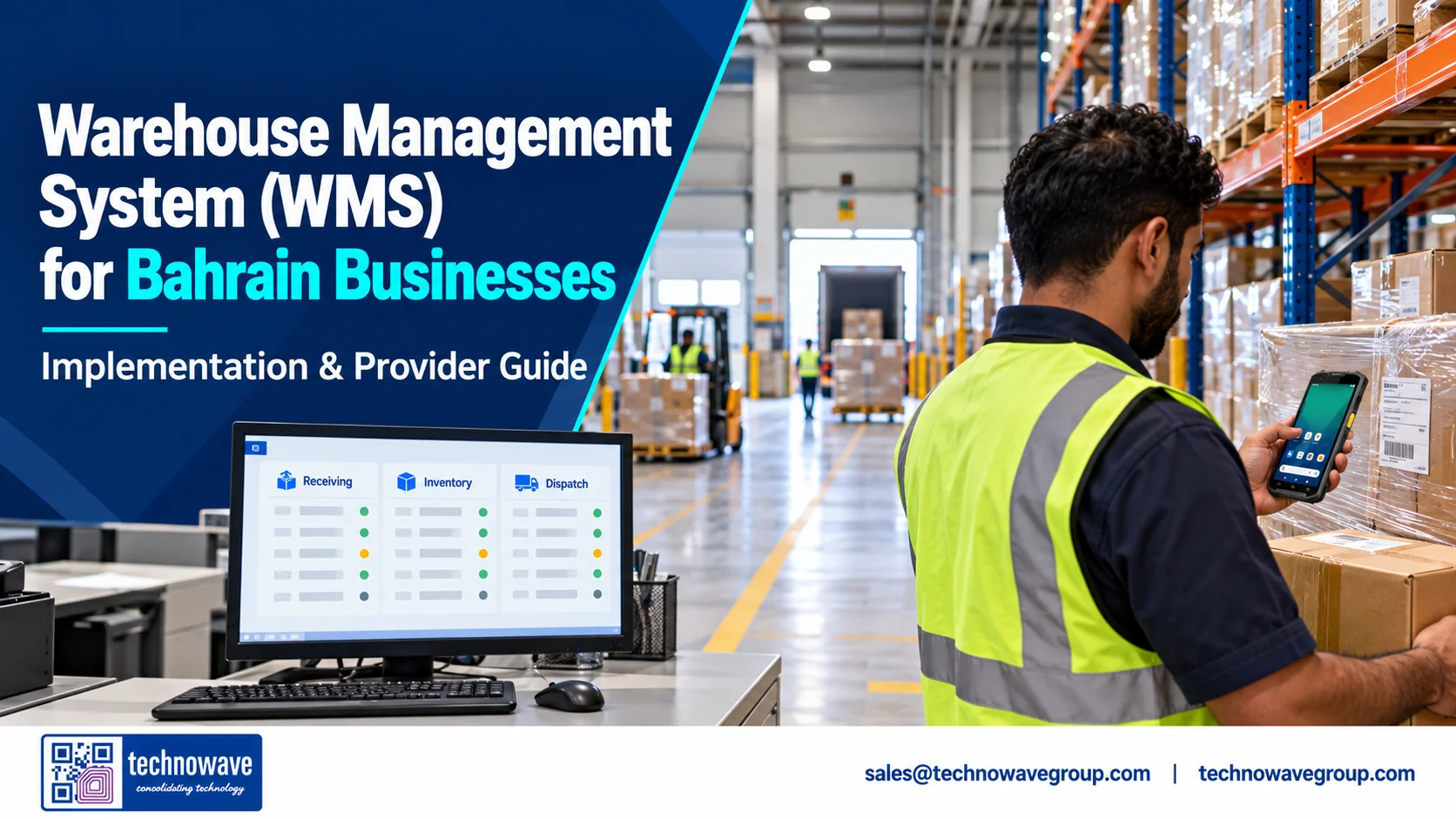
A warehouse management system Bahrain buyers can rely on is not simply software for stock visibility; it is the operational layer that controls receiving, put-away, replenishment, picking, cycle counting, dispatch, and user accountability across Bahrain’s fast-moving retail, distribution, and industrial environments. For Bahrain businesses, the right WMS should integrate cleanly with barcode or RFID workflows, support Arabic-English operational teams where required, and come with local implementation capability rather than remote-only software support.
What is a warehouse management system? It is a software platform that manages warehouse transactions and inventory movement in real time, usually through handheld devices, barcode labels, RFID, workstation screens, and integrations with ERP, POS, courier, or finance systems. Unlike a basic inventory module, a WMS governs where stock is, who moved it, what task is pending, and how the next action should happen.
In Bahrain, that difference matters because many businesses operate under pressure from store replenishment deadlines, cross-border supply movement to Saudi Arabia, temperature-sensitive inventory rules, or multi-location stock control. Buyers researching a Warehouse Management System usually need practical answers on implementation, provider evaluation, data control, and rollout risk; this guide focuses on those decisions.
Why Bahrain Businesses Need a WMS Beyond Basic Inventory Software
Many Bahrain companies already have an ERP or accounting package, but warehouse inefficiency usually persists because ERP stock modules were not designed to orchestrate floor-level activity. They can store item balances and transaction history, yet often lack directed put-away, bin validation, scan-based picking, exception handling, and task-level accountability. A WMS closes that operational gap by converting stock records into controlled warehouse actions.
For retail distributors in Bahrain, the pain point is usually order accuracy and replenishment speed. For 3PL and logistics operators, it is customer-level segregation, lot tracking, and proof of handling. For manufacturers and industrial stores, it is spare-parts visibility, location discipline, and reduction of manual searching. The buying question is not “Do we need software?” but “Which warehouse process failures are we trying to eliminate first?”
Can a WMS help if your warehouse is not large? Yes, if the business suffers from frequent stock adjustments, paper-based receiving, picker dependency on memory, or delayed dispatch confirmation. Smaller Bahrain operations often benefit from rule-based scanning sooner than they expect because a few avoidable errors can disrupt customer service, customs documentation, or store availability.
A Bahrain-specific evaluation should also consider operational geography. Businesses serving local retail branches, e-commerce delivery points, and Saudi-bound shipments through the King Fahd Causeway need cleaner dispatch sequencing and status visibility than generic inventory systems provide. If your business also manages fixed equipment and non-sale assets, it is worth aligning warehouse control with broader asset management system practices so devices, cages, tools, and returnable items are not tracked outside the main control framework.
Features Bahrain Buyers Should Prioritise When Comparing WMS Providers
The best WMS for Bahrain is not the one with the longest feature list; it is the one that matches your transaction profile. Start by classifying your warehouse into one of four practical models: retail distribution, wholesale and trading, 3PL, or manufacturing support. Each model requires different logic for allocation, FEFO or FIFO control, customer ownership, wave picking, returns, or internal consumption tracking.
What should buyers check before choosing a warehouse management system in Bahrain? First, verify whether the system supports the transaction depth you actually need: receiving against purchase orders, blind receiving, quality hold, bin transfer, replenishment triggers, batch or serial capture, cycle count variance approval, and shipping confirmation. Second, confirm device compatibility for barcode scanners, mobile computers, label printers, and optionally RFID readers. Third, ask whether the provider can configure operational roles for supervisors, checkers, pickers, and auditors without custom coding for every rule change.
Provider evaluation criteria that matter in real operations
- Integration method: API, database-level sync, file exchange, or middleware with ERP and finance systems.
- Mobility layer: Android handheld support, offline tolerance, and barcode performance on damaged labels.
- Location structure: rack, shelf, pallet, floor, quarantine, returns, and staging zones.
- Inventory logic: lot, serial, expiry, batch status, and owner-based stock segregation.
- Support model: local deployment, training, preventive maintenance, and device troubleshooting.
The table below gives Bahrain buyers a more useful comparison than generic “cloud vs on-prem” marketing language.
| Deployment model | Best fit in Bahrain | Main advantage | Main caution |
|---|---|---|---|
| SaaS cloud WMS | Multi-branch distributors, fast rollouts, lighter internal IT teams | Faster updates and lower infrastructure management | Must verify connectivity resilience, data hosting policy, and integration ownership |
| On-premise WMS | Highly controlled environments, strict internal hosting preference | Greater direct control over infrastructure and internal access rules | Higher internal responsibility for backup, patching, and server upkeep |
| Hybrid WMS | Bahrain businesses integrating legacy ERP with mobile warehouse workflows | Flexible transition path and staged migration | Architecture can become complex if interfaces are poorly documented |
Buyers should also examine provider evidence. A relevant Bahrain implementation or sector-adjacent rollout is more useful than a generic product demo. For example, the University Of Bahrain case study shows local project execution capability, while broader operational learning can be seen in this asset management guide for modern businesses, especially where stock, devices, and controlled assets overlap.
Security, Compliance, and Data-Control Considerations for Bahrain Warehouses
A WMS project in Bahrain should be reviewed not only by operations but also by IT, finance, and internal audit. Warehouse data includes item master information, user credentials, movement history, approval logs, supplier references, and sometimes customer-linked dispatch records. That means access design is a business risk issue, not just a software setting.
What security or compliance factors matter for warehouse management system implementation in Bahrain? At minimum, buyers should insist on role-based access control, detailed audit trails, password policy enforcement, session timeout rules, and segregation of duties for receipt approval, stock adjustment, and dispatch confirmation. If handhelds are shared across shifts, device login discipline and mobile application session control become especially important.
Bahrain organisations should also assess where data is stored, how backups are scheduled, and how quickly the system can be restored after network or hardware failure. For sectors such as healthcare, government, education, and regulated distribution, retention of transaction history and traceability of stock corrections may be as important as speed. If your warehouse interfaces with gate entry, contractors, or controlled delivery zones, broader workflow alignment with tools such as a Visitor Management System may also improve chain-of-custody discipline around receiving and dispatch areas.
Another overlooked point is label governance. A secure WMS fails operationally if item labels, pallet labels, or bin labels are inconsistent or easy to duplicate. Buyers in Bahrain should ask how the provider handles label templates, reprint permissions, printer mapping, and exception workflows when labels are damaged or unreadable. In real warehouse conditions, security and data quality are inseparable from barcode execution.
Warehouse Management System Implementation in Bahrain: Timeline, Planning, and Rollout Risks
How long does warehouse management system implementation usually take? The honest answer is that timeline depends less on software installation and more on master-data readiness, process clarity, integration complexity, and site discipline. A Bahrain business with clean item codes, stable warehouse rules, and limited interfaces can move quickly; a business with duplicate SKUs, undocumented bin locations, and changing approval logic will not.
A practical implementation sequence should include discovery, process mapping, location design, item-master cleansing, label strategy, device selection, integration testing, user acceptance testing, pilot operation, and phased go-live support. Buyers should ask providers to separate configuration tasks from business-preparation tasks. Many delayed projects are blamed on software when the real issue is incomplete SKU data, undefined unit-of-measure rules, or late barcode labeling decisions.
Common implementation mistakes and how to avoid them
- Replicating bad manual processes: do not digitise uncontrolled stock movement; redesign it first.
- Skipping pilot transactions: test receipts, transfers, replenishment, picks, returns, and adjustments with real users.
- Under-specifying hardware: scanner range, battery management, printer duty cycle, and Wi-Fi coverage affect adoption.
- Ignoring exception handling: damaged stock, short receipt, mixed pallets, and urgent orders must be defined before go-live.
For Bahrain warehouses serving retail stores, hospitality supply points, pharmacies, industrial projects, or cross-dock shipments, phased rollout is usually safer than a big-bang cutover. Start with one process or one zone, validate transaction discipline, then expand. A provider that can supply software, labels, scanners, printers, training, and floor-level support generally reduces go-live friction because there is no handoff gap between system configuration and warehouse execution.
Warehouse Management System Pricing Bahrain Buyers Should Expect and How to Judge ROI
Warehouse management system pricing Bahrain buyers receive usually combines more than software licensing. Total project cost may include discovery workshops, configuration, ERP integration, handheld devices, barcode printers, labels, wireless preparation, training, support, and annual maintenance. That is why comparing two quotations by software price alone often leads to the wrong decision.
What does a warehouse management system typically cost in Bahrain? Cost depends on user count, number of sites, transaction complexity, integration depth, hardware scope, and whether the project uses standard workflows or heavy customization. A retail replenishment warehouse with barcode picking may be simpler than a 3PL operation requiring customer-level stock ownership, billing events, and lot-controlled dispatch. Buyers should therefore request a line-by-line commercial breakdown tied to the actual operating model.
ROI should be evaluated against concrete operating pain: repeated stock counts, order errors, dispatch delays, searching time, manual report consolidation, and weak audit traceability. When a provider can show how the solution reduces non-productive movement and improves transaction discipline, the financial case becomes clearer. For decision-makers reviewing a warehouse management system provider Bahrain, the better question is: “Which recurring operating losses remain if we do nothing for another year?”
When selecting a provider, Bahrain buyers should look beyond software brochures and assess implementation ownership, hardware knowledge, service continuity, and post-go-live accountability. That is where Technowave International is relevant: the company combines warehouse software capability with barcode, RFID, mobility, labeling, installation, and after-sales support across the GCC. If your business needs a practical WMS roadmap rather than a generic product pitch, contact the team for a Bahrain-focused consultation via WhatsApp or email.
FAQ
Q: What should buyers check before choosing Warehouse Management System in Bahrain?
A: Check transaction fit first: receiving, put-away, picking, replenishment, returns, cycle count, and dispatch confirmation. Then review ERP integration method, handheld and printer compatibility, location structure, user-role control, audit trail depth, and whether the provider can support rollout locally rather than only remotely.
Q: How can businesses compare Warehouse Management System providers?
A: Compare providers on implementation experience, process-mapping capability, device knowledge, integration ownership, training method, support response, and evidence from similar sectors. A strong demo matters less than a provider’s ability to configure real warehouse exceptions and support warehouse staff during go-live.
Q: What does Warehouse Management System typically cost in Bahrain?
A: Pricing varies by users, sites, integrations, hardware, labeling scope, and customization. Ask for a detailed proposal showing software, setup, training, support, scanners, printers, and annual maintenance separately. That structure lets buyers compare commercial offers without missing hidden infrastructure or service costs.
Q: How long does Warehouse Management System implementation usually take?
A: Implementation time depends on master-data quality, process stability, and interface complexity. Software can be configured quickly, but warehouse readiness often takes longer. Plan for discovery, item and location data cleanup, test transactions, user training, pilot operation, and controlled go-live support.
Q: What security or compliance factors matter for Warehouse Management System in Bahrain?
A: Focus on role-based access, stock-adjustment approvals, user traceability, backup and recovery procedures, session control on shared handhelds, and reliable label governance. Regulated sectors should also review data retention, audit history, lot or serial traceability, and internal policy alignment for inventory corrections.
Q: Is a WMS suitable for smaller Bahrain warehouses?
A: Yes, if the business faces regular stock discrepancies, paper-based receiving, slow picking, or dependency on staff memory. Even smaller warehouses gain value when scan-based control replaces verbal instructions and spreadsheet reconciliation, especially where service accuracy affects store supply or customer delivery commitments.
Related Articles
- Asset Management: A Complete Guide for Modern Businesses
- RFID Asset Management System for Businesses: Features and Benefits
- How RFID Inventory Management Systems Transform Businesses in India
- On-Premise vs. Cloud-Based Warehouse Management System: 2026 Migration & TCO Guide
- How to Implement RFID IT Asset Tracking in Bahrain Data Centers
- Smart Retail Technology ROI Calculator: What Indian Businesses Can Expect from RFID, ESL & Analytics Investment
Warehouse Management System Bahrain Implementation Guide
Practical guide to warehouse management system Bahrain selection, implementation, pricing, security, and provider evaluation for Bahrain buyers.