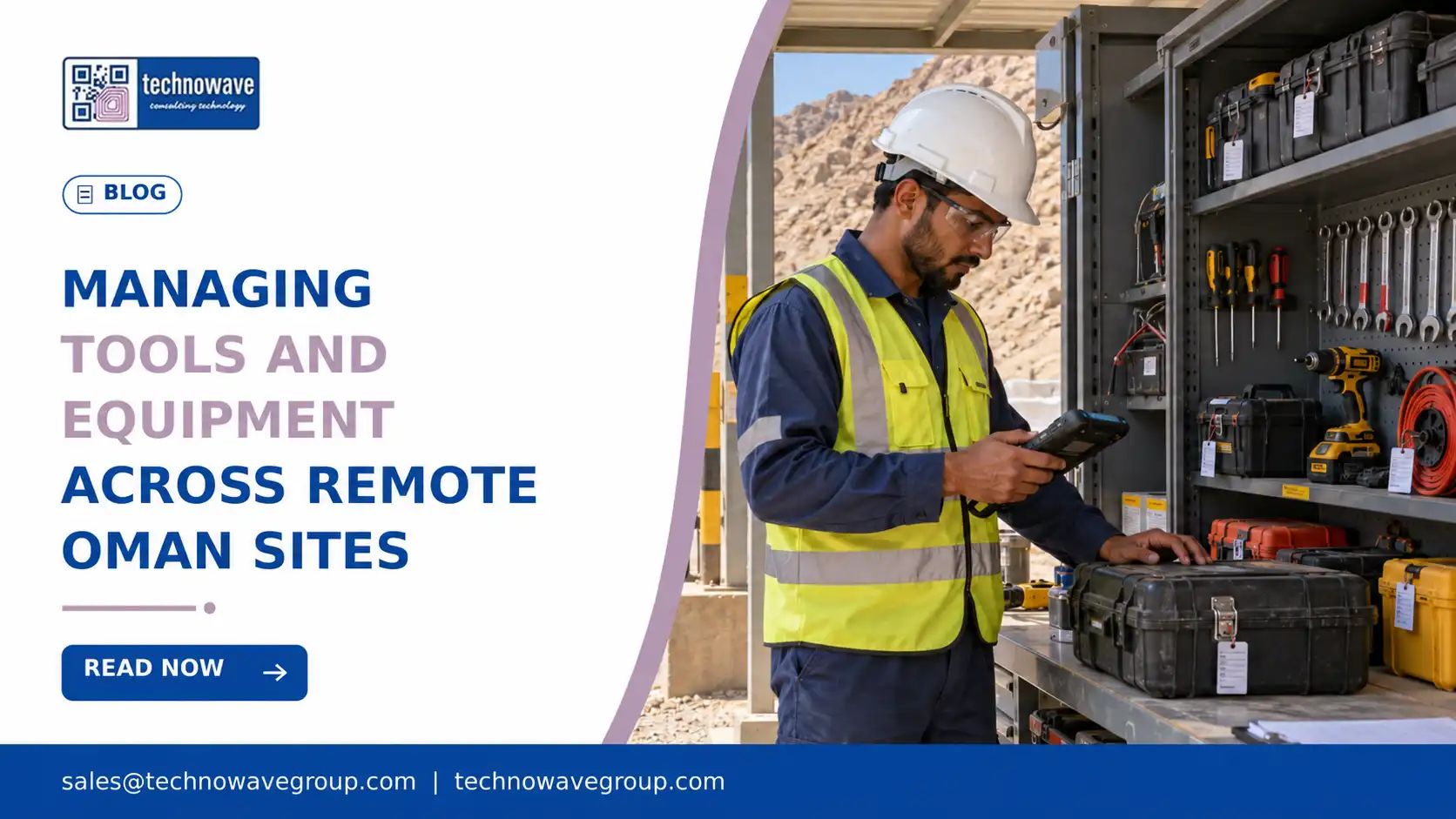
Tool and equipment tracking Oman projects succeed when they are designed for remote-site reality: long travel times, mixed connectivity, subcontractor handovers, and constant movement between stores, vehicles, workshops, and field locations. The right approach is not just tagging tools; it is defining who issues them, how movements are recorded offline, what counts as proof of return, and which assets justify barcode, passive RFID, or active RFID.
In Oman, buyers usually need a practical operating model more than a generic software list. For industrial yards in Sohar, field teams in Duqm, utilities, facilities, hospitality maintenance, and multi-branch service businesses, the tracking design must match tool criticality, distance between locations, and accountability by technician, cost centre, or project.
What is tool and equipment tracking? It is a controlled process for identifying, issuing, locating, auditing, maintaining, and returning tools and movable equipment using labels or tags, handheld devices, and a central system. For firms already reviewing broader inventory tracking or regional rollout requirements in Oman, tool tracking sits between stores control and fixed asset governance: faster than finance-led asset audits, but more accountable than a manual tool crib register.
Why remote Oman sites fail without a site-specific tracking model
Remote operations in Oman often break down at the handover points, not at the warehouse. A drill, torque wrench, gas detector, tablet, or calibrated meter may be booked out correctly from Muscat or Sohar, but the movement between transport vehicle, temporary store, subcontractor supervisor, and final user is left to paper notes or messaging apps. That is where visibility disappears.
The first buyer question should be direct: where do losses actually happen? In practice, there are four common failure zones: issue counter, inter-site transfer, maintenance return, and project demobilisation. If your process does not capture those events with a timestamp, user ID, and site code, the software dashboard will still look neat while field accountability remains weak.
Oman buyers should also separate three asset classes before selecting technology:
- High-volume consumable-adjacent tools such as hand tools and low-cost accessories, usually best handled with barcode and batch issue rules.
- Reusable operational equipment such as ladders, power tools, scanners, radios, and testing devices, often suited to barcode or passive RFID depending on read-speed requirements.
- High-value or high-risk mobile assets such as generators, compressors, specialist instruments, and site containers, where active RFID or a hybrid method may be justified.
For a useful field perspective, the same principles appear in RFID Technology in Construction Sites: Monitoring Workforce, Tools & Materials, but remote Oman deployments need an additional operating discipline around offline transactions and vehicle-based transfers. That is especially important where teams move between interior regions and coastal projects with inconsistent network coverage.
Choosing between barcode, passive RFID, and active RFID for Oman conditions
Not every remote-site problem needs active RFID. Buyers searching for “active RFID asset tracking” are usually trying to solve one of three issues: they want automatic location updates without line-of-sight scanning, they need faster yard sweeps, or they are dealing with assets too valuable to rely on manual issue/return control. Those are valid needs, but active RFID becomes expensive if used on every tool rather than on the right asset layer.
When should you use barcode? Use it where a human-controlled issue point already exists and scan compliance can realistically be enforced. Barcodes are cost-effective for hand tools, PPE kits, spare devices, and workshop items, especially when supervisors already verify issue and return at the counter.
When should you use passive RFID? Use it when you need quicker stock counts, faster cage or room audits, and less dependence on line-of-sight. Passive RFID is strong for bins, tool cabinets, maintenance kits, returnable cases, and mid-value assets that move frequently between stores and project teams.
When should you use active RFID? Use it selectively for mobile equipment where zone-level visibility matters more than unit-tag cost. This can include temporary generators, compressors, trailers, specialised meters, or critical kits moving across large compounds. A common Oman mistake is over-specifying active tags for all assets instead of applying them only to the mobile, high-impact layer.
| Tracking method | Best fit in Oman | Strengths | Limits |
|---|---|---|---|
| Barcode | Tool stores, workshops, branch issue counters | Low tag cost, simple workflows, easy training | Requires deliberate scanning and visible labels |
| Passive RFID | Rapid audits, cabinets, cages, inter-site kits | Faster counts, no strict line-of-sight, scalable | Read performance depends on tag placement and environment |
| Active RFID | High-value mobile equipment across large sites | Automated zone visibility, better for wide-area movement | Higher tag and infrastructure cost, battery management |
Selection should also consider dust, heat, metal surfaces, and cleaning practices. Equipment stored in metal cages, mounted on steel structures, or exposed to washdown conditions needs tag material, adhesive, and placement testing before rollout. A pilot with real field conditions is more valuable than a catalogue comparison.
Operational requirements buyers in Oman should define before procurement
Most implementation delays come from undefined rules, not missing hardware. Before asking for quotations, buyers should map the transaction logic: who can issue a tool, whether return requires supervisor approval, how damaged items are quarantined, and whether subcontractors receive named accountability or pooled access. These decisions affect software fields, handheld workflows, and report design.
Non-negotiable requirements for remote-site control
- Offline data capture: handheld users must be able to issue, receive, transfer, and audit without continuous connectivity.
- Hierarchical locations: company, region, site, store, cage, vehicle, room, and technician-level assignment should all be supported.
- Maintenance status: available, issued, under repair, calibration due, lost, retired, and quarantine states must be distinct.
- User accountability: operator, supervisor, subcontractor, and cost-centre mapping should be available in reports.
- Exception handling: partial returns, damaged returns, and substitute items need controlled workflows.
Buyers should also ask: will this system only record ownership, or will it improve field discipline? If the answer is the former, ROI will be weak. A usable system must produce daily issue lists, overdue returns, unverified transfers, calibration alerts, and site-wise variance reports. Finance may care about asset existence, but operations cares about whether the right kit reaches the right technician on time.
Integration matters, but not every project needs deep ERP integration on day one. In Oman, many successful deployments start with core master data import, user-role setup, and export-based reconciliation, then move to API or middleware integration later. That phased approach reduces initial risk while still giving stores and field teams immediate control.
For buyers comparing a tool and equipment tagging service with a full digital tracking platform, it is important to distinguish between one-time labelling and an ongoing operating system. Tags without disciplined issue, audit, and maintenance workflows simply create a better-looking version of the old manual problem.
Security, compliance, and data handling for multi-site operations
Tool tracking data may look operational, but it carries security and compliance implications. A remote-site system records who had access to tools, where sensitive equipment was last seen, and whether calibration or safety inspection was current at the time of use. For sectors such as utilities, healthcare engineering, education campuses, logistics, and government-linked facilities, that audit trail matters.
Buyers should ask five security questions early. Who can edit asset history? Can users backdate transactions? Are deleted records recoverable in audit logs? How are handheld logins controlled? What happens if a device is lost? Systems intended for Oman field use should support role-based access, password policy enforcement, device-level authentication, and a clear trail of issue, return, transfer, and maintenance events.
Compliance tracking is especially important for inspection tools, test instruments, and safety-critical equipment. If the same handheld workflow can show calibration due dates, lock issue of expired equipment, or trigger maintenance holds, the tracking system becomes operationally safer, not just administratively cleaner. That is where “asset compliance tracking” moves from a reporting function to a frontline control.
Data hosting preferences vary by buyer. Some Oman organisations are comfortable with cloud access for distributed visibility, while others require tightly controlled environments or local hosting preferences due to policy. The practical point is not cloud versus on-premise as an ideology; it is whether the deployment can deliver secure synchronisation for remote users, controlled admin rights, and exportable audit evidence when management or auditors request it.
A useful procurement practice is to require vendors to demonstrate live exception scenarios, not just dashboards. Ask them to show an overdue return, a blocked issue because calibration expired, and a user attempting an unauthorised edit. Those demonstrations reveal system maturity faster than presentation slides.
Implementation timeline, budget logic, and the mistakes that increase cost
How long does tool and equipment tracking implementation Oman usually take? For most mid-sized organisations, the timeline depends less on software installation and more on data preparation, tag selection, site survey, and operating-rule approval. A straightforward single-store deployment can move quickly, while multi-site rollouts across workshops, depots, branches, and project locations take longer because location structures, user roles, and movement scenarios must be tested.
A practical rollout sequence is usually: asset classification, sample tagging, pilot in one live site, handheld workflow validation, user training, then phased expansion. Where teams are spread across remote sites, the pilot should include poor-connectivity scenarios, not just head-office testing. If offline synchronisation fails in the field, user confidence drops immediately and manual side-records reappear.
What does tool and equipment tracking pricing Oman depend on? Budget is typically shaped by six variables:
- Number and type of assets to be tagged
- Barcode versus passive RFID versus active RFID architecture
- Handheld device count and ruggedness level
- Software scope, users, and reporting complexity
- Integration with ERP, maintenance, or HR systems
- On-site tagging, training, AMC, and support coverage
The biggest cost mistake is buying advanced hardware before confirming the operating model. The second is underestimating tagging labour and data cleansing. The third is treating all items the same; high-value mobile assets may justify richer tracking, while basic hand tools may need only controlled barcode issue. Buyers can review broader company capabilities, regional support, and deployment experience through Technowave International and practical project examples such as the Oman-based MS Max installation case study, which, although focused on another solution area, demonstrates local rollout capability and support discipline. If you are planning remote-site control in Oman, the right next step is a workflow-led assessment followed by a pilot, then a phased deployment supported by a provider that can supply hardware, software, tagging, integration, and after-sales service. Contact the team by WhatsApp or email to review your sites, tool classes, and implementation priorities.
FAQ: Tool and equipment tracking Oman
Q: What should buyers check before choosing tool and equipment tracking in Oman?
A: Check your movement points first: issue counter, vehicle transfer, remote-site handover, maintenance return, and project closeout. Then confirm offline capability, location hierarchy, maintenance status controls, audit trails, and whether the proposed tag type actually suits metal, heat, dust, and outdoor handling.
Q: How can businesses compare tool and equipment tracking providers?
A: Compare providers on workflow fit, not only device brands. Ask for a live demo of issue, return, transfer, overdue alerts, and calibration control. Review local support capacity, tagging services, handheld expertise, AMC options, and whether the provider can integrate software, hardware, and field deployment.
Q: What does tool and equipment tracking typically cost in Oman?
A: Costs vary by asset count, tag technology, handheld quantity, software scope, and integration depth. Barcode-based projects are usually the most economical. Passive RFID adds speed and infrastructure considerations, while active RFID suits selected high-value mobile assets where automated visibility justifies the higher spend.
Q: How long does tool and equipment tracking implementation usually take?
A: The deciding factor is process readiness, not software installation alone. A small controlled site can be deployed relatively quickly, while multi-site environments take longer because data cleansing, tag trials, offline testing, user permissions, and phased training must be completed before full rollout.
Q: What security or compliance factors matter for tool and equipment tracking?
A: Focus on role-based access, edit restrictions, audit logs, lost-device controls, and status rules for maintenance or calibration. If equipment should not be issued after expiry or inspection failure, the system should enforce that automatically rather than relying on users to remember policy.
Q: Is active RFID necessary for every remote Oman site?
A: No. Active RFID is best for selected high-value equipment needing zone-level visibility across larger compounds. Many Oman organisations get better value from a hybrid model: barcode for routine issue, passive RFID for fast audits, and active RFID only for assets where automation solves a clear control problem.
Related Articles
- Industrial Asset Tracking in Kuwait: Managing Oilfield and Construction Equipment in Extreme Environments
- Digital Gallery Labels: Revolutionizing Art Exhibits Across UAE
- RFID in Construction & Real Estate: Tracking Workforce, Materials & Site Safety Efficiently
- CCTV & Surveillance Systems in Oman: Frequently Asked Questions Answered
- CCTV Camera Installation & Surveillance Systems for Businesses in Oman
- Get a Custom Warehouse Solution for Digital Transformation in Oman: Implementation & Support
Tool and Equipment Tracking Oman for Remote Sites
Practical guide to tool and equipment tracking Oman for remote sites, including selection, rollout, security, pricing, and common mistakes.