
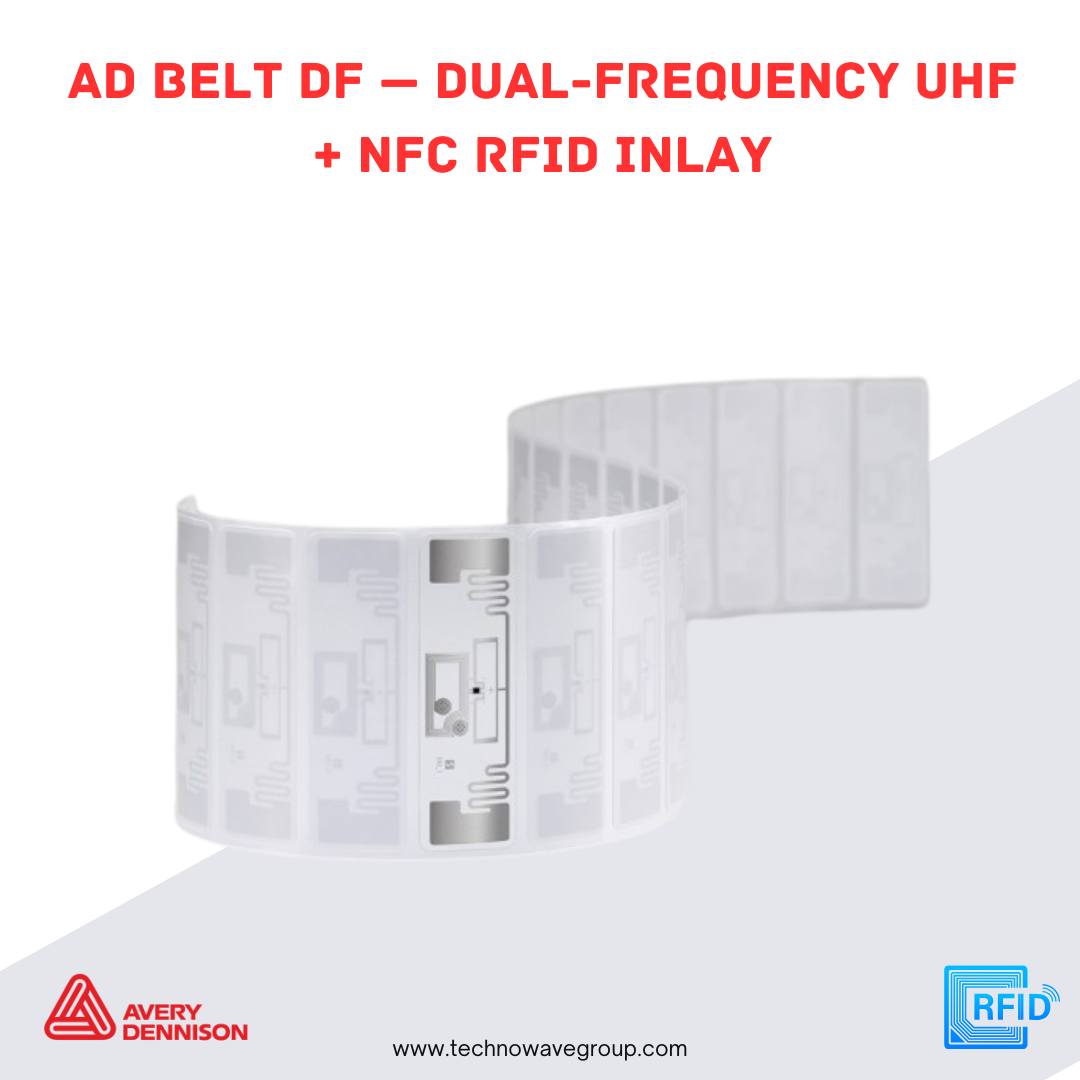
Description
Overview
AD Belt DF merges two radio interfaces in a single inlay so the same tag can be used throughout the item’s journey: UHF for warehouse portals, conveyors, and handhelds—and NFC for tap-to-verify and post-purchase experiences. Built on the proven Belt antenna geometry and powered by the EM4425 (echo-V) IC, Belt DF offers 2048-bit shared user memory that both interfaces can access, simplifying your data model across operations and customer touchpoints.
Why It Stands Out
-
One tag, two worlds: Long-range logistics with UHF, plus mobile tap via NFC for authentication, product info, and returns.
-
Shared memory architecture: A single user memory map for both interfaces reduces integration complexity.
-
Field-proven Belt platform: Stable, repeatable performance in close-coupling retail environments and industrial lanes.
-
Conversion-friendly: Available in wet/inlay paper tag constructions for easy label conversion and print-and-apply.
-
Scalable programs: Suitable for global deployments and multi-channel journeys from factory to consumer.
Typical Applications
-
Brand Protection & Anti-Counterfeit: Consumer tap-to-verify, warranty activation, and traceability.
-
Retail Supply Chain: Case/carton and item-level tracking with dock-door and handheld UHF reads.
-
Reverse Logistics / Returns: NFC-based return validation linked to UHF audit trails.
-
Industrial & Automotive: Dual-use parts labeling where operational reads and field/service taps are required.
-
After-Sales Engagement: Care instructions, product content, or loyalty experiences via NFC.
Technical Highlights (Quick Reference)
-
RF Standards & Bands:
-
UHF RAIN: EPC Class-1 Gen2v2 / ISO 18000-63, 860–960 MHz (region dependent)
-
HF/NFC: ISO 15693 (NFC Type 5), 13.56 MHz
-
-
IC / Memory: EM4425 (echo-V) with 2048-bit shared user memory (accessible from UHF and NFC), plus EPC/TID areas.
-
Antenna Size: 70 × 20 mm (approx.).
-
Typical Die-Cut (wet/tag): 73 × 23 mm (approx.).
-
Construction Options: PET-based inlay with paper face; wet inlay/paper tag formats.
-
Web / Core / Pitch (typical): Web ~76 mm; core 76 mm (3 in); pitch ~26 mm.
-
Operating Temperature: –40 °C to +85 °C (typical).
-
Use-Case Advantages: Authentication (NFC), omnichannel engagement, UHF operations (gates/handhelds), and unified data handling.
Selection Guide (Choose the Right Belt DF Variant)
-
Program & Compliance: Confirm retailer/industry mandates for dual-frequency tags and data retention.
-
Label Format: Select wet inlay or finished paper tag to match converting and print-apply lines.
-
Data Model: Define EPC structure and NFC payloads (e.g., NDEF records) using the shared memory.
-
Packaging & Substrate: Match face/adhesive to carton, corrugate, or plastic; validate in real environments.
-
Read Scenarios: Standardize label placement for both UHF portals and NFC taps (front-of-pack, hang tag, etc.).
Implementation Notes
-
Pilot end-to-end: Test dock-door reads, handheld cycles, and NFC tap UX before rollout.
-
Encode & verify: Use encode-and-verify with bad-tag rejection to protect data integrity.
-
Security & Privacy: Apply passwords/lock bits; design NFC flows that balance convenience with security.
-
Returns Workflow: Map NFC tap outcomes to RMA events while UHF provides operational checkpoints.
-
Placement Consistency: Fix a placement spec for reliable UHF coverage and intuitive NFC tap zones.
FAQs
Q1. What does dual-frequency mean in practice?
The tag supports UHF for long-range operational reads and NFC for short-range smartphone taps—both accessing the same user memory.
Q2. How much user memory is available?
2048 bits of user memory are available on the EM4425 and can be read/written via UHF and NFC.
Q3. Will it work globally?
Yes. UHF operates across 860–960 MHz bands (subject to regional regulations) and NFC operates at 13.56 MHz worldwide.
Q4. Is this suitable for item-level retail?
Yes—Belt DF is commonly used where both warehouse automation and consumer interaction are required.
Q5. What about on-metal or liquids?
Standard Belt DF is not an on-metal tag. For difficult materials (metal/high-liquid), use a spacer or a tag designed for those surfaces.


Reviews
There are no reviews yet.