
Showing all 10 resultsSorted by latest


Avery Dennison provides a comprehensive portfolio of RFID inlays, intelligent labels, tags and identification solutions developed for item-level visibility, inventory management, supply-chain traceability and product authentication.
The Avery Dennison RFID portfolio includes RAIN RFID UHF inlays, NFC-enabled labels, dual-frequency RFID tags and specialised on-metal RFID labels. These products can be used across retail, apparel, warehousing, logistics, manufacturing, automotive, healthcare and other industries where reliable product identification and real-time tracking are required.
Technowave supplies a selection of Avery Dennison RFID tags and labels in the UAE, including compact item-level inlays, long-range supply-chain tags, dual-frequency labels and RFID solutions designed for challenging surfaces.
Avery Dennison RFID products are available in different antenna sizes, chip configurations, frequency ranges and delivery formats. Selecting the correct product depends on the tagged material, required reading distance, label dimensions, RFID reader configuration and operating environment.
| RFID Product Type | Recommended Applications | Main Advantage |
|---|---|---|
| RAIN RFID UHF inlays | Inventory, retail, logistics and warehouse tracking | Fast identification of multiple tagged items |
| NFC RFID labels | Product authentication and consumer interaction | Can support short-range interaction using compatible mobile devices |
| Dual-frequency RFID labels | Retail, authentication and supply-chain management | Combines UHF RFID and NFC capabilities |
| On-metal RFID labels | Equipment, electronics and metal assets | Designed to operate on or close to metallic surfaces |
| Compact RFID inlays | Apparel, healthcare and small product labels | Strong RFID performance within a smaller footprint |
| Long-range RFID inlays | Cartons, pallets, logistics and industrial tracking | Wider reading coverage for supply-chain applications |
| RFID-printable labels | On-demand product and asset identification | Can be printed and encoded with compatible RFID printers |
RAIN RFID operates in the UHF frequency band and is commonly used for inventory tracking, item-level identification, logistics and supply-chain automation. Depending on the tag, antenna, reader power and installation environment, UHF RFID labels can be identified from several metres away without requiring direct line of sight.
A single RFID reader can capture multiple tagged items within the reading zone, making UHF RFID suitable for applications where conventional one-by-one barcode scanning would require significant time and manual effort. Avery Dennison states that suitable RAIN RFID inlays and tags can provide read ranges of up to approximately 10 metres under appropriate conditions.
Common UHF RFID applications include:
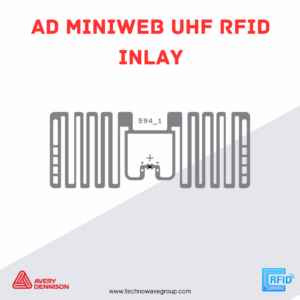
Compact RFID inlays are suitable for products where label space is limited. They can be incorporated into product labels, apparel hang tags, stickers, packaging and other converted media.
Products such as the Avery Dennison AD Miniweb are designed for retail, apparel, industrial, automotive, healthcare and logistics applications. Their compact antenna footprint makes them suitable for item-level identification while maintaining dependable RFID performance across different materials and operating environments.
Compact Avery Dennison RFID inlays can be considered for:
Avery Dennison’s long-format RFID inlays are designed for applications where dependable reading performance and wider coverage are required.
The Avery Dennison AD Dogbone family is commonly suited to supply-chain, logistics and industrial applications. Its antenna design can provide effective performance on materials such as cardboard, plastic and glass, including environments where nearby materials may affect RFID performance.
These RFID inlays can be used for:
| Application | RFID Function |
|---|---|
| Carton tracking | Identifies cartons during receiving, storage and dispatch |
| Pallet identification | Supports pallet movement monitoring at RFID portals |
| Warehouse automation | Captures tagged goods moving through controlled zones |
| Industrial tracking | Identifies components, containers and work-in-progress |
| Returnable assets | Tracks bins, crates and reusable transport items |
| Distribution operations | Improves visibility between warehouses and delivery points |
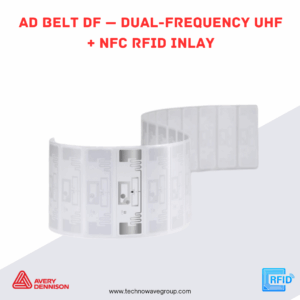
Dual-frequency RFID products combine RAIN RFID UHF and NFC functionality within one inlay. This allows businesses to use the UHF component for inventory and supply-chain tracking while using NFC for close-range product interaction, authentication or digital consumer experiences.
The Avery Dennison AD Belt DF is designed for item-level tagging, supply-chain management, industrial applications and brand protection. Its dual-frequency configuration enables one label to support operational RFID tracking and customer-facing NFC interactions.
Potential dual-frequency applications include:
Standard RFID labels can experience reduced performance when placed directly on metal because the surface can interfere with the RFID antenna. On-metal RFID labels are specifically engineered to operate on metallic surfaces or products containing metal.
Avery Dennison on-metal RFID labels can be used to identify:
The appropriate on-metal tag should be selected based on the asset size, surface shape, required read range, mounting method and environmental exposure.
Avery Dennison RFID products may be available in several delivery formats depending on the selected model.
| Format | Description |
|---|---|
| Dry inlay | RFID antenna and chip without an adhesive label construction |
| Wet inlay | RFID inlay supplied with an adhesive backing |
| Label or sticker | Finished RFID label ready for application or printing |
| Paper tag | RFID inlay converted into a paper-based tag format |
| Hang tag | RFID-enabled tag suitable for apparel and retail products |
| Durable tag | Tag construction developed for more demanding environments |
| Printable RFID label | Label designed for printing and encoding with an RFID printer |
Availability varies according to the selected Avery Dennison product, chip and regional frequency configuration.
Avery Dennison RFID labels can provide item-level visibility across stores, stockrooms, distribution centres and fulfilment operations. RFID can support faster stock counts, improved inventory visibility, replenishment processes and order verification.
In apparel retail, individual garments can be identified without scanning each barcode separately. RFID-enabled processes can also support product authentication, omnichannel fulfilment and loss-prevention workflows.
RFID labels can be applied to individual products, cartons, pallets and reusable containers. Tagged items can then be identified at receiving points, storage locations, dispatch zones and RFID portals.
This can help businesses improve:
Avery Dennison RFID inlays can support the identification of raw materials, components, tools, work-in-progress and finished products.
RFID data can be integrated with manufacturing, ERP, warehouse or asset-management platforms to provide better visibility across operational processes.
RFID-enabled labels can support inventory management, traceability, expiry monitoring and supply-chain visibility across food production, distribution, grocery and food-service environments. The suitability of an RFID label must be evaluated according to packaging material, moisture, temperature and direct or indirect food-contact requirements.
Compact RFID inlays can be used for selected medical supplies, laboratory materials, equipment and healthcare inventory. Product selection should consider the material being tagged, required dimensions, regulatory requirements and the intended tracking environment.
RFID tags can support component identification, production tracking, logistics, returnable container management and automotive supply-chain processes. Avery Dennison offers RFID technologies across UHF, HF and NFC frequency bands for different automotive applications.
| Business Requirement | Potential RFID Benefit |
|---|---|
| Faster inventory counting | Multiple RFID-tagged items can be captured within a reading zone |
| Improved stock visibility | Tagged products can be identified at different operational stages |
| Reduced manual scanning | RFID does not normally require direct line-of-sight scanning |
| Supply-chain traceability | Products, cartons and assets can be assigned unique digital identities |
| Dispatch verification | RFID can help confirm items before shipment |
| Product authentication | NFC and dual-frequency products can support verification workflows |
| Flexible label formats | Products are available in different sizes, chips and constructions |
| Enterprise integration | RFID information can be connected with WMS, ERP and asset-management systems |
Actual results depend on the application design, tag placement, data quality, reader infrastructure and software integration.
RFID tag selection should not be based only on tag size or maximum advertised reading distance. Each application should be evaluated according to the complete operating environment.
Important selection factors include:
Sample testing is recommended before proceeding with a large RFID label order.
Technowave supplies Avery Dennison RFID tags, labels and inlays for businesses in the UAE and GCC. Our team can help evaluate the product, tagged material, required reading distance and operational environment before recommending an RFID label.
Our RFID implementation support includes:
Browse the Avery Dennison products above or contact Technowave to identify the appropriate RFID inlay, label, tag or printing solution for your application.
An RFID inlay contains an RFID microchip connected to an antenna. The inlay can be converted into a wet inlay, adhesive label, product sticker, hang tag or another finished identification format.
The correct tag depends on the product material, label size, required reading distance, reader configuration and regional frequency. Compact inlays may suit item-level retail applications, while longer antenna designs may be more appropriate for logistics and supply-chain tracking.
Standard RFID labels may not perform correctly on metallic surfaces. A specialised on-metal RFID label should be used for metal assets, equipment and products.
UHF RFID is commonly used for longer-range identification and capturing multiple tagged items. NFC is intended for close-range interaction and can be accessed using compatible NFC-enabled devices. Dual-frequency labels combine both capabilities.
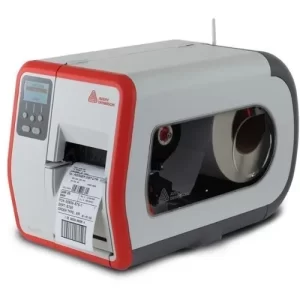
Selected Avery Dennison RFID labels can be printed and encoded using compatible RFID printers. Printer settings, label dimensions, chip type and encoding requirements must be configured correctly.
RFID generally does not require the reader to visually see the printed label. However, reading performance can be affected by metal, liquid, tag orientation, nearby objects and the installation environment.
Technowave supplies Avery Dennison RFID tags, labels and inlays for retail, logistics, warehouse, asset-management and industrial applications in the UAE and GCC.
We supply the full ranges of Zebra, Datalogic, Honeywell, Newland, Chainway, Impinj and more. Send us your requirement and we'll recommend the right device and configuration.
Tell us what you need. Our specialists will reply with pricing, availability and the right configuration for your business.
Prefer WhatsApp? Chat with us · Call +971 4 257 4455