

Showing all 10 resultsSorted by latest


Choose RFID labels and inlays that match your products, equipment and working environment. Technowave supplies UHF RFID labels, NFC/HF tags and dual-frequency inlays for retail, warehousing, logistics, asset management and smart packaging across the UAE, Oman, Bahrain, Kuwait and India.
From printable inventory labels to compact inlays embedded in packaging, we help you select suitable materials, chip options and formats, with support for custom printing, encoding and system integration.
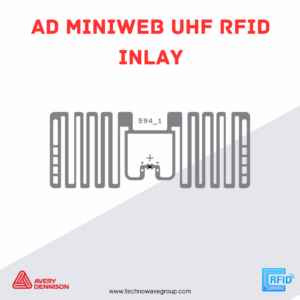
An RFID inlay contains a microchip and antenna mounted on a supporting material. An RFID label incorporates an inlay into a finished label with a printable face material and adhesive.
| Format | Construction | Typical use |
|---|---|---|
| Dry inlay | Chip and antenna on a substrate, without adhesive backing | Integration into packaging, hang tags and custom products |
| Wet inlay | Inlay with adhesive backing, usually supplied on a release liner | Direct attachment or conversion into finished labels |
| Printable RFID label | Inlay combined with a paper or synthetic face and adhesive | Printed product information, barcodes and RFID identification |
Passive UHF RFID labels support fast identification of multiple tagged items without requiring a direct line of sight to each label. They are commonly used for retail stock counts, warehouse receiving, carton tracking and asset verification.
Options include general-purpose labels, compact inlays, jewellery loops and specialist on-metal or flag designs. Read performance depends on the complete combination of tag, reader, antenna, placement and surrounding materials.
Select products compatible with your system’s EPC Gen2 and ISO/IEC 18000-63 requirements.
NFC labels allow customers or staff to tap a compatible smartphone to access product information, instructions, registration pages or digital content.
HF RFID also supports applications such as library and document tracking using compatible readers. Smartphone compatibility depends on the tag protocol, data format, phone and application; not every HF tag offers the same tap experience.
For metal surfaces, use an NFC label specifically designed for on-metal operation.
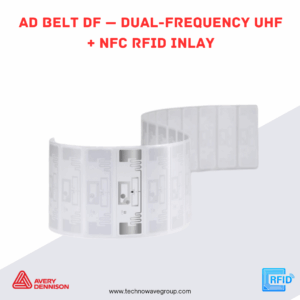
Dual-frequency inlays combine UHF and NFC interfaces in one tag. Businesses can use UHF for inventory and supply-chain processes, then NFC for customer interactions after purchase.
These tags can support product verification workflows, but authentication requires an appropriate chip, data security and backend system. A standard NFC link alone does not prove that a product is genuine.
Choose the label construction according to the surface and conditions it will face:
Ordinary RFID stickers should not be assumed suitable for metal, sterilisation, industrial laundry or harsh outdoor exposure.
Start with the item being tagged and the task you want to improve. Check:
Chip options may include Impinj M730/M750, NXP UCODE 8/9, NFC chips such as NTAG213/216, and dual-frequency options such as EM4425. Choose the complete inlay design and memory configuration rather than selecting by chip name alone.
Test samples on your actual products before committing to a bulk order.
Technowave can assist with:
Do I need an RFID printer to use RFID labels?
No. You can use labels supplied with suitable pre-encoded identifiers or encode them using compatible reader/writer equipment and software. An RFID printer is useful when you want to print text or barcodes and encode the chip in one workflow.
Can smartphones read UHF RFID labels?
Standard smartphones cannot read UHF RFID tags using their built-in NFC hardware. They can read compatible NFC tags. UHF reading requires a suitable external reader or a device with integrated UHF capability.
Will RFID labels work on metal or near liquids?
Standard UHF labels may lose performance on metal or near liquids. A specialist on-metal label, flag design or different placement may help, but the proposed solution should be tested on the actual item.
How far can UHF RFID labels be read?
Reading distance varies from close range to several metres or more, depending on the tag design, reader, antenna, permitted power, orientation and environment. Product specifications should be checked against your intended setup.
Can you supply custom sizes, printing and encoding?
Contact Technowave with your dimensions, artwork, quantity and data requirements. Available options depend on the inlay design, materials, production format and order quantity.
Are globally tuned inlays suitable across the GCC?
Globally tuned inlays can support deployment across different UHF bands. However, readers must still be approved and configured for the regulations of each country. A globally tuned tag does not replace local compliance checks.
Share your application, item material, required quantity, preferred label size and existing printer or reader model. Technowave can recommend suitable RFID labels and inlays and provide a quotation for your project.
We supply the full ranges of Zebra, Datalogic, Honeywell, Newland, Chainway, Impinj and more. Send us your requirement and we'll recommend the right device and configuration.
Tell us what you need. Our specialists will reply with pricing, availability and the right configuration for your business.
Prefer WhatsApp? Chat with us · Call +971 4 257 4455