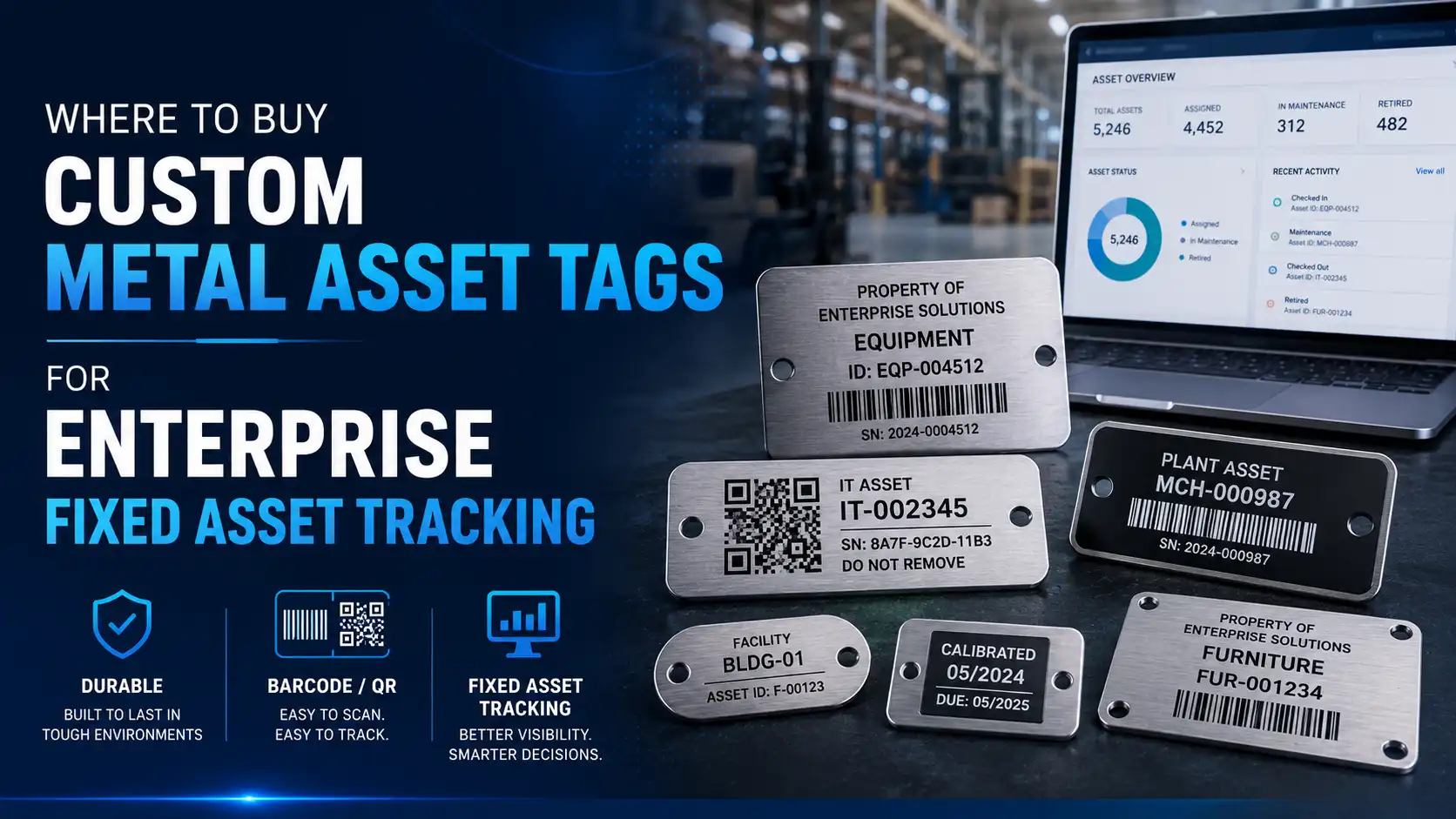
If you need metal asset tags for enterprise fixed asset tracking, buy them from a specialist that can supply the tag, the right mounting method, serialization, barcode or RFID encoding, and software integration as one program. For most organizations, the best source is not a generic label seller but an asset tagging partner that understands lifecycle durability, scanning performance, and how the tag data will connect to audits, disposals, transfers, and compliance records.
Custom metal asset tags are durable identification plates made from industrial materials such as anodized aluminum or stainless steel, usually printed or engraved with serial numbers, barcodes, QR codes, or embedded RFID. They matter because standard polyester labels often fail on IT hardware, machinery, outdoor assets, medical carts, tools, and fleet equipment where heat, chemicals, abrasion, cleaning fluids, or long service life make ordinary labels unreliable.
What custom metal asset tags do in an enterprise asset program
Metal asset tags are used when the identification mark must last for years, not months. In fixed asset tracking, the tag is the physical link between the asset and the digital record in an asset register, which may include depreciation class, custodian, warranty, location, maintenance history, and disposal status. If the tag fails, audit quality drops immediately because the asset can no longer be scanned, reconciled, or verified quickly.
That is why enterprise buyers increasingly combine durable tags with structured software workflows. A serial number on its own is not enough; the tag should map into a system such as an asset management system that supports issue, return, transfer, verification, and reporting. If you are comparing barcode-only versus mixed technologies, this guide on barcode asset tracking limits is useful because it shows where manual scanning begins to slow audits.
Market direction also supports investing in more durable identification. According to Fortune Business Insights, the global asset tracking market was valued at USD 21.84 billion in 2023 and is projected to reach USD 55.45 billion by 2032. Growth is being driven by the same pressures enterprise teams see every day: delayed audits, location errors, compliance demands, and the need to identify assets faster across multiple sites.
Where to buy metal asset tags: what procurement should actually look for
The best place to buy custom metal asset tags is a B2B supplier that can handle material selection, custom serialization, barcode verification, optional RFID, and deployment support. A low-price online plate vendor may supply tags, but enterprise projects usually fail at the points generic sellers do not cover: adhesive selection, reflective barcode readability, formatting for import into asset software, and field application consistency across hundreds or thousands of assets.
When procurement teams compare suppliers, they should ask direct questions. Can the supplier deliver serialized metal asset tags in a file structure that matches your asset register? Can they support both tags and application services such as asset tagging services? Can they supply RFID versions if you later move from line-of-sight scanning to bulk verification with RFID fixed readers or handheld devices?
Local support matters more than buyers initially expect. Imported generic pre-printed tags can look cheaper, but if adhesion fails on powder-coated equipment or serials do not align with your import template, rework costs quickly erase the price advantage. A supplier with implementation experience can also advise whether your project is a one-time tagging exercise or part of a broader operating model such as the processes described in asset tracking system deployment.
Supplier comparison checklist
| Evaluation point | Generic online tag seller | Enterprise asset tagging partner |
|---|---|---|
| Material guidance | Limited catalog choice | Recommends aluminum, stainless steel, or RFID on-metal by use case |
| Serialization control | Basic numbering | Structured sequencing, barcode mapping, import-ready data files |
| Mounting advice | Usually standard adhesive only | Adhesive, rivet, screw, hole, or hybrid mounting guidance |
| Software integration | Not included | Links to asset software and audit workflows |
| Support after delivery | Transactional | Application services, training, AMC, and troubleshooting |
Choosing the right metal: anodized aluminum, stainless steel, and brass
For most office, education, healthcare, and indoor industrial assets, anodized aluminum asset tags are the default choice because they balance durability, cost, and barcode print quality well. Photo-anodized aluminum places the image below the anodic layer, which protects the code and text from normal abrasion and chemicals better than surface printing. Metalcraft states that industrial-grade anodized aluminum tags can withstand continuous temperatures up to 650°F and offer outdoor durability of more than 20 years, according to Metalcraft industry specifications.
Stainless steel is usually selected when the asset environment is harsher still: chemical plants, marine environments, heavy washdown areas, or machinery exposed to repeated impact. It is stronger mechanically than aluminum, but it costs more and barcode contrast must be specified carefully to avoid scanning issues on reflective surfaces. Brass is less common for mainstream asset tracking and is generally chosen for branding, decorative identification, or special legacy environments rather than high-volume enterprise fixed asset programs.
Buyers often ask, Which is better: photo-anodized aluminum or laser-engraved metal? The answer depends on the environment. Photo-anodized aluminum is typically preferred where long-term barcode readability is the priority; laser engraving is stronger for deep permanent text on steel plates but may not produce the same scanner-friendly contrast unless the design and finish are planned correctly.
A second trend is the move from barcode plates to RFID-enabled metal asset tags. Vendors such as HID Global Omni-ID and Zebra Technologies support on-metal RFID designs that can be read without direct line of sight, which is valuable for racks, cages, data center equipment, returnable transport assets, and tools stored densely together.
What information and coding should be on a metal asset tag
A good tag design makes audits faster and data cleaner. At minimum, most enterprises include a unique asset number, company name, and a machine-readable barcode or QR code. Beyond that, the decision is operational: should staff scan a simple ID that pulls the full record from software, or should the tag itself carry more information such as model class, department code, site code, or tamper warning text?
Custom metal asset tags can include serialized numbers, 1D barcodes, 2D codes, logos, color coding, and, where required, UID-style formatting for government or defense-oriented environments. The mistake to avoid is adding too much visible information onto a small plate. Dense artwork can reduce scan zone size, shrink human-readable text, and create confusion during physical verification, especially when users are scanning quickly in plant rooms or storerooms.
Can standard barcode scanners read codes on metallic tags? Yes, but not every finish scans equally well. A matte or photo-anodized finish is generally preferred because highly reflective surfaces can cause inconsistent reads under strong overhead lighting. If your team is also reviewing printing and identification hardware, these asset tags for asset management considerations should be aligned with the scanners, printers, and mobile computers used in the field.
For RFID versions, ask whether the tag uses UHF EPC encoding and whether your readers need special setup. Most on-metal RFID tags are compatible with standard enterprise handheld readers, but read range and orientation depend on asset material, mounting position, reader power, and environment. That means proof-of-concept testing is not optional for metal racks, server chassis, or tool cabinets.
Attachment matters as much as the tag itself
The right attachment method depends on surface energy, texture, temperature, cleaning exposure, and whether the asset may be repainted or serviced. For laptops, monitors, and indoor equipment, high-performance acrylic adhesive is often adequate. For fleet assets, plant equipment, oil-exposed machinery, and outdoor housings, screw-mounted or riveted tags are usually safer because mechanical fastening is less vulnerable to oil contamination, textured paint, or thermal cycling.
Buyers regularly ask, Which adhesive backing is best for oily, textured, or curved surfaces? There is no universal answer, but low-surface-energy plastics and powder-coated metals usually need industrial adhesives designed for difficult bonding. The research commonly points to high-durability options such as 3M 300LSE or 9472LE for demanding surfaces, but real selection should be validated with substrate testing, cleaning procedure review, and dwell-time requirements before a full rollout.
Curved surfaces create another common failure point. A rigid metal plate fixed with full-surface adhesive may lift at the edges on cylinders, pipes, and rounded tools. In those cases, smaller-format plates, flexible on-metal RFID labels, or mechanical fixing through pre-drilled holes is often a better design choice than trying to force one tag format across every asset class.
If your project includes application in the field, require a documented tagging method: surface cleaning standard, cure time, placement rule, photo verification, and exception handling for damaged or inaccessible assets. This is why buyers looking for an asset tagging company should evaluate not only supply capacity but also installation discipline and whether the supplier can support governance after go-live.
Barcode versus RFID metal tags: when the upgrade is worth it
Barcode metal asset tags remain the most economical choice for assets that are audited individually and can be reached easily by staff. They work well in offices, schools, clinics, branch locations, and fixed equipment rooms where a user can approach each item and scan one by one. Barcode programs are simple to understand, easy to train, and effective when asset counts are moderate and audit frequency is manageable.
RFID metal asset tags become attractive when the cost of manual verification starts to exceed the premium of the tag. That usually happens with high asset density, difficult access, repetitive cycle counts, controlled stores, or environments where staff need to locate many assets quickly. In those scenarios, the shift to enterprise fixed asset management with RFID can reduce scan friction because multiple tagged items can be identified in one pass rather than one line-of-sight scan at a time.
Real project structure matters here. A legal and professional services environment may benefit from durable barcode tags tied to a clean audit workflow, as reflected in this Fragomen fixed asset management case study. Heavy industrial and vehicle-centric environments often justify RFID sooner because distance, asset scale, and access constraints change the economics of each audit, as seen in this oil and gas RFID asset management case study.
The practical buying question is not whether RFID is better in theory. It is whether your audit model, asset mix, and control risk justify moving from visible identification to automated identification. If the answer may change over time, buy from a supplier that can support both barcode and RFID within the same asset data structure.
How to choose a supplier that can support the full asset lifecycle
Metal tag procurement should be judged by lifecycle fit, not by unit price alone. The right supplier should be able to advise on material, code format, mounting, software integration, asset register preparation, and replacement policy for damaged or retired assets. If they only quote tag dimensions and quantity breaks, you are buying a plate, not a tracking program.
Ask for evidence in five areas: durability guidance, serialization quality control, field application capability, software compatibility, and support after deployment. Integration is especially important when tags must sync with existing records. A good supplier should explain how custom serial numbers are imported into systems such as easyTRACK, how duplicates are prevented, and how handheld data capture supports verification, transfer, and disposal transactions.
There is also a governance question. Who supplies replacement tags when assets are refurbished? Who maintains reader configuration if you expand to RFID? Who supports periodic audits and exception cleanup? For many enterprises, especially those operating across offices, warehouses, healthcare facilities, and schools, the best buying decision is an end-to-end provider rather than a standalone tag manufacturer.
For organizations that want one partner for Technowave International style delivery of tags, software, field rollout, and after-sales support, the value is operational continuity. Technowave International combines fixed asset management software, asset tagging services, RFID and barcode infrastructure, and local technical support, which is what enterprise buyers typically need once the first tagging phase expands into a long-term control program.
FAQ
Q: What are metal asset tags used for in fixed asset tracking?
A: They provide a durable physical ID for assets that must be audited, transferred, maintained, or disposed of over long service lives. Enterprises use them on IT hardware, machinery, medical devices, tools, fleet equipment, and outdoor assets where ordinary labels may fade, peel, or become unreadable.
Q: Which is better for asset tags: aluminum, stainless steel, or polyester?
A: Aluminum is usually the best balance of durability, scan quality, and cost for most indoor enterprise assets. Stainless steel suits harsher chemical, washdown, or impact-heavy environments. Polyester is cheaper but better reserved for lighter-duty conditions where long-term abrasion, heat, and solvents are not major concerns.
Q: Can custom metal asset tags include barcodes, QR codes, or serial numbers?
A: Yes. Most enterprise tags can be customized with sequential numbers, 1D barcodes, 2D QR or Data Matrix codes, logos, department identifiers, and tamper text. Some can also include embedded on-metal RFID chips, allowing both visual identification and automated wireless reading.
Q: How do I choose between adhesive metal tags and screw-mounted tags?
A: Use adhesive tags for smooth, clean, stable indoor surfaces where drilling is not practical. Choose screw, rivet, or hole-mounted tags for oily machinery, textured coatings, curved surfaces, fleet assets, and outdoor equipment where heat, vibration, or contamination could weaken adhesive performance over time.
Q: What should I look for in a supplier of enterprise metal asset tags?
A: Look for material expertise, barcode verification, serialization control, mounting advice, RFID options, and software integration capability. The strongest suppliers also provide field application support, replacement tag processes, and guidance on how the tags will work inside your wider asset management workflow.
Q: Are on-metal RFID tags compatible with standard handheld RFID readers?
A: Usually yes, provided the tag is designed for metal surfaces and uses a standard enterprise UHF format. However, read range and consistency depend on mounting position, asset material, nearby metal density, and reader configuration, so pilot testing is essential before large-scale deployment.
If your asset tracking program needs more than just tags, work with a supplier that can advise on tag specification, rollout method, software integration, and future RFID readiness. That is the difference between finishing a tagging project and building an asset control system that still works years later.
Related Articles
- Enterprise Fixed Asset Management: Key Strategies, Challenges, and Emerging Trends
- Asset Compliance and Regulatory Tracking in Enterprises
- Fragomen Fixed Asset Management
- How to Standardize Your Fixed Asset Register Before Hiring an Asset Tagging Service
- The Enterprise Guide to Deploying an Asset Tagging Service: RFID and Barcode Best Practices
- How Asset Tracking Improves Operational Control in KUWAIT
Where to Buy Custom Metal Asset Tags
Find the best metal asset tags for enterprise fixed asset tracking, including materials, RFID options, adhesives, and supplier selection tips.