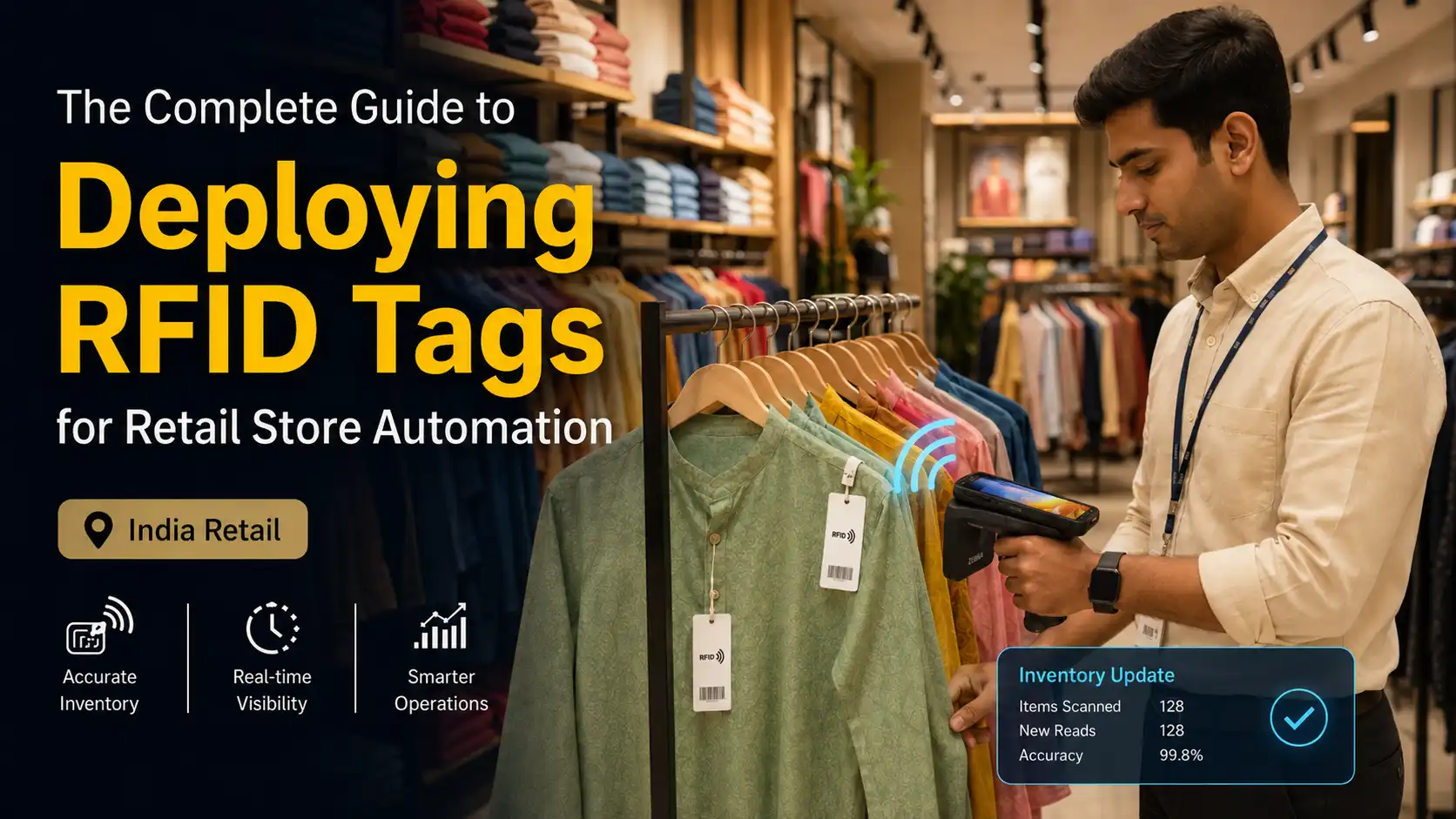
To deploy rfid tags for retail store automation successfully in India, you need more than tags. You need the right UHF tag design, compatible readers, middleware, POS and ERP integration, and a phased rollout plan that works in real stores with metal fixtures, mixed merchandise, and high SKU counts. This guide explains exactly how to implement a retail RFID program step by step, with a practical focus on Indian apparel, fashion, cosmetics, footwear, home, and specialty retail operations.
For most Indian retailers, retail RFID means passive UHF item-level tagging linked to receiving, stock counts, replenishment, shelf visibility, and loss prevention. Early in the project, define whether the goal is faster cycle counting, better omnichannel order accuracy, source tagging at factories, or RFID-enabled EAS. That decision shapes the tag specification, reader placement, and software workflow.
Step 1: Define the retail RFID objective and operating model
Start by deciding what problem the RFID project must solve. In Indian retail, the strongest business cases are inventory accuracy for apparel and footwear, faster receiving from factory-tagged merchandise, and better stock visibility for omnichannel fulfillment. If the goal is vague, the rollout usually becomes a hardware purchase rather than an automation project.
What is a retail RFID deployment in practical terms? It is an item-level identification system where each sellable unit carries a unique EPC code, the code is read by handheld or fixed readers, and the event data updates a central inventory platform. Standards alignment matters here, which is why product encoding and data structure should follow guidance from GS1 India rather than an ad hoc numbering method.
Answer these questions before you test anything: which categories will be tagged, where tagging will happen, which stores will pilot first, and which systems own inventory truth. If your teams already run barcode-based replenishment, returns, and POS, plan a hybrid transition instead of forcing an overnight change. A broader automation roadmap often connects RFID with an inventory tracking system and store digitization projects such as Electronic Shelf Labels solutions.
Practical tip: define success as three measurable outputs: inventory accuracy, counting speed, and receiving time. Common mistake to avoid: launching RFID only because competitors have it, without mapping the store processes that will actually use the data.
Step 2: Choose the right RFID tag type for each product category
The best RFID tags for a retail store in India are usually passive UHF tags, not active tags. Passive UHF is the retail standard for garments, footwear, boxed accessories, and many general merchandise items because it offers low per-item tag cost, fast bulk reading, and compatibility with store handhelds, gates, and printers. Active RFID is better reserved for reusable assets such as trolleys, cages, or high-value movable equipment.
Tag selection should be done by material, packaging, and fixture environment. Apparel hangtags and woven labels usually perform well with standard inlays. Metallic home decor, jewelry displays, and foil-heavy cosmetic packaging require specialized inlays or on-metal label constructions. Liquids and dense product clustering can also detune performance, so lab testing is not enough; live store testing is mandatory.
Retail RFID tag selection comparison
| Retail category | Recommended tag format | Why it fits | Main caution |
|---|---|---|---|
| Apparel and footwear | Passive UHF paper hangtag or care-label inlay | Low unit cost, fast cycle counts, source tagging friendly | Tag orientation varies by folding and packing method |
| Cosmetics and personal care | Small passive UHF label with tuned inlay | Works for boxed items and promotional sets | Liquids and foil packaging need pilot testing |
| Jewelry and small accessories | Specialized small-form-factor passive UHF tag | Supports dense item identification | Read isolation is critical in trays and counters |
| Metallic home goods | On-metal passive UHF tag | Designed for reflective surfaces | Higher tag cost than standard apparel labels |
| Reusable store assets | Active RFID or rugged passive asset tag | Better for long-life tracking of movable equipment | Not economical for normal apparel item tagging |
According to Auburn University RFID Lab, RFID programs in retail can move inventory accuracy from about 65% to above 95% when implemented properly. Practical tip: test at least three tag candidates on the real products and fixtures you sell. Common mistake to avoid: choosing the smallest tag first and discovering later that it reads poorly in packed racks or metal shelving.
Step 3: Specify the hardware, software, and integration stack
RFID tags only create value when they work with the right read infrastructure. A complete setup usually includes RFID printers for encoding, handheld readers for stock counts, fixed readers or portals for backroom and receiving points, antennas, middleware, and integration to POS, ERP, and merchandising systems. For many Indian retailers, handheld-led deployments come first because they produce quick operational gains without major store renovation.
If you are moving from barcodes to RFID, keep both systems live during the transition. POS can still use barcode scanning for sale transactions while RFID powers cycle counts, receiving verification, and floor-to-backroom reconciliation. This hybrid approach reduces disruption and lets your teams continue using familiar checkout devices such as the Zebra DS4600 Series for Retail or the Zebra DS9900 Series corded hybrid imager for retail alongside RFID handheld readers and RFID printers.
Can RFID tags be integrated with POS and ERP systems? Yes, but only when event logic is clearly defined. Your middleware or inventory platform must decide what a read means: received, transferred, counted, exception, or exit alarm event. Integration with SAP, Microsoft Dynamics, or custom retail systems should update stock status in near real time, while user roles, duplicate reads, and exception queues are controlled centrally.
According to RAIN RFID Alliance, retail adoption continues to accelerate because item-level visibility supports better replenishment and omnichannel execution. Practical tip: define a single source of truth for stock before integration begins. Common mistake to avoid: connecting readers directly to multiple systems without middleware rules, which creates duplicate or conflicting inventory events.
Step 4: Deploy the RFID tagging solution in six implementation steps
The fastest way to implement RFID retail automation in India is a phased rollout: one category, one pilot store cluster, one receiving workflow, then scale. Source tagging at factory level is increasingly preferred for fashion brands because tagged merchandise arrives retail-ready and avoids manual relabeling in distribution centers. That is especially useful when sourcing from manufacturing hubs where speed to shelf matters.
- Map SKU and process scope. Identify departments, seasonality, return flows, and high-mix categories. Tip: start with apparel or footwear where passive UHF delivers the cleanest economics. Mistake: including every category at once, including hard-to-read metallic products, in the first phase.
- Select and test tags. Run read tests on folded stock, hanging stock, packed cartons, and store fixtures. Tip: include crowded shelves and backroom racks in the trial. Mistake: approving tags based only on supplier sample sheets.
- Set up encoding and data standards. Define EPC structure, printer templates, and exception handling for damaged or duplicate tags. Tip: align with GS1-based product identity governance. Mistake: allowing each factory or store to use different encoding logic.
- Install readers and software workflows. Configure handheld count paths, receiving stations, and optional gate readers. Tip: establish role-based dashboards for store, warehouse, and HO teams. Mistake: placing fixed readers without a read-zone survey.
- Integrate with POS and ERP. Sync item master, stock ledger, transfers, and sales status. Tip: test returns, markdowns, and inter-store transfers before go-live. Mistake: validating only normal sale transactions.
- Pilot, train, and scale. Measure count speed, read reliability, and exception rates, then roll out by region. Tip: use store champions, not only IT staff, during pilot weeks. Mistake: scaling nationally before fixing pilot process gaps.
For readers comparing methods, source tagging often delivers the best operational ROI because receiving becomes verification rather than manual tagging. For a deeper implementation angle, see this article on RFID technology for Indian retail and practical examples from fashion retail RFID automation. Practical tip: document exception workflows from day one. Common mistake to avoid: treating user training as optional once the hardware is installed.
Step 5: Validate use cases, costs, and risk controls before scaling
Once the pilot is live, evaluate actual store use cases, not just read rates. The main gains usually come from faster cycle counts, better replenishment from backroom to floor, accurate omnichannel promises, and shrink control through RFID-enabled EAS. According to Grand View Research, the global retail RFID market was valued at USD 12.6 billion in 2023 and is projected to grow at a 13.5% CAGR through 2030, reflecting strong demand for item-level retail visibility.
What does it cost to deploy RFID tags for retail store automation? The answer depends on tag type, annual volume, whether tagging is done at source or in-store, the number of handhelds, and integration scope. For apparel RFID tags for retail, buyers should model total operating cost rather than focus only on tag price, because labor savings, stock accuracy, and sales protection often drive the business case more than the label itself.
Will RFID work on metal, jewelry, or liquid-based products? Yes, but not with a one-tag-fits-all approach. These categories need category-specific inlays, spacing rules, and read-zone testing to avoid false assumptions. If shrinkage is a concern, combine RFID with exit control logic and store layouts that preserve customer openness while improving exception visibility.
How long does rollout take across multiple stores? That depends on pilot maturity and merchandising uniformity, but retailers scale faster when item master data, encoding standards, and training content are centralized. If you are evaluating a full-stack project, review RFID solutions for retail stores and complementary store technologies in this retail digital transformation guide. Practical tip: scale by store format, not just by geography. Common mistake to avoid: copying one pilot reader layout into every branch without considering floorplan differences.
FAQ
Q: What are the best RFID tags for a retail store in India?
A: For most apparel, footwear, and fashion accessories, passive UHF RFID tags are the best fit because they support low-cost item tagging and fast bulk reading. For metal-heavy home products or selected cosmetic packaging, use specialized inlays or on-metal tags after live store testing.
Q: How much does it cost to deploy RFID tags for retail store automation?
A: Cost depends on tag format, yearly SKU volumes, handheld and fixed reader count, printer requirements, software licensing, and integration effort. The most accurate budgeting method is category-by-category modeling that includes tag cost, labor saved in receiving and counting, and expected uplift from better stock availability.
Q: Can RFID tags be integrated with POS and ERP systems?
A: Yes. RFID event data can be integrated with POS, ERP, merchandising, and warehouse systems so stock updates remain synchronized. The critical requirement is middleware or business logic that converts raw reads into meaningful transactions such as receive, transfer, count, return, or exception.
Q: Which retail products can be tagged using RFID?
A: Apparel, footwear, bags, boxed accessories, cosmetics, home textiles, and many general merchandise items can be tagged effectively. Jewelry, metallic decor, and liquid-based products can also be tagged, but they usually require specialized label constructions and more careful read testing.
Q: Do I need fixed readers, or are handheld readers enough?
A: Many retailers begin with handheld readers because they are quicker to deploy and ideal for cycle counting, replenishment, and stock verification. Fixed readers become valuable at receiving doors, stockroom transitions, or exit points when you need unattended event capture or RFID-enabled EAS functions.
Q: How long does it take to implement an RFID retail solution across multiple stores?
A: A pilot can move relatively quickly when the item master, tag specification, and workflows are already defined. Multi-store rollouts take longer because training, source tagging coordination, reader calibration, and ERP integration must stay consistent across locations and store formats.
If you are planning RFID tagging for fashion, specialty, or multi-branch retail in India, work with a team that can handle tags, readers, software, integration, rollout, and support as one solution. Technowave International provides end-to-end retail RFID automation, including hardware, software, implementation, and post-deployment support for businesses building accurate, scalable store operations.
Related Articles
- RFID Technology for Indian Retail: Complete Implementation Guide & ROI Analysis
- The Complete Guide to Digital Transformation in Indian Retail: RFID, ESL & Smart Analytics
- Why RFID is Becoming Essential for Modern Indian Retail Stores in 2026
- Smart Retail Technology ROI Calculator: What Indian Businesses Can Expect from RFID, ESL & Analytics Investment
- Footfall Counter for Retail: Why Every Store Needs It in 2025
- PDT Mobile computers’ impact on retail store performance
RFID Tags for Retail Store Automation Guide India
Learn how to deploy RFID tags for retail store automation in India, from tag selection and integration to rollout, inventory accuracy, and ROI.