
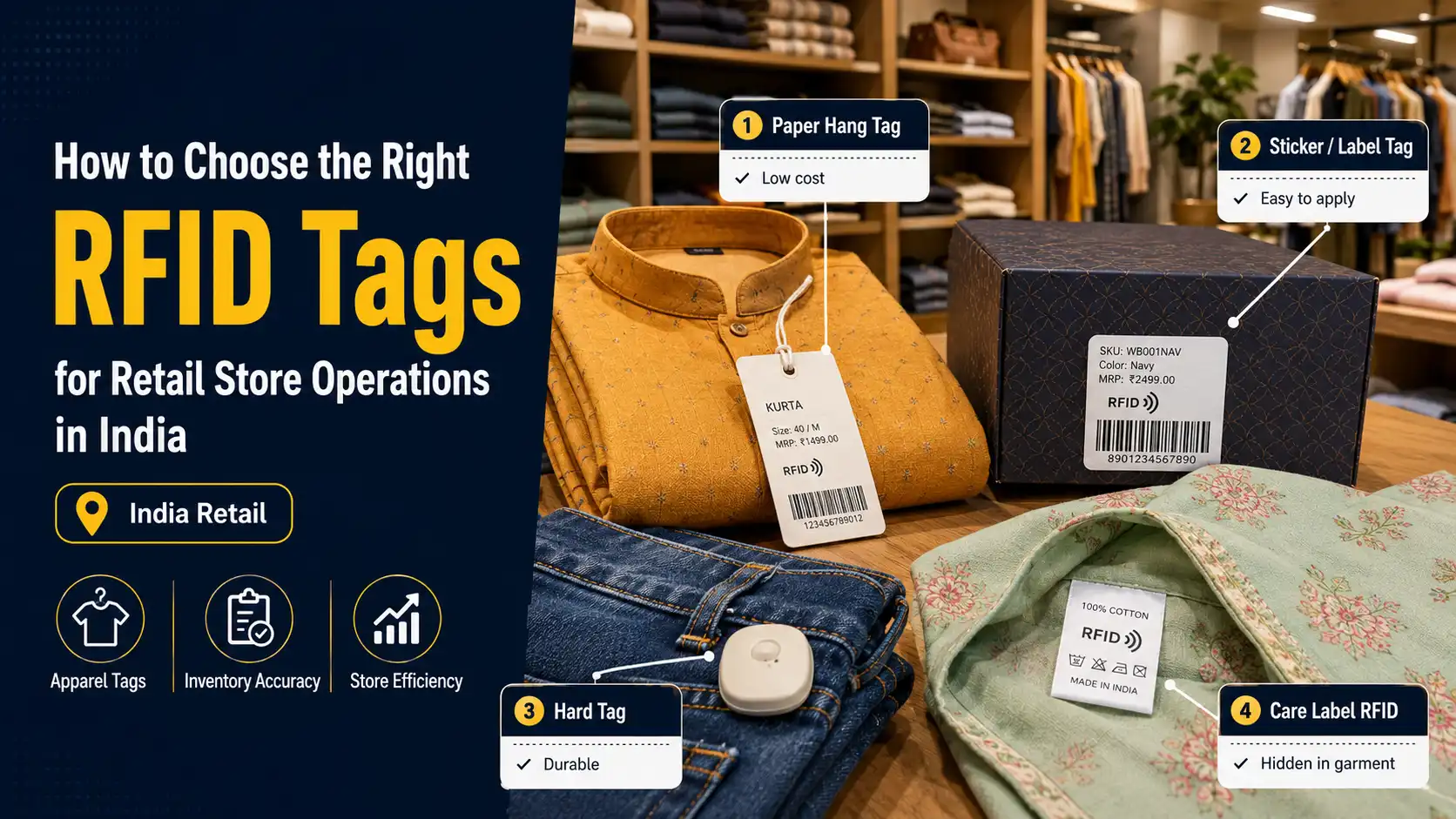
The right rfid tags for retail store operations in India are the ones that match your merchandise material, tagging process, read points, and software workflow. For apparel, footwear, cosmetics, jewellery, and multi-brand retail, the correct tag choice directly affects stock-count speed, replenishment accuracy, and whether the RFID project scales beyond a pilot.
In practical terms, a retail RFID tag is the data carrier attached to each item so staff can identify and count products in bulk using handheld or fixed readers. According to GS1 India, EPC-based identification standards are central to interoperability across the supply chain, which matters if you plan source tagging at factory level and store-level reading later. Indian retailers evaluating RFID retail automation solutions should therefore start with tag selection, not only reader selection.
Why RFID tag choice matters more than most retailers expect
Retail leaders usually begin with a business objective: improve inventory accuracy, reduce stock search time, enable faster cycle counts, or support omni-channel fulfillment. Tag selection determines whether those objectives are achievable. A tag that reads perfectly on cotton apparel may fail on foil-packed cosmetics, metallic gift sets, or liquid perfume bottles.
India’s retail market is expanding quickly, and operational pressure on stores is increasing. According to a joint report by Retailers Association of India and Boston Consulting Group, the Indian retail market is projected to reach USD 2 trillion by 2032, increasing the need for better stock visibility across stores and fulfillment channels. Separately, GS1 India has reported that RFID deployments in retail can lift inventory accuracy from typical legacy levels to above 95% and reduce out-of-stocks materially.
For store operations, the consequence is simple: if the tag is poorly matched to the item, your staff will still scan manually, investigate exceptions, and distrust the data. If the tag is well chosen, cycle counts become fast enough to run during live store hours, replenishment becomes more disciplined, and receiving-to-sales-floor movement becomes easier to trace.
Retailers also need to separate inventory use cases from shopper-engagement use cases. UHF EPC Gen2 is typically the right choice for item-level inventory, stock counts, receiving, and exit/entry read points, while HF/NFC is better suited when you want a phone tap experience for product authentication or campaign interaction. Mixing the two objectives into one tag decision often creates unnecessary cost or weak store performance.
Key technical criteria for selecting retail RFID tags in India
The first filter is merchandise substrate: fabric, leather, cardboard, plastic, metal, glass, or liquid-filled packaging. UHF performance drops significantly when tags are placed directly on metal or close to liquids, so cosmetics, perfume, canned products, and metallic accessories usually require specialty inlays, spacers, or on-metal labels rather than standard paper smart labels. This is one of the most common reasons pilots look good on apparel but fail when extended to adjacent categories.
The second filter is tag construction. Buyers should review inlay size, antenna design, chip sensitivity, memory, adhesive type, print surface, and durability. For high-volume Indian apparel and footwear chains, the RFID IC matters because it influences read sensitivity and dense-reader performance during mass scanning. Source options from manufacturers such as Avery Dennison are often evaluated based on category-specific performance, not just unit price.
Direct buying questions to ask vendors
Ask these questions before approving a tag: What is the minimum readable distance on my actual product? How many items can be reliably captured during a fast handheld sweep? Can the tag survive folding, ironing, transit abrasion, or changing-room handling? Is the EPC structure aligned with GS1 India guidance if I later move to source tagging?
You should also confirm whether the tag is intended for one-time use, reusable use, or both. In luxury or high-value retail, reusable RFID hard tags can support both security and inventory, but they create reverse logistics and retagging work. In fast-moving apparel, disposable hang tags or RFID-enabled fabric care labels are often operationally cleaner. For on-demand tag creation, compatibility with Indian retail RFID workflows and with local encoding processes matters as much as RF performance.
Comparing the main RFID tag types used in retail stores
Indian retailers typically choose among four tag formats: adhesive smart labels, hang tags, fabric care labels, and reusable hard tags. The correct choice depends on whether tagging happens at source, in the DC, or inside stores. It also depends on whether the tag must carry visible branding, pricing, or care information in addition to the EPC.
| Tag type | Best use case | Advantages | Limitations |
|---|---|---|---|
| Adhesive RFID label | Boxed goods, cartons, cosmetics sleeves, footwear boxes | Low profile, printable, fast to apply, economical at volume | Weak on metal/liquid unless specialty design is used |
| RFID hang tag | Apparel, accessories, footwear, multi-brand retail | Good read performance, supports branding and barcode printing | Usually disposable; requires attachment process |
| RFID fabric care label | Source-tagged garments and private-label apparel | Integrated at manufacture, low store labor, hidden placement | Requires supplier alignment and wash/care durability testing |
| RFID hard tag | High-value fashion, luxury, theft-sensitive categories | Reusable, durable, can combine security and inventory | Higher upfront cost, detachment and recirculation needed |
For most apparel chains, the decision is between hang tags and fabric care labels. Hang tags are easier for multi-brand outlets because they can be added in-store or by brand suppliers without changing garment construction. Fabric care labels are stronger when you control manufacturing and want source tagging embedded into the production line, reducing store labor at receiving and tagging.
Paper labels and hard tags are not interchangeable. A paper RFID label is usually for efficient identification and disposal after sale; a hard tag is an asset-like device that must be recovered, checked, and reused. Retailers that underestimate that operational difference often buy reusable tags for categories where labor savings matter more than tag recovery.
When labels must be printed and encoded locally, make sure they work with your chosen inventory tracking and warehouse management workflows and with compatible RFID printers. Reader-side testing should include both retail barcode scanning workflows and RFID capture points because many stores run both technologies side by side.
How to choose RFID tags by product category and store process
Apparel and footwear: UHF RFID hang tags and fabric care labels are usually the strongest options. The key variables are placement on the garment, fold orientation, stacking density, and whether items are replenished from backroom shelves, rail stock, or cartons. Multi-brand outlets in metro cities often prefer versatile inlays that perform consistently across different garment materials and brand packaging styles, even if unit cost is slightly higher.
Jewellery and fashion accessories: Size and presentation matter more than pure read range. Loop tags, flag labels, or miniature specialty tags are selected to avoid interfering with display aesthetics or item handling. Because jewellery counters have dense, small items placed close together, anti-collision performance and reader tuning become as important as tag shape.
Cosmetics, electronics, and packaged goods: Metalized packaging, foil liners, batteries, and liquid-filled bottles can detune standard UHF labels. In these cases, retailers should test on-metal labels, foam-spaced constructions, or packaging-level placement that creates sufficient distance from the problematic material. If a perfume bottle cannot be tagged directly, the carton or outer sleeve may be the correct tagging point.
Source tagging vs in-store tagging
Source tagging is usually better when you have private-label scale, supplier compliance capability, and a clear EPC governance model aligned with GS1 India. In-store tagging is more flexible for imported assortments, short seasonal buys, and brands not yet RFID-enabled, but it adds labor and consistency risk at receiving. Many Indian retailers start with store tagging for speed, then migrate high-volume lines to source tagging once the business case is proven.
Reader, printer, software, and pilot validation considerations
A tag should never be approved in isolation from the rest of the RFID stack. Reader power, antenna orientation, shelf density, doorway geometry, and handheld motion all influence read results. A tag that performs well in lab tests may behave differently during live cycle counts, receiving, or point-of-sale deactivation and validation. Retailers should test tags with the same handhelds, fixed readers, and portals planned for rollout, not with generic demo hardware.
Printer compatibility is equally important for retailers that print and encode on demand. Confirm media width, sensor compatibility, encoding reliability, print surface quality, and whether the printer can support both barcode and RFID workflows without slowing store operations. If you need shelf-ready labels, carton labels, and item tags from one environment, standardization becomes a purchasing advantage. This is where buyers often review the complete mix of RFID retail solution components, including tags, readers, software, and deployment support, rather than buying media separately.
Software integration must define what the EPC means inside your business. The POS, ERP, WMS, or retail inventory application should know whether the tag represents a unique item, a style-size-colour variant, a carton, or a reusable security tag. Without that data discipline, stores may read items successfully but still fail to reconcile stock or support replenishment.
Before full rollout, run a controlled pilot with category-specific acceptance criteria. Test read rates on actual merchandise, folding conditions, fixture types, backroom cartons, trial rooms, and receiving cages. Track exception categories such as unreadable tags, duplicate encoding, placement inconsistency, and damaged labels. Retailers can also learn from real deployment examples such as this fashion retail RFID automation case study and this retail RFID project for Paneri Embroidery, which illustrate how RFID selection connects to store operations rather than functioning as a standalone hardware purchase.
Common mistakes, commercial evaluation, and why the timing matters now
The biggest buying mistake is evaluating tags only by price per piece. For a high-volume apparel store in India, tag price absolutely matters, but the lowest-cost inlay can become the most expensive option if it causes misreads, retagging labor, or poor handheld count performance. Commercial evaluation should include application labor, reusability, printer waste, exception handling, supplier compliance effort, and the cost of operational distrust.
The second mistake is skipping live-environment testing. Retailers often test a flat sample on a desk rather than on folded garments, stacked footwear boxes, metal shelving, packed gift sets, or trial-room returns. The third mistake is using one tag specification across every category. Standardization is useful, but not when it ignores product physics.
Acting now is rational for Indian retailers because RFID is no longer just a pilot technology for flagship stores. As organized retail grows and omni-channel expectations tighten, store teams need faster, more frequent inventory visibility. That pressure is strongest in apparel, footwear, beauty, and high-SKU specialty formats where manual counts disrupt trading hours. If your current stock files are only updated after periodic counts, your replenishment and order promise accuracy are already under pressure.
For retailers that want a practical evaluation process, Technowave International brings together tags, readers, software integration, field testing, and rollout support across retail environments. If you are comparing retail RFID tags India options for apparel, footwear, cosmetics, or jewellery, the next step is to shortlist two or three tag constructions and validate them on your actual merchandise and store process before final procurement.
FAQ
Q: What type of RFID tags are best for retail stores in India?
A: For most Indian apparel and footwear stores, UHF EPC Gen2 hang tags or fabric care labels are the best fit because they support fast cycle counts and item-level inventory. For cosmetics, electronics, and metal-rich packaging, specialty UHF labels with spacing or on-metal designs are often required.
Q: How do I choose RFID tags for apparel, footwear, and jewellery products?
A: Start with product material, tag placement, and how staff handle the item. Apparel usually uses hang tags or care labels, footwear often uses box or swing tags, and jewellery needs miniature loop or specialty tags that preserve presentation while still reading reliably in dense displays.
Q: What is the difference between paper RFID labels, hard tags, and hang tags?
A: Paper RFID labels are adhesive smart labels applied directly to packaging or product surfaces. Hang tags are printed ticket-style tags attached by string or fastener, common in fashion. Hard tags are reusable devices used on higher-value merchandise where durability and security matter more than disposable convenience.
Q: Are RFID tags compatible with handheld readers, fixed readers, and POS systems?
A: They can be, but compatibility depends on frequency, encoding standard, software mapping, and workflow design. A tag may read well on a handheld yet need different validation logic at POS or at a fixed portal. Always test the tag with the exact readers, antennas, printer, and software planned for deployment.
Q: How much do RFID tags for retail inventory management cost in India?
A: Pricing varies by inlay type, order volume, tag construction, print requirements, and whether the label is standard or specialty for metal or liquid environments. High-volume apparel tags are typically more economical than small-run specialty tags. Buyers should calculate total deployment cost, not only unit media price.
Q: Should I use UHF Gen2 or HF/NFC for retail?
A: Use UHF Gen2 for inventory visibility, receiving, stock counts, replenishment, and backroom-to-sales-floor operations. Use HF/NFC when customer phone interaction, authentication, or digital engagement is the primary goal. Many retailers evaluate NFC for marketing separately from UHF for operational inventory control.
Related Articles
- Why RFID is Becoming Essential for Modern Indian Retail Stores in 2026
- Why Supermarkets in India Are Adopting Electronic Shelf Labels for Faster Store Operations
- Smart Retail Technology ROI Calculator: What Indian Businesses Can Expect from RFID, ESL & Analytics Investment
- RFID Technology for Indian Retail: Complete Implementation Guide & ROI Analysis
- Inventory Management Crisis in Indian Retail: How RFID + Smart Technology Solves the ₹50,000 Crore Problem
- Dynamic Pricing in Indian Retail: How ESL Technology Makes It Possible
How to Choose RFID Tags for Retail Store India
Learn how to choose RFID tags for retail store operations in India by product type, read environment, printer compatibility, and rollout needs.