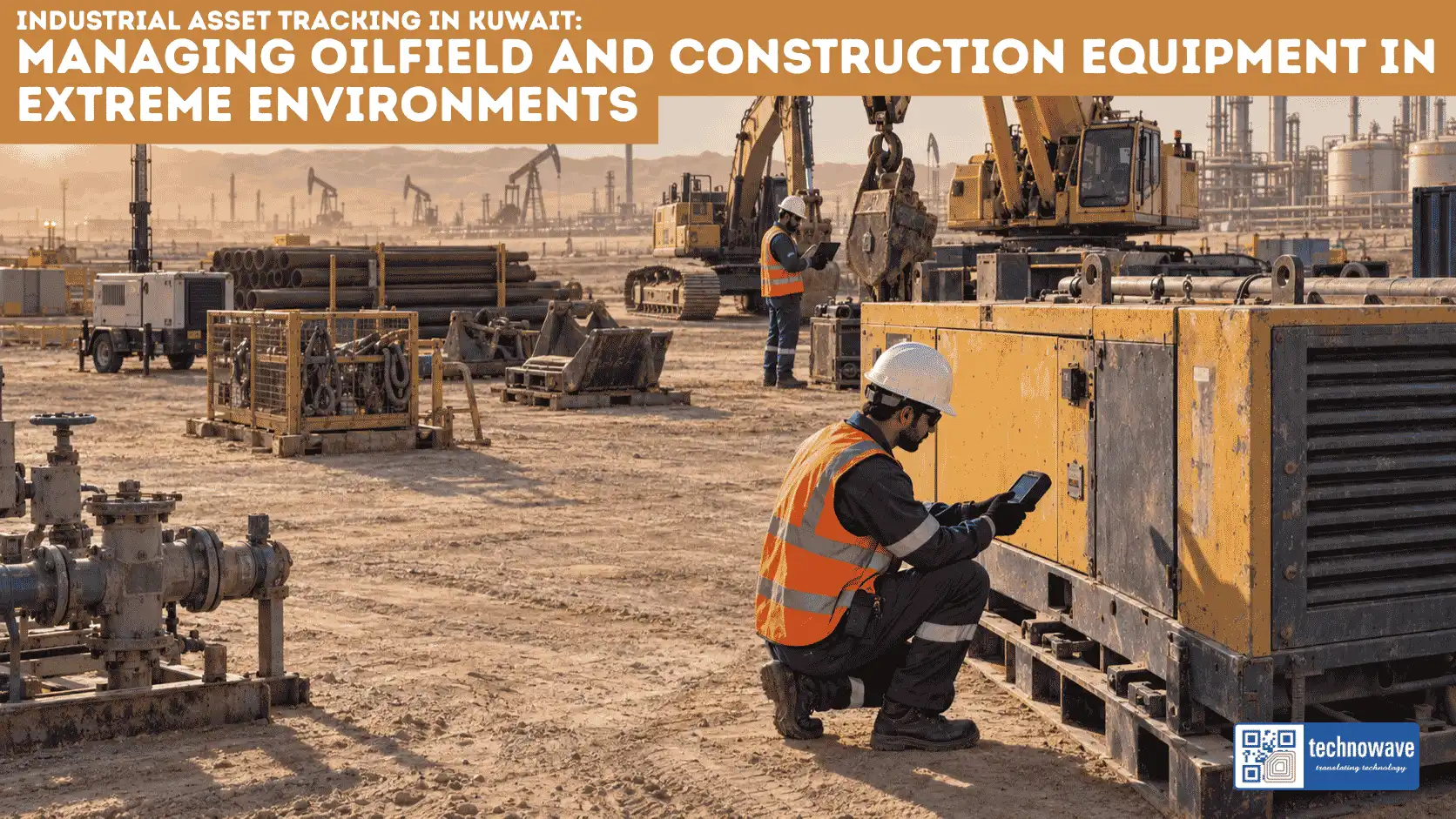
Industrial asset tracking Kuwait projects succeed when the system is designed for heat, metal, dust, hazardous zones, and remote site operations from day one. For oilfield operators, EPC contractors, and heavy equipment fleets, the right combination of RFID, rugged barcode workflows, mobile devices, and maintenance-linked software improves equipment visibility, shortens audits, and reduces costly asset loss across dispersed sites.
What is industrial asset tracking? It is the process of identifying, locating, auditing, and maintaining physical assets such as generators, valves, drilling tools, compressors, scaffolding, and heavy machinery using durable tags, handheld readers, fixed reading points, and asset management software. In Kuwait, that definition matters because outdoor industrial tracking is not an office label project; it is an engineering decision tied to uptime, compliance, and field safety.
Why industrial asset tracking matters in Kuwait’s oil, gas, and construction sectors
Kuwait’s industrial economy depends on assets that move continuously between yards, depots, fabrication areas, well sites, and project locations. A missing lifting accessory, unverified valve, or unreturned generator is not just a bookkeeping issue; it can delay work permits, maintenance schedules, and mobilization plans. That is why asset visibility in Kuwait is usually driven by operations, maintenance, HSE, and finance together, not by IT alone.
According to OPEC, Kuwait’s oil sector contributes around 90% of export revenues and about 50% of GDP, which explains why field equipment control is treated as an operational priority rather than an administrative task. In practical terms, buyers are looking for systems that can prove where an asset is, who last handled it, whether it passed inspection, and whether it is available for redeployment.
In this environment, manual spreadsheets and paper sign-out records break down quickly. Assets are often spread across fenced yards, contractor camps, maintenance workshops, and remote work fronts. An industrial tracking platform must therefore connect tag identity, last known location, service status, and asset history in one record, often alongside operational control practices already discussed for Kuwait businesses.
The business case is straightforward: fewer blind spots, faster verification during shutdowns and audits, better rotation of underused equipment, and less time spent physically searching for tools and plant. For high-value assets in Kuwait, the system is often justified by avoided downtime as much as by audit efficiency.
Why standard tracking methods fail in extreme outdoor conditions
The first buyer question is usually simple: why not use ordinary barcode labels? In Kuwait, exposed industrial assets face direct sun, abrasive sand, thermal cycling, oil contamination, washdowns, impact, and frequent handling by gloves and machinery. Standard paper or low-grade synthetic labels can curl, fade, crack, or detach, especially on painted steel, rough cast surfaces, and hot engine enclosures.
Dust and sandstorms also create a real read-performance problem. Optical scanning depends on line of sight and label surface quality, while UHF RFID can still identify tagged assets without perfect visual alignment. That is why rugged construction asset control programs increasingly combine barcode for close-range task confirmation with RFID for faster bulk identification in yards and laydown areas.
Direct buyer answer: can tags survive Kuwait heat and sunlight?
Yes, but only if you specify the right industrial-grade media. For Kuwait outdoor deployment, buyers should assess metal-mount RFID tags, high-temperature encapsulated tags, UV-resistant face materials, industrial adhesives, rivet or screw fixing options, and handheld devices rated for hot, dusty environments. If assets sit on exposed decks or in desert compounds, tag selection must be based on surface type, vibration, and expected cleaning methods.
Hazardous areas add another layer. Upstream and downstream operators may need ATEX or IECEx-certified hardware for Zone 1 or Zone 2 use, particularly around hydrocarbon processing and storage areas. In those cases, the question is not only “can it read?” but also “can it be deployed safely under site permit and equipment-classification rules used by operators such as KOC and KNPC?”
What assets should be tracked, and with which identification method?
The most effective industrial asset tracking Kuwait deployments do not start by tagging everything. They begin by grouping assets by value, mobility, inspection frequency, replacement risk, and operational criticality. In Kuwait, the highest-priority categories typically include generators, compressors, welding sets, lifting gear, calibrated instruments, valves, pumps, drill tools, pipe spools, scaffolding components, portable tanks, and contractor-owned shared equipment.
A useful rule is to match the identification method to the asset’s environment and handling pattern. Barcode asset tracking works well for indoor stores, controlled workshops, cable drums, consumable bins, and maintenance benches where close scanning is practical. RFID asset tracking is better for metal assets in yards, bulk verification during loading and returns, and equipment that must be identified quickly without cleaning each label face first.
| Asset type | Typical Kuwait environment | Best-fit tagging method | Why |
|---|---|---|---|
| Generators, compressors, pumps | Outdoor yards, remote sites | Metal-mount UHF RFID | Fast identification, durable on metal, good for audits |
| Lifting gear, tools, instruments | Frequent issue/return, inspections | RFID or durable barcode | Supports traceability and service status checks |
| Pipe spools, valves, steel members | Fabrication and project staging | Rugged RFID tag | Handles non-line-of-sight bulk verification |
| Indoor spares and stores inventory | Warehouses and workshops | Industrial barcode label | Lower cost where conditions are controlled |
| Heavy vehicles and mobile plant | Remote multi-site operations | RFID plus telematics/GPS workflow | Links asset identity with movement and utilization |
For tag printing and commissioning, industrial teams also need durable print infrastructure. That is where devices such as industrial barcode printers and the Zebra ZT610 RFID industrial printer become part of the project scope, because tag quality directly affects long-term readability.
How RFID, rugged barcode workflows, and mobile devices improve field visibility
RFID does not replace every process; it improves the specific moments where manual checking causes delay. In a Kuwait yard, a team can walk a zone with a handheld reader and verify many tagged assets in minutes instead of reading each label one by one. In a workshop, a technician can scan an asset, confirm service status, record a repair, and attach a new inspection date from the same mobile workflow.
Direct answer: how does RFID asset tracking work in construction and industrial environments? Each asset receives a unique identity through an RFID tag or durable barcode. Rugged readers or mobile computers capture that identity during issue, transfer, inspection, return, maintenance, or audit events, and the software updates the asset record with user, location, timestamp, and status information.
The most practical design for Kuwait is usually hybrid. Use RFID for outdoor audits, staging areas, and metal-heavy assets; use barcode where low-cost close-range scanning is enough. Pair both with rugged industrial tablets or mobile computers that can cache data offline when field connectivity is weak, then sync later to the central asset database.
ERP and maintenance integration matters more than raw read range
Buyers often focus first on reader range, but the bigger decision is software behavior. Can the platform map asset classes, assign custodians, record maintenance history, trigger due inspections, and exchange data with SAP, Oracle, or another ERP used by major energy and construction firms? A system becomes operationally valuable when it supports work orders, gate movements, and preventive maintenance logic rather than acting as a separate tracking silo.
For companies evaluating this area, the difference between simple tagging and full asset control is the workflow layer. A reader finds the asset; the software decides whether it is compliant, available, overdue, quarantined, or assigned to a crew.
What to look for in an industrial asset tracking system for Kuwait
Start with environment fit, not software screenshots. Ask whether the tags are suitable for steel, curved pipes, painted equipment, and high-temperature surfaces. Ask whether handhelds are rugged enough for dust, drops, glove use, and full-shift battery life. If your sites include hazardous areas, ask directly whether the specific reader or device model is ATEX or IECEx certified for the relevant zone classification.
Next, evaluate process fit. The best asset management system Kuwait buyers can choose is one that mirrors field reality: receiving, tagging, transfer, issue/return, preventive maintenance, calibration, retirement, and multi-site audits. It should support role-based access, photo capture, geotagging where useful, offline operation, and structured reports for finance, engineering, HSE, and external inspection teams.
Implementation support is equally important. Industrial tagging requires site survey work, pilot testing on actual surfaces, adhesive and mounting trials, naming conventions, and disciplined master-data design. Buyers should also look for access to compliance-focused asset tracking practices, plus multi-brand support for printers, scanners, and mobile devices after deployment.
Finally, check the operating model behind the technology. A strong vendor should be able to provide the application, tag media, printing setup, hardware commissioning, integration, user training, and ongoing AMC or repair support. That matters in Kuwait because long-term success depends less on the initial demo and more on how quickly field issues are resolved once the system is live.
Why buyers should act now: maintenance, audits, and support across remote sites
Delaying industrial tracking usually means accepting hidden operating waste. Crews spend time searching for assets, duplicate purchases happen because usable equipment cannot be located, and preventive maintenance slips because the service history is incomplete or trapped in separate records. In shutdowns, turnarounds, and high-pressure project phases, those small control gaps become expensive schedule risks.
Well-designed tracking also improves audit posture. Kuwait industrial operators are under constant pressure to verify asset ownership, inspection status, and maintenance traceability across contractors and internal departments. A system that can instantly show tag identity, movement history, and service events gives management a much stronger position during internal checks and client reviews than manual logs assembled after the fact.
There is also a utilization angle. Remote desert projects and oilfield camps often carry backup equipment because nobody trusts the visibility of what is already deployed. Once location and status become reliable, companies can redeploy idle assets instead of over-ordering. That is particularly useful for shared fleets, project tools, and temporary site infrastructure. Buyers can also review a relevant oil and gas RFID heavy vehicle asset management case study to understand how industrial tracking workflows are applied in practice.
For Kuwait organizations that need an end-to-end solution, Technowave International can support rugged RFID and barcode design, asset management project delivery in Kuwait, industrial printing infrastructure, software integration, and ongoing maintenance support. The right time to evaluate the system is before the next audit cycle, shutdown, or multi-site mobilization exposes another visibility gap.
FAQ
Q: What is the best asset tracking system for oilfield equipment in Kuwait?
A: The best system is usually a hybrid of metal-mount RFID, rugged barcode workflows, handheld or tablet-based data capture, and software that records maintenance and transfer history. For Kuwait oilfield use, buyers should prioritize hazardous-area compatibility, offline capability, and strong support for metal assets in harsh outdoor conditions.
Q: How does RFID asset tracking work in construction and industrial environments?
A: RFID assigns each asset a unique tag that can be read by handheld or fixed readers without perfect line of sight. In construction yards and industrial sites, this helps teams verify equipment faster during issue, return, transfer, and audit activities, especially when dust, distance, and volume make manual barcode scanning inefficient.
Q: Can asset tracking systems handle extreme heat, dust, and outdoor conditions in Kuwait?
A: Yes, if the deployment uses industrial-grade tags, proper mounting methods, rugged mobile hardware, and media selected for metal, UV exposure, heat, and abrasion. Standard office labels are not enough. Buyers should request environmental validation on the exact tag and device models proposed for their site.
Q: What types of industrial assets can be tracked using RFID or barcode technology?
A: Common examples include generators, compressors, pumps, lifting gear, calibrated tools, valves, steel members, cable drums, scaffolding, workshop tools, and heavy vehicles. The choice between RFID and barcode depends on the asset surface, movement pattern, inspection frequency, and whether bulk outdoor reading is required.
Q: How can companies in Kuwait reduce equipment loss and improve audit accuracy?
A: They should standardize asset IDs, tag high-risk mobile equipment first, capture every transfer and issue/return event digitally, and link maintenance status to the same record. Regular handheld audits across yards and remote sites close the visibility gap that causes missing assets, duplicate purchases, and weak audit trails.
Q: Do industrial asset tracking systems integrate with ERP platforms such as SAP or Oracle?
A: Many do, but integration capability varies widely. Buyers should confirm whether the system can exchange master data, location records, asset classes, maintenance status, and transaction events with their ERP. Integration matters because a standalone tracking tool creates another data silo instead of improving operational control.
Related Articles
- Why is Metal Asset Tagging Critical for Harsh Warehouse and Outdoor Environments?
- How to Implement RFID Asset Tracking in Kuwait: A Step-by-Step Guide
- RFID in Construction & Real Estate: Tracking Workforce, Materials & Site Safety Efficiently
- How to Implement RFID IT Asset Tracking in Bahrain Data Centers
- Where to Buy Custom Metal Asset Tags for Enterprise Fixed Asset Tracking
- Asset Compliance and Regulatory Tracking in Enterprises
Industrial Asset Tracking Kuwait for Harsh Sites
Explore industrial asset tracking Kuwait for oilfield and construction equipment using RFID, barcode, and rugged asset management solutions.